


'%3e%3cpath%20d='M21.0949%203.79395L13.9961%209.82854H21.0949V3.79395Z'%20stroke='black'%20stroke-width='1.38'%20stroke-miterlimit='10'/%3e%3cpath%20d='M13.998%209.82854L7.44531%203.79395V9.82854H13.998Z'%20stroke='black'%20stroke-width='1.38'%20stroke-miterlimit='10'/%3e%3cpath%20d='M13.9961%202.69922V25.1919'%20stroke='black'%20stroke-width='1.38'%20stroke-miterlimit='10'/%3e%3cpath%20d='M20.5488%2016.4113L13.9961%209.82812V18.2217L20.5488%2024.0918V16.4113Z'%20stroke='black'%20stroke-width='1.38'%20stroke-miterlimit='10'/%3e%3cpath%20d='M7.44531%2016.4113L13.998%209.82812V18.0526L7.44531%2024.0918V16.4113Z'%20stroke='black'%20stroke-width='1.38'%20stroke-miterlimit='10'/%3e%3cpath%20d='M4.71094%209.82812V18.6057H7.44125V16.4113L13.9941%209.82812H4.71094Z'%20stroke='black'%20stroke-width='1.38'%20stroke-miterlimit='10'/%3e%3cpath%20d='M13.9961%209.82812L20.5488%2016.4113V18.6057H23.2792V9.82812H13.9961Z'%20stroke='black'%20stroke-width='1.38'%20stroke-miterlimit='10'/%3e%3c/g%3e%3c/svg%3e)

'%3e%3cmask%20id='mask0_21456_29260'%20style='mask-type:luminance'%20maskUnits='userSpaceOnUse'%20x='0'%20y='0'%20width='28'%20height='28'%3e%3cpath%20d='M27.5%200.5H0.5V27.5H27.5V0.5Z'%20fill='white'/%3e%3c/mask%3e%3cg%20mask='url(%23mask0_21456_29260)'%3e%3cpath%20d='M14%2027.5C13.4854%2024.1035%2011.8974%2020.9608%209.46828%2018.5317C7.03922%2016.1026%203.89651%2014.5146%200.5%2014C3.89651%2013.4854%207.03922%2011.8974%209.46828%209.46828C11.8974%207.03922%2013.4854%203.89651%2014%200.5C14.5147%203.89644%2016.1028%207.03905%2018.5318%209.46816C20.9609%2011.8972%2024.1035%2013.4853%2027.5%2014C24.1035%2014.5147%2020.9609%2016.1028%2018.5318%2018.5318C16.1028%2020.9609%2014.5147%2024.1035%2014%2027.5Z'%20fill='url(%23paint0_linear_21456_29260)'/%3e%3c/g%3e%3c/g%3e%3cdefs%3e%3clinearGradient%20id='paint0_linear_21456_29260'%20x1='9.5'%20y1='9.5'%20x2='20.75'%20y2='21.875'%20gradientUnits='userSpaceOnUse'%3e%3cstop%20stop-color='%23F0DCD6'/%3e%3cstop%20offset='0.914506'%20stop-color='%231D6DFF'/%3e%3c/linearGradient%3e%3cclipPath%20id='clip0_21456_29260'%3e%3crect%20width='28'%20height='28'%20fill='white'/%3e%3c/clipPath%3e%3c/defs%3e%3c/svg%3e)
'%3e%3cpath%20d='M22.8019%2011.2412L23.5234%2011.6807V12.0103L23.3172%2012.7796L14.5579%2014.9771L13.7344%2012.7951L22.8019%2011.2412Z'%20fill='%23D97757'/%3e%3cpath%20d='M19.5236%204.77832L20.5322%205.00396L20.8%205.35575L21.0552%206.19876L20.9494%206.73644L15.0712%2015.3068L13.1133%2013.2191L18.5338%205.63471L19.5236%204.77832Z'%20fill='%23D97757'/%3e%3cpath%20d='M14.4577%203.43951L15.0761%203L15.5912%203.21976L16.1065%203.9889L14.6949%2013.0345L13.7364%2012.3397L13.3242%2011.131L14.0456%204.31853L14.4577%203.43951Z'%20fill='%23D97757'/%3e%3cpath%20d='M7.84766%203.5851L8.48285%202.7199L8.89716%202.61914L9.71923%202.74717L10.125%203.08581L13.0815%2010.0748L14.1509%2013.3954L12.8997%2014.1372L8.13117%204.91019L7.84766%203.5851Z'%20fill='%23D97757'/%3e%3cpath%20d='M4.77232%208.38688L4.56641%207.50742L5.18478%206.73828L5.90613%206.84816H6.11223L10.4403%2010.2544L11.78%2011.3531L13.6349%2012.8914L12.6044%2014.7594L11.6769%2013.9903L11.0586%2013.331L5.08168%208.82593L4.77232%208.38688Z'%20fill='%23D97757'/%3e%3cpath%20d='M3.53288%2014.0982L3.06641%2013.5489L3.06647%2013.0601L3.53288%2012.8896L8.78833%2013.2193L13.9408%2013.6588L13.7736%2014.7528L3.94502%2014.2082L3.53288%2014.0982Z'%20fill='%23D97757'/%3e%3cpath%20d='M6.62378%2019.8178H5.59334L5.18359%2019.3146V18.7132L6.93299%2017.3946L14.045%2012.5674L14.7648%2013.8785L6.62378%2019.8178Z'%20fill='%23D97757'/%3e%3cpath%20d='M8.57739%2022.8884L8.16518%2022.9984L7.54688%2022.6687L7.64995%2022.1193L13.7299%2013.5488L14.5543%2014.7574L10.0201%2021.1305L8.57739%2022.8884Z'%20fill='%23D97757'/%3e%3cpath%20d='M13.7361%2023.9861L13.4271%2024.4257L12.8088%2024.6454L12.2935%2024.2058L11.9844%2023.5466L13.5301%2014.6465L14.4576%2014.7563L13.7361%2023.9861Z'%20fill='%23D97757'/%3e%3cpath%20d='M18.9869%2021.5713V22.4503L18.8838%2022.7799L18.4716%2022.9997L17.7503%2022.8974L12.7969%2015.0367L14.7617%2013.4404L16.4104%2016.6269L16.5652%2017.7805L18.9869%2021.5713Z'%20fill='%23D97757'/%3e%3cpath%20d='M21.3629%2020.2507L21.4659%2020.8L21.1568%2021.2396L20.8476%2021.1297L19.0958%2019.8112L16.4165%2017.284L14.3555%2015.7457L14.9736%2013.6582L16.0041%2014.3175L16.6226%2015.5259L21.3629%2020.2507Z'%20fill='%23D97757'/%3e%3cpath%20d='M20.0232%2014.6482L22.5995%2014.8679L23.2178%2015.3074L23.6299%2015.9667V16.441L22.4964%2016.9556L16.7256%2015.4173L14.3555%2015.3074L14.9737%2013L16.6226%2014.3185L20.0232%2014.6482Z'%20fill='%23D97757'/%3e%3c/g%3e%3c/svg%3e)
Key Takeaways:
- Single-Platform Solution: VMEG AI will enable you to convert Vietnamese audio to English without the need to use multiple tools and make the whole process a single workflow.
- Plays a variety of audio formats: MP3, WAV, AAC, M4A and many other popular formats.
- Automatic Multi-Speaker Recognition: Recognizes more than one speaker, and gives them distinct English voices to enable them to clearly and naturally talk.
Vietnamese content is increasing at a high rate in social media, education, business and entertainment. This is through interviews and podcasts, marketing videos and online courses, Vietnamese audio and video are finding a wider audience than Vietnam. But, the greatest obstacle to world prominence is still language. It is in this case that Vietnamese to English translation becomes a prerequisite to efficient video localization.
Video localization is not just simple translation. It guarantees preservation of the meaning, tone and cultural context of the content when adapting the content to reach the English-speaking audience. This listicle will discuss the most significant items in Vietnamese to English translation, its importance, its mechanism, and how it can be assisted by AI such as VMEG AI to simplify the very whole process of localization of audio into final products.
Why Translate Vietnamese to English
Tens of millions of people across the world speak Vietnamese, but much of this is not easily available to English speakers. Vietnamese audio translation to English enables creators and businesses to exchange knowledge, narratives, and goods across the world.
Digital marketing, education, and media are some of the areas that are in high demand. Vietnamese YouTube clips, Tik Tok videos, podcasts, and webinars usually become popular among the international audience after being translated into English. Translation assists the brands to spread internationally without necessarily creating the content anew.
English translation of Vietnamese is not an option as the world continues to join hands. It has turned into a strategic requirement of visibility, growth and accessibility.

Vietnamese to English Translation using VMEG AI
VMEG AI also makes it easier by removing the transcription and translation process to enable Vietnamese to English video localization in one workflow. Users do not need to use many tools to process audio because they can do it effectively under a single place.
- Supports 600+ Natural English Voices — Choose from 600+ voice options across US, UK, AU, CA & other accents.
- Multi-Speaker Recognition — Automatically detects and processes multiple speakers in one audio file.
- 170+ Language Support — Translate audio to and from 170+ languages.
- 7000+ Voice Variants — Generate localized audio with access to 7000+ AI‑generated voice styles.
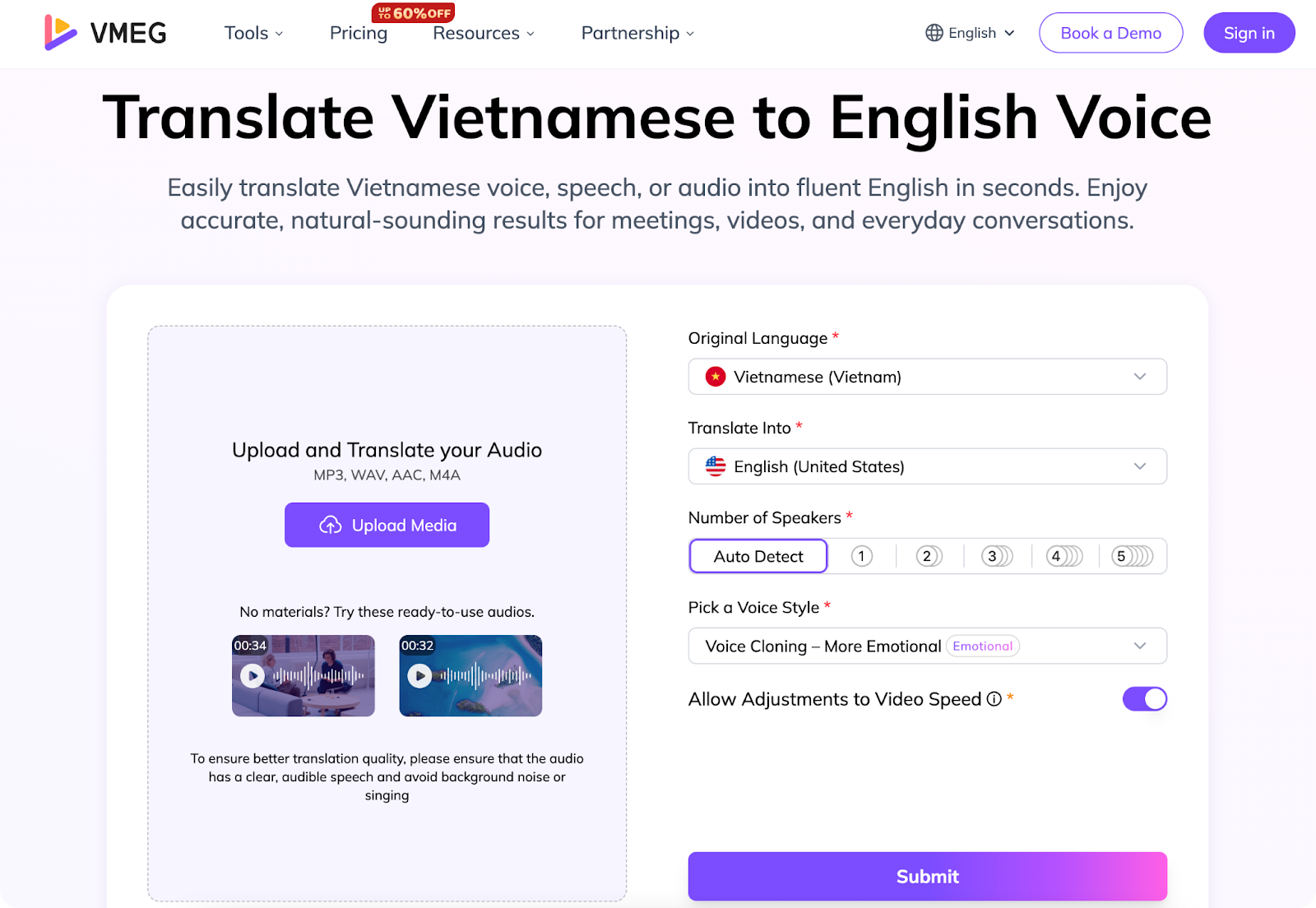
The site is used to recognize the Vietnamese language, translate it into English and also creates subtitles or audio files. This saves time and bates the risk of any errors that may come about as a result of using multiple tools.
VMEG AI can provide a scalable solution that ensures consistency and accuracy between projects to creators and businesses with high frequency or large volumes of content.
How to Translate Vietnamese to English Using VMEG AI: Step-by-Step Guide
Vietnamese audio to English translation may be complicated when performed manually, whereas VMEG AI renders it fast and simple. Whether a podcast, an appointment, an interview or a video, the platform offers correct and natural-sounding translations with the least amount of effort. This is the only way to do it in a few easy steps.
Step 1: Post Your Vietnamese Audio
Begin by selecting the Audio Translator tool of VMEG AI. Upload your Vietnamese audio file into the platform. VMEG can work with the popular MP3, WAV, AAC, and M4A. It can automatically identify several speakers which comes in handy when conducting interviews or group discussion. Also, ensure that your audio is understandable and not too much background noise so that the translation will be correct.
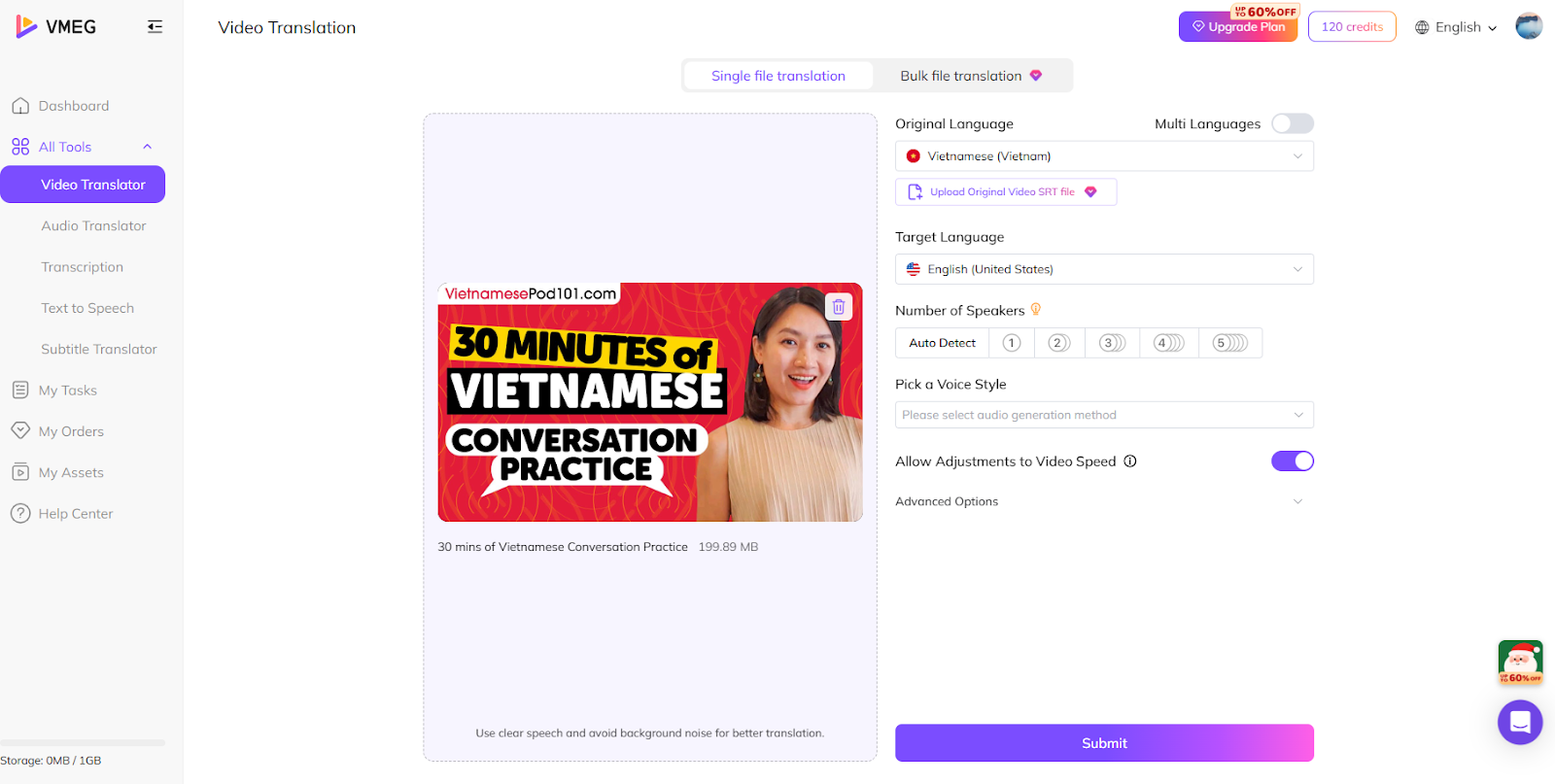
Step 2: Select English as the Target Language
The second step is to choose the English language as the target language. VMEG also provides more than 600 professional English voices, such as American, British, Australian and other regional accents.
You may choose the voice that suits your content and even use methods of AI voice cloning to retain the original tone and emotion of the voice. This assists in developing genuine and natural versions of your audio in Vietnamese language in English.
Step 3: Voice and Prefers Customization
The speed, the pitch, and the expression of emotion of the English voice can be adjusted before finalizing the English voice. This makes the audio that is translated sound natural and it corresponds to the intended tone of the original recording. It is also possible to control multiple speakers and give them each an individual voice to keep the conversation clear and flowing.
Step 4: Export Your Translated Audio
Click submit when you are content with the settings. The audio will be processed by VMEG AI and a refined English version will be created. You may either download the translated audio or you may export it as SRT or VTT subtitles, which are all video-, presentation-, or podcast-ready. This two-way alternative assists creators to reuse content effectively.
Step 5: Check and Translate Using Your Own translation
Once it has been downloaded, listen to the audio to check the accuracy of the translation and the naturalness of the voice. The technology of VMEG AI captures the nuances of speech, and therefore, it can be relied on to use in a professional manner.
The translated information is now able to reach foreign audiences, be incorporated in training resources or even form part of social media texts without language limitations.
Selection of the Approach to the Right Output Subtitles, Voice-Over, or Dubbing
Once translated, the issue of the mode of delivering the English content comes in. One of the most popular usually used is the subtitles, particularly on social media and convenience. They enable the viewers to be able to comprehend something despite the absence of sound.
Another typical feature is voice-over, especially when it comes to presentations, tutorials, and company videos. It maintains the original recording but places English narration.
Full dubbing substitutes the original Vietnamese audio with the English speech. It is frequently applied to professional training videos, documentaries or long-form content aimed at audiences that only understand English.
Vietnamese to English Translation Uses
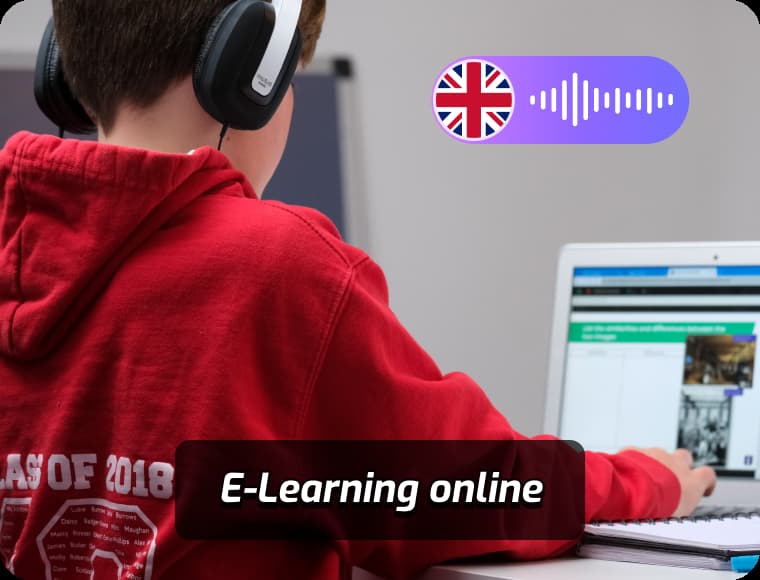
Educational content is one of the key application cases. The Vietnamese lectures, tutorials and training programs can be translated into English so that international students can be reached.
Another important area is marketing. Vietnamese advertisements, product demonstrations, and advertisement videos are translated into English as a language of entry into the international market and appeal to international buyers.
It is also through translation that the creators of content expand audiences. The podcasts in Vietnamese, YouTube video, and interviews have much more reach after being made available in English.
Audio translation is employed in corporate and professional settings to facilitate meetings, in-house training, and recording of information in which clarity and accuracy are central to the translation.
The Obstacles Facing Unique Vietnamese Audio Translation
The Vietnamese language employs the use of tones to pass a message and in this case this message cannot be understood by a translation tool when the audio quality is compromised. Accuracy can be diminished by background noise or talking on top of one another.
Cultural context is another challenge. Some of the Vietnamese words or allusions might lack an English counterpart. These aspects have to be localized to enable English readers to get the intended message.
The timing is also a factor when developing subtitles or dubbing audio. English translations can be even longer than Vietnamese phrases, so there should be close synchronization.
With the help of AI-based applications such as VMEG AI, it is possible to address most of these issues, enhancing the precision of transcription and situational translation.
Why AI Is the Future of Vietnamese to English Translation
Translation manual processes are not only time consuming, but also costly particularly when using a large content library. Speed, Scalability, and Consistency AI is fast and offers the scalability and consistency impossible to the traditional methods.
The contemporary AI applications are trained on large language datasets, which means that they are able to comprehend the context, tone, and structure much better than the previous systems.
Creators and businesses are able to localize effectively and still achieve professional quality with platforms like VMEG AI. This has made expansion internationally easier than ever.
Final Words
Vietnamese to English Translation is also important in the process of video localization and assists the content to cross language and cultural barriers. With the ever-increasing number of global audiences, it is no longer a choice by creators and businesses that wish to reach the international market by translating Vietnamese audio into English.
A high quality localized content can be assured by a systematic process incorporating transcription, translation and making proper choice of output. The AIs such as VMEG AI simplify, enhance the accuracy and scale of this process, transforming Vietnamese audio into a global product.
With the correct strategy, a single Vietnamese item can lead to global interaction, exposure, and expansion.
FAQs
1. What is the most accurate way to translate Vietnamese audio into English?
The best way would be to record the Vietnamese audio, check its accuracy, and only translate it to English with the help of AI tools and a human review.
2. Can AI handle Vietnamese tones and accents correctly?
Yes, the modern AI devices are programmed to identify tones and accents in the Vietnamese language, particularly when the audio is sharp. Analysis of the output guarantees optimal outcomes.
3. Should I use subtitles or voice translation for English audiences?
Accessibility and social media Subtitles are preferred over voice translation or dubbing, whereas presentations, training, and long professional content would prefer subtitles.


Fay
Behind VMEG stands a passionate team of creatives, engineers, and language lovers. At the crossroads of AI and storytelling, they craft tools that bridge languages and cultures.