

'%3e%3cpath%20d='M21.0949%203.79395L13.9961%209.82854H21.0949V3.79395Z'%20stroke='black'%20stroke-width='1.38'%20stroke-miterlimit='10'/%3e%3cpath%20d='M13.998%209.82854L7.44531%203.79395V9.82854H13.998Z'%20stroke='black'%20stroke-width='1.38'%20stroke-miterlimit='10'/%3e%3cpath%20d='M13.9961%202.69922V25.1919'%20stroke='black'%20stroke-width='1.38'%20stroke-miterlimit='10'/%3e%3cpath%20d='M20.5488%2016.4113L13.9961%209.82812V18.2217L20.5488%2024.0918V16.4113Z'%20stroke='black'%20stroke-width='1.38'%20stroke-miterlimit='10'/%3e%3cpath%20d='M7.44531%2016.4113L13.998%209.82812V18.0526L7.44531%2024.0918V16.4113Z'%20stroke='black'%20stroke-width='1.38'%20stroke-miterlimit='10'/%3e%3cpath%20d='M4.71094%209.82812V18.6057H7.44125V16.4113L13.9941%209.82812H4.71094Z'%20stroke='black'%20stroke-width='1.38'%20stroke-miterlimit='10'/%3e%3cpath%20d='M13.9961%209.82812L20.5488%2016.4113V18.6057H23.2792V9.82812H13.9961Z'%20stroke='black'%20stroke-width='1.38'%20stroke-miterlimit='10'/%3e%3c/g%3e%3c/svg%3e)

'%3e%3cmask%20id='mask0_21456_29260'%20style='mask-type:luminance'%20maskUnits='userSpaceOnUse'%20x='0'%20y='0'%20width='28'%20height='28'%3e%3cpath%20d='M27.5%200.5H0.5V27.5H27.5V0.5Z'%20fill='white'/%3e%3c/mask%3e%3cg%20mask='url(%23mask0_21456_29260)'%3e%3cpath%20d='M14%2027.5C13.4854%2024.1035%2011.8974%2020.9608%209.46828%2018.5317C7.03922%2016.1026%203.89651%2014.5146%200.5%2014C3.89651%2013.4854%207.03922%2011.8974%209.46828%209.46828C11.8974%207.03922%2013.4854%203.89651%2014%200.5C14.5147%203.89644%2016.1028%207.03905%2018.5318%209.46816C20.9609%2011.8972%2024.1035%2013.4853%2027.5%2014C24.1035%2014.5147%2020.9609%2016.1028%2018.5318%2018.5318C16.1028%2020.9609%2014.5147%2024.1035%2014%2027.5Z'%20fill='url(%23paint0_linear_21456_29260)'/%3e%3c/g%3e%3c/g%3e%3cdefs%3e%3clinearGradient%20id='paint0_linear_21456_29260'%20x1='9.5'%20y1='9.5'%20x2='20.75'%20y2='21.875'%20gradientUnits='userSpaceOnUse'%3e%3cstop%20stop-color='%23F0DCD6'/%3e%3cstop%20offset='0.914506'%20stop-color='%231D6DFF'/%3e%3c/linearGradient%3e%3cclipPath%20id='clip0_21456_29260'%3e%3crect%20width='28'%20height='28'%20fill='white'/%3e%3c/clipPath%3e%3c/defs%3e%3c/svg%3e)
'%3e%3cpath%20d='M22.8019%2011.2412L23.5234%2011.6807V12.0103L23.3172%2012.7796L14.5579%2014.9771L13.7344%2012.7951L22.8019%2011.2412Z'%20fill='%23D97757'/%3e%3cpath%20d='M19.5236%204.77832L20.5322%205.00396L20.8%205.35575L21.0552%206.19876L20.9494%206.73644L15.0712%2015.3068L13.1133%2013.2191L18.5338%205.63471L19.5236%204.77832Z'%20fill='%23D97757'/%3e%3cpath%20d='M14.4577%203.43951L15.0761%203L15.5912%203.21976L16.1065%203.9889L14.6949%2013.0345L13.7364%2012.3397L13.3242%2011.131L14.0456%204.31853L14.4577%203.43951Z'%20fill='%23D97757'/%3e%3cpath%20d='M7.84766%203.5851L8.48285%202.7199L8.89716%202.61914L9.71923%202.74717L10.125%203.08581L13.0815%2010.0748L14.1509%2013.3954L12.8997%2014.1372L8.13117%204.91019L7.84766%203.5851Z'%20fill='%23D97757'/%3e%3cpath%20d='M4.77232%208.38688L4.56641%207.50742L5.18478%206.73828L5.90613%206.84816H6.11223L10.4403%2010.2544L11.78%2011.3531L13.6349%2012.8914L12.6044%2014.7594L11.6769%2013.9903L11.0586%2013.331L5.08168%208.82593L4.77232%208.38688Z'%20fill='%23D97757'/%3e%3cpath%20d='M3.53288%2014.0982L3.06641%2013.5489L3.06647%2013.0601L3.53288%2012.8896L8.78833%2013.2193L13.9408%2013.6588L13.7736%2014.7528L3.94502%2014.2082L3.53288%2014.0982Z'%20fill='%23D97757'/%3e%3cpath%20d='M6.62378%2019.8178H5.59334L5.18359%2019.3146V18.7132L6.93299%2017.3946L14.045%2012.5674L14.7648%2013.8785L6.62378%2019.8178Z'%20fill='%23D97757'/%3e%3cpath%20d='M8.57739%2022.8884L8.16518%2022.9984L7.54688%2022.6687L7.64995%2022.1193L13.7299%2013.5488L14.5543%2014.7574L10.0201%2021.1305L8.57739%2022.8884Z'%20fill='%23D97757'/%3e%3cpath%20d='M13.7361%2023.9861L13.4271%2024.4257L12.8088%2024.6454L12.2935%2024.2058L11.9844%2023.5466L13.5301%2014.6465L14.4576%2014.7563L13.7361%2023.9861Z'%20fill='%23D97757'/%3e%3cpath%20d='M18.9869%2021.5713V22.4503L18.8838%2022.7799L18.4716%2022.9997L17.7503%2022.8974L12.7969%2015.0367L14.7617%2013.4404L16.4104%2016.6269L16.5652%2017.7805L18.9869%2021.5713Z'%20fill='%23D97757'/%3e%3cpath%20d='M21.3629%2020.2507L21.4659%2020.8L21.1568%2021.2396L20.8476%2021.1297L19.0958%2019.8112L16.4165%2017.284L14.3555%2015.7457L14.9736%2013.6582L16.0041%2014.3175L16.6226%2015.5259L21.3629%2020.2507Z'%20fill='%23D97757'/%3e%3cpath%20d='M20.0232%2014.6482L22.5995%2014.8679L23.2178%2015.3074L23.6299%2015.9667V16.441L22.4964%2016.9556L16.7256%2015.4173L14.3555%2015.3074L14.9737%2013L16.6226%2014.3185L20.0232%2014.6482Z'%20fill='%23D97757'/%3e%3c/g%3e%3c/svg%3e)
Key Takeaways
- AI and human translation each have strengths. AI helps deliver faster results, while human translation ensures accuracy, especially for sensitive information.
- AI translation uses artificial intelligence and offers strengths such as speed, scalability, cost efficiency, consistency, and continuous improvement.
- Human translation needs a professional translator to convert content, and its strengths include deep context and meaning, cultural and emotional intelligence, creativity and nuance, judgement and ethics, and quality assurance.
- Hybrid translation is the best workflow as it combines AI speed with human accuracy. The platform that supports this hybrid translation is VMEG AI.
- Hybrid translation is best for speed and accuracy, for localizing video content globally, and for achieving professional results.
In today’s more connected world, translation has become essential. It helps us understand each other and express our messages clearly. But when it comes to workflow, some may wonder which is better: AI translation or human translation.
According to Fortune Business Insights (2026), many companies in the language services industry provide translation-related solutions and are increasingly combining AI with human expertise.
In this post, we’ll explore how combining AI and human translation can deliver the best of both worlds, boosting speed, accuracy, and overall efficiency.
What Is AI Translation?
AI translation is the use of artificial intelligence to convert text or speech from one language into another automatically. Unlike traditional translation systems, modern AI translation leverages patterns from multilingual datasets, enabling it to produce natural, context-aware translations.
How AI Translation Works
Most AI Translation works by:
- Breaking text into small pieces (tokens) so the system can process it.
- Looking at the entire sentence or paragraph to understand the context.
- Learning from lots of examples of translated text.
- Generating fluent, natural translation in the target language.
Common AI Translation Use Cases
AI translation is widely used in different industries, such as:
- Website and app localization. Some websites and applications use translations to reach a global audience.
- Customer support. Translation is also needed to enable customer support to answer customer queries more easily.
- Business communication. These include emails, reports, and internal documents to ensure that everyone is on the same page.
- E-commerce. In e-commerce, translation is also essential for product descriptions and reviews, so customers can learn more about the product and what others say about it.
- Travel and hospitality. Real-time communication is essential in travel and hospitality. It is also important when you travel, so you can easily communicate, read signage, understand the menu, and more.
- Media and content. Translation is also essential in social media posts to reach a wider audience. It also includes subtitles that make it easier for the audience to understand the message you want to portray.
Strengths of AI Translation
AI Translation offers several advantages that can help you achieve a more effective, efficient workflow.
- Speed. With AI, you can translate a large volume of content in seconds or minutes.
- Scalability. AI can handle many languages, but it still depends on the types of languages it supports.
- Cost efficiency. Using AI in translation can be much more cost-efficient than manual translation for routine content.
- Consistency. It helps in maintaining the meaning of terminology.
- Continuous improvement. AI gets better as the model learn from more data, and developers may also update and improve the service for a better experience.
What Is Human Translation?
Human translation is the process in which a professional translator converts text or speech from one language to another. The translator must understand both languages and their cultures. They interpret context, meaning, tone, and nuance to ensure that translations sound natural and accurate.
How Human Translation Works
The human translation process is simple.
- A professional translator carefully reads and analyzes the source text.
- The context, purpose, tone, and target audience are identified.
- The content is rewritten in the target language for meaning, not just word for word.
- The terminology and translations are checked to ensure consistency and accuracy.
- Before delivery, the translator edits and proofreads to refine clarity and quality.
Common Human Translation Use Cases
- Legal documents, contracts, and compliance materials. Human translation is essential for ensuring accuracy in essential documents.
- Medical and healthcare records, reports, and patient information. Human translation is also crucial in the healthcare industry, as it deals with people’s lives. According to Fortune Business Insights, demand for medical translations is increasing, and accuracy is important, as inaccurate translations can affect how patients understand medical instructions.
- Marketing, branding, and advertising content. It is important because it ensures the message and emotions you want to convey are understood and felt by the audience, enabling them to relate to it and potentially become customers.
- Literary works, books, and creative writing. Accuracy in translation builds trust; a human must translate literary works to capture the message, tone, and emotions.
- Business communications and corporate documentation. In business, it is important to ensure that communication and documents are accurate to avoid issues that might put something at risk.
- Technical manuals and industry-specific materials. When it comes to technical manuals and industry-specific materials, human translation is important, as some terms need to be explained clearly so users can understand them easily.
Strengths of Human Translation
Human translation focuses more on context and accuracy to ensure that the output is accurate and relevant.
- Deep context & meaning. Humans grasp intent, context, irony, humor, subtext, and cultural references. They understand the real meaning behind the words.
- Cultural and emotional intelligence. A human translator can adapt to the tone, politeness, and culture of the target audience. These elements are crucial in marketing, literature, and other emotionally charged contexts.
- Creativity & nuance. Some texts don’t need literal translation, such as idioms, slang, metaphors, wordplay, poetry, and slogans. Humans can create an equivalent word that conveys the original meaning.
- Judgment and ethics. Humans can flag ambiguity, inconsistency, or potentially harmful phrasing. They can also seek clarification and make informed decisions rather than blindly translating text.
- Quality assurance. Humans can spot errors that are technically correct, but wrong in practice, such as dates, numbers, register, and other sensitive content.
AI Translation vs Human Translation
Aspect | AI Translation | Human Translation |
Speed | Faster results | Slower; depends on text length and complexity |
Cost | Free or Low Cost, sometimes depending on the features you need | Higher, reflects expertise and time |
Accuracy (Literal Text) | High for simple, straightforward content | High, with better handling of edge cases |
Context Understanding | Limited; may miss the implicit meaning | Strong; understands intent, subtext, and context |
Cultural Awareness | Weak to moderate; relies on training data | Strong; adapts to cultural norms and expectations |
Tone & Style | Inconsistent for nuanced or creative text | Precise control over tone, register, and voice |
Idioms & Figurative Language | Translation may be literal or awkward | Naturally adapted or recreated |
Quality Assurance | No self-verification | Reviews, edits, and corrects intentionally |
Ethical Judgment | None; outputs text as prompted | Can flag sensitive or problematic content |
Best Use Cases | Internal documents, high-volume content | Legal, medical, literary, marketing, and diplomatic |
The Rise of Hybrid Translation Workflows
Relying on a single translation system may not be a strategic move, especially if you want more accurate and polished output. That’s why it is important to ensure a balance between AI and human translation. With AI and human translation, you can get faster, more accurate results.
What Is Hybrid AI + Human Translation?
Hybrid translation uses both AI and human translation in the workflow. It is combining AI speed with human expertise.
It can be done by:
- Use AI first to translate text.
- Then, a professional human translator will review, edit, proofread, and refine the output to ensure it aligns with the target culture and the original message.
In this way, you will be able to obtain a translated text more quickly and achieve higher accuracy.
Why Hybrid Translation Is the Future of Video Localization
Hybrid translation is the future of video localization because it delivers faster, more accurate results. This also helps in saving time, effort, and resources.
- If you will only use AI translation, you’ll get faster results, but the context might not be highly accurate, especially in complex texts.
- If you will only use human translation, you’ll get a more accurate result, but it may take some time.
So, it is best to use both, as AI provides speed, and human translation ensures accuracy and verifies context.
This is important for video localization, especially when you need to produce more content and ensure it is accurate and relevant to your audience. With hybrid and AI translation, your video localization workflow will be faster.
How VMEG AI Bridges AI Translation and Human Translation
VMEG AI is one of the best AI video translators, built on a hybrid AI and human workflow.
VMEG AI’s Professional Hybrid Translation Workflow
- Speech is converted to text using ASR.
- Human translators review and refine the translation
- AI voice cloning creates multilingual dubbing
- Editors can fine-tune audio and visuals before export.
Why VMEG AI Excels in Video Localization
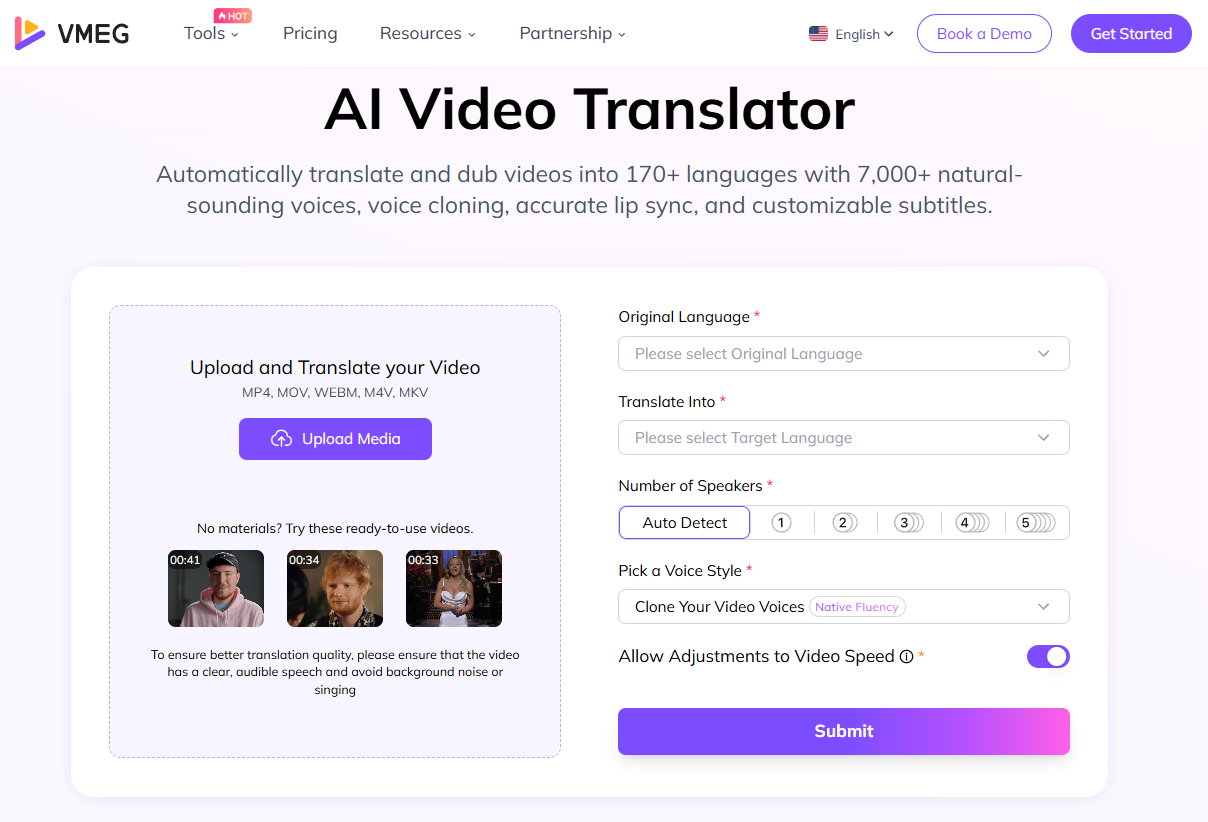
One of VMEG AI’s popular tools is AI Video Translator. It is designed to translate and localize videos into your target language easily.
- Supports more than 170 languages and accents. With its wide range of supported languages and accents, you can easily localize videos. Whether you want to translate it from English to Spanish, Chinese, Arabic, or another language, VMEG can help. This provides a highly accurate result.
- Has more than 7,000 AI Voices. It offers a wide selection of AI voices and supports voice cloning, allowing you to create a voice that suits your brand.
- Accurate Lip-Sync. It provides precise audio translation that aligns with the speaker’smouth movements. This flawless lip-sync works well across complex language pairs, delivering professional-quality results.
Ideal Use Cases for VMEG AI
VMEG AI can be used for a variety of projects, including work, school, social media, business, and marketing.
- Social Media Content. VMEG AI is ideal for social media posts, enabling you to translate your content into multiple languages to reach a wider audience.
- Learning Materials. Educators can easily translate their content into different languages, making it easier for learners to understand the topic.
- Marketing. With VMEG AI, you can create advertisements, product demos, and other marketing materials that resonate well with your audience.
- Training Videos. Localizing training videos is also essential to ensure that trainees can easily understand them and apply what they learn in actual scenarios.
When to Choose AI Translation, Human Translation, or Hybrid
Knowing the proper workflow will help you save time, effort, and cost, and achieve better results.
AI Translation is Best For:
- High volume, low risk content. AI translation is ideal if you need high-volume content, as speed is important in that context. It is also ideal for low-risk content that doesn’t require verification.
- Tight deadlines. If you have tight deadlines, using AI translation is a good strategy, as it can help you speed up the process, but make sure it doesn’t contain any sensitive content.
- Budget constraints. Budget is another factor that affects the decision, so if you have a tight budget, AI translation may be more cost-effective.
Human Translation is Best For:
- Legal, compliance, or sensitive content. Human translation is best for legal, compliance, or sensitive content, as such content requires accuracy and verification.
- Brand storytelling and emotional impact. Emotions play an important part in translation, especially in storytelling. Emotions also help give words meaning. The audience must feel the emotions when reading or hearing the translated text.
Hybrid Translation is Best For:
- Speed and accuracy. Hybrid translation is best if you need speed and accuracy. AI translation provides fast translation, while human translation ensures accuracy.
- Localizing video content globally. Localizing video is also more convenient if hybrid translation is used.
- Professional results. If you need professional results, hybrid translation is the best choice, combining AI for speed and humans for accuracy to deliver professional-quality translations.
FAQs
What is the difference between AI translation and human translation?
AI translation uses artificial intelligence to convert text, videos, and other files, whereas a professional translator handles human translation. AI translation is best for speed, while human translation is best for accuracy.
What is the cost of AI translation and human translation?
The cost of AI and human translation depends on several factors. For AI translation, the cost may be minimal, depending on the platform's features. For human translation, the cost may depend on complexity, expertise, and the time required.
How accurate is AI translation?
The accuracy of AI translation depends on the platform, as features vary across platforms. It is best to check it and have a professional translator verify its accuracy.
Is AI translation as accurate as human translation?
In terms of accuracy, human translation is more accurate because humans understand cultural nuances, tone, and other factors that AI might miss.
Which is better, AI translation vs. human translation?
AI translation is faster: it can translate text in just a few minutes, whereas human translation is more accurate because it understands context, culture, and other important factors. It is best to use hybrid translation for better output.
Conclusion
Both AI and human translations have strengths. Choose AI translation if you prioritize speed and the content doesn’t contain sensitive information. Choose human translation to ensure accuracy, especially for content with sensitive or industry-specific information.
The best workflow combines AI and human translation to ensure speed and accuracy. The ideal AI platform for this hybrid translation is VMEG AI. With VMEG AI, you can easily translate your content into other languages and achieve high accuracy. It requires minimal editing and provides highly accurate translations. If you are looking for a perfect workflow and platform, VMEG AI is the best choice. Be more productive by letting VMEG AI handle heavy lifting, then edit it to personalize it.


The VMEG Team
Behind VMEG stands a passionate team of creatives, engineers, and language lovers. At the crossroads of AI and storytelling, they craft tools that bridge languages and cultures.