

'%3e%3cpath%20d='M21.0949%203.79395L13.9961%209.82854H21.0949V3.79395Z'%20stroke='black'%20stroke-width='1.38'%20stroke-miterlimit='10'/%3e%3cpath%20d='M13.998%209.82854L7.44531%203.79395V9.82854H13.998Z'%20stroke='black'%20stroke-width='1.38'%20stroke-miterlimit='10'/%3e%3cpath%20d='M13.9961%202.69922V25.1919'%20stroke='black'%20stroke-width='1.38'%20stroke-miterlimit='10'/%3e%3cpath%20d='M20.5488%2016.4113L13.9961%209.82812V18.2217L20.5488%2024.0918V16.4113Z'%20stroke='black'%20stroke-width='1.38'%20stroke-miterlimit='10'/%3e%3cpath%20d='M7.44531%2016.4113L13.998%209.82812V18.0526L7.44531%2024.0918V16.4113Z'%20stroke='black'%20stroke-width='1.38'%20stroke-miterlimit='10'/%3e%3cpath%20d='M4.71094%209.82812V18.6057H7.44125V16.4113L13.9941%209.82812H4.71094Z'%20stroke='black'%20stroke-width='1.38'%20stroke-miterlimit='10'/%3e%3cpath%20d='M13.9961%209.82812L20.5488%2016.4113V18.6057H23.2792V9.82812H13.9961Z'%20stroke='black'%20stroke-width='1.38'%20stroke-miterlimit='10'/%3e%3c/g%3e%3c/svg%3e)

'%3e%3cmask%20id='mask0_21456_29260'%20style='mask-type:luminance'%20maskUnits='userSpaceOnUse'%20x='0'%20y='0'%20width='28'%20height='28'%3e%3cpath%20d='M27.5%200.5H0.5V27.5H27.5V0.5Z'%20fill='white'/%3e%3c/mask%3e%3cg%20mask='url(%23mask0_21456_29260)'%3e%3cpath%20d='M14%2027.5C13.4854%2024.1035%2011.8974%2020.9608%209.46828%2018.5317C7.03922%2016.1026%203.89651%2014.5146%200.5%2014C3.89651%2013.4854%207.03922%2011.8974%209.46828%209.46828C11.8974%207.03922%2013.4854%203.89651%2014%200.5C14.5147%203.89644%2016.1028%207.03905%2018.5318%209.46816C20.9609%2011.8972%2024.1035%2013.4853%2027.5%2014C24.1035%2014.5147%2020.9609%2016.1028%2018.5318%2018.5318C16.1028%2020.9609%2014.5147%2024.1035%2014%2027.5Z'%20fill='url(%23paint0_linear_21456_29260)'/%3e%3c/g%3e%3c/g%3e%3cdefs%3e%3clinearGradient%20id='paint0_linear_21456_29260'%20x1='9.5'%20y1='9.5'%20x2='20.75'%20y2='21.875'%20gradientUnits='userSpaceOnUse'%3e%3cstop%20stop-color='%23F0DCD6'/%3e%3cstop%20offset='0.914506'%20stop-color='%231D6DFF'/%3e%3c/linearGradient%3e%3cclipPath%20id='clip0_21456_29260'%3e%3crect%20width='28'%20height='28'%20fill='white'/%3e%3c/clipPath%3e%3c/defs%3e%3c/svg%3e)
'%3e%3cpath%20d='M22.8019%2011.2412L23.5234%2011.6807V12.0103L23.3172%2012.7796L14.5579%2014.9771L13.7344%2012.7951L22.8019%2011.2412Z'%20fill='%23D97757'/%3e%3cpath%20d='M19.5236%204.77832L20.5322%205.00396L20.8%205.35575L21.0552%206.19876L20.9494%206.73644L15.0712%2015.3068L13.1133%2013.2191L18.5338%205.63471L19.5236%204.77832Z'%20fill='%23D97757'/%3e%3cpath%20d='M14.4577%203.43951L15.0761%203L15.5912%203.21976L16.1065%203.9889L14.6949%2013.0345L13.7364%2012.3397L13.3242%2011.131L14.0456%204.31853L14.4577%203.43951Z'%20fill='%23D97757'/%3e%3cpath%20d='M7.84766%203.5851L8.48285%202.7199L8.89716%202.61914L9.71923%202.74717L10.125%203.08581L13.0815%2010.0748L14.1509%2013.3954L12.8997%2014.1372L8.13117%204.91019L7.84766%203.5851Z'%20fill='%23D97757'/%3e%3cpath%20d='M4.77232%208.38688L4.56641%207.50742L5.18478%206.73828L5.90613%206.84816H6.11223L10.4403%2010.2544L11.78%2011.3531L13.6349%2012.8914L12.6044%2014.7594L11.6769%2013.9903L11.0586%2013.331L5.08168%208.82593L4.77232%208.38688Z'%20fill='%23D97757'/%3e%3cpath%20d='M3.53288%2014.0982L3.06641%2013.5489L3.06647%2013.0601L3.53288%2012.8896L8.78833%2013.2193L13.9408%2013.6588L13.7736%2014.7528L3.94502%2014.2082L3.53288%2014.0982Z'%20fill='%23D97757'/%3e%3cpath%20d='M6.62378%2019.8178H5.59334L5.18359%2019.3146V18.7132L6.93299%2017.3946L14.045%2012.5674L14.7648%2013.8785L6.62378%2019.8178Z'%20fill='%23D97757'/%3e%3cpath%20d='M8.57739%2022.8884L8.16518%2022.9984L7.54688%2022.6687L7.64995%2022.1193L13.7299%2013.5488L14.5543%2014.7574L10.0201%2021.1305L8.57739%2022.8884Z'%20fill='%23D97757'/%3e%3cpath%20d='M13.7361%2023.9861L13.4271%2024.4257L12.8088%2024.6454L12.2935%2024.2058L11.9844%2023.5466L13.5301%2014.6465L14.4576%2014.7563L13.7361%2023.9861Z'%20fill='%23D97757'/%3e%3cpath%20d='M18.9869%2021.5713V22.4503L18.8838%2022.7799L18.4716%2022.9997L17.7503%2022.8974L12.7969%2015.0367L14.7617%2013.4404L16.4104%2016.6269L16.5652%2017.7805L18.9869%2021.5713Z'%20fill='%23D97757'/%3e%3cpath%20d='M21.3629%2020.2507L21.4659%2020.8L21.1568%2021.2396L20.8476%2021.1297L19.0958%2019.8112L16.4165%2017.284L14.3555%2015.7457L14.9736%2013.6582L16.0041%2014.3175L16.6226%2015.5259L21.3629%2020.2507Z'%20fill='%23D97757'/%3e%3cpath%20d='M20.0232%2014.6482L22.5995%2014.8679L23.2178%2015.3074L23.6299%2015.9667V16.441L22.4964%2016.9556L16.7256%2015.4173L14.3555%2015.3074L14.9737%2013L16.6226%2014.3185L20.0232%2014.6482Z'%20fill='%23D97757'/%3e%3c/g%3e%3c/svg%3e)
Key Takeaways
- Video localization requires an AI Agent workflow, as there is growing demand for multilingual video content, and manual localization pipelines have some limitations that can affect production speed and content quality.
- The AI Agent workflow for video localization includes video input and media analysis, speech recognition and transcription, content segmentation, language detection, translation agent execution, subtitle generation and synchronization, AI voiceover and dubbing, visual text localization, quality assurance and error detection, and export and distribution.
- AI Agent workflows offer benefits such as faster global content distribution, lower localization costs, consistent multilingual branding, and scalable video marketing.
- Some of the challenges in AI Agent workflows for video localization include subtitle timing accuracy, cultural translation nuances, lip-sync complexity, and quality assurance.
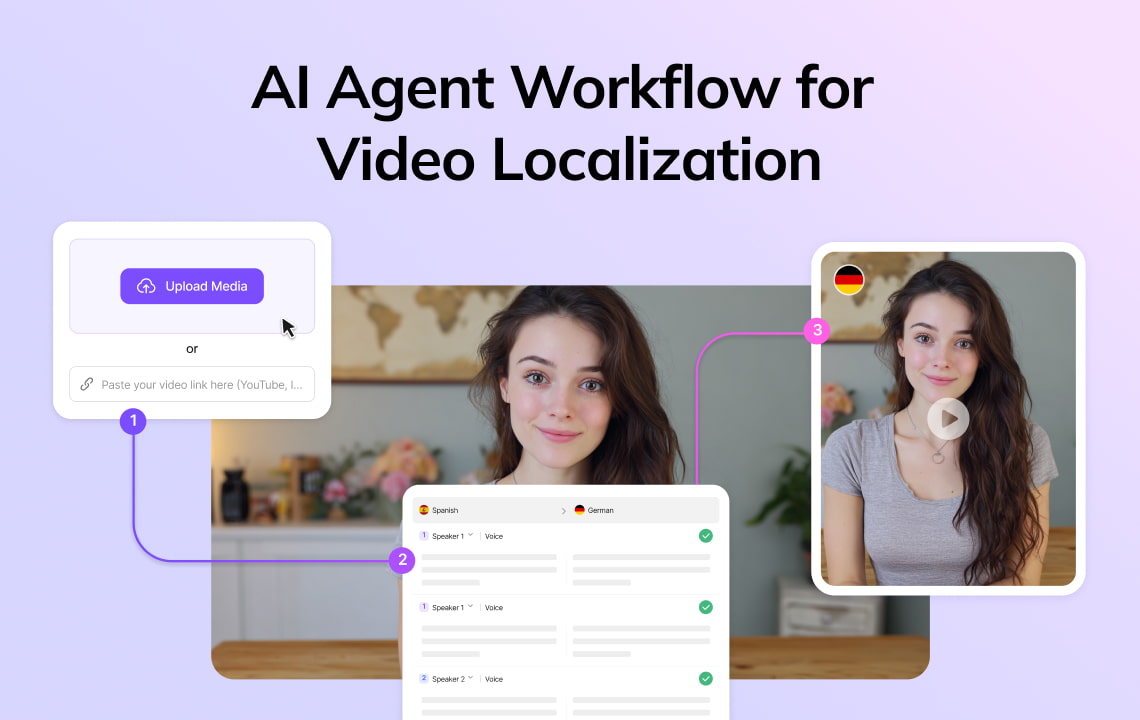
- VMEG’s AI agent for video localization has a simple AI agent workflow that makes it easier to localize content. It also has a human-in-the-loop feature where the agent's proposed plan will be approved first before generating an output, and it provides an editor that allows users to edit content before exporting it.
An AI agent is one of the technological trends that is changing the way things work. AI agents bring various benefits, such as saving time, effort, and cost. Each AI agent has its own workflow, depending on its purpose, such as video localization.
What Is an AI Agent Workflow?
An AI Agent Workflow is the process by which an agent plans, decides, and acts using the components integrated into it. The AI Agent workflow varies depending on the goal that must be achieved.
Why Workflows Are Critical for Video Localization
Video localization comprises multiple steps, including transcription, translation, subtitle timing, voice generation, and quality assurance. A structured workflow is important to maintain accuracy and efficiency. AI agent workflows help automate and coordinate each step.
Here are the advantages of having a structured workflow:
- Task Orchestration. It ensures that each task, such as transcription, translation, and dubbing, occurs in the right order.
- Parallel Processing. It allows multiple language versions to be generated simultaneously.
- Automated Error Detection. Helps in identifying timing issues, untranslated text, or formatting problems.
- Consistency across outputs. It ensures that style rules, terminology, and brand voice are consistent in all outputs.
Components of an AI Localization Agent
Here are the components of an AI localization agent that make the video localization process easier:
- Input Processing Module The input is the source that an AI agent can refer to, such as video, audio, or links. It extracts audio tracks, identifies speakers, and prepares data for transcription.
- Speech-to-Text Engine The AI Agent converts spoken dialogue into a text script by using automatic speech recognition. Accurate transcription is important because it serves as the foundation for translation and subtitles.
- Translation and Localization Module It applies Machine Translation to convert transcripts into target languages. Advanced systems can also adapt phrasing, idioms, and cultural references to make it relevant to different audiences.
- Timing and Subtitle Alignment The agent synchronizes translated text with the video's timing to ensure the generated subtitles are aligned. It can include adjusting segment lengths to match the reader's reading speed and incorporating scene transitions.
- Voice Generation or Dubbing Engine Some localization agents integrate text-to-speech systems to generate natural-sounding voice-overs or dubbing in multiple languages.
- Quality Control Layer A validation module checks for translation errors, missing segments, subtitle overlaps, and timing mismatches before the localized video is finalized.
- Workflow Integration Layer The agent connects with other systems in the pipeline, passing outputs to the next agent or collecting results from previous steps. This orchestration allows multiple agents to collaborate in a coordinated workflow.
Why Video Localization Requires AI Agent Workflows
Localizing video can be time-consuming, as it consists of various elements, such as visuals, audio, and text that give meaning to it. To make the process faster, AI agent workflows are important to save time and effort.
Growing Demand for Multilingual Video Content
According to Statista (2026), video is one of the most widely used online formats across different types of content.
Across platforms such as social media, videos are among the most widely used media formats for various purposes such as marketing, education, entertainment, lifestyle content, and more.
For brands, companies, and creators, creating multilingual versions of video content is a good strategy to reach a wider audience. Scalable workflows help businesses and individuals keep up with the pace of content production. It helps speed up the video localization process.
Limitations of Manual Localization Pipelines
In the manual localization process, the workflow relies more on manual effort from editors, translators, voice actors, and other talents. This workflow can produce quality output but has some limitations, such as:
- Slow turnaround times
- High production costs
- Complex coordination between teams
AI agent workflows help create a consistent number of pieces of content, making the process faster and smoother.
Why AI Agents Are Better for Scalable Localization
An AI agent workflow can handle multiple tasks, such as translation, transcription, voice synthesis, and subtitle alignment.
Those AI systems powered by Natural Language Processing and Speech Recognition can analyze video content and generate translated outputs.
AI Agent Workflow for Video Localization (Step-by-Step)
The AI Agent Workflow may vary depending on how the system is built. Here is an example of an AI agent workflow for video localization.
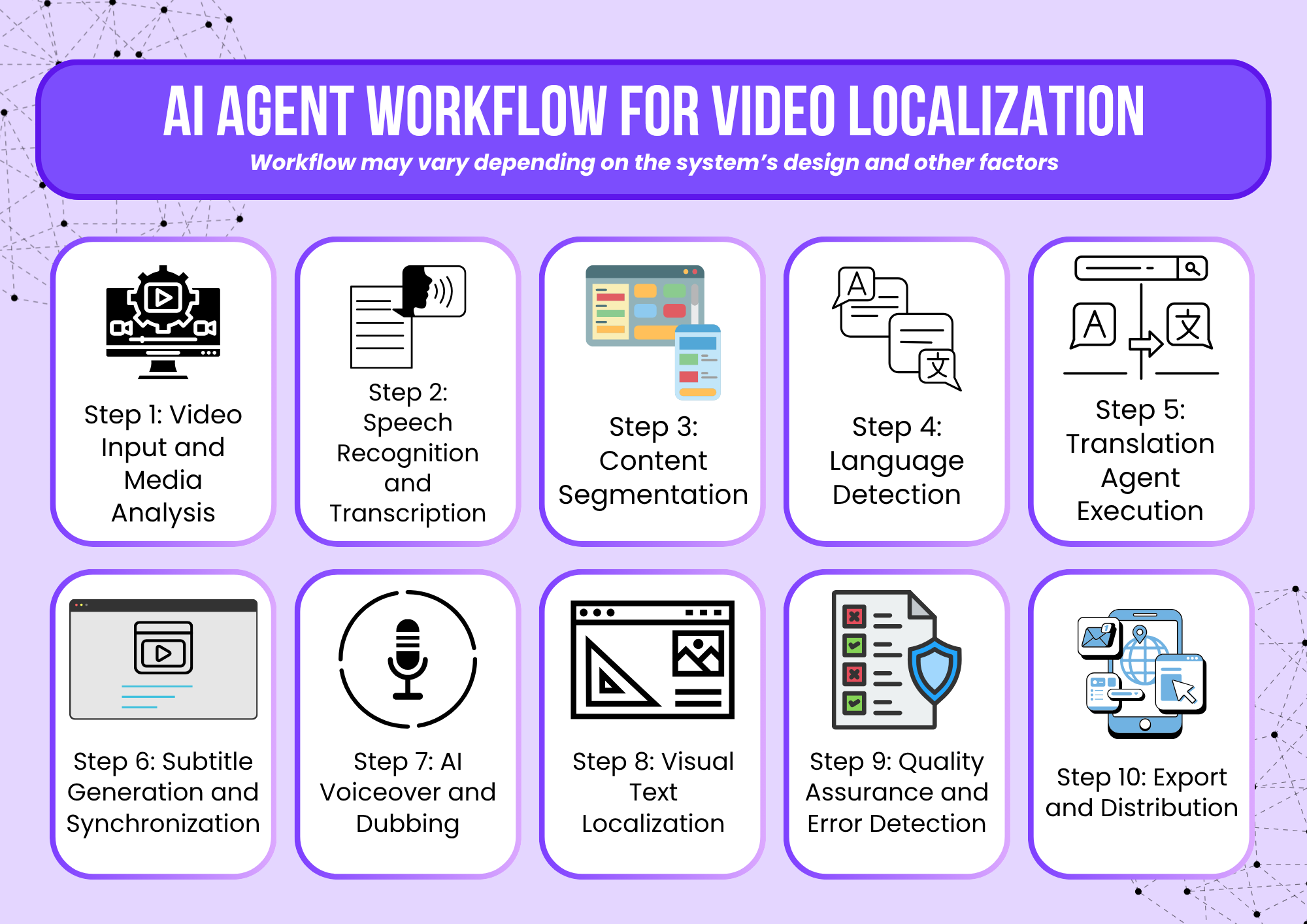
Step 1: Video Input and Media Analysis
The workflow begins when the AI system receives the source video file and prompt. The AI agent analyzes media to identify key components, including audio tracks, speech segments, background music, on-screen text, and visual context.
It ensures that the system understands the video’s structure and prepares it for downstream tasks. It also extracts metadata, such as audio channels, frame rate, and resolution, to maintain synchronization during later localization stages.
Step 2: Speech Recognition and Transcription
The automatic speech recognition agent will convert the spoken dialogue into text. It detects speakers, timestamps speech segments, and generates accurate transcripts of the original language.
This transcription is important as it will serve as the foundation for translation, subtitles, and dubbing. Systems that use modern AI models can also identify pauses, filler words, and tone, thereby improving localization quality.
Step 3: Content Segmentation
After transcription, the system divides the content into smaller logical segments. Segments may be based on sentences, phrases, scene changes, or speaker turns.
It helps maintain proper timing and ensures translations align correctly with the video’s pacing and context. With this process, AI agents can process different sections simultaneously for faster localization.
Step 4: Language Detection
The AI agent verifies the source language or the original language of the spoken content. If a video contains multiple languages, the system identifies each language segment and tags it accordingly.
Accurate language detection ensures the correct translation models and linguistic rules are applied during the next stage. Accuracy is important to ensure that the language is translated correctly.
Step 5: Translation Agent Execution
After identifying the language, the translation agent converts the transcribed text into the target language. Advanced AI translation systems preserve meaning, context, tone, and cultural nuance.
It may also apply localization rules, such as adapting idioms, adjusting phrasing for regional audiences, and maintaining brand terminology consistency, to ensure it is culturally relevant.
Step 6: Subtitle Generation and Synchronization
The translated text will be formatted into subtitles. The AI aligns each subtitle segment with the corresponding timestamps from the transcription stage.
It optimizes subtitle length, line breaks, and reading speed to ensure viewers can comfortably read subtitles while watching the video. It helps give viewers a good overall experience.
Step 7: AI Voiceover and Dubbing
The system can generate localized voiceovers using AI-generated voices. The AI agent can produce natural-sounding speech in the target language.
It will synchronize it with the video’s original timing. Advanced systems can also adjust pacing and intonation to ensure they match the original emotion of the speaker and delivery style.
Step 8: Visual Text Localization
Some videos contain text embedded within the visuals, such as titles, captions, signs, or graphics. Computer vision models detect these texts on screen and extract them using optical character recognition.
The text is translated and reinserted into the video while preserving design elements such as font style, color, and positioning. It helps ensure that every element in the videos is properly aligned.
Step 9: Quality Assurance and Error Detection
Before finalizing the localized video, a quality assurance agent reviews the output. The AI agent checks for translation errors, timing mismatches, subtitle overlap, missing segments, and audio synchronization issues.
Some systems also run human-in-the-loop reviews, allowing humans to make edits to ensure the final output is accurate. Human-in-the-loop also helps ensure that the generated output aligns with the content goals.
Step 10: Export and Distribution
Finally, the system compiles all localized assets, including subtitles, translated transcripts, dubbed audio tracks, and updated visuals, into the final video output.
The AI agent exports the video in the required formats and prepares it for distribution across platforms such as streaming services, social media, or learning platforms. It ensures that the localized output is optimized for the target audience and delivery channel.
How VMEG AI Uses AI Agent Workflows for Video Localization
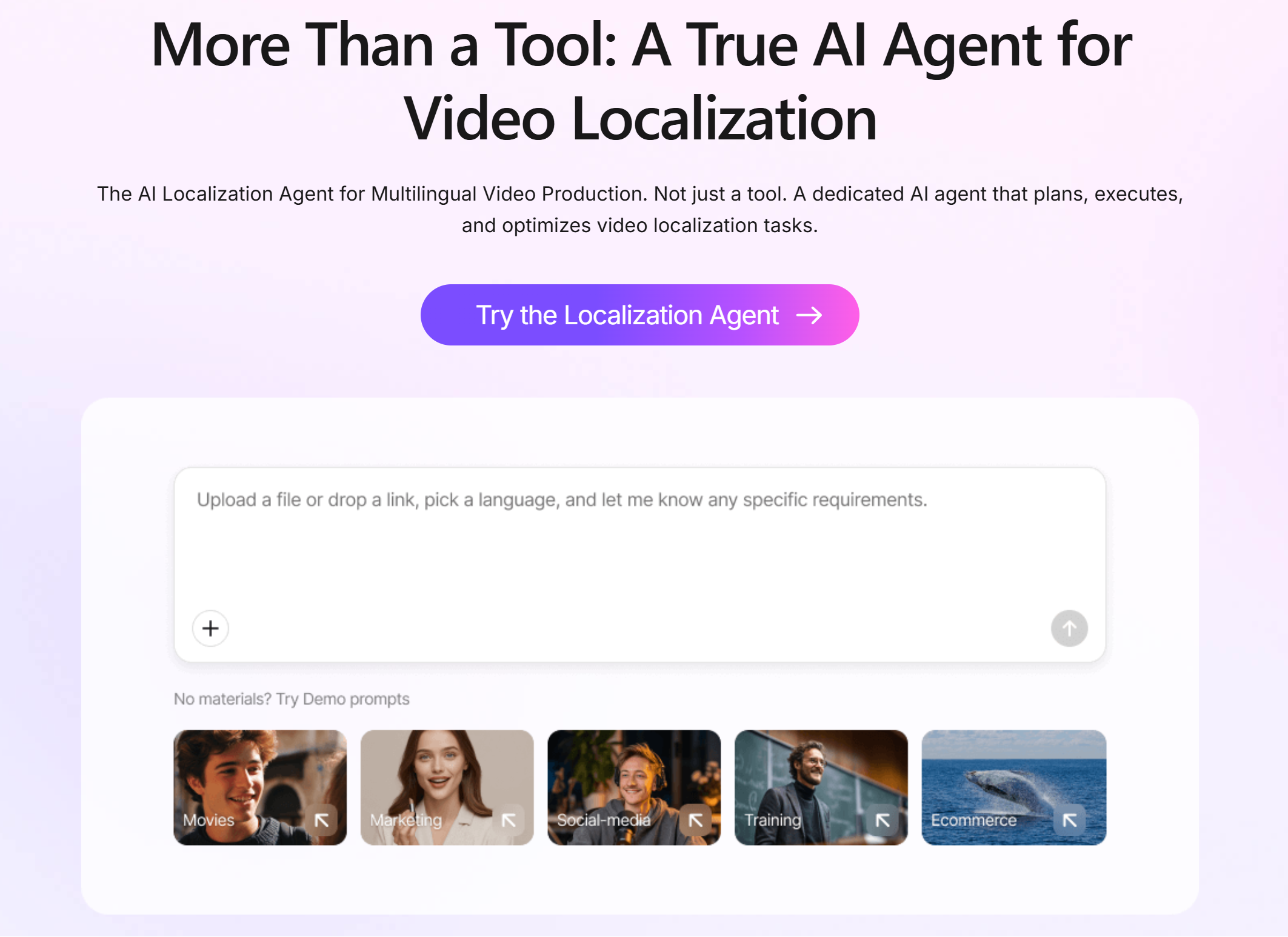
VMEG AI, an AI-powered localization tool, offers an AI Agent for Video Localization feature that simplifies and speeds up the localization process.
The VMEG’s AI Agent Workflow
Step 1: Upload Files and Enter Prompt.
- Upload files or drop a link.
- Type task instructions into the chat window.
- Choose a language you want your content to be translated into.
The files or link, the task instructions, and the target language are the inputs that will be used by the system in processing the context.
- It allows the VMEG AI Agent to understand the video context.
- The system will prepare an initial solution for the task.
Step 2: Review and Approve Agent’s Plan
- The AI Agent will create a plan.
- The user will check the AI agent's proposed plan.
- The user will make the necessary adjustments to ensure the output aligns with expectations.
- Approve the AI agent’s plan if you are satisfied with it.
Step 3: Preview, Edit, and Export
- Preview the output’s first version.
- If anything needs adjustment, open the editor to refine the output.
- Once satisfied, export the final result.
Advantages of AI Agent Workflows for Video Localization with VMEG AI
Faster Global Content Distribution
AI agent workflows reduce the time required to localize videos for international audiences. Instead of a manual process, it can produce localized videos in just a few minutes.
It is helpful for businesses and individuals to publish multilingual versions of the same video more quickly. With this, they will be able to respond faster to regional trends and create more content, ensuring that the content reaches a worldwide audience without production delays.
Lower Localization Costs
Many specialists are required in traditional video localization, as you will need translators, voice actors, editors, and production managers, and this can increase costs.
AI-powered workflows streamline tasks by automating processes. With a streamlined, faster workflow, individuals and businesses can stay within budget. It makes video localization easier and more accessible, even for small and medium-sized businesses and individuals.
Consistent Multilingual Branding
A brand is an important element that helps the audience to recognize your content easily. Maintaining a consistent brand voice and style across languages can be challenging, especially when different teams are involved.
With centralized workflows, users can create outputs with a consistent, unified voice, style, and identity. It helps the audience recognize the brand easily and builds trust worldwide.
Scalable Video Marketing
In digital marketing, video is one of the media types used, as businesses produce and localize content at scale.
The AI agent workflow makes it easier to replicate videos across multiple languages and audiences without additional production time. Those who want to expand into new markets and bring content to an international audience can benefit from an AI agent workflow to efficiently scale video marketing efforts while maintaining quality and speed.
Challenges of AI Agent Workflows in Video Localization
Subtitle Timing Accuracy
Accurate subtitle timing is a challenge in AI-driven video localization. Various factors affect subtitle timing accuracy, including sentence length, speech speed, and pacing. Subtitles may appear too early, too late, or stay on screen for too long. Subtitle timing issues can disrupt the viewer's experience.
To ensure that subtitles are accurate and properly synchronized, the system must include advanced speech recognition, timestamp mapping, and human review to ensure subtitles match the rhythm of the original content.
Cultural Translation Nuances
Localization is not just about direct translation. It should also capture the cultural context to make the content relevant to the audience.
AI systems may struggle with idioms, humor, slang, and culturally specific references. A phrase that works well in one language might sound awkward, confusing, or even offensive in another language. AI agent workflows must incorporate context and cultural adaptation to make it relevant.
Lip-Sync Complexity
Another challenge in AI workflows is lip-sync, as different languages vary in word length, phoneme structure, and sentence rhythm. It may not naturally match the original speaker's mouth movements.
Advanced AI techniques attempt to adjust timing, rewrite lines, or even modify facial animation to improve alignment, but achieving natural lip synchronization remains technically demanding. VMEG AI provides synchronized lip-sync to make the video look natural.
Quality Assurance
Maintaining quality across different content is another challenge. There might be issues with AI workflows, such as mistranslations, formatting errors, incorrect names, or incorrect terminology. It is important to have a quality assurance process to ensure that the content is accurate and relevant.
Human-in-the-loop is one of the features that help maintain quality. The content will be more accurate with human reviews. Automated checks and human reviews can ensure the output maintains the proper tone, context, and overall accuracy.
FAQs
What is an AI agent workflow?
An AI agent workflow is the process by which an AI agent operates, including perceiving the input, understanding the context, planning tasks, checking quality, and generating output.
What is an AI agent workflow for video localization?
The AI agent workflow for video localization includes several steps: perceiving and analyzing the video, understanding the prompt to determine the goal, integrating and processing video elements, performing quality assurance, and exporting.
How do AI agents automate video translation?
AI agents extract speech from a video using speech recognition, translate the text with machine translation, and then generate automatically translated subtitles or dubbed audio.
How to create an AI agent workflow?
To create an AI agent workflow, define the goal, break it into tasks, choose AI tools or models for each task, connect them with triggers or automation, and test the workflow.
What is an example of an AI agent workflow?
An example of an AI agent workflow is the VMEG AI’s localization agent, where the user uploads a file or pastes a link, types a prompt, and the agent generates a plan. The user will review the plan created by an AI agent, and the agent will then create a localized video. After localizing content, humans can review and edit before exporting to ensure quality.
Conclusion
The AI agent workflows vary depending on how the system is designed and built. The AI agents workflow provides a faster, more convenient way to achieve a goal. In video localization, an AI agent's workflow consists of various stages, from perceiving the video and understanding the prompt to checking quality and exporting.
VMEG AI is an ideal video localization tool to localize your content as it has a simple AI agent workflow, and best of all, it provides highly accurate output, as it ensures that it captures the right context, has proper lip-sync and dubbing synchronization, and has a human-in-the-loop stage that ensures quality and relevance.


The VMEG Team
Behind VMEG stands a passionate team of creatives, engineers, and language lovers. At the crossroads of AI and storytelling, they craft tools that bridge languages and cultures.