

'%3e%3cpath%20d='M21.0949%203.79395L13.9961%209.82854H21.0949V3.79395Z'%20stroke='black'%20stroke-width='1.38'%20stroke-miterlimit='10'/%3e%3cpath%20d='M13.998%209.82854L7.44531%203.79395V9.82854H13.998Z'%20stroke='black'%20stroke-width='1.38'%20stroke-miterlimit='10'/%3e%3cpath%20d='M13.9961%202.69922V25.1919'%20stroke='black'%20stroke-width='1.38'%20stroke-miterlimit='10'/%3e%3cpath%20d='M20.5488%2016.4113L13.9961%209.82812V18.2217L20.5488%2024.0918V16.4113Z'%20stroke='black'%20stroke-width='1.38'%20stroke-miterlimit='10'/%3e%3cpath%20d='M7.44531%2016.4113L13.998%209.82812V18.0526L7.44531%2024.0918V16.4113Z'%20stroke='black'%20stroke-width='1.38'%20stroke-miterlimit='10'/%3e%3cpath%20d='M4.71094%209.82812V18.6057H7.44125V16.4113L13.9941%209.82812H4.71094Z'%20stroke='black'%20stroke-width='1.38'%20stroke-miterlimit='10'/%3e%3cpath%20d='M13.9961%209.82812L20.5488%2016.4113V18.6057H23.2792V9.82812H13.9961Z'%20stroke='black'%20stroke-width='1.38'%20stroke-miterlimit='10'/%3e%3c/g%3e%3c/svg%3e)

'%3e%3cmask%20id='mask0_21456_29260'%20style='mask-type:luminance'%20maskUnits='userSpaceOnUse'%20x='0'%20y='0'%20width='28'%20height='28'%3e%3cpath%20d='M27.5%200.5H0.5V27.5H27.5V0.5Z'%20fill='white'/%3e%3c/mask%3e%3cg%20mask='url(%23mask0_21456_29260)'%3e%3cpath%20d='M14%2027.5C13.4854%2024.1035%2011.8974%2020.9608%209.46828%2018.5317C7.03922%2016.1026%203.89651%2014.5146%200.5%2014C3.89651%2013.4854%207.03922%2011.8974%209.46828%209.46828C11.8974%207.03922%2013.4854%203.89651%2014%200.5C14.5147%203.89644%2016.1028%207.03905%2018.5318%209.46816C20.9609%2011.8972%2024.1035%2013.4853%2027.5%2014C24.1035%2014.5147%2020.9609%2016.1028%2018.5318%2018.5318C16.1028%2020.9609%2014.5147%2024.1035%2014%2027.5Z'%20fill='url(%23paint0_linear_21456_29260)'/%3e%3c/g%3e%3c/g%3e%3cdefs%3e%3clinearGradient%20id='paint0_linear_21456_29260'%20x1='9.5'%20y1='9.5'%20x2='20.75'%20y2='21.875'%20gradientUnits='userSpaceOnUse'%3e%3cstop%20stop-color='%23F0DCD6'/%3e%3cstop%20offset='0.914506'%20stop-color='%231D6DFF'/%3e%3c/linearGradient%3e%3cclipPath%20id='clip0_21456_29260'%3e%3crect%20width='28'%20height='28'%20fill='white'/%3e%3c/clipPath%3e%3c/defs%3e%3c/svg%3e)
'%3e%3cpath%20d='M22.8019%2011.2412L23.5234%2011.6807V12.0103L23.3172%2012.7796L14.5579%2014.9771L13.7344%2012.7951L22.8019%2011.2412Z'%20fill='%23D97757'/%3e%3cpath%20d='M19.5236%204.77832L20.5322%205.00396L20.8%205.35575L21.0552%206.19876L20.9494%206.73644L15.0712%2015.3068L13.1133%2013.2191L18.5338%205.63471L19.5236%204.77832Z'%20fill='%23D97757'/%3e%3cpath%20d='M14.4577%203.43951L15.0761%203L15.5912%203.21976L16.1065%203.9889L14.6949%2013.0345L13.7364%2012.3397L13.3242%2011.131L14.0456%204.31853L14.4577%203.43951Z'%20fill='%23D97757'/%3e%3cpath%20d='M7.84766%203.5851L8.48285%202.7199L8.89716%202.61914L9.71923%202.74717L10.125%203.08581L13.0815%2010.0748L14.1509%2013.3954L12.8997%2014.1372L8.13117%204.91019L7.84766%203.5851Z'%20fill='%23D97757'/%3e%3cpath%20d='M4.77232%208.38688L4.56641%207.50742L5.18478%206.73828L5.90613%206.84816H6.11223L10.4403%2010.2544L11.78%2011.3531L13.6349%2012.8914L12.6044%2014.7594L11.6769%2013.9903L11.0586%2013.331L5.08168%208.82593L4.77232%208.38688Z'%20fill='%23D97757'/%3e%3cpath%20d='M3.53288%2014.0982L3.06641%2013.5489L3.06647%2013.0601L3.53288%2012.8896L8.78833%2013.2193L13.9408%2013.6588L13.7736%2014.7528L3.94502%2014.2082L3.53288%2014.0982Z'%20fill='%23D97757'/%3e%3cpath%20d='M6.62378%2019.8178H5.59334L5.18359%2019.3146V18.7132L6.93299%2017.3946L14.045%2012.5674L14.7648%2013.8785L6.62378%2019.8178Z'%20fill='%23D97757'/%3e%3cpath%20d='M8.57739%2022.8884L8.16518%2022.9984L7.54688%2022.6687L7.64995%2022.1193L13.7299%2013.5488L14.5543%2014.7574L10.0201%2021.1305L8.57739%2022.8884Z'%20fill='%23D97757'/%3e%3cpath%20d='M13.7361%2023.9861L13.4271%2024.4257L12.8088%2024.6454L12.2935%2024.2058L11.9844%2023.5466L13.5301%2014.6465L14.4576%2014.7563L13.7361%2023.9861Z'%20fill='%23D97757'/%3e%3cpath%20d='M18.9869%2021.5713V22.4503L18.8838%2022.7799L18.4716%2022.9997L17.7503%2022.8974L12.7969%2015.0367L14.7617%2013.4404L16.4104%2016.6269L16.5652%2017.7805L18.9869%2021.5713Z'%20fill='%23D97757'/%3e%3cpath%20d='M21.3629%2020.2507L21.4659%2020.8L21.1568%2021.2396L20.8476%2021.1297L19.0958%2019.8112L16.4165%2017.284L14.3555%2015.7457L14.9736%2013.6582L16.0041%2014.3175L16.6226%2015.5259L21.3629%2020.2507Z'%20fill='%23D97757'/%3e%3cpath%20d='M20.0232%2014.6482L22.5995%2014.8679L23.2178%2015.3074L23.6299%2015.9667V16.441L22.4964%2016.9556L16.7256%2015.4173L14.3555%2015.3074L14.9737%2013L16.6226%2014.3185L20.0232%2014.6482Z'%20fill='%23D97757'/%3e%3c/g%3e%3c/svg%3e)
Key Takeaways
- The way AI agents work varies depending on their design and purpose. In localization, AI agents work by perceiving data from the prompt and uploaded file, then processing the context, creating a plan, and acting to generate an output.
- The technologies behind AI agent localization include automatic speech recognition, large language models, text-to-speech synthesis, computer vision, alignment algorithms, and vector databases.
- The benefits of AI agents for video localization include speed, scalability, cost reduction, consistency, and continuous localization.
- AI agents will continue to improve, depending on the developers and other factors. In the future, AI agents may work better through multi-agent systems, industry-specific agents, self-improving systems, hybrid localization workflows, and context-awareness.
- One platform that features an AI Agent for video localization is VMEG AI. It makes locaizing video content easier, helping users save time, effort, and cost.
: AI agents are one of the trends that make work faster and easier. Each AI agent is designed according to its own purpose. Businesses and individuals can use it for various activities, including localization.
What Is an AI Agent?
McKinsey & Company (2025) defines an AI agent as a tool that people use to collaborate with Artificial Intelligence. These agents have the capability to do the things that usually require humans, such as automating and doing complex tasks.
It is software or a system designed to plan, decide, and perform tasks. AI agents bring various benefits to users, helping them be more productive by saving time and effort on repetitive tasks.
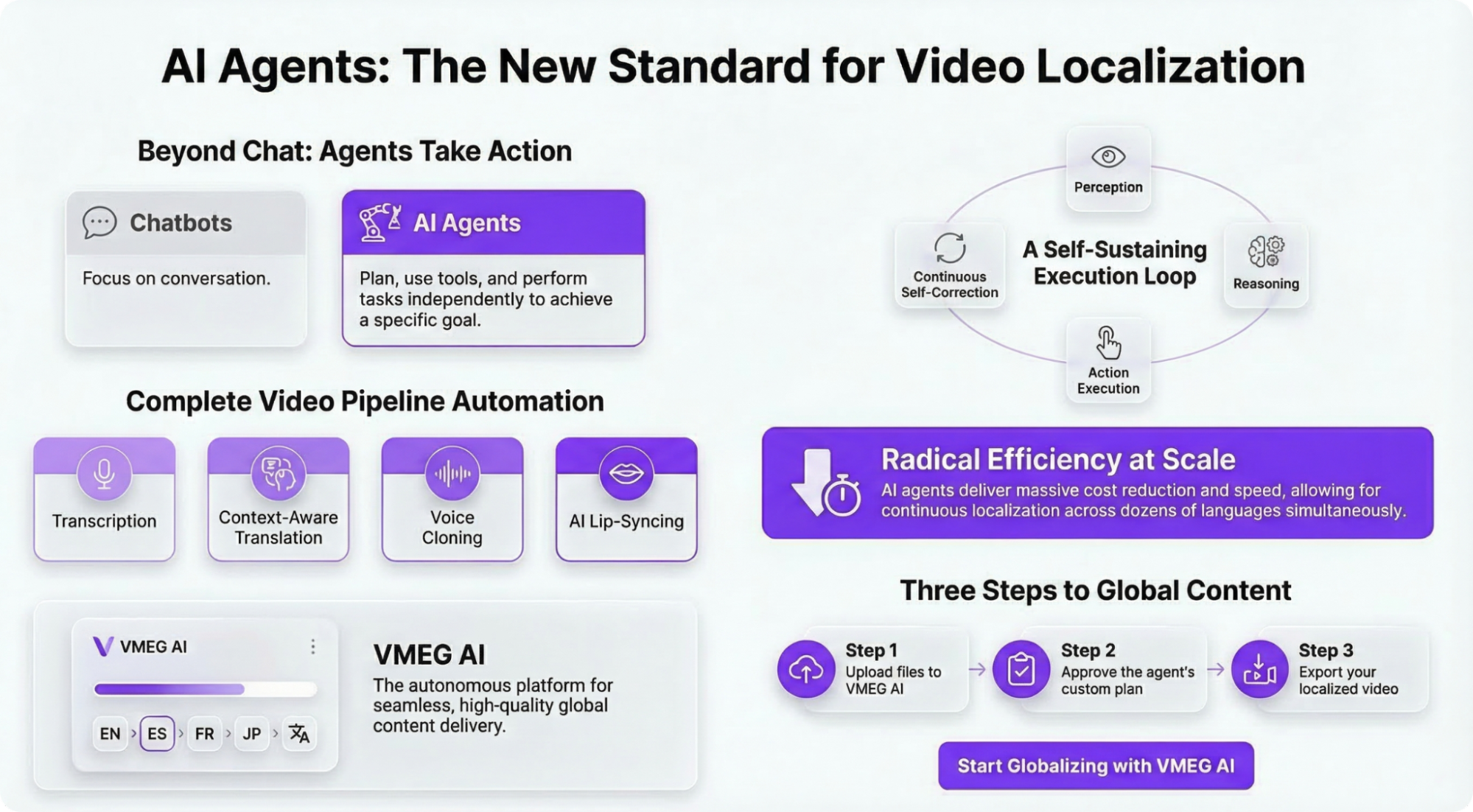
AI Agent vs Chatbot
AI agents and chatbots are systems that have different functions and purposes.
Chatbots: A chatbot is mainly designed to have conversations with users.
Purpose: Answer questions or help through text/voice interaction.
Typical features:
- Responds to user prompts
- Usually works inside messaging interfaces
- Often follows predefined flows or limited reasoning
- Does not act independently outside the chat
Examples:
- Customer support bots on websites
- FAQ bots in messaging apps.
- AI assistants used mainly for conversation.
Example scenario:
- User: “What are your store hours?”
- Chatbot: “Our store is open from 9 AM to 6 PM.”
The chatbot responds to user input but does not perform actions.
AI AgentAn AI agent is designed to take actions to accomplish goals, not just chat. The goals depend on how they are designed.
Purpose: Plan, decide, and perform tasks autonomously.
Typical features:
- Has a goal
- Can use tools/APIs
- Can take multiple steps
- Can act without constant user input
- Often remembers context or state
Examples:
A system that:
- searching the web
- analyzes data
- writes a report
- Autonomous task systems built with frameworks.
Example scenario:
User: “Find the cheapest flight to Malaysia next month and email me options.”
An AI agent might:
- Search flights
- Compare prices
- Create a summary
- Send an email
That’s multiple actions toward a goal.
How AI Agents Work
The way AI Agents work may vary, depending on their purpose and other factors integrated into them.
1. Goal Definition
Defining a goal helps the AI agent to know what it should accomplish and guides its decisions and actions. This goal must be clear and specific so the AI agent can effectively plan and determine the steps to achieve it.
For example, your goal is to localize a video. You need an AI agent for video localization to do it for you.
2. Perception
AI agents need input or source data to use as a reference. It is where an AI agent collects data from sources. The input can include sensors, prompts, information, files, and other data needed by an agent. It helps AI agents understand the scenario or events so they can plan their actions effectively.
3. Context Processing (Understanding the Task)
The AI agent will process the context to determine what needs to be done, make decisions, and plan tasks to achieve the goal. When an AI agent knows the right context, the output will be accurate and relevant.
4. Memory Systems
Memory systems are used to keep information. Short-term memory stores data for the current task. On the other hand, long-term memory can store data from past experiences and recognize patterns. An AI agent must have a good memory to learn from past interactions and deliver effective results.
5. Reasoning & Planning
This is the process by which an AI agent creates plans to achieve a goal. It consists of evaluating possible actions, breaking complex tasks into smaller steps, and planning the sequence of operations.
6. Tool Usage & Integration
AI agents can use various tools to process tasks and achieve their goals. The tools can include web search engines, databases, and other platforms necessary to complete the task.
7. Action Execution
The AI agent will execute the action based on the plan it created. It can involve running commands, sending messages, and other actions to help meet the goal. It is where the agent interacts with the environment to produce real outcomes.
8. Feedback & Self-Correction
The agent will evaluate the results of its actions through a feedback mechanism. Depending on its design, it can check whether the output meets the goal, refine its approach, and analyze errors. It helps the agent to improve continuously and deliver better, more reliable, and accurate results over time.
Main Types of AI Agents
Here are some of the main types of AI agents:
Simple Reflex Agents. Simple reflex agents are the simplest type and use predefined rules to complete tasks.
Model-based Reflex Agents. These agents have an internal model of the environment that helps them learn from past experiences.
Goal-based Agents. These agents determine the best actions and consider future outcomes that will lead them closer to the goals.
Utility-Based Agents. It maximizes the utility function and considers and measures the desirability of the particular outcome.
Learning Agents. Learning agents improve their performance by learning from their past interactions and experiences.
How an AI Agent Works in Video Localization
Task/Goal: Localizing YouTube content into Spanish with subtitles while keeping the voice style.
Step 1: Understand the Goal
The AI agent extracts:
- Source language: English
- Target language: Spanish (depending on the user)
- Preserve original voice style
- Add subtitles
- Output format: YouTube-ready
It then decomposes the task into:
- Extract audio
- Transcribe speech
- Translate script
- Clone or synthesize voice
- Lip-sync video
- Generate subtitles
- Render final videos
Step 2: Analyze the Video
The agent performs:
Speech to Text:
Converts audio into a transcript.
Script Structuring
Identifies:
- Sentence timing
- Emotional tone
- Pauses
- Speaker identity (if multiple speakers)
Scene Detection:
Matches spoken segments to timestamps for accurate lip sync.
Step 3: Translation with Context Awareness
Unlike basic translation tools, the AI agent:
- Preserves idioms
- Adjusts cultural references
- Maintains persuasive tone (if marketing content)
- Adapts humor where needed
Step 4: Voice Cloning & Dubbing
The agent:
- Analyzes pitch, tone, speed
- Synthesizes voice in Spanish
- Matches emotional intensity
- Adjusts pacing to fit mouth movements
- This goes beyond simple text-to-speech — it optimizes for naturalness and synchronization.
Step 5: AI Lip Sync
Using facial landmark tracking, the system:
- Detects mouth shape per frame
- Adjusts lip movement to match translated speech
- Maintains realism
Step 6: Subtitle Generation
The agent:
- Creates SRT files
- Syncs timestamps automatically
- Formats for YouTube standards
- Can optionally burn captions into the video
Step 7: Rendering & Delivery
The AI agent:
- Optimizes audio levels
- Exports to the chosen file format.
- Delivers output.
Real-World Example: AI Agent in Video Localization Using VMEG AI
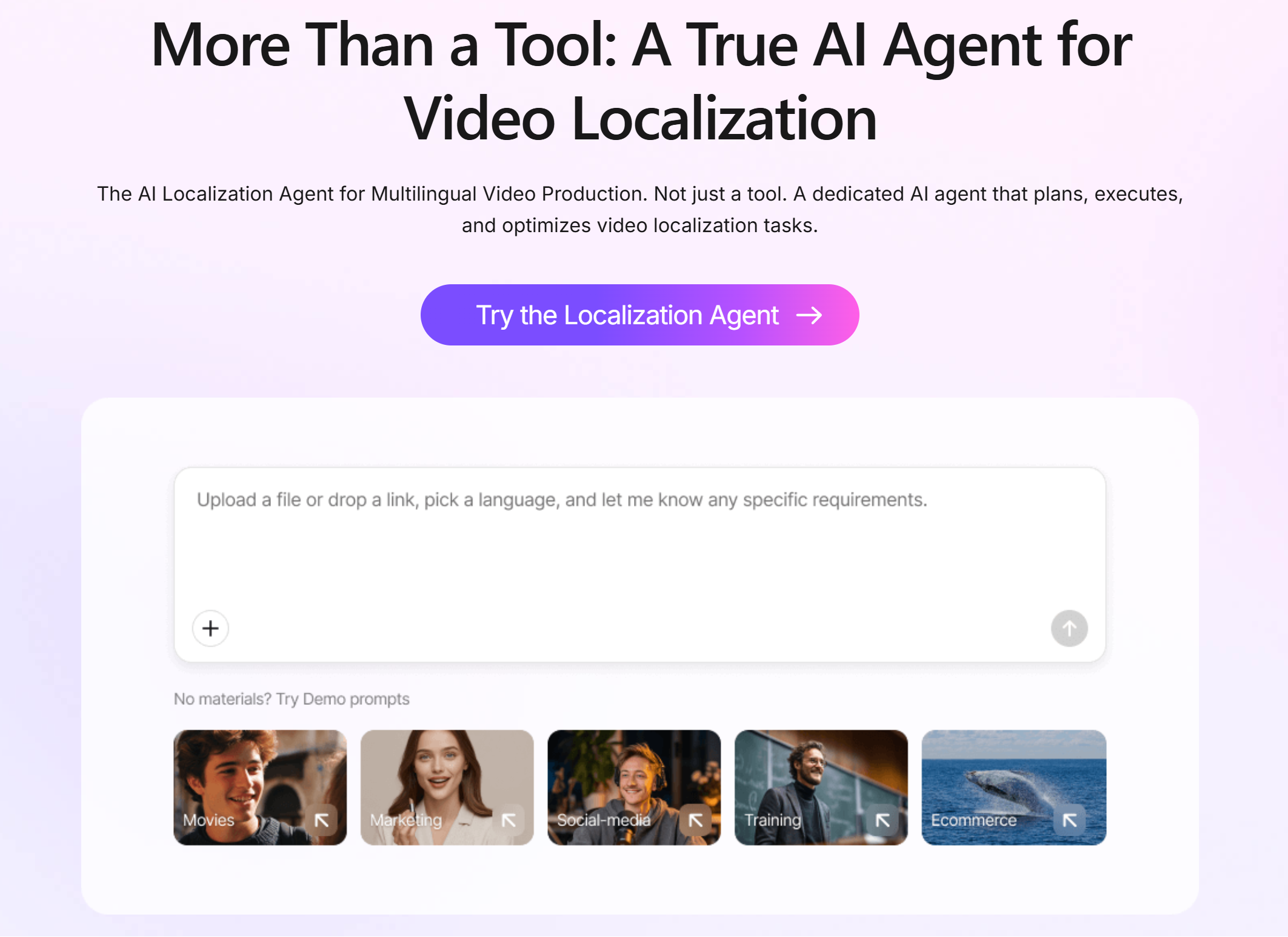
Video is one type of media used by individuals and businesses to connect with their audiences. Some of these individuals and businesses localize video to bring their content to audiences worldwide, extending their reach.
Video localization can help attract a larger audience and create new opportunities, such as collaborations with individuals or brands.
Localizing video is now easier with modern technologies, such as AI agents. Even if you are a beginner in video localization, you can do it easily with a tool like VMEG AI, which features an AI agent for video localization.
With VMEG AI, you can localize videos in three easy steps:
- Enter the prompt and upload files. Enter the prompt and upload your file so that the agent will understand the context and plan a solution.
- Review and approve the AI Agent’s plan. VMEG AI will generate a proposed plan. Check it so you can make adjustments. If you are satisfied, click Approve.
- Preview, Edit, and Export. After the agent generates the output, check it to see if adjustments are needed. If there are some adjustments, users can edit the output in the editor. After editing, users can export the output.
Technologies Behind AI Video Localization Agents
Automatic Speech Recognition (ASR)
It converts the spoken language in the video to text. This is the first layer of localization. It can identify spoken dialogue, speakers, sentence boundaries, background noise, and speech clarity. These are used to create transcripts that can be turned into captions, subtitles, or scripts.
Large Language Models
It helps agents understand the context and ensure high-quality translation. These models analyze the meaning of sentences rather than translating words directly.
Text-to-Speech
When the translated script is ready, AI agents will generate localized audio using text-to-speech systems. It helps produce videos with realistic voices and captures the speaker's emotion.
Computer Vision
It helps AI agents in analyzing visual elements in the video itself. It helps detect on-screen text, scene changes, the speaker's face, and lip movements.
Alignment Algorithms
Localization requires accurate synchronization among text, audio, and visuals. Alignment algorithms ensure that subtitles, dubbed audio, and other elements match the original speech timing, making the output appealing to the audience.
Vector Databases
To ensure consistency, AI localization systems may store terminology and past translations. It helps improve translations and maintain consistent brand terminology.
Benefits of AI Agents in Video Localization
Here are some of the benefits of using AI Agents in localizing videos:
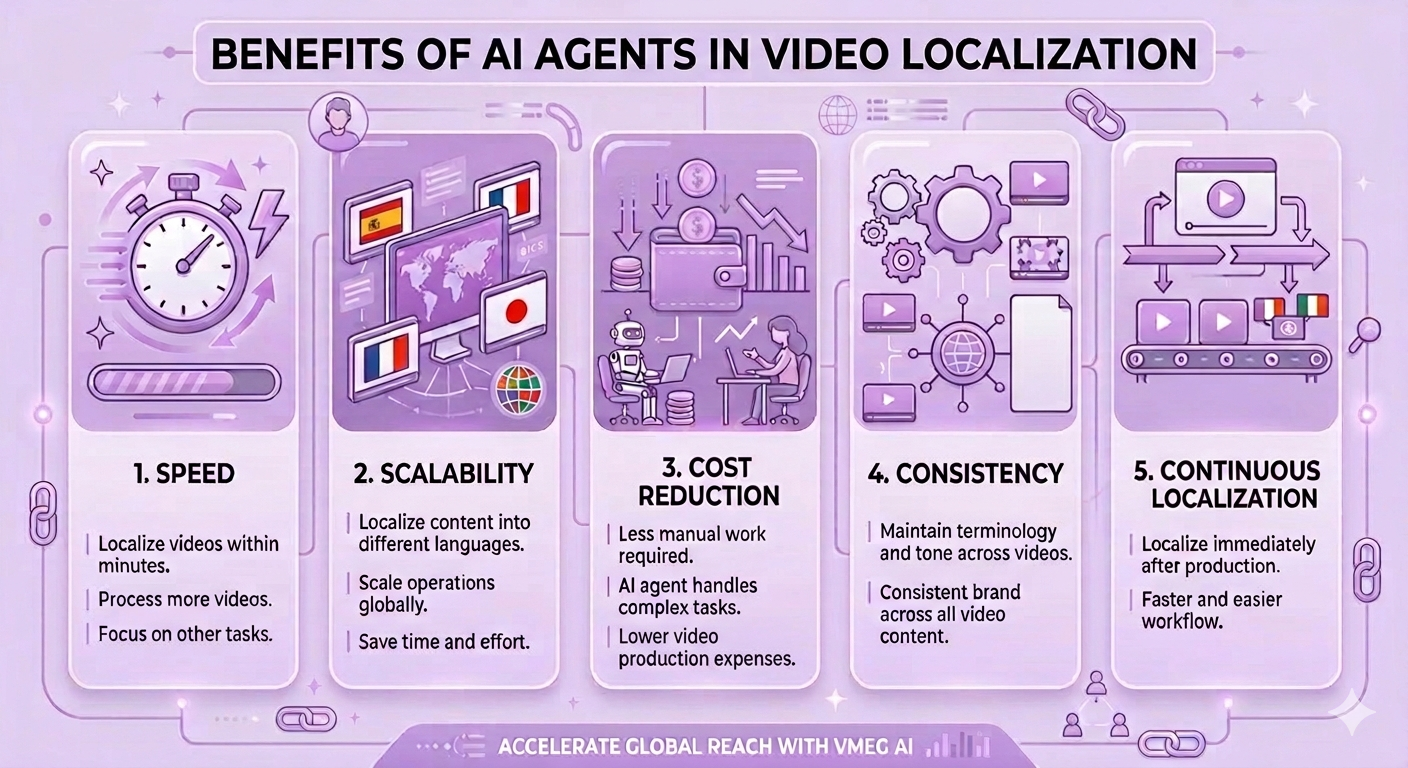
Speed. Localizing videos will be faster, as it can be done within a few minutes. With this, you will be able to localize more videos and focus on other tasks.
Scalability. It helps users localize content into different languages. It will also help you save time and effort.
Cost Reduction. Using AI agents can also reduce costs, as less manual work is required. The AI agent will handle the complex tasks.
Consistency. AI agents can help maintain consistency in terminology and tone across videos. This is helpful for those who want to maintain a consistent brand across all video content.
Continuous Localization. Videos can be localized immediately after production. It helps in keeping the workflow faster and easier.
Future of AI Agents in Localization
There are various emerging trends in video localization AI agents that will be game changers for content localization. It will make global content distribution easier, allowing creators to reach international audiences more easily.
Multi-Agent Collaboration
Multi-agent collaboration is the process by which different agents work together to achieve a goal. They work as a team, with responsibilities assigned to each agent, who acts based on the shared information. This is ideal for complex environments and tasks. Gartner says that, in 2026, multi-agent systems will be among the strategic technology trends.
Industry-Specific AI Agents
AI Agents' specialization will help users choose an AI Agent that best fits their specific task. For example, if you need to localize video content, you need an AI agent in the localization industry, such as VMEG AI.
Self-Improving Systems
It is important that an AI agent can self-improve by learning from past interactions, recognizing patterns and behaviors, and assessing the impact of its outputs, so that it can improve over time.
AI Human Hybrid Localization Workflows
Another important feature of AI agents is the human-in-the-loop, which will help ensure that the output generated by AI is verified and aligned with expectations.
AI Dubbing, Lip-Sync, and Context Awareness
Dubbing, lip-sync, and context awareness are important factors that must be continuously improved to make the AI Agent more useful and convenient over time. It also helps in generating content that looks natural and realistic.
FAQs
How do AI agents work together?
AI agents collaborate and work as a team. Tasks may be assigned depending on each agent's capabilities and the goal that it needs to achieve.
What are the 5 main types of agents in AI?
The five main types of agents in AI are simple reflex agents, model-based reflex agents, goal-based agents, utility-based agents, and learning agents.
What are AI agents used for?
AI agents are used for different use cases, as each AI agent has its own design and purpose. It can be used for localization, research, and other purposes.
What is an example of an AI agent?
An example of an AI agent is the VMEG AI Agent for Video Localization, where you can localize video content.
Who needs an AI agent?
Various individuals and businesses, such as content creators, business owners, researchers, educators, and others, may need an AI agent. For example, if you are a video content creator who wants to localize video content, you may need an AI agent-based video localization tool, such as VMEG AI.
Conclusion
AI agents work in various ways depending on their design and purpose. In localization, AI agents work by uploading a file and typing a prompt, which they use as a reference when making decisions and creating a localized video.
If you are looking for an AI agent for video localization, VMEG AI is the best choice. It is easy to use and provides high-quality lip-sync and dubbing. It also has a human-in-the-loop feature that lets you edit the generated output to ensure it aligns with your brand and content goals.


The VMEG Team
Behind VMEG stands a passionate team of creatives, engineers, and language lovers. At the crossroads of AI and storytelling, they craft tools that bridge languages and cultures.