

'%3e%3cpath%20d='M21.0949%203.79395L13.9961%209.82854H21.0949V3.79395Z'%20stroke='black'%20stroke-width='1.38'%20stroke-miterlimit='10'/%3e%3cpath%20d='M13.998%209.82854L7.44531%203.79395V9.82854H13.998Z'%20stroke='black'%20stroke-width='1.38'%20stroke-miterlimit='10'/%3e%3cpath%20d='M13.9961%202.69922V25.1919'%20stroke='black'%20stroke-width='1.38'%20stroke-miterlimit='10'/%3e%3cpath%20d='M20.5488%2016.4113L13.9961%209.82812V18.2217L20.5488%2024.0918V16.4113Z'%20stroke='black'%20stroke-width='1.38'%20stroke-miterlimit='10'/%3e%3cpath%20d='M7.44531%2016.4113L13.998%209.82812V18.0526L7.44531%2024.0918V16.4113Z'%20stroke='black'%20stroke-width='1.38'%20stroke-miterlimit='10'/%3e%3cpath%20d='M4.71094%209.82812V18.6057H7.44125V16.4113L13.9941%209.82812H4.71094Z'%20stroke='black'%20stroke-width='1.38'%20stroke-miterlimit='10'/%3e%3cpath%20d='M13.9961%209.82812L20.5488%2016.4113V18.6057H23.2792V9.82812H13.9961Z'%20stroke='black'%20stroke-width='1.38'%20stroke-miterlimit='10'/%3e%3c/g%3e%3c/svg%3e)

'%3e%3cmask%20id='mask0_21456_29260'%20style='mask-type:luminance'%20maskUnits='userSpaceOnUse'%20x='0'%20y='0'%20width='28'%20height='28'%3e%3cpath%20d='M27.5%200.5H0.5V27.5H27.5V0.5Z'%20fill='white'/%3e%3c/mask%3e%3cg%20mask='url(%23mask0_21456_29260)'%3e%3cpath%20d='M14%2027.5C13.4854%2024.1035%2011.8974%2020.9608%209.46828%2018.5317C7.03922%2016.1026%203.89651%2014.5146%200.5%2014C3.89651%2013.4854%207.03922%2011.8974%209.46828%209.46828C11.8974%207.03922%2013.4854%203.89651%2014%200.5C14.5147%203.89644%2016.1028%207.03905%2018.5318%209.46816C20.9609%2011.8972%2024.1035%2013.4853%2027.5%2014C24.1035%2014.5147%2020.9609%2016.1028%2018.5318%2018.5318C16.1028%2020.9609%2014.5147%2024.1035%2014%2027.5Z'%20fill='url(%23paint0_linear_21456_29260)'/%3e%3c/g%3e%3c/g%3e%3cdefs%3e%3clinearGradient%20id='paint0_linear_21456_29260'%20x1='9.5'%20y1='9.5'%20x2='20.75'%20y2='21.875'%20gradientUnits='userSpaceOnUse'%3e%3cstop%20stop-color='%23F0DCD6'/%3e%3cstop%20offset='0.914506'%20stop-color='%231D6DFF'/%3e%3c/linearGradient%3e%3cclipPath%20id='clip0_21456_29260'%3e%3crect%20width='28'%20height='28'%20fill='white'/%3e%3c/clipPath%3e%3c/defs%3e%3c/svg%3e)
'%3e%3cpath%20d='M22.8019%2011.2412L23.5234%2011.6807V12.0103L23.3172%2012.7796L14.5579%2014.9771L13.7344%2012.7951L22.8019%2011.2412Z'%20fill='%23D97757'/%3e%3cpath%20d='M19.5236%204.77832L20.5322%205.00396L20.8%205.35575L21.0552%206.19876L20.9494%206.73644L15.0712%2015.3068L13.1133%2013.2191L18.5338%205.63471L19.5236%204.77832Z'%20fill='%23D97757'/%3e%3cpath%20d='M14.4577%203.43951L15.0761%203L15.5912%203.21976L16.1065%203.9889L14.6949%2013.0345L13.7364%2012.3397L13.3242%2011.131L14.0456%204.31853L14.4577%203.43951Z'%20fill='%23D97757'/%3e%3cpath%20d='M7.84766%203.5851L8.48285%202.7199L8.89716%202.61914L9.71923%202.74717L10.125%203.08581L13.0815%2010.0748L14.1509%2013.3954L12.8997%2014.1372L8.13117%204.91019L7.84766%203.5851Z'%20fill='%23D97757'/%3e%3cpath%20d='M4.77232%208.38688L4.56641%207.50742L5.18478%206.73828L5.90613%206.84816H6.11223L10.4403%2010.2544L11.78%2011.3531L13.6349%2012.8914L12.6044%2014.7594L11.6769%2013.9903L11.0586%2013.331L5.08168%208.82593L4.77232%208.38688Z'%20fill='%23D97757'/%3e%3cpath%20d='M3.53288%2014.0982L3.06641%2013.5489L3.06647%2013.0601L3.53288%2012.8896L8.78833%2013.2193L13.9408%2013.6588L13.7736%2014.7528L3.94502%2014.2082L3.53288%2014.0982Z'%20fill='%23D97757'/%3e%3cpath%20d='M6.62378%2019.8178H5.59334L5.18359%2019.3146V18.7132L6.93299%2017.3946L14.045%2012.5674L14.7648%2013.8785L6.62378%2019.8178Z'%20fill='%23D97757'/%3e%3cpath%20d='M8.57739%2022.8884L8.16518%2022.9984L7.54688%2022.6687L7.64995%2022.1193L13.7299%2013.5488L14.5543%2014.7574L10.0201%2021.1305L8.57739%2022.8884Z'%20fill='%23D97757'/%3e%3cpath%20d='M13.7361%2023.9861L13.4271%2024.4257L12.8088%2024.6454L12.2935%2024.2058L11.9844%2023.5466L13.5301%2014.6465L14.4576%2014.7563L13.7361%2023.9861Z'%20fill='%23D97757'/%3e%3cpath%20d='M18.9869%2021.5713V22.4503L18.8838%2022.7799L18.4716%2022.9997L17.7503%2022.8974L12.7969%2015.0367L14.7617%2013.4404L16.4104%2016.6269L16.5652%2017.7805L18.9869%2021.5713Z'%20fill='%23D97757'/%3e%3cpath%20d='M21.3629%2020.2507L21.4659%2020.8L21.1568%2021.2396L20.8476%2021.1297L19.0958%2019.8112L16.4165%2017.284L14.3555%2015.7457L14.9736%2013.6582L16.0041%2014.3175L16.6226%2015.5259L21.3629%2020.2507Z'%20fill='%23D97757'/%3e%3cpath%20d='M20.0232%2014.6482L22.5995%2014.8679L23.2178%2015.3074L23.6299%2015.9667V16.441L22.4964%2016.9556L16.7256%2015.4173L14.3555%2015.3074L14.9737%2013L16.6226%2014.3185L20.0232%2014.6482Z'%20fill='%23D97757'/%3e%3c/g%3e%3c/svg%3e)
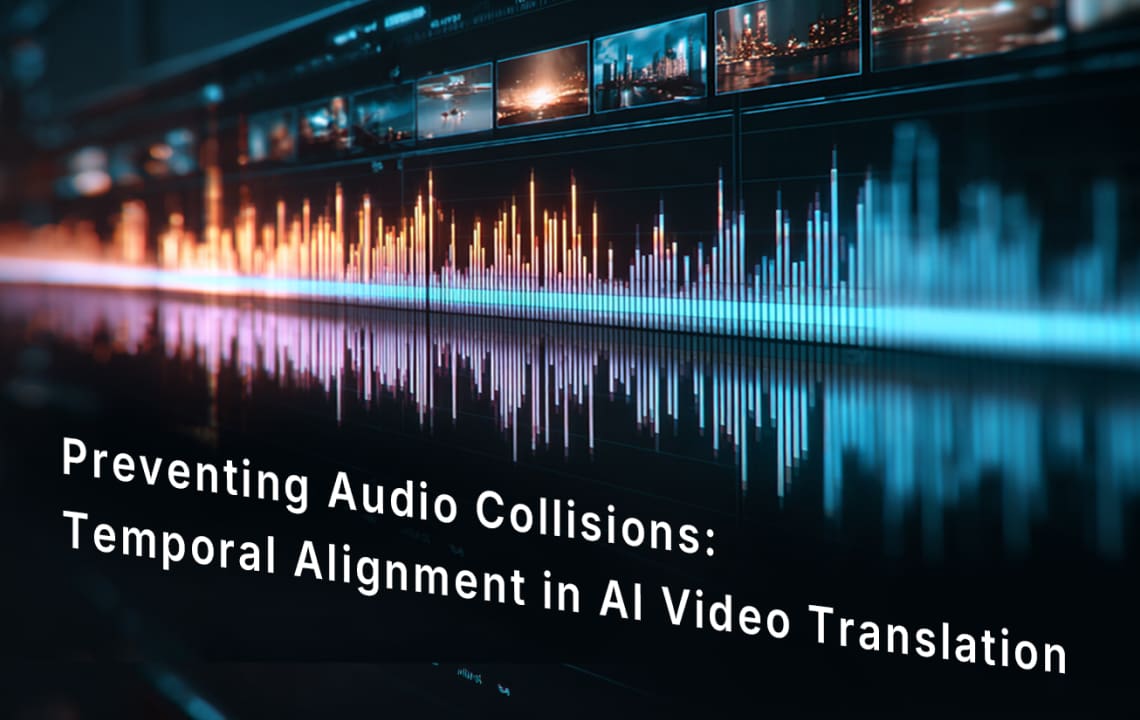
When people talk about AI video translation, many assume the main challenges are simply audio source separation (removing the original speech) and text translation. In reality, what makes a dubbed video feel natural and cinematic lies in a far more overlooked dimension: reshaping the timeline across languages and managing conflicts with background music and sound effects.
When a concise English sentence is translated into German or Chinese, its duration almost inevitably changes. To make the new dubbing match the speaker’s lip movements or on-screen actions, the system often has to speed up or slow down the audio to some extent. But once this kind of adaptive time-stretching is applied, a critical side effect appears: the actual landing points of the new voice begin to drift -- A line may finish too early or spill into the next shot.
If we still rely on traditional audio ducking at that point—simply turning down the background whenever speech is detected—the newly generated voice is very likely to collide with a music climax intentionally placed by the director, or with key explosions and environmental sound effects. That can completely disrupt the audiovisual rhythm of the original work.
So how does VMEG’s AI video localization workflow resolve this tension?
Step 1: More than separation — a “timeline report”
To preserve the atmosphere of the original video, intuitively, the first step is to use deep learning models for source separation, splitting intelligible speech from music and sound effects into multiple clean tracks. But a sophisticated pipeline does not stop at separation alone.
At the same time, the system performs a full “timeline checkup” on the audio:
- Voice Activity Detection (VAD): identifies which regions contain speech and which are truly silent.
- Alignment-style algorithms (similar in spirit to forced alignment): estimate the start and end time of each small speech segment, down to the phoneme or syllable level.
- Non-speech segment detection: marks regions occupied by music, sound effects, and other non-speech content—segments that should not be arbitrarily stretched, but must still be respected on the timeline.
- Rhythmic anchor detection: detects abrupt changes in background energy and extracts key rhythmic landmarks such as bass hits and music entry/exit points.
If the original soundtrack is just “sound,” then the output of this step is really a high-precision structural report of the timeline:
- when someone is speaking, and for how long;
- when the director intentionally leaves space for the music to speak;
- and which moments are sound-design “danger zones” that must be respected.
Step 2: Adaptive time-stretching based on speech-rate ratio
Once the AI dubbing in the target language is generated, the first question is not “how do we stretch the whole track?” but rather: compared with the original, is this new speech too fast or too slow? The key is not simply comparing total duration. Instead, the system needs to build a relatively reasonable notion of speech-rate ratio based on the characteristics of each language:
- For some languages, character count is a good approximation of speaking rate.
- For others, word count is a better measure.
- And for languages without explicit word boundaries, dedicated adaptation and approximation strategies are needed.
For each original utterance (from ASR) and its corresponding translation or dubbed line, the system estimates:
- how many “units” the source speech contains, and how long it took;
- how many “units” the dubbed target speech contains, and how long it takes.
- From that, it derives the actual speech rate of the source language, the actual speech rate of the target language, and a theoretically more comfortable target speech rate.
The purpose of this process is to produce a set of coefficients indicating how much each dubbed line should reasonably be sped up or slowed down. But there are two practical constraints:
- You cannot accelerate indefinitely: no matter how fast the speech becomes, the audience still needs time to understand it.
- You cannot slow it down indefinitely either: dragging it out too much breaks the visual rhythm and may even exceed the shot length.
So the system applies nonlinear compression and clipping to these speech-rate ratios. Extreme cases are handled gently and forced into a range that remains comfortable to the human ear while still respecting the pacing of the picture. Overall, the rhythm stays as faithful as possible to the original temporal envelope: leave space where the original leaves space, and stay tight where the original stays tight.
Put simply:
the speech can be a little faster or a little slower, but not absurdly so. Within the "temporal envelope" provided by the original video, the system re-typesets the rhythm of each speaker’s voice.
Step 3: Using alignment to carry over the director’s original mix
One point worth emphasizing is that in a workflow like this, we do not necessarily rebuild a complex real-time mixing system during localization. Instead, we rely more on timeline alignment to place the TTS output back into the original picture-and-audio structure as precisely as possible, so the director’s original mixing intent can be inherited.
You can think of this stage as three layers of time mapping.
- From ASR to video: establishing the temporal reference of who speaks when
Based on the earlier timeline analysis, the system already knows:
- where each original line begins and ends on the video timeline;
- how long the silent gaps are between lines;
- which regions are occupied by music, ambience, or pure sound effects.
At its core, this step builds a precise mapping between the speech track and the visual track.
- From ASR to TTS: transferring duration and rhythmic constraints to the new voice
After the speech-rate ratios are computed in Step 2, the system selects an appropriate overall speed adjustment for each speaker, or for a group of consecutive lines, while keeping the result comfortable to listen to. It then lays out the TTS audio inside the corresponding time slots:
- ensuring the new dubbing finishes within the time window originally reserved for that dialogue;
- preserving necessary pauses and moments of silence;
- avoiding excessive overflow or over-compression.
As a result, the original alignment between ASR and video is effectively transferred into a new alignment between TTS and video.
- Preserving the original mix indirectly through temporal consistency
Once the TTS is aligned back to the original speech positions on the timeline, there is no longer a strong need to explicitly remix the entire background track:
- areas where the original soundtrack already left room for dialogue will still be occupied by the new dubbed speech;
- gaps and impact points originally reserved for music or ambient effects will mostly remain unobstructed;
- and the background music and effects can largely preserve their original temporal distribution and relative loudness design.
In other words, rather than actively “telling” the music and sound effects when to rise or fall, we use precise temporal alignment so that the new dubbing naturally steps into the rhythmic slots that the director originally left for speech.
The real mixing decisions still primarily come from the original production. We are simply reproducing them faithfully in another language through alignment and time-stretching.
From “machine-translated” to “professionally dubbed”
In video localization, translating the literal meaning is only the foundation. Preserving emotional resonance is the real next level.
A truly mature AI video translation workflow usually does not boast about how many large models it uses. Instead, it quietly focuses on three tasks that may sound more like engineering than magic:
- accurately understanding the temporal structure and emotional rhythm of the original audio;
- carefully modeling speech rate and reorganizing the timeline across languages;
- and, on that basis, transferring the director’s original mixing intent through alignment, rather than relying on crude volume ducking.
That is the real challenge in turning something that feels “machine translated” into something that feels like a professionally dubbed production that VMEG has resolved. The hard part is not whether a system can generate a voice. The hard part is whether it can make that voice sound as if it belonged to the film all along—breathing at exactly the right moments.

Dingyi
Behind VMEG stands a passionate team of creatives, engineers, and language lovers. At the crossroads of AI and storytelling, they craft tools that bridge languages and cultures.