

'%3e%3cpath%20d='M21.0949%203.79395L13.9961%209.82854H21.0949V3.79395Z'%20stroke='black'%20stroke-width='1.38'%20stroke-miterlimit='10'/%3e%3cpath%20d='M13.998%209.82854L7.44531%203.79395V9.82854H13.998Z'%20stroke='black'%20stroke-width='1.38'%20stroke-miterlimit='10'/%3e%3cpath%20d='M13.9961%202.69922V25.1919'%20stroke='black'%20stroke-width='1.38'%20stroke-miterlimit='10'/%3e%3cpath%20d='M20.5488%2016.4113L13.9961%209.82812V18.2217L20.5488%2024.0918V16.4113Z'%20stroke='black'%20stroke-width='1.38'%20stroke-miterlimit='10'/%3e%3cpath%20d='M7.44531%2016.4113L13.998%209.82812V18.0526L7.44531%2024.0918V16.4113Z'%20stroke='black'%20stroke-width='1.38'%20stroke-miterlimit='10'/%3e%3cpath%20d='M4.71094%209.82812V18.6057H7.44125V16.4113L13.9941%209.82812H4.71094Z'%20stroke='black'%20stroke-width='1.38'%20stroke-miterlimit='10'/%3e%3cpath%20d='M13.9961%209.82812L20.5488%2016.4113V18.6057H23.2792V9.82812H13.9961Z'%20stroke='black'%20stroke-width='1.38'%20stroke-miterlimit='10'/%3e%3c/g%3e%3c/svg%3e)

'%3e%3cmask%20id='mask0_21456_29260'%20style='mask-type:luminance'%20maskUnits='userSpaceOnUse'%20x='0'%20y='0'%20width='28'%20height='28'%3e%3cpath%20d='M27.5%200.5H0.5V27.5H27.5V0.5Z'%20fill='white'/%3e%3c/mask%3e%3cg%20mask='url(%23mask0_21456_29260)'%3e%3cpath%20d='M14%2027.5C13.4854%2024.1035%2011.8974%2020.9608%209.46828%2018.5317C7.03922%2016.1026%203.89651%2014.5146%200.5%2014C3.89651%2013.4854%207.03922%2011.8974%209.46828%209.46828C11.8974%207.03922%2013.4854%203.89651%2014%200.5C14.5147%203.89644%2016.1028%207.03905%2018.5318%209.46816C20.9609%2011.8972%2024.1035%2013.4853%2027.5%2014C24.1035%2014.5147%2020.9609%2016.1028%2018.5318%2018.5318C16.1028%2020.9609%2014.5147%2024.1035%2014%2027.5Z'%20fill='url(%23paint0_linear_21456_29260)'/%3e%3c/g%3e%3c/g%3e%3cdefs%3e%3clinearGradient%20id='paint0_linear_21456_29260'%20x1='9.5'%20y1='9.5'%20x2='20.75'%20y2='21.875'%20gradientUnits='userSpaceOnUse'%3e%3cstop%20stop-color='%23F0DCD6'/%3e%3cstop%20offset='0.914506'%20stop-color='%231D6DFF'/%3e%3c/linearGradient%3e%3cclipPath%20id='clip0_21456_29260'%3e%3crect%20width='28'%20height='28'%20fill='white'/%3e%3c/clipPath%3e%3c/defs%3e%3c/svg%3e)
'%3e%3cpath%20d='M22.8019%2011.2412L23.5234%2011.6807V12.0103L23.3172%2012.7796L14.5579%2014.9771L13.7344%2012.7951L22.8019%2011.2412Z'%20fill='%23D97757'/%3e%3cpath%20d='M19.5236%204.77832L20.5322%205.00396L20.8%205.35575L21.0552%206.19876L20.9494%206.73644L15.0712%2015.3068L13.1133%2013.2191L18.5338%205.63471L19.5236%204.77832Z'%20fill='%23D97757'/%3e%3cpath%20d='M14.4577%203.43951L15.0761%203L15.5912%203.21976L16.1065%203.9889L14.6949%2013.0345L13.7364%2012.3397L13.3242%2011.131L14.0456%204.31853L14.4577%203.43951Z'%20fill='%23D97757'/%3e%3cpath%20d='M7.84766%203.5851L8.48285%202.7199L8.89716%202.61914L9.71923%202.74717L10.125%203.08581L13.0815%2010.0748L14.1509%2013.3954L12.8997%2014.1372L8.13117%204.91019L7.84766%203.5851Z'%20fill='%23D97757'/%3e%3cpath%20d='M4.77232%208.38688L4.56641%207.50742L5.18478%206.73828L5.90613%206.84816H6.11223L10.4403%2010.2544L11.78%2011.3531L13.6349%2012.8914L12.6044%2014.7594L11.6769%2013.9903L11.0586%2013.331L5.08168%208.82593L4.77232%208.38688Z'%20fill='%23D97757'/%3e%3cpath%20d='M3.53288%2014.0982L3.06641%2013.5489L3.06647%2013.0601L3.53288%2012.8896L8.78833%2013.2193L13.9408%2013.6588L13.7736%2014.7528L3.94502%2014.2082L3.53288%2014.0982Z'%20fill='%23D97757'/%3e%3cpath%20d='M6.62378%2019.8178H5.59334L5.18359%2019.3146V18.7132L6.93299%2017.3946L14.045%2012.5674L14.7648%2013.8785L6.62378%2019.8178Z'%20fill='%23D97757'/%3e%3cpath%20d='M8.57739%2022.8884L8.16518%2022.9984L7.54688%2022.6687L7.64995%2022.1193L13.7299%2013.5488L14.5543%2014.7574L10.0201%2021.1305L8.57739%2022.8884Z'%20fill='%23D97757'/%3e%3cpath%20d='M13.7361%2023.9861L13.4271%2024.4257L12.8088%2024.6454L12.2935%2024.2058L11.9844%2023.5466L13.5301%2014.6465L14.4576%2014.7563L13.7361%2023.9861Z'%20fill='%23D97757'/%3e%3cpath%20d='M18.9869%2021.5713V22.4503L18.8838%2022.7799L18.4716%2022.9997L17.7503%2022.8974L12.7969%2015.0367L14.7617%2013.4404L16.4104%2016.6269L16.5652%2017.7805L18.9869%2021.5713Z'%20fill='%23D97757'/%3e%3cpath%20d='M21.3629%2020.2507L21.4659%2020.8L21.1568%2021.2396L20.8476%2021.1297L19.0958%2019.8112L16.4165%2017.284L14.3555%2015.7457L14.9736%2013.6582L16.0041%2014.3175L16.6226%2015.5259L21.3629%2020.2507Z'%20fill='%23D97757'/%3e%3cpath%20d='M20.0232%2014.6482L22.5995%2014.8679L23.2178%2015.3074L23.6299%2015.9667V16.441L22.4964%2016.9556L16.7256%2015.4173L14.3555%2015.3074L14.9737%2013L16.6226%2014.3185L20.0232%2014.6482Z'%20fill='%23D97757'/%3e%3c/g%3e%3c/svg%3e)
Key Takeaways
- The core types of AI agents are simple reflex agents, model-based reflex agents, goal-based agents, utility-based agents, and learning agents. There are still other types of AI agents, such as hierarchical agents, multi-agent systems, and reactive agents.
- The role of AI agents in 2026 and beyond varies depending on their purpose and other factors. Some of its roles include automating tasks, providing customer support, serving as a personal assistant, supporting business decisions, and localizing video content.
- Using AI agents provides various benefits, such as automating repetitive tasks, increasing productivity, enabling 24/7 availability, improving decision-making, reducing costs, personalizing experiences, and enhancing the user experience.
- There are also challenges in designing and using AI agents, including data privacy, accuracy, ethics, feelings and emotions, unpredictability, and technical requirements.
- VMEG AI is one platform that offers an AI Agent. It offers an AI video localization agent ideal for those who localize video content.
AI agents play an important role in speeding up workflows. There are different types of AI agents, from simple reflex agents to learning agents. In this post, we’ll discuss types of AI agents and their role in 2026.
What is an AI Agent?
An AI agent is a software system or program designed to carry out complex tasks. It comprises models, tools, frameworks, and workflows. It can collect data, interact with its environment, perform tasks according to its design, and achieve the set goal.
Humans set the tasks to be done or the goals to be achieved. The AI agent can act independently, but its level of autonomy may vary. It can choose the best course of action for a given task and meet the desired goals.
Components of AI Agents
The components of AI agents may vary depending on the system's design and purpose. The concept of AI Agents is perception, decision, and action.
Here are some of the components of AI Agents:
Perception
- The agent interprets and understands the sources, then polishes, processes, and structures them, and employs AI-based solutions.
- The sources or inputs depend on the agent’s purpose and can come from data feeds, sensors, and other sources.
- Example: A chatbot reads user input.
- Purpose: Its purpose is to convert the raw data into usable information. The agent must accurately perceive the data to make good decisions and achieve its goals.
Decision Making / Reasoning
- This is known as the brain of an AI Agent, which reacts to its environment.
- It uses different algorithms, such as rules, planning, reinforcement learning, and large language models, depending on the purpose and AI complexity.
- It evaluates the current state, goals, and possible actions.
Action
- This is where the AI Agent interacts with its environment by performing actions.
- Examples: A robot moves its arms, and a trading agent buys or sells stocks.
- Purpose: Execute its decisions in the real world or digital environment.
Learning
- This is where the agent learns from its past experiences, such as patterns, predictions, and decisions based on feedback.
- The agent adapts to the environment using data.
- Learning techniques: Supervised learning, unsupervised learning, reinforcement learning, and online learning.
Other Components of AI Agents
Planning
- The agent plans a series of actions before implementing them.
- It includes breaking complex goals into steps or strategies.
- Example: Multi-step problem solving
Memory
- It allows the agent to remember data and information.
- Stores information for short-term and long-term use.
- Types
- Short-term memory (conversation context)
- Long-term memory (knowledge base)
Communication
- It allows AI agents to interact with humans, other agents, systems, or tools.
- Examples: multi-agent collaboration
AI Agents vs. AI Assistants vs. Bots
AI agents, AI assistants, and bots automate tasks, interact with users, use AI or automation, are designed to achieve goals, integrate with digital systems, and improve user experience.
Feature | AI Agents | AI Assistant | Bots |
Definition | Autonomous AI systems that can plan, decide, and execute tasks to achieve goals | AI systems that help users perform tasks through conversation or commands | Simple automated programs that respond to predefined inputs |
Autonomy | High | Moderate | Very Low |
Decision-making | Goal-driven planning and decision-making | Some reasoning with AI models | Rule-based or scripted |
Interaction style | May act independently with minimal user input | Conversational and interactive | Usually command or menu-based |
Learning ability | Often adaptive and can improve strategies | Often uses machine learning | Usually, none or minimal |
Task complexity | Complex multi-step workflows | Multi-step tasks with user guidance | Simple repetitive tasks |
Example Workflow | Example Goal: Create a marketing report. Example Agent Workflow: Search for market data. Analyze trends Generate charts Write report Send it to the user | User: Remind me to call John tomorrow at 9 AM. Assistant: Reminder set for tomorrow at 9 AM. | User: What are your business hours? Bot: We are open from 9 AM to 5 PM. |
Real-World Examples of AI Agents
Autonomous Vehicles
AI agents that drive cars, trucks, or drones by detecting objects, planning routes, and controlling the environment.
Research and Information Agents
Agents that search for information, analyze data, summarize findings, and produce reports with minimal human input.
Smart Home Control Agents
Agents that automatically adjust lighting, control temperature, and manage appliances based on the user behavior or environmental conditions.
Warehouse Management Robots
Robotic agents that move inventory, sort packages, and optimize storage locations. They coordinate with other robots to complete logistics tasks.
Personal Task Agents
Agents that help manage personal productivity by scheduling meetings, organizing emails, and planning tasks.
Why Understanding Types of AI Agents Matters
It is important to understand the types of AI Agents to design, choose, and use AI systems effectively and efficiently.
- Helps Choose the Right AI for a Task
Each AI agent is designed for a different purpose, so their levels of complexity vary. Understanding its types is important to ensure developers and organizations choose the most suitable AI system for a specific problem.
- Improves System Design and Development
Knowing the types of AI agents helps developers design better AI systems. Each type has different structures, capabilities, and limitations. It helps developers choose the right algorithms, design appropriate architectures, and build more effective and efficient solutions.
- Increases Efficiency and Performance
The system becomes more efficient and performs better when the right type of AI agent is used. With the right AI agent, the system can make better decisions, perform tasks more effectively, and reduce errors. With this, the overall performance and productivity will improve.
- Supports Innovation and Future Development
Innovation and development play an important role in enabling researchers and developers to develop more advanced AI technologies. It encourages improved automation, new applications, and smarter systems across various fields.
Core Types of AI Agents
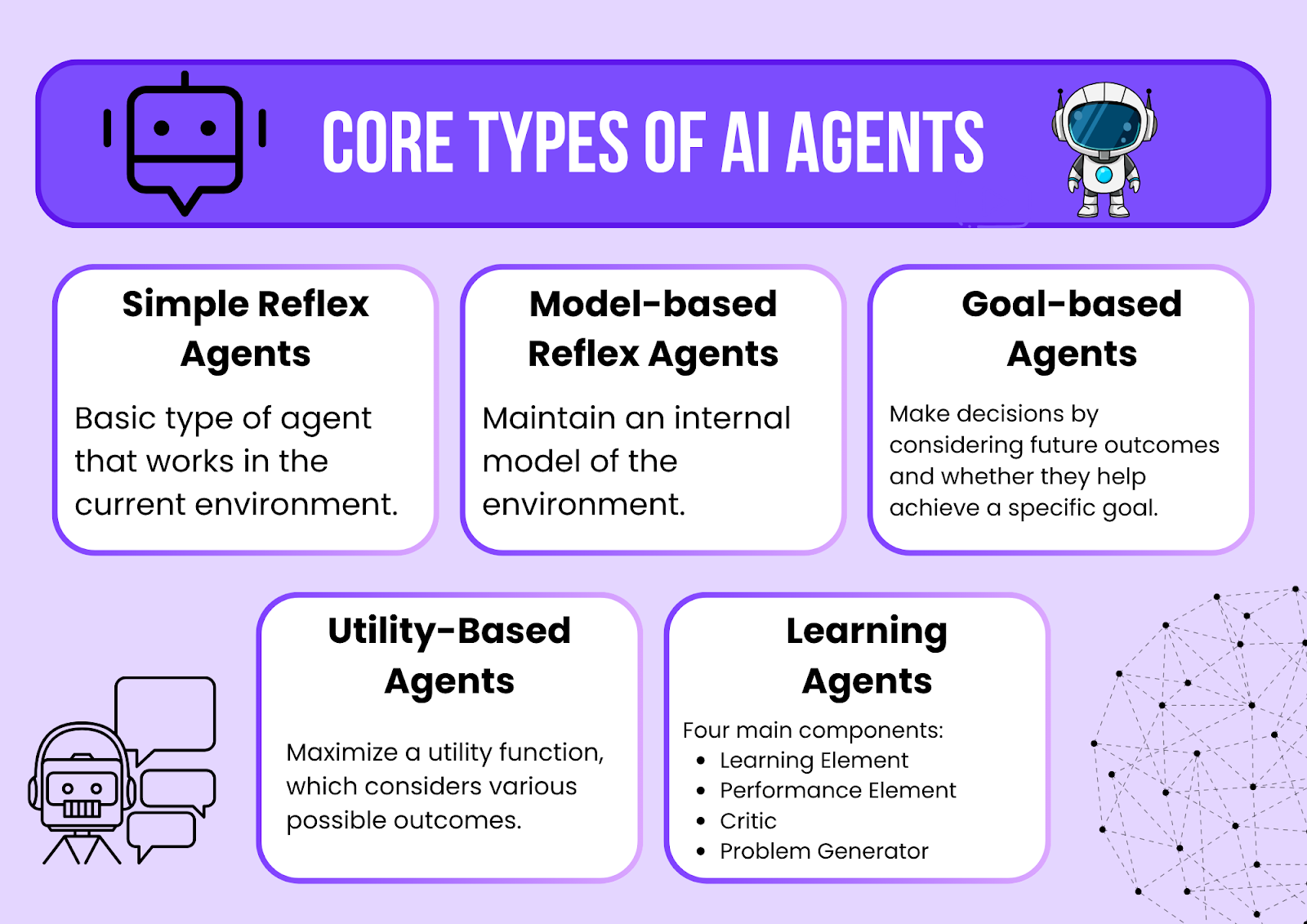
The types of AI agents vary depending on function, purpose, and other factors. Here are some of the main types of AI Agents:
Simple Reflex Agents
A simple reflex agent is a basic type of agent that works in the current environment. It cannot store past experiences. It uses predefined rules in deciding what to do.
- They do not store past information.
- The decisions are based on the current situation.
- It suits best in a fully observable environment.
Example:
A thermostat that turns on the heater if the temperature drops below a certain level.
Limitations:
- Cannot learn from past experiences.
- Can make some mistakes if the scenario is beyond the predefined rules.
Model-based Reflex Agents
Model-based reflex agents maintain an internal model of the environment. This internal model and the ability to learn from past experiences help them to make better decisions. This allows them to track aspects of the world that are not directly observable.
- Update an internal state that represents the environment.
- Use this internal model to make better decisions.
Example:
A robot vacuum that remembers which areas of the room have already been cleaned.
Advantages
- Works in partially observable environments.
- Can reason about internal aspects of the environment.
Goal-based Agents
Goal-based agents make decisions by considering future outcomes and whether they help achieve a specific goal. They plan and reason to choose the best actions to achieve the goal or objectives.
- They evaluate actions based on how they move the system closer to a goal.
- Often use search and planning algorithms.
Example:
A navigation system that finds the shortest or best route to a destination.
Advantages
- More flexible than reflex agents.
- Can evaluate multiple possible actions.
Utility-Based Agents
Utility-based agents not only aim to achieve goals but also to maximize a utility function, which considers various possible outcomes.
- The utility function measures the desirability of a particular outcome.
- Useful in situations involving trade-offs and uncertainty.
Example:
A ride-sharing algorithm that balances shortest travel time, fuel cost, and driver availability.
Advantages:
- Can handle complex decision-making.
- Chooses the most beneficial outcome based on utility.
Learning Agents
Learning agents can improve their performance over time by learning from experience and adapting to new data. It learns from environmental feedback to improve performance and make better decisions.
They typically consist of four main components:
- Learning Element – It helps enhance the agent’s knowledge by learning from experiences and feedback.
- Performance Element – Chooses actions.
- Critic – Evaluates the agent’s performance.
- Problem Generator – Suggests actions that lead to new learning opportunities.
Example:
Recommendation systems that improve suggestions based on user behavior.
Advantages
- Can adapt to new environments.
- Performance improves with experience and data.
Other Types of AI Agents
Hierarchical Agents
Hierarchical agents organize decision-making into multiple levels of control.
- Higher levels handle strategic planning and break down complex tasks into smaller tasks.
- Lower levels manage specific actions or the smaller tasks created by higher-level agents.
Example:
A self-driving car system where:
High level: route planning
Mid-level: lane changes
Low level: steering and braking
Advantages:
- Simplifies complex decision-making.
- Allows modular design.
Multi-agent Systems
Multi-agent systems consist of multiple agents interacting within a shared environment.
These agents may:
- Cooperate
- Compete
- Coordinate tasks
Examples
- Autonomous delivery drones coordinating routes.
- Online trading bots interacting in financial markets.
Advantages
- Can solve large, distributed problems.
- Enables collaboration and scalability.
Roles of AI Agents in 2026
AI agents play an important role across different industries and activities, depending on their design and purpose. Here are some of the roles of AI Agents in 2026:
- Automate tasks. They handle tasks that can be automated or repetitive, allowing humans to focus more on high-value activities.
- Customer support. AI Agents can handle tasks, such as customer concerns or inquiries, make decisions, and escalate tasks to humans.
- Personal assistants. AI agents can help save time and resources by handling other tasks, allowing humans to focus on more important tasks and be more productive.
- Business decision support. Businesses can benefit from AI agents, which can automate tasks, make better decisions, and develop strategies to help achieve their goals.
- Localizing video content. Today, video is one of the most popular media used by individuals and businesses for a variety of purposes, including content creation, promotional videos, and more. With an AI Agent designed for video localization, you will be able to create content faster and more effectively.
How Do AI Agents Work?
AI agents work differently and have different processes because they were built for different purposes, so the systems that govern their operation vary.
- Perceive. AI agents gather data from different sources and inputs.
- Understanding and Reason. Based on the available data and inputs, the AI Agent will evaluate possible solutions and interpret the requests.
- Planning. The AI agent plans the tasks to be performed to achieve the goals.
- Tools. The AI agent uses available tools to complete tasks.
- Action. It executes its decision.
- Memory. The AI agent can have short-term or long-term memory, which helps it learn from past experiences and store information to create personalized responses and improve decision-making.
- Learning and Improvement. It helps agents to learn from past interactions, optimize strategies, and update models.
Benefits of Using AI Agents
AI agents provide many benefits to individuals and businesses. They can automate work, increase efficiency, improve decision-making, and more.
- Automation of Repetitive Tasks. AI agents are beneficial in automating repetitive tasks, so you don’t have to do things repeatedly. It will help them to focus more on strategic and creative tasks.
- Increased Productivity. Agents can complete tasks faster and manage multiple tasks simultaneously. With AI agents, workflows will be faster, delays reduced, and operational efficiency improved.
- 24/7 Availability. AI agents can perform tasks continuously and remain reliable as long as the factors they require are functioning properly.
- Improve Decision-Making. AI agents can provide insights and analyze large amounts of data. This can help individuals make better decisions that lead to better results.
- Cost Reduction. Using AI agents can reduce operational costs, but it still depends on their nature and complexity. It can make operations more scalable by minimizing errors and improving efficiency.
- Personalization. AI agents can provide personalized services and solutions to meet diverse needs. It analyzes user preferences and behavior to provide solutions tailored to their goals.
- Better User Experience. AI agents can provide faster responses and seamless interactions, delivering a better overall user experience.
Challenges With Designing and Using AI Agents
AI agents are helpful, as they provide various benefits, but they also face some challenges.
- Data privacy. Privacy must be our top priority to protect important information, as others can use it for various activities. It is important to design an AI agent carefully to avoid privacy or data leakage issues.
- Accuracy and Ethics. AI agents' responses can be inaccurate. To ensure accuracy and ethical compliance, there must be a strong, reliable system with a human-in-the-loop feature.
- Feelings and Emotions. Some AI agents struggle with tasks or goals where feelings and emotions play an important role. It may lack emotional intelligence, which can affect decisions and outputs.
- Unpredictability. Unpredictable events may occur in the AI environment and affect the overall performance of AI agents.
- Technical Requirements. Designing and using an AI agent can be challenging, and there may be many trial-and-error steps to test whether the system will work well. The developers must have the knowledge, skills, and experience to create something that delivers a good result.
VMEG AI: A Task-Specific AI Video Localization Agent
According to the predictions of Gartner (2025), task-specific AI agents will be incorporated into 40% of enterprise applications by 2026.
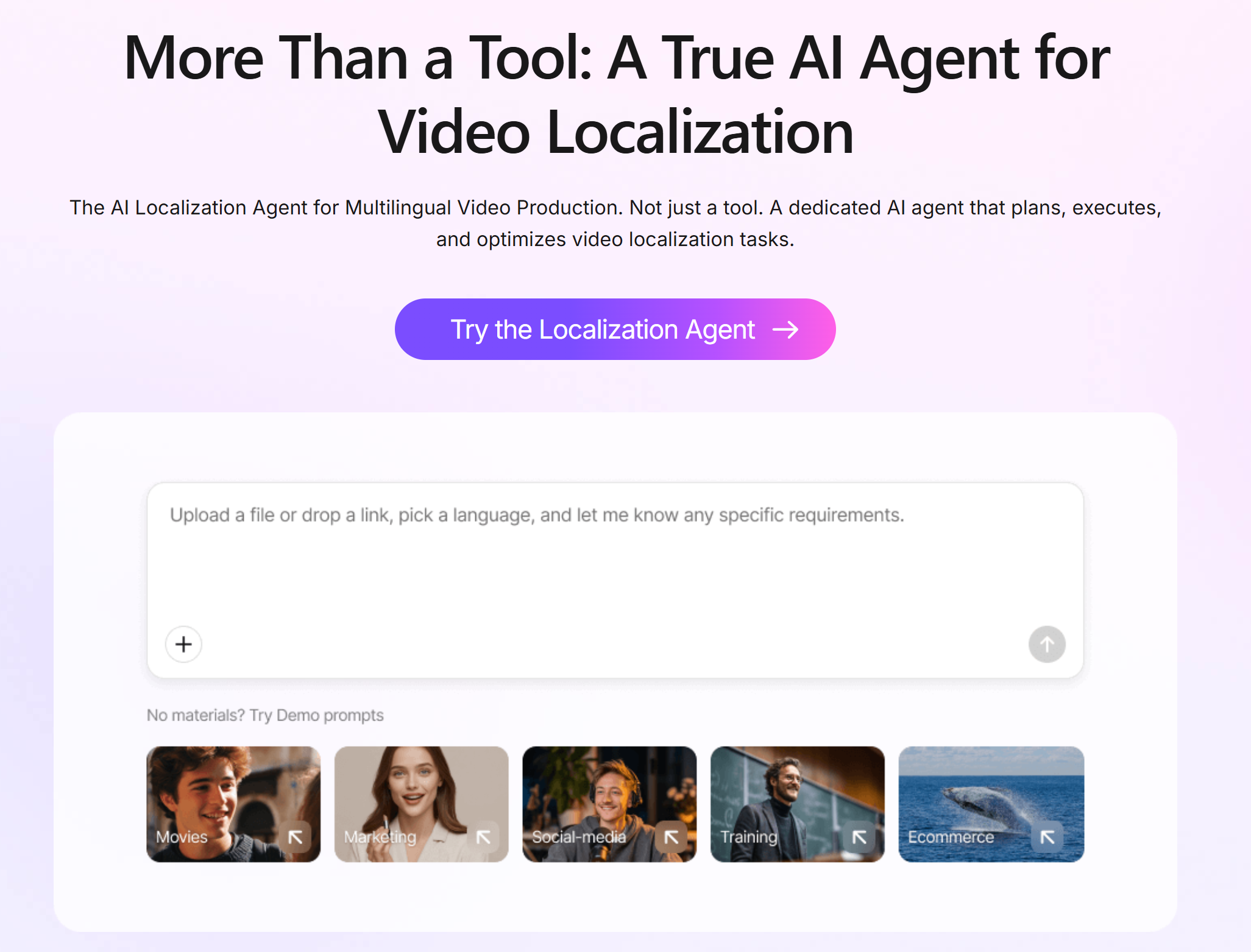
Video localization is one of the factors that help bring content to your target audience and make it accessible to a wider audience. If you are creating videos, such as social media content, training videos, learning materials, or product presentations for a multilingual audience, you need an AI agent for video localization like VMEG AI.
Who Should Use VMEG AI?
- Businesses. Businesses should use VMEG AI, especially when creating video content for an international audience. It will help them to produce videos faster and reach a larger target audience.
- Educators. Education is now beyond borders. If you are an educator creating courses and learning modules for students from around the world, having a localization agent will help you save time.
- Individuals from different industries. Whether you are a social media creator or creating a video for a project, you can use VMEG AI to localize content smoothly.
Benefits of Using VMEG AI Video Localization Agent
Here are some of the benefits of using the VMEG AI video localization agent:
- Faster Delivery. With VMEG AI, individuals and businesses can localize videos faster, as it offers autonomous task execution.
- Contextual Awareness. VMEG AI can create not just accurate translations but also make contextually aware decisions, which helps preserve intonation and cultural context.
- Human-in-the-loop Feature. It provides a human-in-the-loop feature alongside its autonomous workflow, helping create high-quality content by ensuring it aligns with the brand and message.
- Large-scale batch production. This helps users be more productive by saving time and reducing costs. With this, production will be more effective and efficient.
FAQs
What are the 5 main types of AI agents?
The 5 main types of AI agents are simple reflex agents, model-based reflex agents, goal-based reflex agents, utility-based agents, and learning agents.
What are the risks or challenges of using AI agents?
The risks or challenges of using AI agents are data privacy, accuracy and ethics, feelings and emotions, unpredictability, and technical requirements.
When not to use an AI agent?
An AI agent must not be used when the risk of mistakes is high, full control is required, data privacy is sensitive, and environmental changes are unpredictable.
Do we really need an AI agent?
The need for an AI agent depends on your tasks, preferred workflow, risks, and output. For example, if you are a content creator with an international audience, you might need a tool such as VMEG AI that includes an AI Video Localization Agent.
What is a simple example of an AI agent?
A simple example of an AI agent is a personal task agent that helps the user be more productive. Another example of a tool with an AI agent feature is VMEG AI, which localizes video using an AI Agent.
Conclusion
AI agents are among the features that will play an important role in performing tasks and achieving goals. It provides various benefits, such as increased productivity and reduced costs.
One tool that provides AI agent features is VMEG AI. It offers an AI agent for video localization, ideal for those who localize video content. If you create videos, whether for personal or business use, VMEG AI’s video localization agent is the perfect tool to be more productive.


The VMEG Team
Behind VMEG stands a passionate team of creatives, engineers, and language lovers. At the crossroads of AI and storytelling, they craft tools that bridge languages and cultures.