

'%3e%3cpath%20d='M21.0949%203.79395L13.9961%209.82854H21.0949V3.79395Z'%20stroke='black'%20stroke-width='1.38'%20stroke-miterlimit='10'/%3e%3cpath%20d='M13.998%209.82854L7.44531%203.79395V9.82854H13.998Z'%20stroke='black'%20stroke-width='1.38'%20stroke-miterlimit='10'/%3e%3cpath%20d='M13.9961%202.69922V25.1919'%20stroke='black'%20stroke-width='1.38'%20stroke-miterlimit='10'/%3e%3cpath%20d='M20.5488%2016.4113L13.9961%209.82812V18.2217L20.5488%2024.0918V16.4113Z'%20stroke='black'%20stroke-width='1.38'%20stroke-miterlimit='10'/%3e%3cpath%20d='M7.44531%2016.4113L13.998%209.82812V18.0526L7.44531%2024.0918V16.4113Z'%20stroke='black'%20stroke-width='1.38'%20stroke-miterlimit='10'/%3e%3cpath%20d='M4.71094%209.82812V18.6057H7.44125V16.4113L13.9941%209.82812H4.71094Z'%20stroke='black'%20stroke-width='1.38'%20stroke-miterlimit='10'/%3e%3cpath%20d='M13.9961%209.82812L20.5488%2016.4113V18.6057H23.2792V9.82812H13.9961Z'%20stroke='black'%20stroke-width='1.38'%20stroke-miterlimit='10'/%3e%3c/g%3e%3c/svg%3e)

'%3e%3cmask%20id='mask0_21456_29260'%20style='mask-type:luminance'%20maskUnits='userSpaceOnUse'%20x='0'%20y='0'%20width='28'%20height='28'%3e%3cpath%20d='M27.5%200.5H0.5V27.5H27.5V0.5Z'%20fill='white'/%3e%3c/mask%3e%3cg%20mask='url(%23mask0_21456_29260)'%3e%3cpath%20d='M14%2027.5C13.4854%2024.1035%2011.8974%2020.9608%209.46828%2018.5317C7.03922%2016.1026%203.89651%2014.5146%200.5%2014C3.89651%2013.4854%207.03922%2011.8974%209.46828%209.46828C11.8974%207.03922%2013.4854%203.89651%2014%200.5C14.5147%203.89644%2016.1028%207.03905%2018.5318%209.46816C20.9609%2011.8972%2024.1035%2013.4853%2027.5%2014C24.1035%2014.5147%2020.9609%2016.1028%2018.5318%2018.5318C16.1028%2020.9609%2014.5147%2024.1035%2014%2027.5Z'%20fill='url(%23paint0_linear_21456_29260)'/%3e%3c/g%3e%3c/g%3e%3cdefs%3e%3clinearGradient%20id='paint0_linear_21456_29260'%20x1='9.5'%20y1='9.5'%20x2='20.75'%20y2='21.875'%20gradientUnits='userSpaceOnUse'%3e%3cstop%20stop-color='%23F0DCD6'/%3e%3cstop%20offset='0.914506'%20stop-color='%231D6DFF'/%3e%3c/linearGradient%3e%3cclipPath%20id='clip0_21456_29260'%3e%3crect%20width='28'%20height='28'%20fill='white'/%3e%3c/clipPath%3e%3c/defs%3e%3c/svg%3e)
'%3e%3cpath%20d='M22.8019%2011.2412L23.5234%2011.6807V12.0103L23.3172%2012.7796L14.5579%2014.9771L13.7344%2012.7951L22.8019%2011.2412Z'%20fill='%23D97757'/%3e%3cpath%20d='M19.5236%204.77832L20.5322%205.00396L20.8%205.35575L21.0552%206.19876L20.9494%206.73644L15.0712%2015.3068L13.1133%2013.2191L18.5338%205.63471L19.5236%204.77832Z'%20fill='%23D97757'/%3e%3cpath%20d='M14.4577%203.43951L15.0761%203L15.5912%203.21976L16.1065%203.9889L14.6949%2013.0345L13.7364%2012.3397L13.3242%2011.131L14.0456%204.31853L14.4577%203.43951Z'%20fill='%23D97757'/%3e%3cpath%20d='M7.84766%203.5851L8.48285%202.7199L8.89716%202.61914L9.71923%202.74717L10.125%203.08581L13.0815%2010.0748L14.1509%2013.3954L12.8997%2014.1372L8.13117%204.91019L7.84766%203.5851Z'%20fill='%23D97757'/%3e%3cpath%20d='M4.77232%208.38688L4.56641%207.50742L5.18478%206.73828L5.90613%206.84816H6.11223L10.4403%2010.2544L11.78%2011.3531L13.6349%2012.8914L12.6044%2014.7594L11.6769%2013.9903L11.0586%2013.331L5.08168%208.82593L4.77232%208.38688Z'%20fill='%23D97757'/%3e%3cpath%20d='M3.53288%2014.0982L3.06641%2013.5489L3.06647%2013.0601L3.53288%2012.8896L8.78833%2013.2193L13.9408%2013.6588L13.7736%2014.7528L3.94502%2014.2082L3.53288%2014.0982Z'%20fill='%23D97757'/%3e%3cpath%20d='M6.62378%2019.8178H5.59334L5.18359%2019.3146V18.7132L6.93299%2017.3946L14.045%2012.5674L14.7648%2013.8785L6.62378%2019.8178Z'%20fill='%23D97757'/%3e%3cpath%20d='M8.57739%2022.8884L8.16518%2022.9984L7.54688%2022.6687L7.64995%2022.1193L13.7299%2013.5488L14.5543%2014.7574L10.0201%2021.1305L8.57739%2022.8884Z'%20fill='%23D97757'/%3e%3cpath%20d='M13.7361%2023.9861L13.4271%2024.4257L12.8088%2024.6454L12.2935%2024.2058L11.9844%2023.5466L13.5301%2014.6465L14.4576%2014.7563L13.7361%2023.9861Z'%20fill='%23D97757'/%3e%3cpath%20d='M18.9869%2021.5713V22.4503L18.8838%2022.7799L18.4716%2022.9997L17.7503%2022.8974L12.7969%2015.0367L14.7617%2013.4404L16.4104%2016.6269L16.5652%2017.7805L18.9869%2021.5713Z'%20fill='%23D97757'/%3e%3cpath%20d='M21.3629%2020.2507L21.4659%2020.8L21.1568%2021.2396L20.8476%2021.1297L19.0958%2019.8112L16.4165%2017.284L14.3555%2015.7457L14.9736%2013.6582L16.0041%2014.3175L16.6226%2015.5259L21.3629%2020.2507Z'%20fill='%23D97757'/%3e%3cpath%20d='M20.0232%2014.6482L22.5995%2014.8679L23.2178%2015.3074L23.6299%2015.9667V16.441L22.4964%2016.9556L16.7256%2015.4173L14.3555%2015.3074L14.9737%2013L16.6226%2014.3185L20.0232%2014.6482Z'%20fill='%23D97757'/%3e%3c/g%3e%3c/svg%3e)
Key Takeaways
- A documentary film presents real people, events, situations, or phenomena. Filmmakers may add creative storytelling, narration, visuals, interviews, sounds, and other elements to make it engaging.
- Some characteristics of a film documentary include non-fiction storytelling, research-driven narrative, an educational or informational purpose, use of real footage and interviews, and a narrative perspective or point of view.
- The purpose of documentary films is to educate audiences, preserve history, raise awareness about social issues, and investigate real-world events.
- Some elements of documentary films include subject or topic, purpose or message, real footage, interviews, point of view, story structure and editing, sound and narration, and visual style.
- VMEG AI is an ideal tool for documentary filmmakers looking to localize their films to reach a global audience. It supports more than 170 languages, 7000 voices, an AI agent for video localization, and more.
A documentary film is a non-fiction film. It shows real people, events, or situations. It is created for various purposes, such as raising awareness, educating the audience, and more. This glossary entry explains the definition, characteristics, types, purposes, elements, how it is made, how AI tools are changing documentary filmmaking, how documentary films reach global audiences, and why documentary films are important.
What Is a Film Documentary?
According to the Cambridge Dictionary, a documentary is a film, television, or radio program that focuses on real-life topics and factual content.
Britannica (2026) describes documentary film as a motion picture that uses factual content to inform or entertain by presenting and interpreting real events.
A documentary film depicts real-life events. It is done for various purposes, such as educating, entertaining, or informing the audience. It plays an important role in preserving history and educating people about facts. These documentaries can offer insight into various subjects and give audiences new perspectives they can apply in real life.
Examples of Documentary Films
There are many documentary films in different genres. Here are some examples of documentary films.
- March of the Penguins
March of the Penguins is based on the real-life journey of emperor penguins, with narration and editing that present the story in a more emotional and visually engaging way.
- Free Solo
Another example of a documentary film is Free Solo. It documents a real, dangerous climb as it actually happened. The editing and interviews enhance the drama, but don’t change the facts.
Key Characteristics of a Film Documentary
Here are some of the key characteristics of a film documentary:
Non-Fiction Storytelling
Documentary films are non-fiction. They show real people, events, or issues. Just like other stories, it is designed to be creative and engaging so that the audience can relate to it and the film can have an emotional impact.
Research-Driven Narrative
In-depth research is important to ensure the film is accurate. Filmmakers do various research activities using credible sources, such as expert opinions, archives, firsthand accounts, and interviews, to gather real and important information.
Educational or Informational Purpose
Documentary films are created for educational, informational, or awareness-raising purposes. After watching the film, whether it is science, history, or social issues, the filmmakers aim to let the audience gain new knowledge and insights.
Use of Real Footage and Interviews
Documentaries usually use real-life footage, photographs, and other recorded events. To provide multiple perspectives and make the film authentic, it includes interviews with experts, witnesses, and other individuals involved in the event.
Narrative Perspective or Point of View
The filmmakers’ perspectives shape the documentaries. Even if the film depicts real events, the choices in narration, editing, and structure influence how the story is interpreted, highlighting specific themes and viewpoints.
Main Types of Film Documentaries
Here are the main types of film documentaries:
Observational Documentary
Observational documentary, also known as “fly-on-the-wall,” captures reality as it unfolds. Filmmakers have little to no intervention. There are no narration or staged scenes, so the audience creates their own conclusion based on the events.
Expository Documentary
Expository documentaries are structured to inform or explain a topic directly. Extensive research is part of its process to ensure accuracy. It is usually supported by visuals, facts, and evidence to build a clear argument or perspective. Narrator or voice-over is used to guide the audience.
Participatory Documentary
In a participatory documentary, the filmmaker is part of the film. They actively engage with the subject or participants. They may appear on camera, interview subjects or participants, ask questions, or influence events, making their presence a visible part of the storytelling process.
Reflexive Documentary
These documentaries focus on the filmmaking process. It draws attention to how the documentary is made, encouraging viewers to think critically about the nature of truth, representation, and media construction.
Performative Documentary
In this type of documentary, filmmakers usually share their own perspectives or stories. It emphasizes personal experience and emotional connection.
Poetic Documentary
Poetic documentaries focus more on mood or emotions. To evoke feelings and impressions, artistic editing, music, and abstract sequences are used. Cinematography is more valued in this type of content than heavy information delivery.
The Purposes of Documentary Films
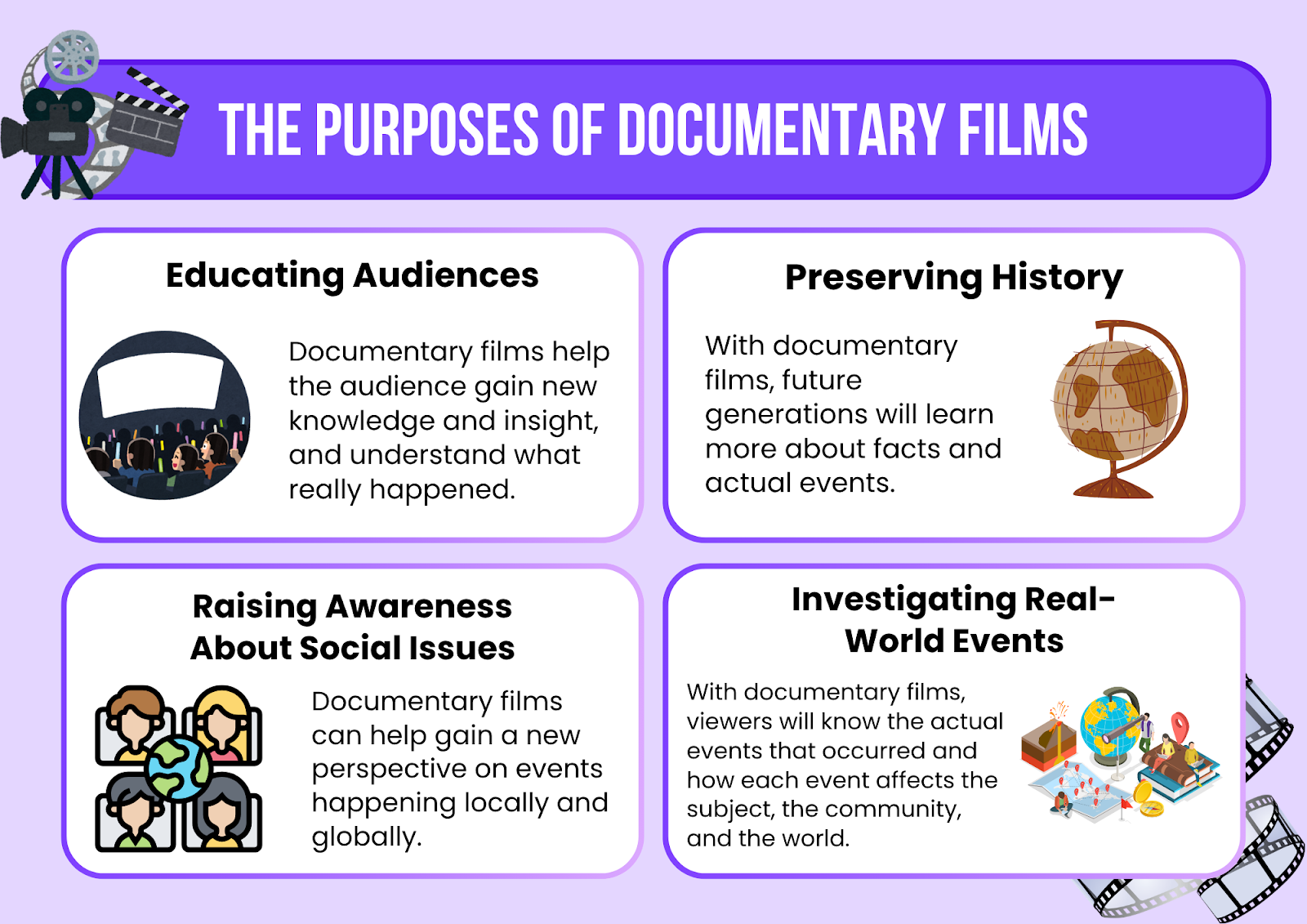
Each documentary film is created with a purpose, such as educating audiences, preserving history, raising awareness about social issues, and investigating real-world events.
Educating Audiences
One purpose of documentary films is to educate the audience about a topic or event. It helps the audience gain new knowledge and insight, and understand what really happened.
Preserving History
Another purpose of documentary films is to preserve history. With these films, future generations will learn more about facts and actual events. This is also about learning why things happened back then and what their impact was then and now.
Raising Awareness About Social Issues
It also helps raise awareness of social issues. This can help gain a new perspective on events happening locally and globally. It will help people to be aware of social issues happening around them and their impact on society at large. This will help viewers understand the changes and be more aware.
Investigating Real-World Events
Investigating real-world events is one of the purposes of documentary films. With these, viewers will know the actual events that occurred and how each event affects the subject, the community, and the world.
Elements of Documentary Film
Here are the elements of documentary film:
- Subject / Topic. The subject or topic shows what the film is all about, its category, and helps identify the right audience. It is also helpful in educational settings, so educators can determine whether it is suitable as a learning material for a given topic.
- Purpose / Message. The purpose of documentary film can be educational, historical preservation, raising awareness, and investigating real-world events. The message is the information that the film wants to convey to the audience.
- Real Footage (Actuality). It shows the actual footage to ensure its accuracy and reliability. In this way, the audience will see what actually happened, helping them know the truth.
- Interviews and Point of View. Interviews are conducted to gather diverse perspectives on a topic or event. Filmmakers can interview those who actually experienced the event, the witnesses, the experts, and other individuals who are involved and have expert knowledge that will help the audience learn more about the film’s subject.
- Story Structure and Editing. The film must be carefully structured to ensure that the series of events and other elements are in the correct sequence. It helps the audience know the cause and effect. Editing enhances the story by adding sounds, effects, and other elements that convey the film's message and make it more engaging.
- Sound and Narration. These are also important elements of a documentary film, as they evoke emotion and help the audience better understand the film. The sound must be well chosen and well-balanced to complement the scenes. The narration must be clear, and the way words are said matters, as it can affect the film.
- Visual Style. Visual style shows how the film looks on screen. It shapes how the audience perceives the story, the realism, and the documentary's mood. It includes lighting, color tone, composition, visual materials, and other elements that affect the visual style. It also helps in influencing emotional response.
How Documentary Films Are Made
In documentaries, filmmakers can arrange the sequence of events creatively depending on their perspective and storytelling style. However, it should stay true to the facts of the real events.
- Concept and Research
Filmmakers begin by developing a concept and conducting research about the topic or subject. They must understand the film's purpose and identify its target audience. Research is essential to ensure that the facts presented and narrated are accurate and reliable.
- Writing a Treatment or Proposal
Writing a treatment or proposal is an important step in making a documentary. It helps clarify the vision and encourages others to support the project. A treatment includes a detailed narrative description of the documentary, such as the title, logline, synopsis, structure, characters, visual style, tone, and theme. A proposal is used to pitch the project to funders, producers, or organizations. It typically includes a title page, an introduction, an overview, objectives, the target audience, the treatment, a production plan, a budget, a distribution plan, and a director’s statement.
- Planning and Pre-Production
Planning involves creating a step-by-step guide for the entire production process. This ensures proper organization and a clear sequence of ideas. Pre-production is the preparation stage, which includes casting, location scouting, scriptwriting and finalization, hiring crew members, creating storyboards, budgeting, scheduling, and preparing props, costumes, and other materials.
- Production (Filming / Shooting)
During this stage, filmmakers begin recording footage, including key scenes, real-life events, and other important moments of the story.
- Conducting Interviews
Interviews are an essential part of documentaries. People such as witnesses, experts, and individuals with relevant knowledge are interviewed. This helps strengthen the film's accuracy and credibility while providing deeper insights for the audience.
- Collecting Supporting Materials
This involves gathering materials that support the footage and interviews, such as photos, videos, and documents. These elements provide additional context and enhance the film's overall quality and authenticity.
- Editing
After filming, all footage and materials are compiled and organized. The editor arranges them into a clear and engaging sequence to effectively communicate the story and message. The narrator can also add voice-over narration at this stage. Nimdzi Insights (2019) defines voice-over in filmmaking as off-screen narration used in documentary productions and other audiovisual media.
- Sound Design and Music
Sound design and music are added to enhance the film's emotional impact. These elements must be carefully chosen to match the scenes and influence how the audience perceives the documentary.
- Review and Revisions
Filmmakers review the entire film to ensure clarity, accuracy, and consistency. Necessary revisions are made to improve visuals, sound, and overall presentation.
- Distribution and Release
Finally, the completed documentary is distributed and released through platforms such as cinemas, television, or online streaming services.
How AI Tools Like VMEG AI Are Changing Documentary Filmmaking
What Is VMEG AI?
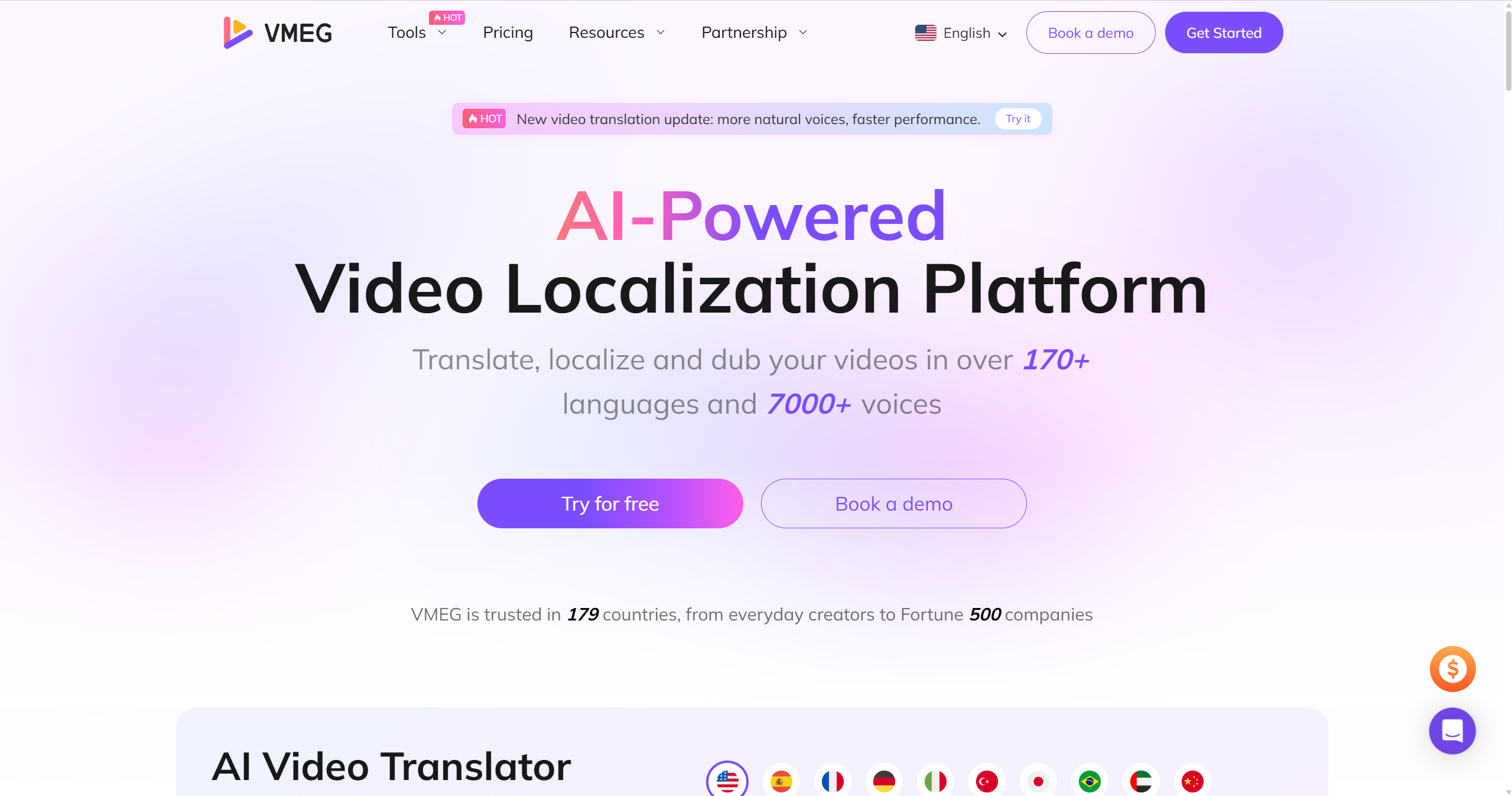
VMEG AI is an AI-powered localization tool that supports more than 170 languages. It also includes an AI Agent for video localization, which makes localization easier.
- It helps creators adapt video content for different languages and regions.
- It can automatically translate dialogue and adjust content to make it more accessible to global audiences.
How VMEG AI Helps Documentary Creators
VMEG AI supports documentary filmmakers by making their work easier to share across different countries and cultures.
VMEG AI can:
- Quickly create translations
- Reduce the time and cost of manual localization.
It is useful for documentaries aimed at international viewers, as it ensures language is not a barrier to understanding the content.
Why AI Matters for Documentary Distribution
AI tools like VMEG AI play an important role in expanding documentaries' reach.
By localizing content into multiple languages, filmmakers can distribute their work to wider audiences through global platforms.
It can:
- Increases accessibility
- Improves audience engagement
- Allows important stories to be understood by people from around the world.
How Documentary Films Reach Global Audiences
Streaming Platforms
Streaming platforms are among the most effective ways for documentaries to reach audiences worldwide. Various services, such as YouTube and other streaming platforms, allow filmmakers to distribute their work globally. Through these platforms, documentaries can reach a wider audience and gain popularity across different countries.
Film Festivals
Film festivals provide an important venue for showcasing documentaries to international audiences. Events like the Sundance and Cannes Film Festivals allow filmmakers to showcase their work, gain recognition, and connect with distributors. Being featured in or winning awards at film festivals can significantly increase a documentary’s visibility.
Educational Institutions
Schools, colleges, and universities use documentaries as learning tools. Educators often include documentary films in their curriculum to help students understand real-world issues, history, and culture. In this way, documentaries reach a wide audience of learners across different regions and contribute to education and awareness.
AI-Powered Localization Tools
AI-Powered localization tools, such as VMEG AI, help filmmakers localize their content by translating it into different languages. These tools can translate dialogues and subtitles and adapt content for local cultures. It helps documentaries become more accessible to people from various countries, increasing their global impact.
Why Documentary Films Are Important
Promoting Awareness and Social Change
Documentary films help promote awareness of important issues and events. They help audiences better understand real-world situations and can influence people’s thoughts, decisions, and actions. By presenting real-life stories, documentaries can encourage social awareness and inspire change.
Recording Real-World History
Documentaries play a vital role in recording and preserving real-world history. They capture events as they happen, helping future audiences understand past situations, cultures, and experiences. In this way, documentaries serve as a valuable resource for learning about historical topics and real-life developments.
Providing Educational Content
Documentary films provide educational content by helping audiences learn new information and gain deeper insights into various subjects. They are often used as learning tools in schools and other educational settings to explain complex topics in more engaging, understandable ways.
Giving Voice to Underrepresented Communities
Documentaries also give a voice to underrepresented and marginalized communities. They highlight the experiences, struggles, and perspectives of people who may not always be heard in mainstream media. This helps raise awareness, promote understanding, and can contribute to positive social impact.
FAQs
What is the definition of a documentary film?
A documentary film presents real-life people, events, or situations. It is created to document, observe, or explain real events, using actual footage, interviews, and narration.
What is the purpose of a documentary film?
The purpose of a documentary film is to educate audiences, preserve history, raise awareness about social issues, and investigate real-world events.
What are the types of documentary films?
The main types of documentary films are observational, expository, participatory, reflective, performative, and poetic.
What makes a documentary film good?
A good documentary film is accurate, well-structured, and engaging. It presents reliable information, tells a clear and compelling story, uses strong visuals and sound, and connects with the audience effectively while maintaining authenticity.
What qualifies a film as a documentary?
A film qualifies as a documentary if its goal or focus is to represent real people, events, situations, or phenomena. It should be grounded in reality, even if creative storytelling techniques are used. It must aim to document or interpret real-world subjects rather than fictional ones.
Conclusion
Documentary films are more than just the presentation of facts about a topic. They also help the audience gain a deeper perspective on the subject they present by combining creative storytelling with facts.
If you are a filmmaker creating documentaries and want to localize them to reach a global audience, you need a localization tool such as VMEG AI. VMEG AI is a platform that lets you localize your content, supporting more than 170 languages. It also includes an AI Agent for video localization, which speeds up the process.


The VMEG Team
Behind VMEG stands a passionate team of creatives, engineers, and language lovers. At the crossroads of AI and storytelling, they craft tools that bridge languages and cultures.