

'%3e%3cpath%20d='M21.0949%203.79395L13.9961%209.82854H21.0949V3.79395Z'%20stroke='black'%20stroke-width='1.38'%20stroke-miterlimit='10'/%3e%3cpath%20d='M13.998%209.82854L7.44531%203.79395V9.82854H13.998Z'%20stroke='black'%20stroke-width='1.38'%20stroke-miterlimit='10'/%3e%3cpath%20d='M13.9961%202.69922V25.1919'%20stroke='black'%20stroke-width='1.38'%20stroke-miterlimit='10'/%3e%3cpath%20d='M20.5488%2016.4113L13.9961%209.82812V18.2217L20.5488%2024.0918V16.4113Z'%20stroke='black'%20stroke-width='1.38'%20stroke-miterlimit='10'/%3e%3cpath%20d='M7.44531%2016.4113L13.998%209.82812V18.0526L7.44531%2024.0918V16.4113Z'%20stroke='black'%20stroke-width='1.38'%20stroke-miterlimit='10'/%3e%3cpath%20d='M4.71094%209.82812V18.6057H7.44125V16.4113L13.9941%209.82812H4.71094Z'%20stroke='black'%20stroke-width='1.38'%20stroke-miterlimit='10'/%3e%3cpath%20d='M13.9961%209.82812L20.5488%2016.4113V18.6057H23.2792V9.82812H13.9961Z'%20stroke='black'%20stroke-width='1.38'%20stroke-miterlimit='10'/%3e%3c/g%3e%3c/svg%3e)

'%3e%3cmask%20id='mask0_21456_29260'%20style='mask-type:luminance'%20maskUnits='userSpaceOnUse'%20x='0'%20y='0'%20width='28'%20height='28'%3e%3cpath%20d='M27.5%200.5H0.5V27.5H27.5V0.5Z'%20fill='white'/%3e%3c/mask%3e%3cg%20mask='url(%23mask0_21456_29260)'%3e%3cpath%20d='M14%2027.5C13.4854%2024.1035%2011.8974%2020.9608%209.46828%2018.5317C7.03922%2016.1026%203.89651%2014.5146%200.5%2014C3.89651%2013.4854%207.03922%2011.8974%209.46828%209.46828C11.8974%207.03922%2013.4854%203.89651%2014%200.5C14.5147%203.89644%2016.1028%207.03905%2018.5318%209.46816C20.9609%2011.8972%2024.1035%2013.4853%2027.5%2014C24.1035%2014.5147%2020.9609%2016.1028%2018.5318%2018.5318C16.1028%2020.9609%2014.5147%2024.1035%2014%2027.5Z'%20fill='url(%23paint0_linear_21456_29260)'/%3e%3c/g%3e%3c/g%3e%3cdefs%3e%3clinearGradient%20id='paint0_linear_21456_29260'%20x1='9.5'%20y1='9.5'%20x2='20.75'%20y2='21.875'%20gradientUnits='userSpaceOnUse'%3e%3cstop%20stop-color='%23F0DCD6'/%3e%3cstop%20offset='0.914506'%20stop-color='%231D6DFF'/%3e%3c/linearGradient%3e%3cclipPath%20id='clip0_21456_29260'%3e%3crect%20width='28'%20height='28'%20fill='white'/%3e%3c/clipPath%3e%3c/defs%3e%3c/svg%3e)
'%3e%3cpath%20d='M22.8019%2011.2412L23.5234%2011.6807V12.0103L23.3172%2012.7796L14.5579%2014.9771L13.7344%2012.7951L22.8019%2011.2412Z'%20fill='%23D97757'/%3e%3cpath%20d='M19.5236%204.77832L20.5322%205.00396L20.8%205.35575L21.0552%206.19876L20.9494%206.73644L15.0712%2015.3068L13.1133%2013.2191L18.5338%205.63471L19.5236%204.77832Z'%20fill='%23D97757'/%3e%3cpath%20d='M14.4577%203.43951L15.0761%203L15.5912%203.21976L16.1065%203.9889L14.6949%2013.0345L13.7364%2012.3397L13.3242%2011.131L14.0456%204.31853L14.4577%203.43951Z'%20fill='%23D97757'/%3e%3cpath%20d='M7.84766%203.5851L8.48285%202.7199L8.89716%202.61914L9.71923%202.74717L10.125%203.08581L13.0815%2010.0748L14.1509%2013.3954L12.8997%2014.1372L8.13117%204.91019L7.84766%203.5851Z'%20fill='%23D97757'/%3e%3cpath%20d='M4.77232%208.38688L4.56641%207.50742L5.18478%206.73828L5.90613%206.84816H6.11223L10.4403%2010.2544L11.78%2011.3531L13.6349%2012.8914L12.6044%2014.7594L11.6769%2013.9903L11.0586%2013.331L5.08168%208.82593L4.77232%208.38688Z'%20fill='%23D97757'/%3e%3cpath%20d='M3.53288%2014.0982L3.06641%2013.5489L3.06647%2013.0601L3.53288%2012.8896L8.78833%2013.2193L13.9408%2013.6588L13.7736%2014.7528L3.94502%2014.2082L3.53288%2014.0982Z'%20fill='%23D97757'/%3e%3cpath%20d='M6.62378%2019.8178H5.59334L5.18359%2019.3146V18.7132L6.93299%2017.3946L14.045%2012.5674L14.7648%2013.8785L6.62378%2019.8178Z'%20fill='%23D97757'/%3e%3cpath%20d='M8.57739%2022.8884L8.16518%2022.9984L7.54688%2022.6687L7.64995%2022.1193L13.7299%2013.5488L14.5543%2014.7574L10.0201%2021.1305L8.57739%2022.8884Z'%20fill='%23D97757'/%3e%3cpath%20d='M13.7361%2023.9861L13.4271%2024.4257L12.8088%2024.6454L12.2935%2024.2058L11.9844%2023.5466L13.5301%2014.6465L14.4576%2014.7563L13.7361%2023.9861Z'%20fill='%23D97757'/%3e%3cpath%20d='M18.9869%2021.5713V22.4503L18.8838%2022.7799L18.4716%2022.9997L17.7503%2022.8974L12.7969%2015.0367L14.7617%2013.4404L16.4104%2016.6269L16.5652%2017.7805L18.9869%2021.5713Z'%20fill='%23D97757'/%3e%3cpath%20d='M21.3629%2020.2507L21.4659%2020.8L21.1568%2021.2396L20.8476%2021.1297L19.0958%2019.8112L16.4165%2017.284L14.3555%2015.7457L14.9736%2013.6582L16.0041%2014.3175L16.6226%2015.5259L21.3629%2020.2507Z'%20fill='%23D97757'/%3e%3cpath%20d='M20.0232%2014.6482L22.5995%2014.8679L23.2178%2015.3074L23.6299%2015.9667V16.441L22.4964%2016.9556L16.7256%2015.4173L14.3555%2015.3074L14.9737%2013L16.6226%2014.3185L20.0232%2014.6482Z'%20fill='%23D97757'/%3e%3c/g%3e%3c/svg%3e)
Key Takeaways
- A short film is known for its shorter runtime, typically 40 minutes or less, and typically focuses on one character and fewer locations. It is a good stepping stone for beginners in filmmaking.
- The characteristics of short films are concise storytelling, limited characters and locations, strong visual storytelling, and experimental and creative freedom.
- Short films can be narrative, documentary, animated, experimental, and commercial.
- To make a successful short film, you need to keep the story simple, focus on one emotional impact, prioritize audio quality, optimize for online viewing, and submit to film festivals.
- VMEG AI is a platform you localizing your short films. Localizing short films can help reach a wider audience and open up more opportunities.
What is a short film? A short film is a work of art that runs around 40 minutes or less. It is a good stepping stone for emerging filmmakers. With short films, they can create a film with less pressure and more flexibility. This guide explains what a short film is, its types, characteristics, examples, and more.
What Is a Short Film?
According to Sundance, a short film has a shorter runtime and is driven by creativity in its expression, and goes beyond the usual way of telling a story.
According to The Ouray International Film Festival, a short film is a cinematic piece that runs around 40 minutes or less. It expresses a story clearly and to the point. The time is used effectively to grab the audience's attention and make a lasting impact.
How Long Is a Short Film?
Toronto Film School (2024) says the short film’s length depends on the platform where it will be shared, though it is usually shorter than 40 minutes.
Duration matters in a short film as its length can influence festival selection, distribution opportunities, and audience engagement. If you want a competitive edge, ensure that the film you will create is concise and well-paced.
Key Characteristics of a Short Film
Here are some of the key characteristics of a short film:
Concise Storytelling
A short film presents concise storytelling, covering all the important aspects of the story to ensure the message is clear and the audience understands it well.
Limited Characters and Locations
Since short films have a limited time, there are also limits on characters and locations. It has limited characters so that the audience can focus on them and their stories. If there are too many characters, it can be confusing, and everyone’s role will not be highlighted. The location is also limited to a specific key location relevant to the story.
Strong Visual Storytelling
The visual is an important element in storytelling. Every visual element must be aligned and matched to make it appealing and not distracting. Short films have a show-don't-tell approach.
Experimental and Creative Freedom
It offers experimental and creative freedom, especially for those new to creating short films. With short films, there is less pressure, which helps short film creators test their ideas.
Types of Short Films
Narrative Short Films
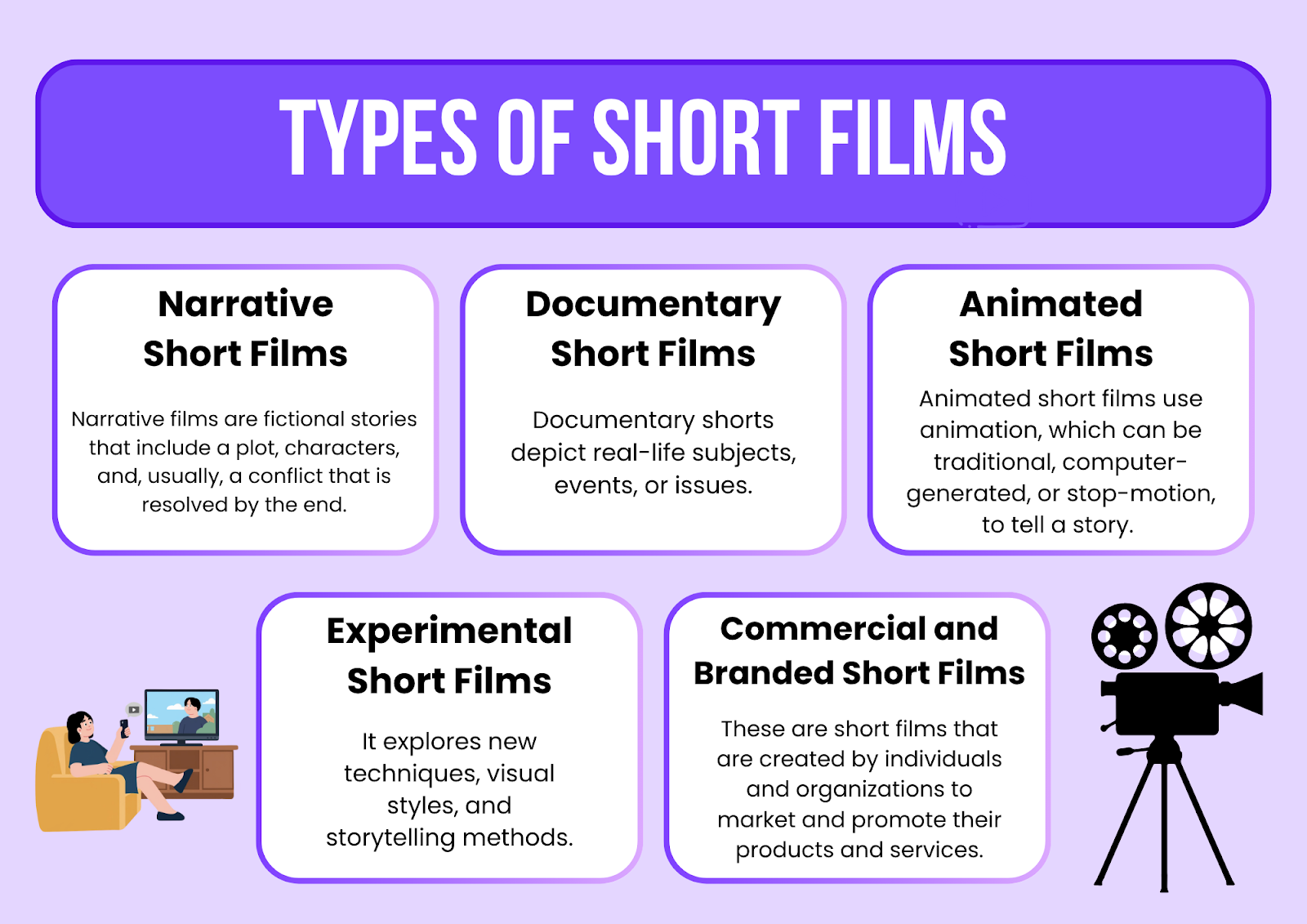
Narrative films are fictional stories that include a plot, characters, and, usually, a conflict that is resolved by the end. These films have a clear beginning, middle, and end and are shorter than traditional films.
Documentary Short Films
Documentary shorts depict real-life subjects, events, or issues. Its purposes are to inform, educate, raise awareness, and provide insight into a particular topic. These short films use interviews, archival footage, and observational storytelling techniques.
Animated Short Films
Animated short films use animation, which can be traditional, computer-generated, or stop-motion, to tell a story. These can be whimsical, fantastical, serious, or experimental. It provides creators with unlimited visual possibilities.
Experimental Short Films
Experimental short films are those that do not strictly follow traditional filmmaking rules. It explores new techniques, visual styles, and storytelling methods. It prioritizes mood, symbolism, and artistic expression over a linear narrative.
Commercial and Branded Short Films
These are short films created by individuals and organizations to market and promote their products and services. It aims to engage audiences and convey a message in a memorable way that aligns with their brand and the organization's core values.
Why Short Films Matter in Filmmaking
- Entry point for new filmmakers. It is great for new filmmakers to enhance and develop their skills, as it is quick and easy to create and puts less pressure on them.
- Portfolio building and film school requirements. Short films help build a portfolio so you can show your work to others and convince them to work with you. It also helps students in film school apply their acquired knowledge and skills in practice and gain real-world experience.
- Film festival exposure. Film festival exposure is one way short film creators can showcase their work. It can also help them gain recognition and awards.
- Creative experimentation. Short films help in experimenting creatively. It can help discover new techniques to improve film production.
Short Film Examples
- Hair Love
Hair Love is a short film about a father learning to style his daughter’s hair. At first, he struggles, but with love and patience, he succeeds, while the mother’s situation adds deeper meaning to the story.
- Umbrella
Umbrella is a short film about a young boy in an orphanage who wants a yellow umbrella. The yellow umbrella is important to him because it is connected to his past.
- Piper
Piper is a short film about a young sandpiper who is afraid of the ocean. Because its food is buried in the sand, and the waves make it hard to reach. One day, a wave covers the bird, and when it opens its eyes underwater, it sees things differently. This experience helps it to learn not to be afraid of the waves.
Short Film vs Feature Film: What’s the Difference?
Factor | Short Film | Feature Film |
Length | Under 40 minutes; can be 5-30 minutes. | Typically over 60 minutes |
Narrative | Focuses on a single idea, character, or moment because of limited time. | Full narrative arc with multiple characters, plots, and other details. |
Production Scale | Low budget, fewer locations, and minimal crew | Larger production with more budget, crews, actors, and locations. |
Distribution | Online platforms, film festivals | Streaming platforms, cinemas. |
Purpose | Educational, experimental, proof-of-concept for a larger project | Entertainment, storytelling, and commercial release |
How to Create a Short Film
The process of creating a short film can vary depending on the techniques, strategies, and other factors. Here is an example of how to create a short film:
Step 1 – Develop a Simple Idea
Start with a simple idea, as you don’t have to complicate things. Define the story you want to express, the audience who will watch it, and how the audience can relate to it, and if the location and other elements needed are available.
Step 2 – Write a Short Script
Write a short script to guide the actors and everyone involved to ensure the production flows smoothly. The short script must include the important details so everyone knows what the story is about and how it will be executed effectively.
Step 3 – Plan Your Production
Create a production plan outlining the step-by-step procedures you will follow. The props, settings, characters, equipment, and other requirements must be part of the production plan, so you know their roles, availability, and where to outsource them.
Step 4 – Shoot Efficiently
Film efficiently, keeping the short film's length in mind. Ensure clear communication among all involved to keep production running smoothly and finish faster.
Step 5 – Edit and Finalize
Edit the film to ensure it has a good structure and order. Add visuals, sounds, and effects that suit the story to enhance the message you want to express. After editing and finalizing, check it to ensure everything aligns with the vision.
How VMEG AI Helps Localize Short Films
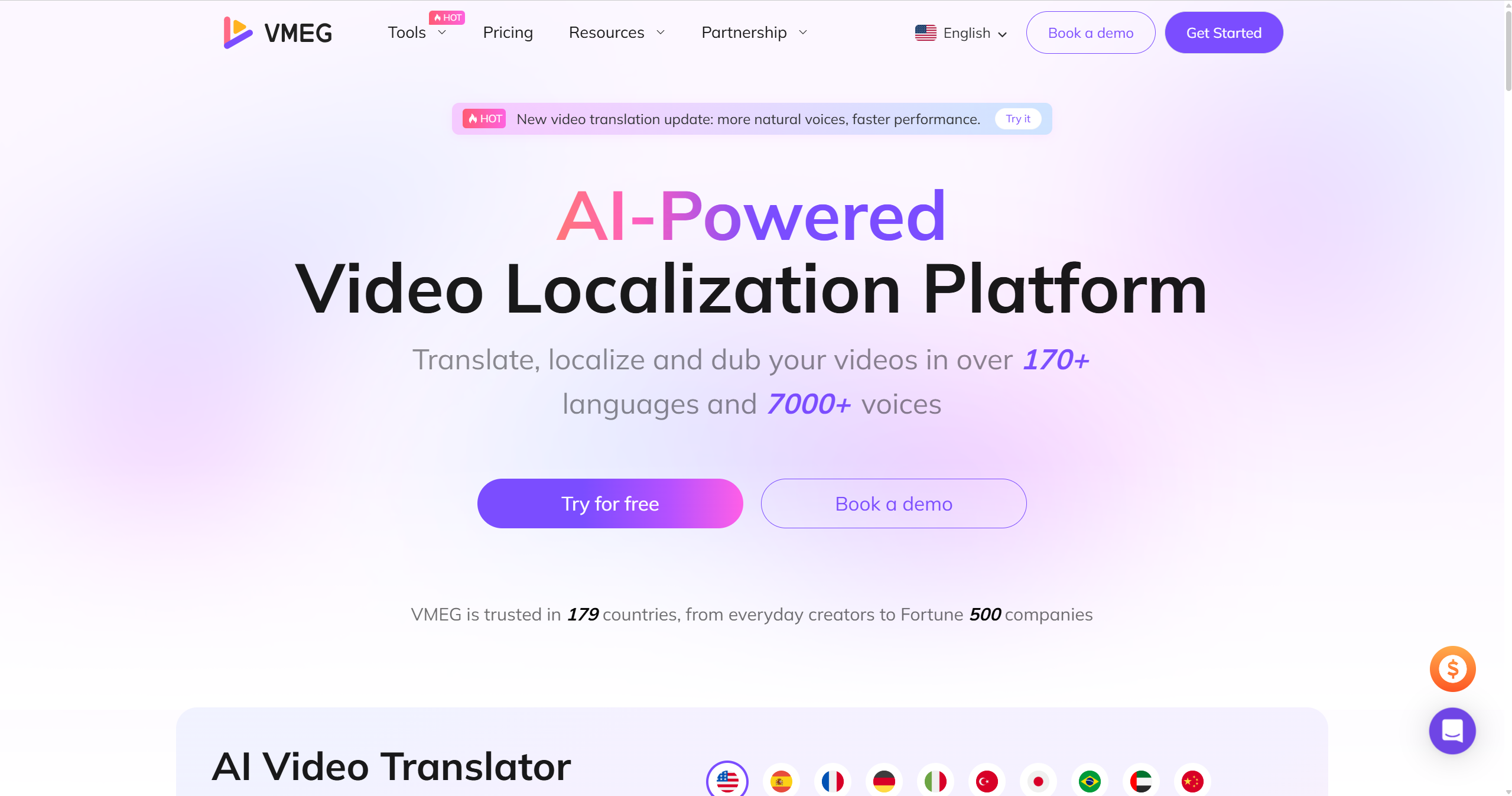
VMEG is an AI-powered video localization platform that can help you bring your content to a global audience by translating, transcribing, dubbing, and localizing it.
Here’s how VMEG AI can help localize short films:
AI-Powered Video Localization
VMEG AI offers a range of tools for translation, transcription, subtitles, and text-to-speech. It also features a localization agent, editing studio, batch and automation, and professional workflow.
Automatic Subtitles and Translation
Translate subtitles to different languages and reach a wider audience. It can transcribe and translate subtitles while preserving context and syncing flawlessly, resulting in a clean, professional look.
Voice Dubbing and Localization
It supports more than 170 languages and 7,000 lifelike voices. With this tool, you can easily bring your content to a global audience with just a few clicks.
Content Repurposing
Repurpose your content into different formats. You can transcribe your videos and audio so you can turn them into blog posts, articles, and other written content. You can also choose a clip or part of your localized content and turn it into social media posts, helping maximize output.
Where to Watch and Share Short Films
- Film festivals. Film festivals are among the best places to watch and discover movies. For short film creators, it is important to understand the requirements for participating in film festivals.
- Streaming platforms. Another platform where short films can be watched and shared is streaming platforms. With these platforms, various short films can be discovered. If you want to share your work on streaming platforms, check their requirements to know what you need to do.
- Social media platforms. Have you ever encountered a short film on your social media feed, got interested, and watched it? Many people use social media, making it one of the best platforms for watching and sharing short films. This is an ideal platform for beginners who want to create short films, as it is easier to set up and can reach a wider audience.
Tips for Making a Successful Short Film
Keep the Story Simple
Simplicity is important to ensure the message is delivered effectively to the audience. Sometimes, complex stories can lead to confusion when poorly structured. A simple story is ideal for beginners creating short films.
Focus on One Emotional Impact
Focus on the main emotion you want your audience to feel. Emotions play an important role in creating a connection between the story and the audience.
Prioritize Audio Quality
Have you ever watched a video with poor sound quality? How did you feel? Probably you feel distracted and just didn’t watch it. Always prioritize audio quality. The sound must be clear so the audience can easily understand it.
Optimize for Online Viewing
Many people are now watching online on devices, as it offers greater convenience. Teasers or trailers can be posted online to reach a wider audience and pique interest.
Submit to Film Festivals
Another tip is to submit to film festivals. Being part of a film festival can help bring recognition to the short film and reach a larger audience, so more people can discover it.
FAQs
What is the purpose of a short film?
The purpose of a short film is to tell a focused story, experiment with ideas, or showcase talent. It can also be a stepping stone into the filmmaking field, a way to demonstrate skills, and a way to pitch bigger projects.
Can a short film be 5 minutes?
Yes, short films can be 5 minutes, and this length is ideal for those who want to tell a quick, impactful story.
Do short films get Oscars?
Yes, short films can get Oscars and other awards and recognitions.
Do short films make money?
The profit from short films can vary. Some short films don’t generate significant profit, such as independent films. Short films can earn money through film festival prizes, streaming deals, brand sponsorship, or grants. These can also lead to career opportunities.
Do actors get paid for short films?
Actors are not always paid, as it depends on the budget. For example, in low-budget or student films, the actors are often unpaid or offered small stipends. In professional short films, actors may be paid depending on agreements.
Conclusion
A short film is a good stepping stone for those new to creating them. And to make your short films reach a wider audience, localization is the key. It can help localize short films in different languages.
VMEG AI is the best localization tool for your short films and other video content. It supports more than 170 languages so that you can reach a wider audience. This platform is also ideal for all skill levels, so even if you are a beginner, you can easily localize your content.
Try VMEG AI now and localize your content to reach a global audience.


The VMEG Team
Behind VMEG stands a passionate team of creatives, engineers, and language lovers. At the crossroads of AI and storytelling, they craft tools that bridge languages and cultures.