

'%3e%3cpath%20d='M21.0949%203.79395L13.9961%209.82854H21.0949V3.79395Z'%20stroke='black'%20stroke-width='1.38'%20stroke-miterlimit='10'/%3e%3cpath%20d='M13.998%209.82854L7.44531%203.79395V9.82854H13.998Z'%20stroke='black'%20stroke-width='1.38'%20stroke-miterlimit='10'/%3e%3cpath%20d='M13.9961%202.69922V25.1919'%20stroke='black'%20stroke-width='1.38'%20stroke-miterlimit='10'/%3e%3cpath%20d='M20.5488%2016.4113L13.9961%209.82812V18.2217L20.5488%2024.0918V16.4113Z'%20stroke='black'%20stroke-width='1.38'%20stroke-miterlimit='10'/%3e%3cpath%20d='M7.44531%2016.4113L13.998%209.82812V18.0526L7.44531%2024.0918V16.4113Z'%20stroke='black'%20stroke-width='1.38'%20stroke-miterlimit='10'/%3e%3cpath%20d='M4.71094%209.82812V18.6057H7.44125V16.4113L13.9941%209.82812H4.71094Z'%20stroke='black'%20stroke-width='1.38'%20stroke-miterlimit='10'/%3e%3cpath%20d='M13.9961%209.82812L20.5488%2016.4113V18.6057H23.2792V9.82812H13.9961Z'%20stroke='black'%20stroke-width='1.38'%20stroke-miterlimit='10'/%3e%3c/g%3e%3c/svg%3e)

'%3e%3cmask%20id='mask0_21456_29260'%20style='mask-type:luminance'%20maskUnits='userSpaceOnUse'%20x='0'%20y='0'%20width='28'%20height='28'%3e%3cpath%20d='M27.5%200.5H0.5V27.5H27.5V0.5Z'%20fill='white'/%3e%3c/mask%3e%3cg%20mask='url(%23mask0_21456_29260)'%3e%3cpath%20d='M14%2027.5C13.4854%2024.1035%2011.8974%2020.9608%209.46828%2018.5317C7.03922%2016.1026%203.89651%2014.5146%200.5%2014C3.89651%2013.4854%207.03922%2011.8974%209.46828%209.46828C11.8974%207.03922%2013.4854%203.89651%2014%200.5C14.5147%203.89644%2016.1028%207.03905%2018.5318%209.46816C20.9609%2011.8972%2024.1035%2013.4853%2027.5%2014C24.1035%2014.5147%2020.9609%2016.1028%2018.5318%2018.5318C16.1028%2020.9609%2014.5147%2024.1035%2014%2027.5Z'%20fill='url(%23paint0_linear_21456_29260)'/%3e%3c/g%3e%3c/g%3e%3cdefs%3e%3clinearGradient%20id='paint0_linear_21456_29260'%20x1='9.5'%20y1='9.5'%20x2='20.75'%20y2='21.875'%20gradientUnits='userSpaceOnUse'%3e%3cstop%20stop-color='%23F0DCD6'/%3e%3cstop%20offset='0.914506'%20stop-color='%231D6DFF'/%3e%3c/linearGradient%3e%3cclipPath%20id='clip0_21456_29260'%3e%3crect%20width='28'%20height='28'%20fill='white'/%3e%3c/clipPath%3e%3c/defs%3e%3c/svg%3e)
'%3e%3cpath%20d='M22.8019%2011.2412L23.5234%2011.6807V12.0103L23.3172%2012.7796L14.5579%2014.9771L13.7344%2012.7951L22.8019%2011.2412Z'%20fill='%23D97757'/%3e%3cpath%20d='M19.5236%204.77832L20.5322%205.00396L20.8%205.35575L21.0552%206.19876L20.9494%206.73644L15.0712%2015.3068L13.1133%2013.2191L18.5338%205.63471L19.5236%204.77832Z'%20fill='%23D97757'/%3e%3cpath%20d='M14.4577%203.43951L15.0761%203L15.5912%203.21976L16.1065%203.9889L14.6949%2013.0345L13.7364%2012.3397L13.3242%2011.131L14.0456%204.31853L14.4577%203.43951Z'%20fill='%23D97757'/%3e%3cpath%20d='M7.84766%203.5851L8.48285%202.7199L8.89716%202.61914L9.71923%202.74717L10.125%203.08581L13.0815%2010.0748L14.1509%2013.3954L12.8997%2014.1372L8.13117%204.91019L7.84766%203.5851Z'%20fill='%23D97757'/%3e%3cpath%20d='M4.77232%208.38688L4.56641%207.50742L5.18478%206.73828L5.90613%206.84816H6.11223L10.4403%2010.2544L11.78%2011.3531L13.6349%2012.8914L12.6044%2014.7594L11.6769%2013.9903L11.0586%2013.331L5.08168%208.82593L4.77232%208.38688Z'%20fill='%23D97757'/%3e%3cpath%20d='M3.53288%2014.0982L3.06641%2013.5489L3.06647%2013.0601L3.53288%2012.8896L8.78833%2013.2193L13.9408%2013.6588L13.7736%2014.7528L3.94502%2014.2082L3.53288%2014.0982Z'%20fill='%23D97757'/%3e%3cpath%20d='M6.62378%2019.8178H5.59334L5.18359%2019.3146V18.7132L6.93299%2017.3946L14.045%2012.5674L14.7648%2013.8785L6.62378%2019.8178Z'%20fill='%23D97757'/%3e%3cpath%20d='M8.57739%2022.8884L8.16518%2022.9984L7.54688%2022.6687L7.64995%2022.1193L13.7299%2013.5488L14.5543%2014.7574L10.0201%2021.1305L8.57739%2022.8884Z'%20fill='%23D97757'/%3e%3cpath%20d='M13.7361%2023.9861L13.4271%2024.4257L12.8088%2024.6454L12.2935%2024.2058L11.9844%2023.5466L13.5301%2014.6465L14.4576%2014.7563L13.7361%2023.9861Z'%20fill='%23D97757'/%3e%3cpath%20d='M18.9869%2021.5713V22.4503L18.8838%2022.7799L18.4716%2022.9997L17.7503%2022.8974L12.7969%2015.0367L14.7617%2013.4404L16.4104%2016.6269L16.5652%2017.7805L18.9869%2021.5713Z'%20fill='%23D97757'/%3e%3cpath%20d='M21.3629%2020.2507L21.4659%2020.8L21.1568%2021.2396L20.8476%2021.1297L19.0958%2019.8112L16.4165%2017.284L14.3555%2015.7457L14.9736%2013.6582L16.0041%2014.3175L16.6226%2015.5259L21.3629%2020.2507Z'%20fill='%23D97757'/%3e%3cpath%20d='M20.0232%2014.6482L22.5995%2014.8679L23.2178%2015.3074L23.6299%2015.9667V16.441L22.4964%2016.9556L16.7256%2015.4173L14.3555%2015.3074L14.9737%2013L16.6226%2014.3185L20.0232%2014.6482Z'%20fill='%23D97757'/%3e%3c/g%3e%3c/svg%3e)
Key Takeaways
- A tracking shot is a shot in which the camera physically moves with the subject. Some examples of tracking shots are following the subject on the street, following them as they run, or following them as they enter a room.
- Tracking shots work by having the camera move along a path, following a subject or scene, and using equipment such as a dolly, stabilizer, steadicam, or tracks.
- The types of tracking shots may vary depending on motion and equipment. Some types of tracking shots include dolly, trucking, arc, follow, steadicam, and drone tracking.
- Common mistakes in tracking shots include overusing camera movement, poor stabilization, lack of purposeful motion, and ignoring subject framing.
- AI tools such as VMEG AI can help you preserve the motion when localizing the content with tracking shots. It also ensures that subtitles are accurate, that dubbing matches the scene, and that content can be localized faster.
A tracking shot is a technique in which the camera physically moves with the subject, keeping the content looking professional and helping the audience stay engaged. In this post, we will discuss the definition of tracking shot, how it works, its types, why filmmakers use it, examples, and more.
What Is a Tracking Shot?
According to Adobe, a tracking shot follows a subject as the camera moves with it.
According to the Merriam-Webster Dictionary, a tracking shot is a scene filmed using a moving dolly.
A tracking shot is a filmmaking technique in which a camera moves through a scene rather than remaining stationary. The movement can be done in different directions, such as forward, backward, sideways, or around the subject.
Filmmakers use it as it helps make the audience feel you are inside the scene, follows actions smoothly without cutting, and builds tension or realism.
Examples of Tracking Shots
Here are some examples of scenes where tracking shots are used:
- Walking. The camera follows the subject on the street.
- Running. The camera tracks the subject or character during a chase.
- Conversation while moving. A tracking shot is used when two people walk while the camera moves alongside them.
- Entering a location. In this scene, the camera follows a subject into a room.
How a Tracking Shot Works in Filmmaking
Camera Movement Along a Path
A tracking shot is a camera movement along a planned path within a scene, rather than staying in a fixed position. The camera can move backward, forward, or side to side, depending on the scene. The purpose of this technique is to guide the viewer's attention, to keep them engaged.
Following a Subject or Scene
The camera tracks a moving subject, such as a person, animal, or object. It focuses on the subject and keeps the audience engaged in the scene. It helps create a sense of motion and continuity in the story, immersing the audience.
Equipment Used for Tracking Shots
Here are some of the equipment used by filmmakers in tracking shots:
- Dolly. This is a platform with wheels that moves smoothly along the tracks.
- Gimbal/Stabilizer. These are handheld devices that help in reducing shakiness.
- Steadicam. With this equipment, the operator can move, such as walking or running, while keeping the shot steady.
- Rail or Tracks. These are the ones that guide the dolly to ensure its movement is consistent.
Types of Tracking Shots
The types of tracking shots vary depending on the equipment used and the type of motion. Here are some of the types of tracking shots:
Dolly Shot (Push-In / Pull-Out)
In this shot, the camera moves toward (push in) or away from (pull-out) the subject. This shot is used to emphasize emotions or reveal more of a scene. The dolly with tracks is used for a smooth motion.
Trucking Shot
A trucking shot is a camera movement that moves sideways, parallel to the subject. It keeps the subject in frame while showing the movement across a scene. This shot is ideal for following the subject, such as when walking or driving.
Arc Shot
In this shot, the camera moves in an arc, following a curve or semi-circle around the subject. It enhances the dynamic perspective and visual interest, making it more appealing. It highlights the characters or actions from different angles.
Follow Shot
Follow shot is a camera movement that stays behind or beside a moving subject. It helps the audience feel as if they are following the subject’s actions. This shot is used in walking or chase scenes.
Steadicam Shot
In this shot, the operator wears a stabilizing rig where the camera is mounted. This is ideal for long takes through complex locations, as it allows smooth, fluid movement, even on uneven surfaces.
Drone Tracking Shot
A drone tracking shot is a shot in which a camera is mounted on a drone. It flies above or around the subject, adding dramatic, cinematic scale to outdoor scenes. This is perfect for shots that are impossible to take with ground equipment.
Why Filmmakers Use Tracking Shots
Enhancing Immersion
Filmmakers use tracking shots to immerse the audience, so they feel they are inside the scene. It keeps the audience focused on the action or story, naturally following the characters' way. It keeps the action smooth and real.
Creating Visual Continuity
Tracking shots help connect different parts of a scene without cuts. This helps keep the motion smooth and makes the story's flow clear. It helps in reducing confusion for viewers and makes movement feel seamless.
Building Emotional Impact
Tracking shots help create emotional impact by focusing on a character’s expressions, feelings, and actions. It can build tension or excitement in the audience and let emotions grow without interruption. It can make the scene more personal, dramatic, or intense, thereby making key moments more powerful.
Showcasing Environment and Scale
It also helps showcase the scene’s setting, providing a clearer view of the surroundings. This shot also helps explain the environment where the action takes place. It makes the scenes feel bigger and more detailed.
Examples of Tracking Shots in Film
Here are some examples of tracking shots in film:
Goodfellas (1990)
This film is directed by Martin Scorsese. The Copacabana scene is one of the well-known tracking shots in the film Godfellas. It follows the characters through the back entrances, hallways, and kitchen. It helps the audience feel like they are walking with the characters and get a glimpse of their exclusive lifestyle.
1917 (2019)
1917 is directed by Sam Mendes. This film is known for a long tracking shot that makes it look like a one continuous shot. A tracking shot follows soldiers across trenches and battlefields. It helps the audience feel the character's journey and enhances emotional intensity and realism.
The Shining (1980)
The Shining is directed by Stanley Kubrick. The tracking shots are used to build suspense and unease. The camera follows the character as he rides his tricycle through the hotel's corridors. It makes the audience feel like they are following the character and that something might happen at any time.
Tracking Shot vs Other Camera Movements
Tracking Shot vs Pan Shot
Tracking Shot | Pan Shot |
The camera physically moves through space. | The camera stays in one place or a fixed position. |
The camera follows a person/object. | The camera rotates left or right. |
Camera moves or travels | The camera turns. |
Create immersion and movement. | Follow the action from a stationary point. |
Tracking Shot vs Zoom Shot
Tracking Shot | Zoom Shot |
The camera physically moves closer to or farther from the subject. | The camera stays still, but the lens zooms in or out. |
Tracks real movement, which adds depth. | Provides optical change, which can feel flatter. |
It makes the scene more natural and immersive. | It can make the scenes feel more artificial or stylized. |
Tracking Shot vs Dolly Zoom
Tracking Shot | Dolly Zoom |
The camera physically moves through a scene to follow the subject. It can move backward, forward, or sideways. | The camera moves while zooming in the lens in the opposite direction. |
It makes viewers feel like they are part of the action. | It creates tension or dramatic realization. |
It maintains a consistent perspective. | It gives a distorting perspective. |
Tracking Shot vs Handheld Shot
Tracking Shot | Handheld Shot |
It uses rails or stabilizing equipment | The operator holds the camera |
Immerses the audience in a cinematic and controlled way. | It makes the scene feel raw and can be chaotic. |
Tracking feels polished. | May result in natural shakes and instability. |
How to Create a Tracking Shot
Creating a tracking shot can vary, depending on the scene, story, and other elements. Here is a simple way to create a tracking shot:
Step 1: Plan the Movement Path
Plan the camera’s movement, whether forward, backward, or sideways, or a combination. Mark the path to avoid obstacles that can interfere when filming. In planning the movement, consider the scene's purpose and what you want your viewers to feel or notice.
Step 2: Choose the Right Equipment
Choose the right equipment for the scene and purpose. A dolly or a slider can help you achieve a smooth, linear movement; a steadicam is ideal for a flexible, handheld-like smooth motion; and a tripod on tracks is great if the path is predictable and straight.
Step 3: Stabilize the Camera
Stabilizing the camera is important to ensure that the shot looks clean and professional. Stabilizers and rails can help in preventing shakiness. Also, ensure the mounts are secured and balanced for a good shot.
Step 4: Coordinate Subject Movement
The coordination or synchronization between the subject and the camera’s pace should match, so that the scenes feel natural and seamless. Markers on the floor can be used if necessary.
Step 5: Rehearse and Adjust Timing
Rehearsal is helpful as it can provide familiarity. Practice runs before filming so mistakes can be avoided, and the final shot is fluid and immersive. Adjust speed, positioning, and angles to achieve the best look on camera.
Common Mistakes When Using Tracking Shots
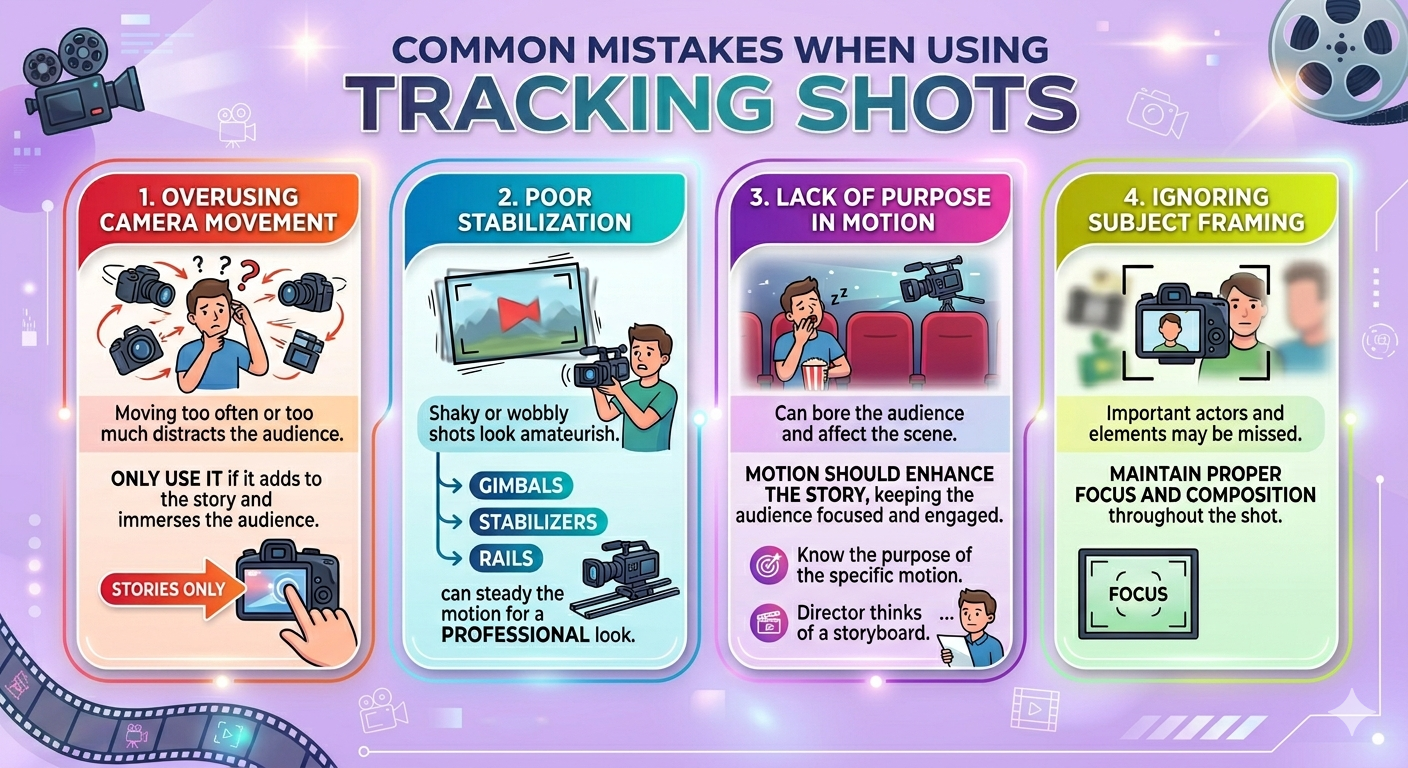
Overusing Camera Movement
Overusing camera movement, such as moving it too often or too much, can distract the audience. Use tracking shots only if they add to the story and help the audience immerse themselves in the scene.
Poor Stabilization
Another common mistake is poor stabilization. The scene can look amateurish when the shots are shaky or wobbly. Stabilizer, gimbals, or rails can help steady the motion and look professional.
Lack of Purpose in Motion
The lack of purpose in motion can affect the scene and bore the audience. The camera movement should enhance the story and help the audience stay focused and engaged. It is important to know the purpose of a specific motion.
Ignoring Subject Framing
Framing is important; if ignored, actors and other important elements may be missed. Maintain proper focus and composition throughout the shot to ensure all elements are captured.
When to Use a Tracking Shot in Video Content
Knowing when to use a tracking shot is important because it enhances audience engagement and storytelling.
Film and Narrative Storytelling
Tracking shots in movies, film, and narrative-driven content can help establish setting and space, follow characters' actions, enhance the cinematic style, build suspense or tension, clearly show movement, and engage viewers by making them feel part of the story.
Documentaries and Interviews
In non-fiction content, such as documentaries and interviews, tracking shots can make visuals more interesting in static content, give context or scale, and connect narrative elements. For those with long segments, it helps in keeping the audience focused and interested.
Marketing and Commercial Videos
For promotional content, tracking shots can make the product presentation more creative. It can highlight the product’s features, demonstrate its value to the audience, and create emotional engagement that makes them excited to try and buy the new product.
Social Media and Short-Form Content
Tracking shots can also be used in social media and short-form content. It can grab attention quickly, show environment and context, and add depth to storytelling, making it more engaging to the audience. It can make them stop scrolling and watch the film.
How VMEG AI Supports Tracking Shots in Video Localization

Preserving Motion Continuity Across Languages
With VMEG AI, the motion is preserved across languages. It helps synchronize the translation with the speaker's lip movements, making it look natural and not distract the audience.
Accurate Subtitle Placement for Moving Scenes
VMEG AI’s subtitle translator can help in translating subtitles into different languages. It can transcribe and translate subtitles while preserving context, ensuring consistent meaning and message across languages. It also syncs timing perfectly, making it look natural.
AI Dubbing That Matches Scene Flow
Dub your videos into more than 170 languages. VMEG AI also supports more than 7,000 lifelike voices, giving various options so that you can choose the best one that suits your content and brand voice.
Streamlining Localization
Platforms like VMEG AI can speed up your workflow. Instead of doing localization manually, you can do it automatically in a few minutes. It can help you save more time and effort, helping you be more productive.
Scaling Multilingual Video Production
Create more videos faster with VMEG AI. With this platform, you can create different multilingual versions of your content in less time. It can also help you stay up to date with new trends, increasing audience engagement worldwide.
FAQs
What does a tracking shot do for the audience?
The tracking shot keeps the audience engaged and helps them feel part of the scene.
When to use a tracking shot?
Tracking shots are used when you need to follow subjects' actions, build emotion, show movement clearly, add creativity, make visuals more interesting in static content, and keep the audience engaged.
What equipment is used for tracking shots?
Some of the equipment used in tracking shots is a camera, dolly, gimbal, stabilizer, seadicam, rails, or tracks.
What is the purpose of a tracking shot?
The purposes of a tracking shot include immersing the audience, creating emotional impact, keeping smooth motion, and showcasing the scene settings.
Can you do a drone tracking shot?
Yes, you can do a drone tracking shot, especially if it helps improve the scene.
Conclusion
A tracking shot is one of the techniques that make content more visually and emotionally appealing. It must be done right so the audience stays engaged and is not distracted.
If you are a content creator and use tracking shots and want to localize your content, VMEG AI is the best platform for you. It can help you easily localize content with its AI dubbing, subtitle translator, voice cloning, and more. With VMEG AI, you can preserve the motion while ensuring that the translated content is synchronized, making it look natural.


The VMEG Team
Behind VMEG stands a passionate team of creatives, engineers, and language lovers. At the crossroads of AI and storytelling, they craft tools that bridge languages and cultures.