

'%3e%3cpath%20d='M21.0949%203.79395L13.9961%209.82854H21.0949V3.79395Z'%20stroke='black'%20stroke-width='1.38'%20stroke-miterlimit='10'/%3e%3cpath%20d='M13.998%209.82854L7.44531%203.79395V9.82854H13.998Z'%20stroke='black'%20stroke-width='1.38'%20stroke-miterlimit='10'/%3e%3cpath%20d='M13.9961%202.69922V25.1919'%20stroke='black'%20stroke-width='1.38'%20stroke-miterlimit='10'/%3e%3cpath%20d='M20.5488%2016.4113L13.9961%209.82812V18.2217L20.5488%2024.0918V16.4113Z'%20stroke='black'%20stroke-width='1.38'%20stroke-miterlimit='10'/%3e%3cpath%20d='M7.44531%2016.4113L13.998%209.82812V18.0526L7.44531%2024.0918V16.4113Z'%20stroke='black'%20stroke-width='1.38'%20stroke-miterlimit='10'/%3e%3cpath%20d='M4.71094%209.82812V18.6057H7.44125V16.4113L13.9941%209.82812H4.71094Z'%20stroke='black'%20stroke-width='1.38'%20stroke-miterlimit='10'/%3e%3cpath%20d='M13.9961%209.82812L20.5488%2016.4113V18.6057H23.2792V9.82812H13.9961Z'%20stroke='black'%20stroke-width='1.38'%20stroke-miterlimit='10'/%3e%3c/g%3e%3c/svg%3e)

'%3e%3cmask%20id='mask0_21456_29260'%20style='mask-type:luminance'%20maskUnits='userSpaceOnUse'%20x='0'%20y='0'%20width='28'%20height='28'%3e%3cpath%20d='M27.5%200.5H0.5V27.5H27.5V0.5Z'%20fill='white'/%3e%3c/mask%3e%3cg%20mask='url(%23mask0_21456_29260)'%3e%3cpath%20d='M14%2027.5C13.4854%2024.1035%2011.8974%2020.9608%209.46828%2018.5317C7.03922%2016.1026%203.89651%2014.5146%200.5%2014C3.89651%2013.4854%207.03922%2011.8974%209.46828%209.46828C11.8974%207.03922%2013.4854%203.89651%2014%200.5C14.5147%203.89644%2016.1028%207.03905%2018.5318%209.46816C20.9609%2011.8972%2024.1035%2013.4853%2027.5%2014C24.1035%2014.5147%2020.9609%2016.1028%2018.5318%2018.5318C16.1028%2020.9609%2014.5147%2024.1035%2014%2027.5Z'%20fill='url(%23paint0_linear_21456_29260)'/%3e%3c/g%3e%3c/g%3e%3cdefs%3e%3clinearGradient%20id='paint0_linear_21456_29260'%20x1='9.5'%20y1='9.5'%20x2='20.75'%20y2='21.875'%20gradientUnits='userSpaceOnUse'%3e%3cstop%20stop-color='%23F0DCD6'/%3e%3cstop%20offset='0.914506'%20stop-color='%231D6DFF'/%3e%3c/linearGradient%3e%3cclipPath%20id='clip0_21456_29260'%3e%3crect%20width='28'%20height='28'%20fill='white'/%3e%3c/clipPath%3e%3c/defs%3e%3c/svg%3e)
'%3e%3cpath%20d='M22.8019%2011.2412L23.5234%2011.6807V12.0103L23.3172%2012.7796L14.5579%2014.9771L13.7344%2012.7951L22.8019%2011.2412Z'%20fill='%23D97757'/%3e%3cpath%20d='M19.5236%204.77832L20.5322%205.00396L20.8%205.35575L21.0552%206.19876L20.9494%206.73644L15.0712%2015.3068L13.1133%2013.2191L18.5338%205.63471L19.5236%204.77832Z'%20fill='%23D97757'/%3e%3cpath%20d='M14.4577%203.43951L15.0761%203L15.5912%203.21976L16.1065%203.9889L14.6949%2013.0345L13.7364%2012.3397L13.3242%2011.131L14.0456%204.31853L14.4577%203.43951Z'%20fill='%23D97757'/%3e%3cpath%20d='M7.84766%203.5851L8.48285%202.7199L8.89716%202.61914L9.71923%202.74717L10.125%203.08581L13.0815%2010.0748L14.1509%2013.3954L12.8997%2014.1372L8.13117%204.91019L7.84766%203.5851Z'%20fill='%23D97757'/%3e%3cpath%20d='M4.77232%208.38688L4.56641%207.50742L5.18478%206.73828L5.90613%206.84816H6.11223L10.4403%2010.2544L11.78%2011.3531L13.6349%2012.8914L12.6044%2014.7594L11.6769%2013.9903L11.0586%2013.331L5.08168%208.82593L4.77232%208.38688Z'%20fill='%23D97757'/%3e%3cpath%20d='M3.53288%2014.0982L3.06641%2013.5489L3.06647%2013.0601L3.53288%2012.8896L8.78833%2013.2193L13.9408%2013.6588L13.7736%2014.7528L3.94502%2014.2082L3.53288%2014.0982Z'%20fill='%23D97757'/%3e%3cpath%20d='M6.62378%2019.8178H5.59334L5.18359%2019.3146V18.7132L6.93299%2017.3946L14.045%2012.5674L14.7648%2013.8785L6.62378%2019.8178Z'%20fill='%23D97757'/%3e%3cpath%20d='M8.57739%2022.8884L8.16518%2022.9984L7.54688%2022.6687L7.64995%2022.1193L13.7299%2013.5488L14.5543%2014.7574L10.0201%2021.1305L8.57739%2022.8884Z'%20fill='%23D97757'/%3e%3cpath%20d='M13.7361%2023.9861L13.4271%2024.4257L12.8088%2024.6454L12.2935%2024.2058L11.9844%2023.5466L13.5301%2014.6465L14.4576%2014.7563L13.7361%2023.9861Z'%20fill='%23D97757'/%3e%3cpath%20d='M18.9869%2021.5713V22.4503L18.8838%2022.7799L18.4716%2022.9997L17.7503%2022.8974L12.7969%2015.0367L14.7617%2013.4404L16.4104%2016.6269L16.5652%2017.7805L18.9869%2021.5713Z'%20fill='%23D97757'/%3e%3cpath%20d='M21.3629%2020.2507L21.4659%2020.8L21.1568%2021.2396L20.8476%2021.1297L19.0958%2019.8112L16.4165%2017.284L14.3555%2015.7457L14.9736%2013.6582L16.0041%2014.3175L16.6226%2015.5259L21.3629%2020.2507Z'%20fill='%23D97757'/%3e%3cpath%20d='M20.0232%2014.6482L22.5995%2014.8679L23.2178%2015.3074L23.6299%2015.9667V16.441L22.4964%2016.9556L16.7256%2015.4173L14.3555%2015.3074L14.9737%2013L16.6226%2014.3185L20.0232%2014.6482Z'%20fill='%23D97757'/%3e%3c/g%3e%3c/svg%3e)
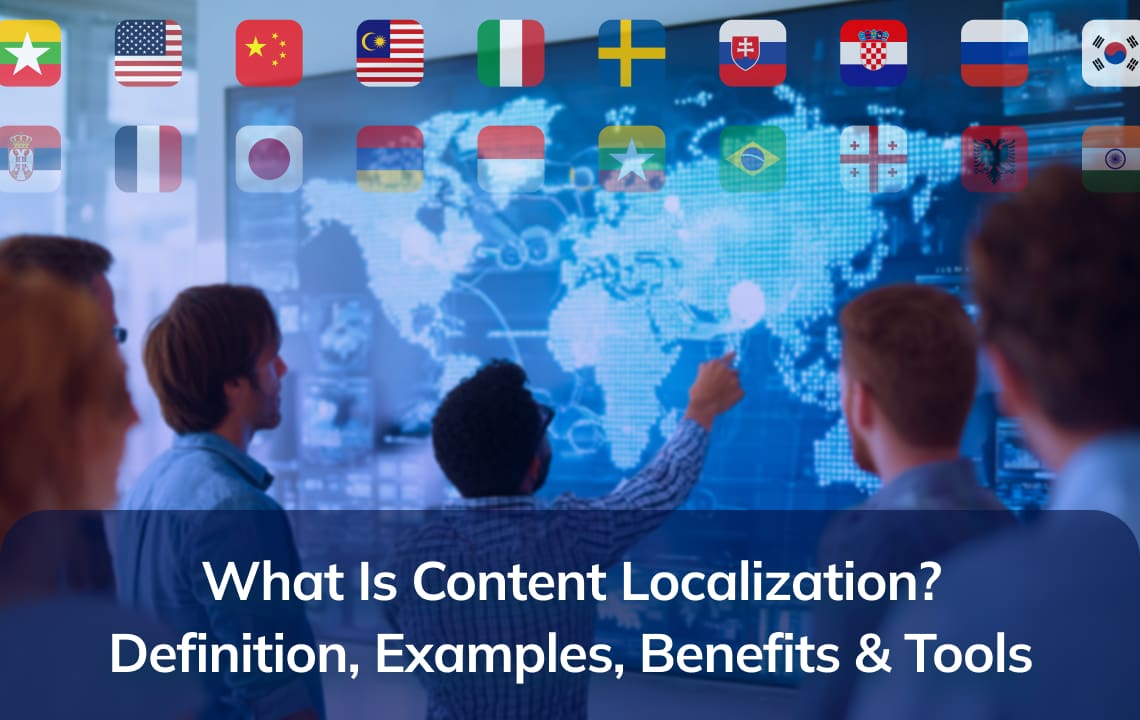
As businesses and individuals expand into new markets, localized content has become a necessity. Content localization can help your content reach an international audience and open doors to opportunities, such as collaboration and partnerships.
In a 2022 What It Means episode, Forrester analyst Kathleen Pierce explains that localizing content is a competitive advantage. She also says that having a clear vision and designating a leader in localization are steps that make content localization effective.
What is Content Localization?
Content localization is the process of adapting content for the local audience to ensure that it is relevant. It is more than just translation, as it ensures that the content suits the culture, context, and local terms.
Purpose of Content Localization
- Increase relevance. Content localization ensures the content is relevant to the audience, with language, tone, visuals, culture, and examples crafted to make it feel native.
- Build trust and credibility. People are likely to trust a brand that reflects their culture, values, and expectations.
- Increase engagement. When the audience relates to the content, they are more likely to engage, which can drive conversions and sales.
- Improve user experience. Localized content can improve the user experience by using familiar context, such as phrases, specific formats, visuals, and references.
- Support global brand consistency. With content localization, you can stay consistent with your brand voice and style, while adapting to local cultures, norms, and values.
What Content Localization Includes
- Language adaptation. The language must be adapted to the specific region or country to ensure the audience can easily understand it.
- Cultural references & idioms. Culture is an important consideration when localizing content, as it plays a significant role in people’s lives.
- Tone, formality, and messaging. Respect is one of the values that localized content should have; that's why it is important to check the tone, formality, and messaging.
- Visual elements. The visual elements, such as images, colors, and gestures, must also be appropriate to the local audience.
- Local formats. Dates, currencies, and units may vary across cultures, and it is important to follow the specific formats for the audience.
- Legal and regional compliance. The content must comply with applicable laws and regulations, as some regions may require specific language, disclosures, and content standards.
Examples of Content Localization
- Changing language, tone, and formality. The message is localized, such as the instructions, to ensure it is easily understood.
- Adapting examples and references. The examples and references must be relatable to the audience. It must be something they use, do, or have an important role in.
- Using local currencies and payment methods. Some e-commerce stores use local currencies and payment methods to make the process more convenient, encouraging customers to buy.
- Aligning content with local customs and holidays. Content such as promotions must be timed with local customs and holidays to make it more appealing.
- Following local rules and expectations. Content should include notices, disclaimers, or consent messages in accordance with local laws and regulations.
Who Needs Content Localization?
Global Businesses
Global businesses need to localize content to reach a wider audience. It can also create new opportunities for them and help them explore new markets.
E-Commerce and Retail Brands
Content localization is also needed by e-commerce and retail brands, as it promotes familiarity. When the audience is familiar with the currency, visuals, and style, they are more likely to browse and purchase products or services.
Tech and SaaS Companies
Tech and SaaS companies also need localized content to engage the target audience and probably convert them into customers.
Marketing and Advertising Agencies
It is also needed in marketing and advertising agencies to ensure that advertisements, promotional strategies, and materials are relevant to the audience, so they engage and are more likely to purchase.
Media and Entertainment
Content localization is also needed in media and entertainment to help audiences relate to the content. For example, if they publish a localized show or movie, the target audience is likely to watch it, especially if the subtitles are in their native language.
Educational Platforms
Localizing content is essential on educational platforms, as it helps learners understand the topic more easily, especially when they can relate to examples and references.
Why Content Localization Matters in 2026
Content localization matters in 2026 and beyond, as we are more connected than before.
Global Reach and Market Opportunities
Localization helps reach a global audience and create new market opportunities by opening doors to collaboration.
Customer Engagement Across Languages
It will be easier for the audience or customers to engage with content in a language that they understand.
Trust and Brand Credibility Internationally
Localized content can help you be seen as knowledgeable, and if the audience sees that it suits their lifestyle and culture, you can gain their trust and strengthen brand credibility.
SEO and Visibility in Local Markets
It helps with SEO because when users search for a specific keyword, your content is more likely to appear in search results.
Adaptation to Trends in Multilingual AI Content
To stay competitive in the industry, it is important to understand industry trends, especially now that we are more connected; knowing what's trending helps increase engagement.
Competitive Advantage in an Increasingly Globalized Economy
Localizing content is a competitive advantage. It can open new opportunities, such as collaborations and partnerships, that can help you expand your business.
Content Localization vs Translation vs Transcreation: Key Differences
Here are the differences between content localization, translation, and transcreation:
Translation
Translation is the process of converting content from one language to another as accurately as possible. The language changes while the structure, tone, and content stay the same.
It focuses on:
- Words and meaning
- Grammar and syntax
- Fidelity to the original text.
Content Localization
Content localization includes translation, making the content relevant to the audience so it feels natural in a specific region or country. The language, date, time, currency, units, idioms, references, and UI elements change.
It focuses on:
- Language and local conventions
- Cultural norms
- Practical details
Transcreation
Transcreation is the process of recreating content in another language, focusing on emotion and creativity to ensure it maintains the same emotional and persuasive impact, even when some words change. The wording, metaphors, humor, structure, and sometimes even the concept can change in transcreation.
It focuses on:
- Emotion
- Tone
- Brand voice
- Audience reaction
Types of Content That Can Be Localized
Website & Landing Pages
The language, UI elements, dates, time, currency, and units are localized to make it relevant. It also involves adapting messaging, visuals, navigation, SEO keywords, and calls to action to the specific location.
Marketing & Sales Content
The promotions must be aligned with holidays and special events, and dates, holiday names, and references must be localized. It ensures that the content resonates with the local audience by adjusting tone, cultural preferences, and value propositions.
Video Content (Subtitles, Dubbing, Voiceovers)
The subtitles, dubbing, and voice-overs are localized so they are relevant and feel natural. It includes translation, timing, cultural adaptation, and sometimes transcreation to ensure that humor, intent, and emotions feel natural to the local audience.
Social Media Content
It adapts posts, captions, hashtags, emojis, visuals, and posting schedules to ensure they align with the platform's preferences, local trends, and cultural norms, so they feel native.
Mobile Apps & SaaS Platforms
It includes UI text, error messages, onboarding flows, notifications, and help content. It also involves formatting, legal requirements, and user expectations to ensure compliance with the local laws.
eCommerce Product Pages
Localization helps build credibility on e-commerce product pages by using product descriptions, pricing, currencies, measurements, payment methods, shipping details, reviews, and promotional materials.
Training, eLearning & Internal Content
It includes learning and onboarding materials, compliance training, and internal documents to ensure the content is consistent and effective across different countries or regions. It ensures that the message is clear, appropriate to the local culture, and compliant with the laws.
The Content Localization Process
Here's the content localization process from identifying the target audience to optimizing content for better results and return on investment, so that all efforts, money, and resources will pay off.
Market & Audience Research
Localizing content starts with understanding your target market. research language variants, cultural norms, user behavior, legal and other requirements, and competitors. This will help you determine which tone and messaging style are best for your content.
Content Audit & Prioritization
Some content cannot be localized at once. Auditing helps determine which ones should be localized first based on your goals, impact, market relevance, and market performance. The content that must be prioritized is high-visibility, high-conversion content.
Translation & Localization Execution
This is the part where content is translated and localized using AI tools or professionals. This may involve direct translation, cultural adaptation, and transcreation to ensure that the content is clear, relevant, and consistent across markets.
Cultural Review & Quality Assurance
After the content is generated by AI tools, a professional or human editor will review and edit it to ensure it is high-quality. This ensures that the content is accurate and appropriate. The terms, formats, and culture are reviewed to ensure the content feels natural and aligned with local expectations.
Publishing, Testing & Optimization
After checking the file type, you need to export. Publish it on your prepared platforms, test it to see how it performs for users, and perform technical checks to identify areas for improvement. The content must be optimized continuously to keep its relevance.
VMEG AI – Best AI Localization Tool for Multilimedia Content
VMEG AI is an advanced AI-powered localization tool designed to help individuals and businesses adapt content for a global audience. With VMEG AI, you can streamline video, audio, and digital content localization while keeping language accuracy, cultural relevance, and brand consistency.
VMEG AI Content Localization Features
- More than 170 languages and 7,000 AI lifelike voices
- Perfect for various projects, including social media posts, training materials, online courses, marketing materials, and more.
- It has different localization tools for translation, transcription, subtitles, and text-to-speech.
- It provides synchronized lip sync and dubbing.
- Supports voice cloning, personalization, and brand consistency
How to Localize Content With VMEG AI
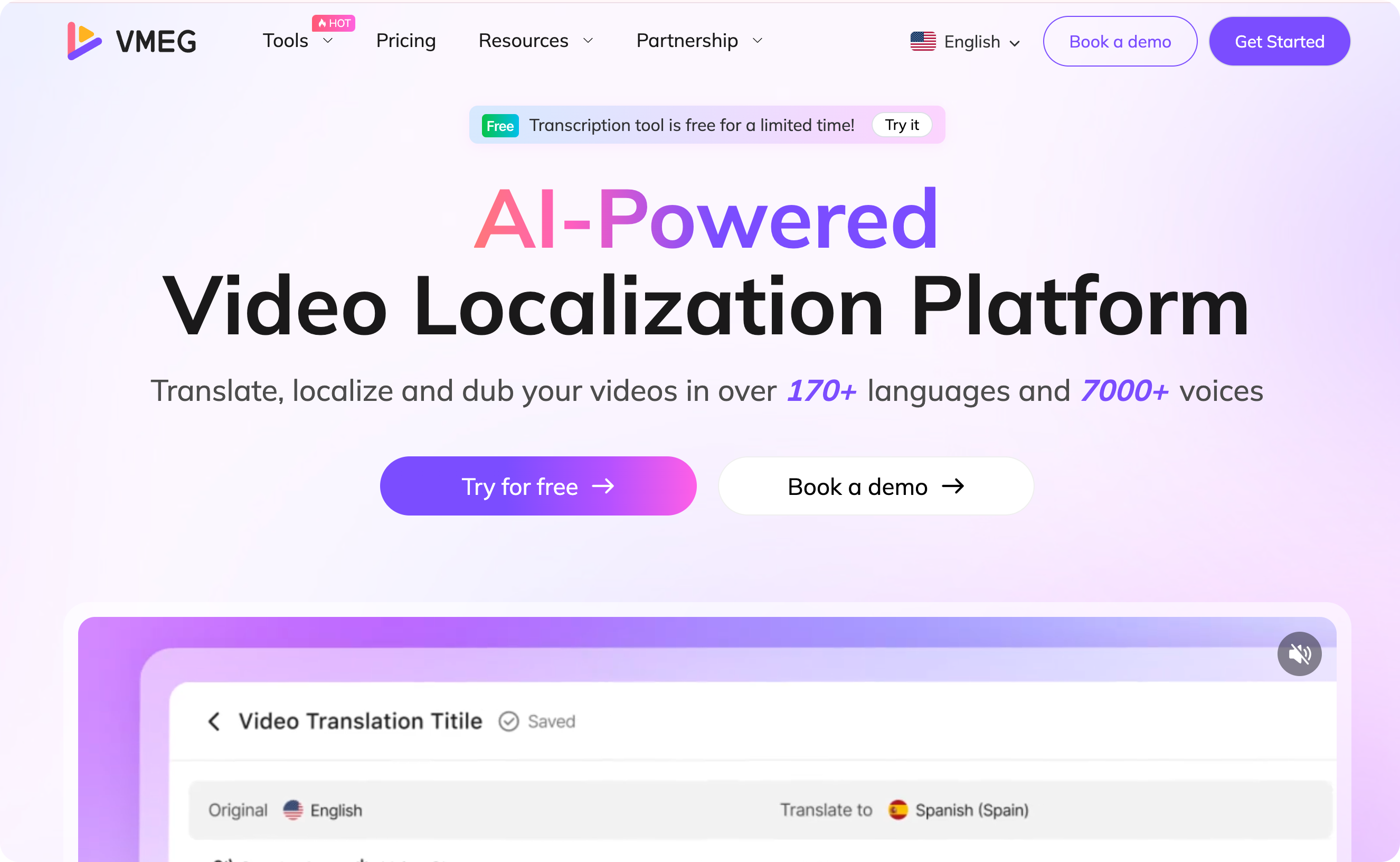
- Upload a file or paste the link.
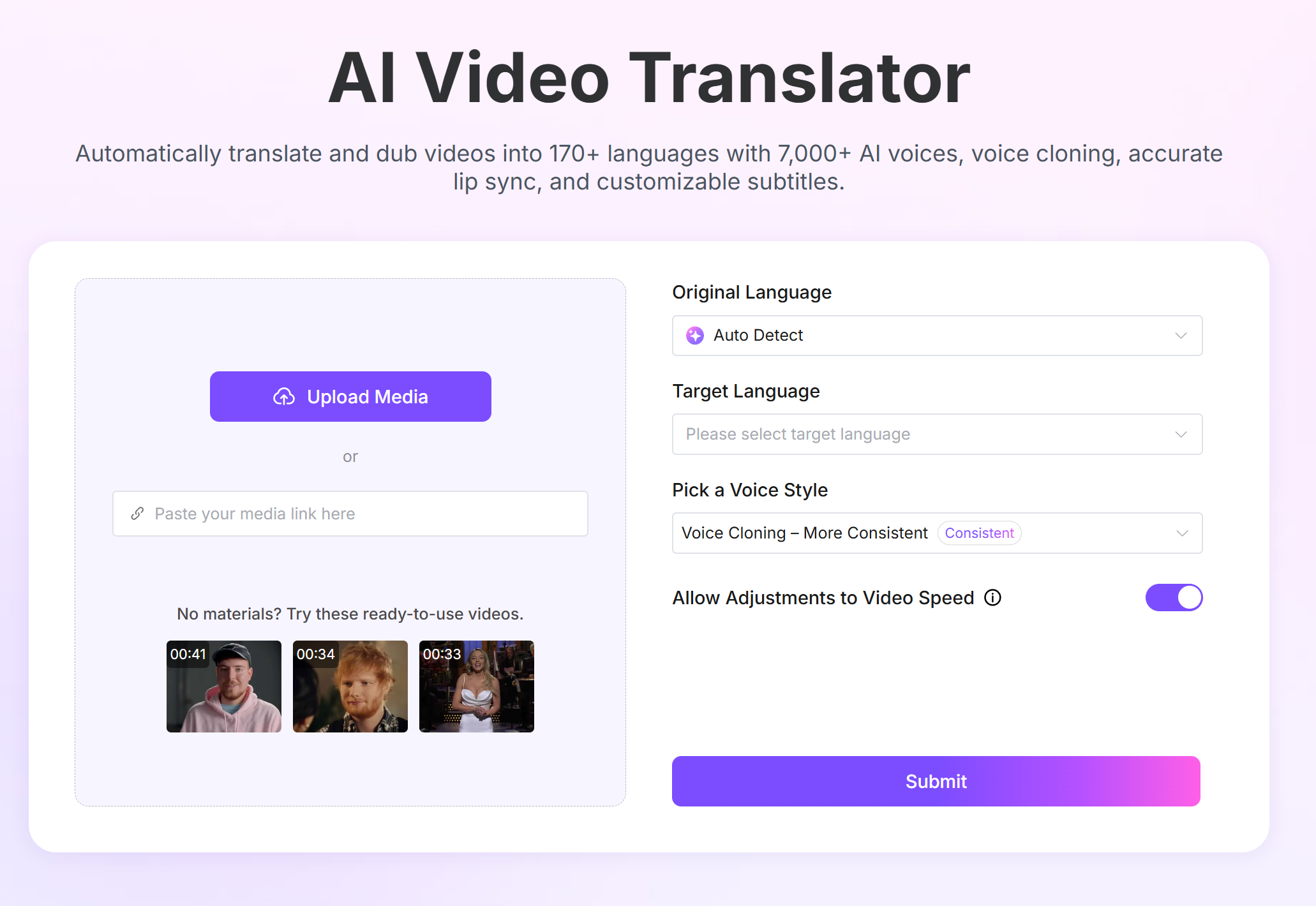
- Choose your preferences, such as the original language, target language, number of speakers, voice style, and video speed adjustments.
- Click submit, then review the generated output before downloading.
Benefits of Using VMEG AI
- Reduce localization time and cost.
- Improves scalability so that you can do more
- Faster market entry with AI
- Consistent content across regions
With VMEG, you can be more productive and focus on high-value localization tasks, as it does hard work for you, helping you save time, effort, and resources. Try VMEG AI now and see how it transforms your workflow and gives you better results.
Common Content Localization Challenges and How to Solve Them
You may encounter challenges when localizing your content, and if they are not addressed appropriately, they can affect the output and overall performance. It is best to address them immediately to prevent other issues.
Language and Meaning
One of the challenges of localization is preserving the meaning of the original language and ensuring that it sounds natural to avoid awkwardness or confusion. It is important to have a human professional verify the accuracy, clarity, and intent to ensure they are maintained.
Cultural & Regional Differences
Each region or country has its own cultural norms, humor, and symbols. Some content may work well in one market but can be inappropriate to others. It is important to research content elements, such as the message, visuals, and examples, to ensure they are culturally relevant.
Technical & Design Constraints
When content is localized, some technical and design requirements also change. The character sets, text lengths, and other formatting requirements can affect the layout and user interface. The content must be properly formatted to prevent any UI or readability issues.
Consistency & Quality
Maintaining consistent brand style, terms, and tone across languages can be difficult. Use style guides and a glossary, and create an effective workflow to ensure consistency and high-quality output across all localized content.
Process and Scalability
The process may become slower as the volume of content increases. Doing this manually can take time, so using AI platforms, AI-assisted workflows, and centralized content management helps ensure speed and quality.
Legal & Compliance
Local laws, regulations, and industry standards vary by region or country, and localized content must comply with them. Regularly review and verify these requirements to ensure legal accuracy, data privacy, and compliance with other regulations.
How to Create a Content Localization Strategy
Creating a content localization strategy can be a competitive advantage, as it can help you build an effective, efficient workflow and achieve better results.
Choose Target Markets First
Identify your target market to determine which offers the most potential. The factors you need to consider are demand, competition, language requirements, cultural differences, and regulatory constraints. It helps ensure that resources are used appropriately and that localization efforts are effective.
Localize High-Impact Content First
The value of each piece of content varies. You need to prioritize first the content that drives visibility, engagement, or conversions, such as landing pages, product descriptions, marketing campaigns, and onboarding flows. that there will be a better result and a higher return on investment.
Build a Localization Style Guide
It helps define the tone of voice, terms, formatting rules, and cultural preferences for each market. It helps maintain consistency across languages and themes and ensures that the brand identity and local relevance are maintained in each piece of content.
Combine AI Tools with Human Review
AI-powered localization tools help speed up the process, while human review ensures accuracy, nuance, and cultural relevance.
Measure Localization Success (KPIs)
To measure content success, you need to track engagement, conversion, feedback, bounce rates, and market-specific growth. This will help you determine whether the localization is effective and identify what to enhance or change in the process.
FAQs
What is content localization?
Content localization is the process of adapting content to a local audience so it feels native and resonates with them.
What is an example of content localization?
Examples of localization include changing language, tone, and formality; using local currencies and payment methods; aligning content with local customs and holidays; and following local rules and expectations.
How to do content localization?
Content localization involves changing language, dates, times, currencies, units, idioms, references, and UI elements to ensure it is relevant to the local audience.
What is the purpose of content localization?
The purpose of contract localization is to increase relevance, build trust and credibility, increase engagement, improve experience, and support global brand consistency.
What are the different types of content localization?
The different types of content include website and landing pages, marketing and sales, video, social media content, mobile apps, SaaS platforms, e-commerce product pages, e-learning, and more.
Conclusion
Content localization is an important part of reaching a global audience. Various types of content can be localized, such as social media posts, marketing materials, learning modules, and more. The best way to ensure accuracy and speed is to use AI tools that support hybrid translation, allowing humans to edit the content before publication.
VMEG provides an editing space where you can refine the AI-generated output to ensure accuracy and quality before publishing or sharing it. It also provides high accuracy, reducing editing effort so you can create and localize content faster.


The VMEG Team
Behind VMEG stands a passionate team of creatives, engineers, and language lovers. At the crossroads of AI and storytelling, they craft tools that bridge languages and cultures.