

'%3e%3cpath%20d='M21.0949%203.79395L13.9961%209.82854H21.0949V3.79395Z'%20stroke='black'%20stroke-width='1.38'%20stroke-miterlimit='10'/%3e%3cpath%20d='M13.998%209.82854L7.44531%203.79395V9.82854H13.998Z'%20stroke='black'%20stroke-width='1.38'%20stroke-miterlimit='10'/%3e%3cpath%20d='M13.9961%202.69922V25.1919'%20stroke='black'%20stroke-width='1.38'%20stroke-miterlimit='10'/%3e%3cpath%20d='M20.5488%2016.4113L13.9961%209.82812V18.2217L20.5488%2024.0918V16.4113Z'%20stroke='black'%20stroke-width='1.38'%20stroke-miterlimit='10'/%3e%3cpath%20d='M7.44531%2016.4113L13.998%209.82812V18.0526L7.44531%2024.0918V16.4113Z'%20stroke='black'%20stroke-width='1.38'%20stroke-miterlimit='10'/%3e%3cpath%20d='M4.71094%209.82812V18.6057H7.44125V16.4113L13.9941%209.82812H4.71094Z'%20stroke='black'%20stroke-width='1.38'%20stroke-miterlimit='10'/%3e%3cpath%20d='M13.9961%209.82812L20.5488%2016.4113V18.6057H23.2792V9.82812H13.9961Z'%20stroke='black'%20stroke-width='1.38'%20stroke-miterlimit='10'/%3e%3c/g%3e%3c/svg%3e)

'%3e%3cmask%20id='mask0_21456_29260'%20style='mask-type:luminance'%20maskUnits='userSpaceOnUse'%20x='0'%20y='0'%20width='28'%20height='28'%3e%3cpath%20d='M27.5%200.5H0.5V27.5H27.5V0.5Z'%20fill='white'/%3e%3c/mask%3e%3cg%20mask='url(%23mask0_21456_29260)'%3e%3cpath%20d='M14%2027.5C13.4854%2024.1035%2011.8974%2020.9608%209.46828%2018.5317C7.03922%2016.1026%203.89651%2014.5146%200.5%2014C3.89651%2013.4854%207.03922%2011.8974%209.46828%209.46828C11.8974%207.03922%2013.4854%203.89651%2014%200.5C14.5147%203.89644%2016.1028%207.03905%2018.5318%209.46816C20.9609%2011.8972%2024.1035%2013.4853%2027.5%2014C24.1035%2014.5147%2020.9609%2016.1028%2018.5318%2018.5318C16.1028%2020.9609%2014.5147%2024.1035%2014%2027.5Z'%20fill='url(%23paint0_linear_21456_29260)'/%3e%3c/g%3e%3c/g%3e%3cdefs%3e%3clinearGradient%20id='paint0_linear_21456_29260'%20x1='9.5'%20y1='9.5'%20x2='20.75'%20y2='21.875'%20gradientUnits='userSpaceOnUse'%3e%3cstop%20stop-color='%23F0DCD6'/%3e%3cstop%20offset='0.914506'%20stop-color='%231D6DFF'/%3e%3c/linearGradient%3e%3cclipPath%20id='clip0_21456_29260'%3e%3crect%20width='28'%20height='28'%20fill='white'/%3e%3c/clipPath%3e%3c/defs%3e%3c/svg%3e)
'%3e%3cpath%20d='M22.8019%2011.2412L23.5234%2011.6807V12.0103L23.3172%2012.7796L14.5579%2014.9771L13.7344%2012.7951L22.8019%2011.2412Z'%20fill='%23D97757'/%3e%3cpath%20d='M19.5236%204.77832L20.5322%205.00396L20.8%205.35575L21.0552%206.19876L20.9494%206.73644L15.0712%2015.3068L13.1133%2013.2191L18.5338%205.63471L19.5236%204.77832Z'%20fill='%23D97757'/%3e%3cpath%20d='M14.4577%203.43951L15.0761%203L15.5912%203.21976L16.1065%203.9889L14.6949%2013.0345L13.7364%2012.3397L13.3242%2011.131L14.0456%204.31853L14.4577%203.43951Z'%20fill='%23D97757'/%3e%3cpath%20d='M7.84766%203.5851L8.48285%202.7199L8.89716%202.61914L9.71923%202.74717L10.125%203.08581L13.0815%2010.0748L14.1509%2013.3954L12.8997%2014.1372L8.13117%204.91019L7.84766%203.5851Z'%20fill='%23D97757'/%3e%3cpath%20d='M4.77232%208.38688L4.56641%207.50742L5.18478%206.73828L5.90613%206.84816H6.11223L10.4403%2010.2544L11.78%2011.3531L13.6349%2012.8914L12.6044%2014.7594L11.6769%2013.9903L11.0586%2013.331L5.08168%208.82593L4.77232%208.38688Z'%20fill='%23D97757'/%3e%3cpath%20d='M3.53288%2014.0982L3.06641%2013.5489L3.06647%2013.0601L3.53288%2012.8896L8.78833%2013.2193L13.9408%2013.6588L13.7736%2014.7528L3.94502%2014.2082L3.53288%2014.0982Z'%20fill='%23D97757'/%3e%3cpath%20d='M6.62378%2019.8178H5.59334L5.18359%2019.3146V18.7132L6.93299%2017.3946L14.045%2012.5674L14.7648%2013.8785L6.62378%2019.8178Z'%20fill='%23D97757'/%3e%3cpath%20d='M8.57739%2022.8884L8.16518%2022.9984L7.54688%2022.6687L7.64995%2022.1193L13.7299%2013.5488L14.5543%2014.7574L10.0201%2021.1305L8.57739%2022.8884Z'%20fill='%23D97757'/%3e%3cpath%20d='M13.7361%2023.9861L13.4271%2024.4257L12.8088%2024.6454L12.2935%2024.2058L11.9844%2023.5466L13.5301%2014.6465L14.4576%2014.7563L13.7361%2023.9861Z'%20fill='%23D97757'/%3e%3cpath%20d='M18.9869%2021.5713V22.4503L18.8838%2022.7799L18.4716%2022.9997L17.7503%2022.8974L12.7969%2015.0367L14.7617%2013.4404L16.4104%2016.6269L16.5652%2017.7805L18.9869%2021.5713Z'%20fill='%23D97757'/%3e%3cpath%20d='M21.3629%2020.2507L21.4659%2020.8L21.1568%2021.2396L20.8476%2021.1297L19.0958%2019.8112L16.4165%2017.284L14.3555%2015.7457L14.9736%2013.6582L16.0041%2014.3175L16.6226%2015.5259L21.3629%2020.2507Z'%20fill='%23D97757'/%3e%3cpath%20d='M20.0232%2014.6482L22.5995%2014.8679L23.2178%2015.3074L23.6299%2015.9667V16.441L22.4964%2016.9556L16.7256%2015.4173L14.3555%2015.3074L14.9737%2013L16.6226%2014.3185L20.0232%2014.6482Z'%20fill='%23D97757'/%3e%3c/g%3e%3c/svg%3e)
Gaining access to the international markets is not just having words translated but meaning, culture and experience. In the case of global brands, it is crucial to know what is meant by localization vs internationalization in order to reach out to the audiences across borders. The two are typically said together, though they play different roles in ensuring that your content, particularly video and multimedia, appeals to the global audience.
We will discuss the 7 major differences between localization and internationalization, the importance of these differences and how solutions such as VMEG AI - The Ultimate Multimedia Translator are transforming the process through which global brands will localize video content.
Understanding the Basics
To discuss the differences, it is better to specify what each of the terms refers to:
- Localization (L10n): Localization refers to the process of making content local to a specific language, cultural bias and regional specifics of a particular target market. To illustrate, when marketing a video to the U.S. it may require new subtitles, localised voiceovers and even some different visuals where it was aimed at the Japanese or French markets.
- Internationalization (I18n): Before localisation, there is internationalization. It entails product, software and media design to ensure that they can be easily adapted to other markets in the future. It has something to do with getting ready so that your content or platform can be translated and adapted to various cultures in the future with ease.
Consider it in the following way: internationalization is the base and localization is the personalization created on the base of it.
1. Purpose and Focus
The purpose of localization vs internationalization is the major distinction between the two.
- Localization is concerned with the appropriation of the existing content to fit a particular area. This involves text translation, tone matching of voices, currency exchange, modifications of images or even adapting of humor to the indigenous culture.
- Internationalization, however, is more concerned with the preparation of your product or media so that it can be used in future to underpin localization. This involves devising an open system-like system-code like multi-lingual code or video code that can accommodate easily integrated subtitles.
Example: In case you develop an e-learning platform, internationalization will make sure that your software will be capable of accepting various language inputs and date formats. It is then localized to Spanish, Japanese or Arabic speakers.
2. Process Timeline
The other significant difference between the localization and internationalization is their occurrence in the development or the production enterprise.
- The first one occurs in internationalization, when designing or production. It will make sure that your product or content is globally adaptable.
- Localization occurs after the process by which you make the decision to join particular markets.
To localize videos: In VMEG AI, creators are able to internationalize their workflow by generating videos with flexible subtitle tracks or script templates. Subsequently, the AI-based translation engine at VMEG AI has the capability to localize the videos in 170+ languages creating natural lip sync and natural voiceovers.
This sequence reduces the reworking and allows the seamless nature of the links between various languages and cultures.
3. Scope of Work
The degree to which adaptation goes deep is determined by the scope of each process.
- Localization deals with content at a surface and deep-level, that is, language, images, cultural content, gestures, and even pacing.
- Internationalization is more technical and structural- this is because it makes sure that the underlying system is capable of responding to the changes in a smooth way.
Example: The internationalization of a streaming platform may include the creation of its application that supports the use of right-to-left scripts, such as Arabic. The localization is then used in adapting its movie descriptions, artwork and subtitles to that region.
VMEG AI eases this phase, as it presents a single platform that streamlines the internationalization and the localization processes in a way that makes them compatible with each other, that is, the brands can expand their business to the international level without any need to employ multiple language professionals.
4. Technical vs Cultural Adaptation
Another critical dimension that is important in localization vs internationalization is the technical vs cultural dimension.
- The internationalization is more technical. It is related to code structures, file format and system level flexibility.
- Localization is cultural. It dwells upon the tone, emotion, imagery and style of communication that suits the culture of the target audience.
As an example, a color and a symbol that does not have a negative connotation in a certain area will have a negative meaning in another area. On the same note, humor or idioms are usually lost in literal translations.
The solution to this cultural-technical gap is VMEG AI that incorporates AI-generated voice replication and emotion matching, which allow localized videos to sound natural and culturally accurate. It does not just translate words but it localizes the whole process of listening and seeing.
5. Who’s Involved
These two stages are dealt with by different teams.
- Developers, engineers and system architects are usually involved in internationalization. They are supposed to ensure that the infrastructure is capable of supporting multilingual and multi-cultural content.
- Localization entails linguists, translators, voice artists, marketers and cultural consultants to localize the final content to suit the target market.
This process is rather complicated in the case of global brands that deal with video or audio-based content. But VMEG AI makes a difference by automating these processes. Its user-friendly platform enables its creators and educators to post their content and have an entirely localized video, with lips, native voices and accurate subtitles, within minutes, not weeks.
6. Impact on Global Growth
- Localization vs internationalization also dictate the speed at which an internationalization of a brand will take place and its effectiveness.
- Scalability is guaranteed through internationalization. With internationalized systems, the process of introducing new languages or regions is made a lot easier and cheaper.
- Engagement is achieved through localization. Users will tend to connect, share and trust your brand more when the content is authentic and relatable.
Case Scenario: We will consider a case of a company in the world that organizes education in various countries. In case its platform is already globalized (it supports various scripts, currencies, and time zones), it can be localized with ease with a solution such as VMEG AI- which can translate video lectures, find speaker voices, and synchronize lips automatically.
The strategy is effective not only in terms of increased accessibility but also brand loyalty and credibility in markets.
7. End Goal and Measurement of Success
Lastly, the localization and internationalization goal outcomes are very different.
The success of internationalization is determined by the ease with which the material can be translated into other languages without significant technical complications.
The impact of localization is gauged by the degree to which the content that is adapted appeals to the target audience.
Even a video that is perfectly internationalized can not work unless it is localized and the cultural touch or the natural conversation is correct. On the same note, a high level of localization will be more efficient when it is founded on an effective internationalization framework.
VMEG AI balances the two extremes. It enables global brands to make content that is truly multilingual at the expense of international readiness (via multi-format video compatibility) and high-quality localization (via AI-driven translation and voice matching).
How VMEG AI Enhances Video Localization
To get a more precise idea of the place of VMEG AI - The Ultimate Multimedia Translator in this ecosystem, we should consider it in a bit more detail.
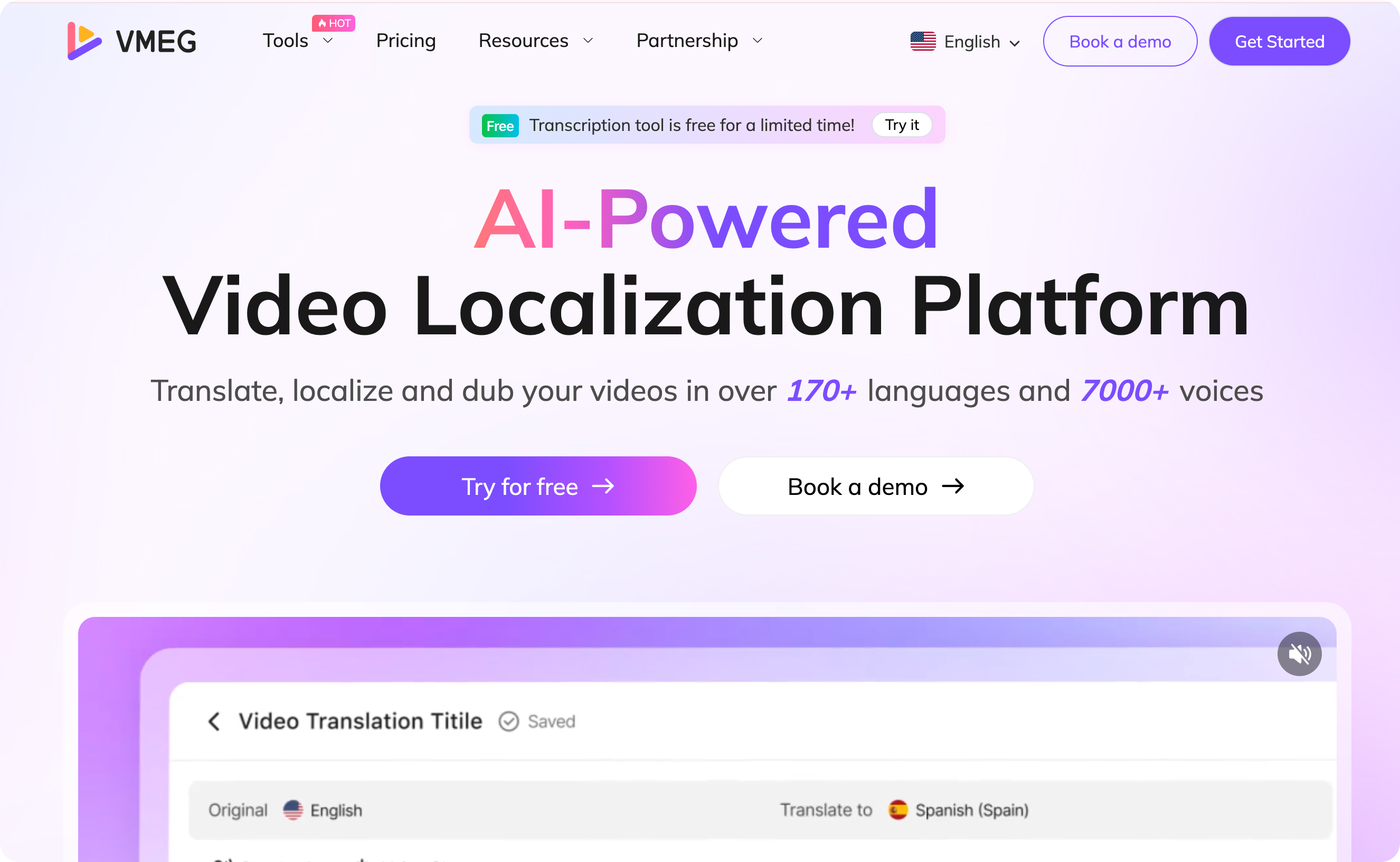
1. Beyond Text: Voices and Faces Translation
VMEG AI does not only translate subtitles, but also the overall video experience. It identifies lips, recreates voices and provides emotionally correct translations using sophisticated AI. This is to make sure your localized videos are not robotic.
2. Supports 170+ Languages
VMEG AI supports more than 170 languages in English and Spanish to Korean and Swahili, one of the most accommodative tools of localizing multimedia.
3. Transcript Extraction on YouTube Automatically
To creators and marketers, VMEG AI has the ability to automatically extract and translate the transcripts on YouTube, which makes the process of localization more rapid than ever before.
4. User-Friendly and Fast
Its interface is developed to be user friendly- drag, drop, translate. You can make your videos multilingual in minutes, regardless of whether you are a small business, educator or content creator.
5. Ideal for Professionals
VMEG AI eases the professional globalization of creators, educators, and global marketers - effortlessly overcoming the technical and cultural divide.
Comparison Table: Localization vs Internationalization
Aspect | Localization | Internationalization |
Focus | Adapting content for specific regions | Designing content to support multiple regions |
Timing | Happens after production | Happens during design/development |
Nature | Cultural and linguistic | Technical and structural |
Teams Involved | Translators, marketers, cultural experts | Developers, designers, engineers |
Output | Region-specific content | Globally adaptable framework |
Goal | Engagement and relatability | Scalability and flexibility |
Tool Example | VMEG AI for translating and lip-syncing videos | Multilingual-ready video templates or systems |
Reason Why Global Brands Should Care
The knowledge of localization / internationalization is not only a technical difference but it is a strategic benefit. Those that succeed in both can go global more quickly, examine stronger emotional bonds, and can have a stable brand image in different regions.
It is now possible to create localization of the professional quality even in small teams with the help of AI-driven tools such as VMEG AI, without the heavy budgets and complicated workflow. Translating a podcast, an educational video or a marketing campaign, VMEG AI makes sure that your message sounds natural, authentic and accessible to all parts of the world.
Final Thoughts
To live in a world where videos rule the digital narrative, it is no longer a matter of choice, more than necessity to master localization vs internationalization. Although internationalization preconditions international flexibility, localization makes your content real to each individual audience.
The two of them are a team of strength in defining how brands communicate, educate, and inspire across borders. And through devices such as VMEG AI -The Ultimate Multimedia Translator, international communication has been made human and effortless.
As a creator who wants to tap into multilingual markets or a global brand entering new markets, it is high time to invest in a smarter, AI-driven localization that speaks every language of your target audience.


The VMEG Team
Behind VMEG stands a passionate team of creatives, engineers, and language lovers. At the crossroads of AI and storytelling, they craft tools that bridge languages and cultures.