Introduction
Imagine watching an AI-dubbed interview where the host suddenly starts speaking with the guest’s cloned voice.
Or reading subtitles where every response is attributed to the wrong person.
The transcription itself may be perfectly correct, but the experience immediately feels broken.
This is why speaker diarization matters.
Speaker diarization answers one simple question:
Who spoke, and when?
Yet solving that question reliably in real-world videos remains surprisingly difficult.
More importantly, optimizing speaker diarization alone does not necessarily improve the overall user experience. In production AI video localization systems, it often competes with transcription accuracy, subtitle segmentation, translation quality, and dubbing consistency.
This article explores why.
From Speech to Localized Video
Speaker diarization is only one step in a much larger pipeline.
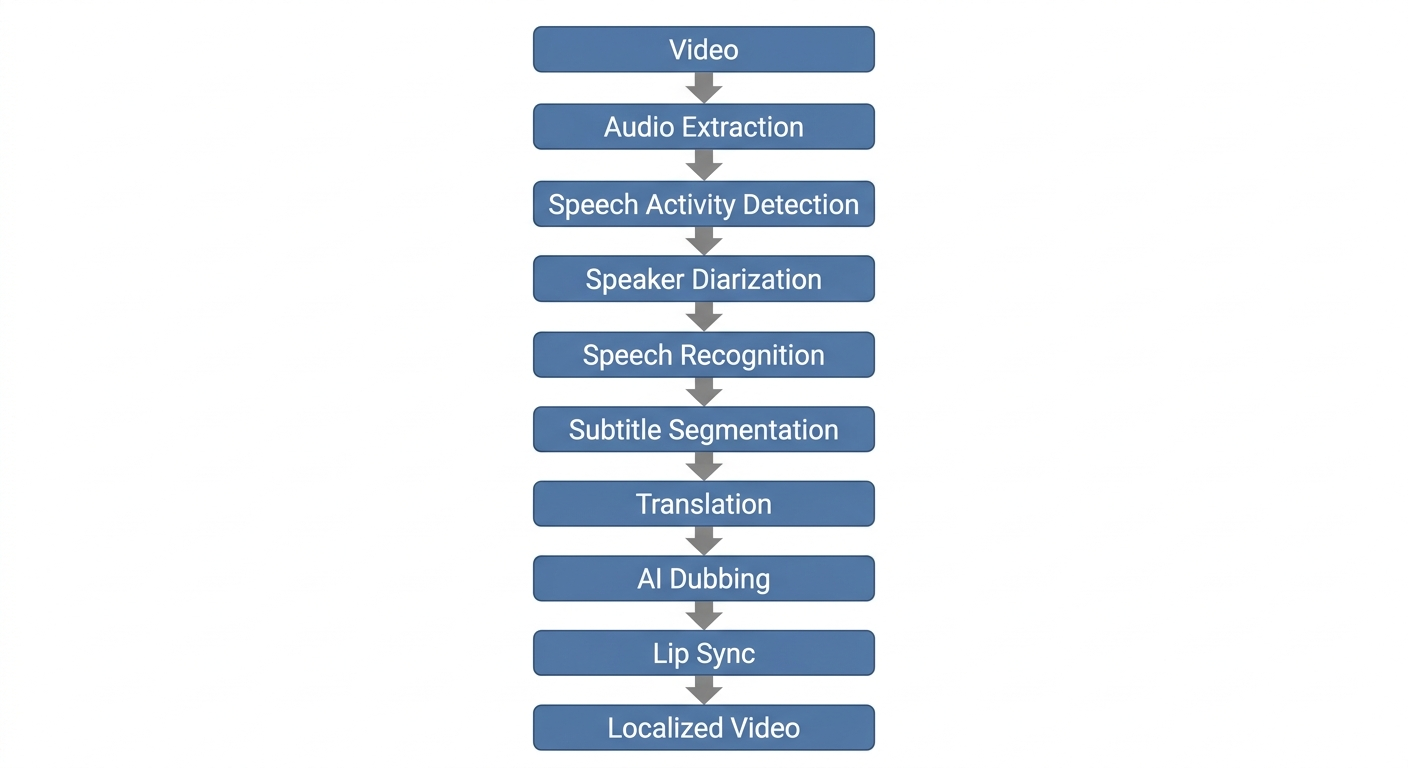
A mistake near the beginning propagates all the way to the final video.
One incorrect speaker label can result in:
- incorrect subtitles
- inconsistent translations
- wrong cloned voices
- broken dialogue flow
- distracting viewing experience
Why Speaker Diarization Matters
For many applications, speaker identity is just as important as the spoken words.
Consider a podcast.
Without diarization:
Welcome everyone.

Thanks for inviting me.

Let's talk about AI.

Absolutely.
With diarization:
Host:
Welcome everyone.

Guest:
Thanks for inviting me.

Host:
Let's talk about AI.

Guest:
Absolutely.
The transcript becomes immediately easier to understand.
Now imagine translating that conversation into Japanese or generating AI dubbing.
Without consistent speaker labels, maintaining dialogue coherence becomes much more difficult.
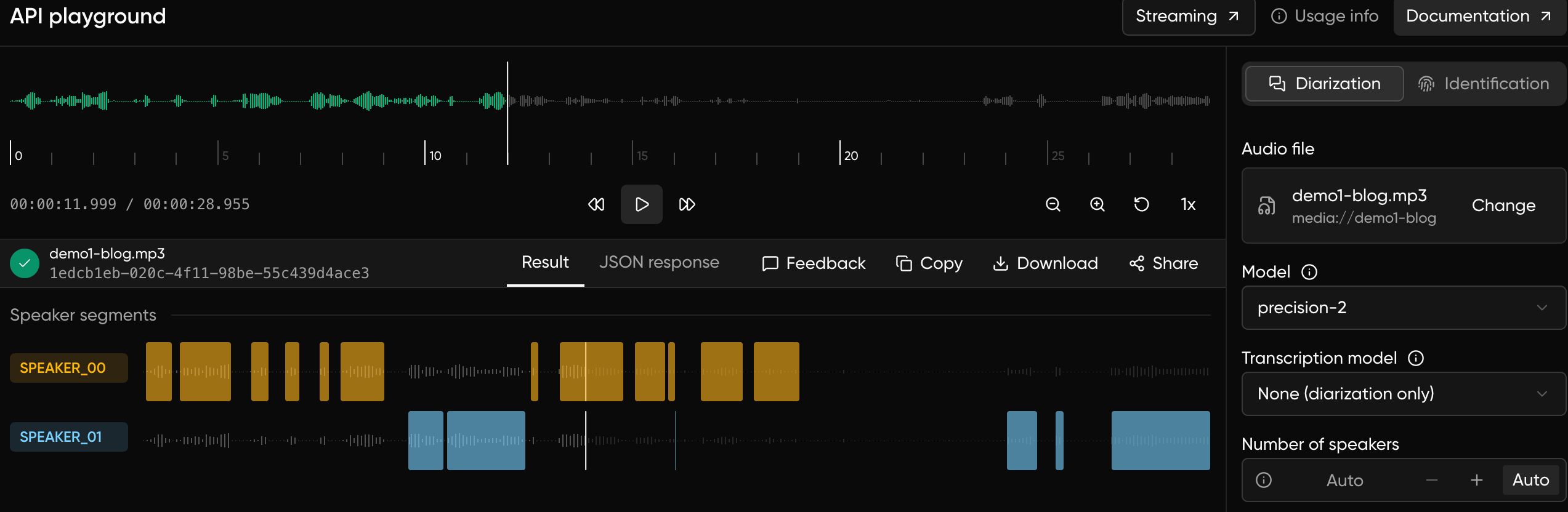
Pyannote:
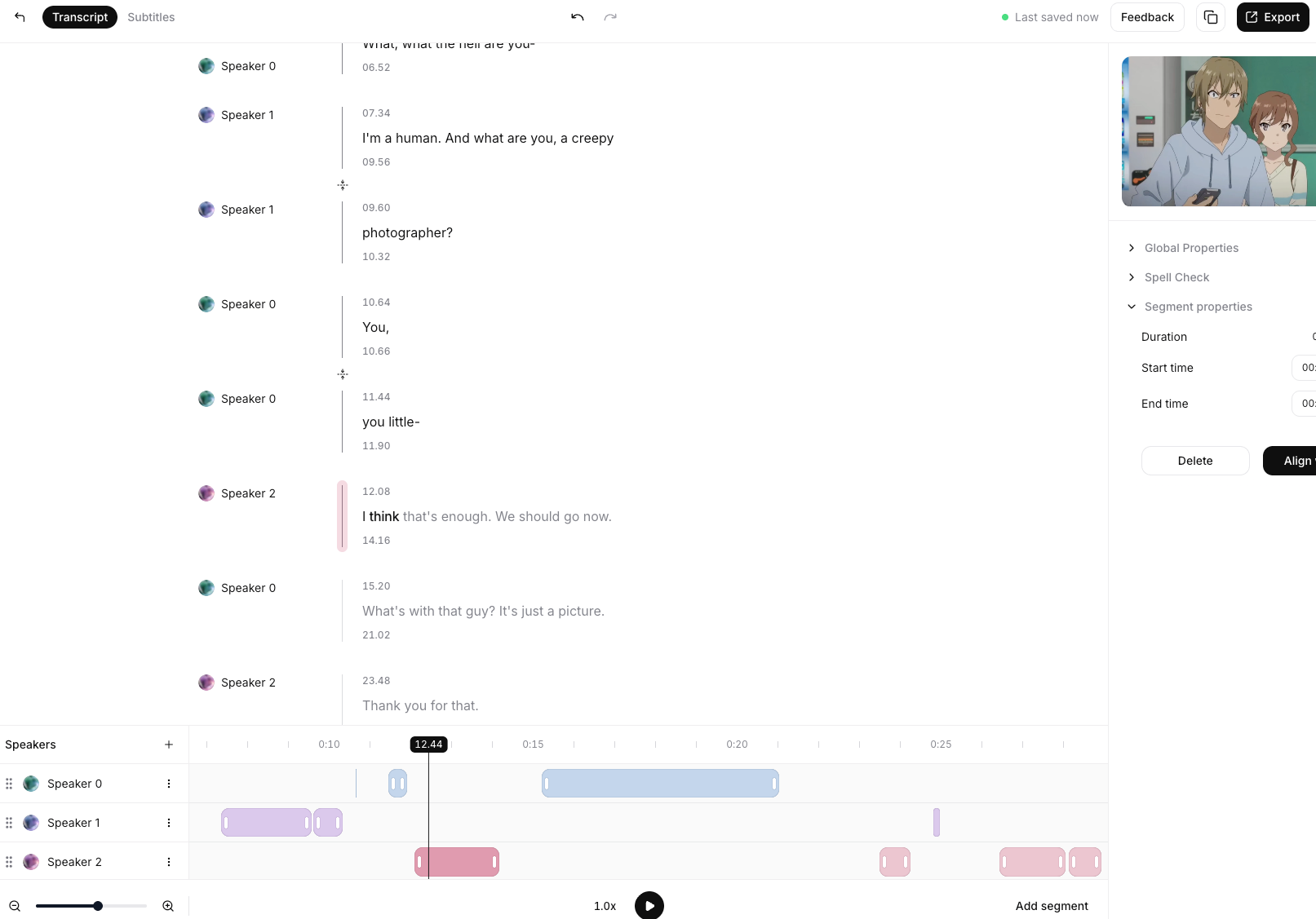
ElevenLabs:
VMEG:
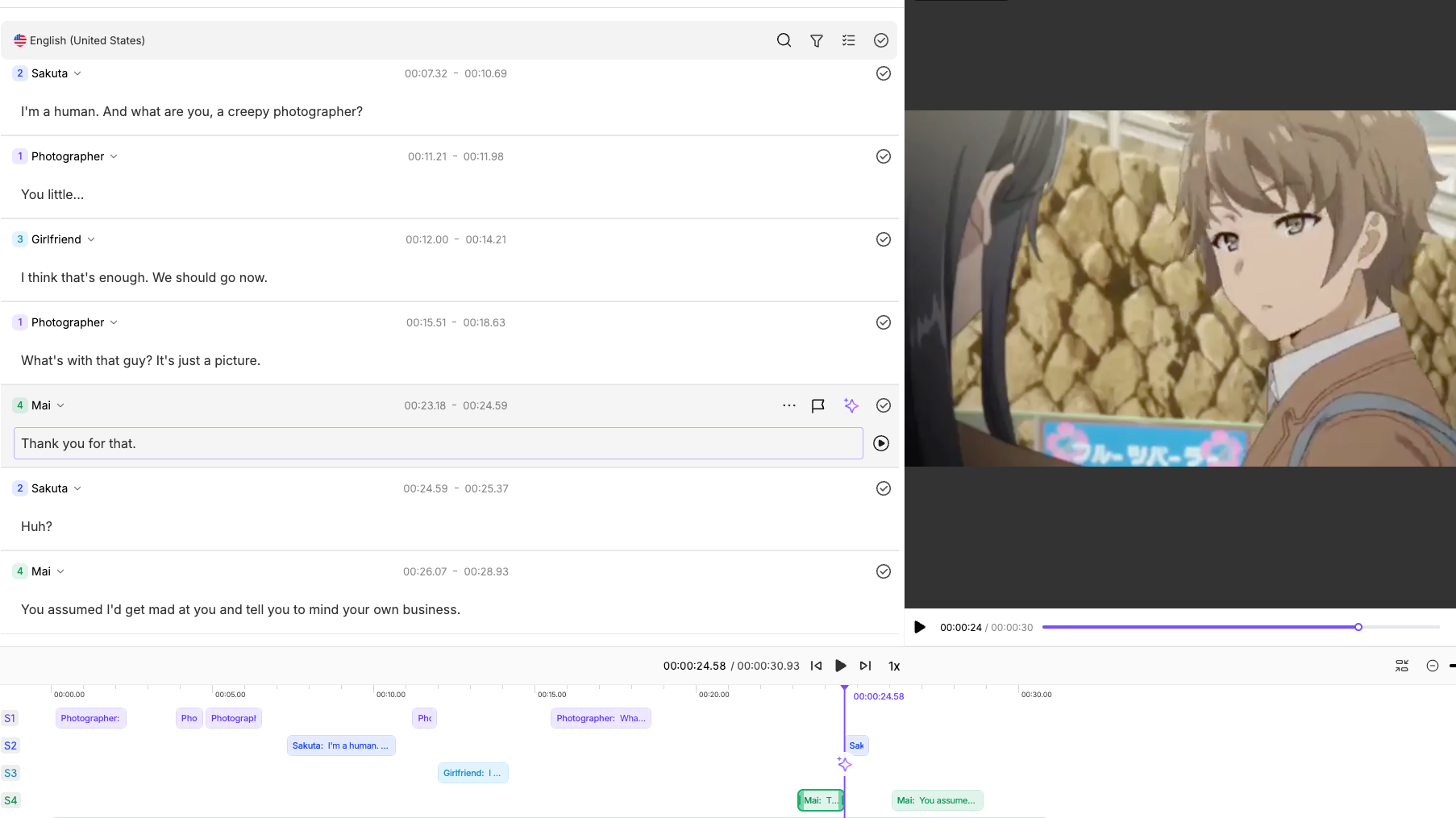
In this case, ElevenLabs only identified three speakers, which means it believes two girls are the same. In fact, there are four speakers, two males and two females, while pyannote only recognized two. The mistake will cause voice consistency issues in the whole task of video dubbing.
Why It Is Still Hard
Many benchmark datasets make speaker diarization look nearly solved.
Real-world videos tell a different story.
Some common challenges include:
| Challenge | Why it matters |
|---|---|
| Overlapping speech | Multiple speakers talk simultaneously |
| Background music | Speaker embeddings become less reliable |
| Similar voices | Family members or coworkers may sound alike |
| Emotional speech | Laughter, shouting, whispering change voice characteristics |
| Short responses | “Yeah”, “Okay”, “Mm-hmm” provide little speaker information |
| Noisy recordings | Mobile phones, echoes, traffic reduce accuracy |
| Long videos | Speaker drift accumulates over time |
Modern diarization systems perform well under controlled conditions, but accuracy can degrade substantially in unconstrained videos such as interviews, vlogs, livestreams, or documentaries.
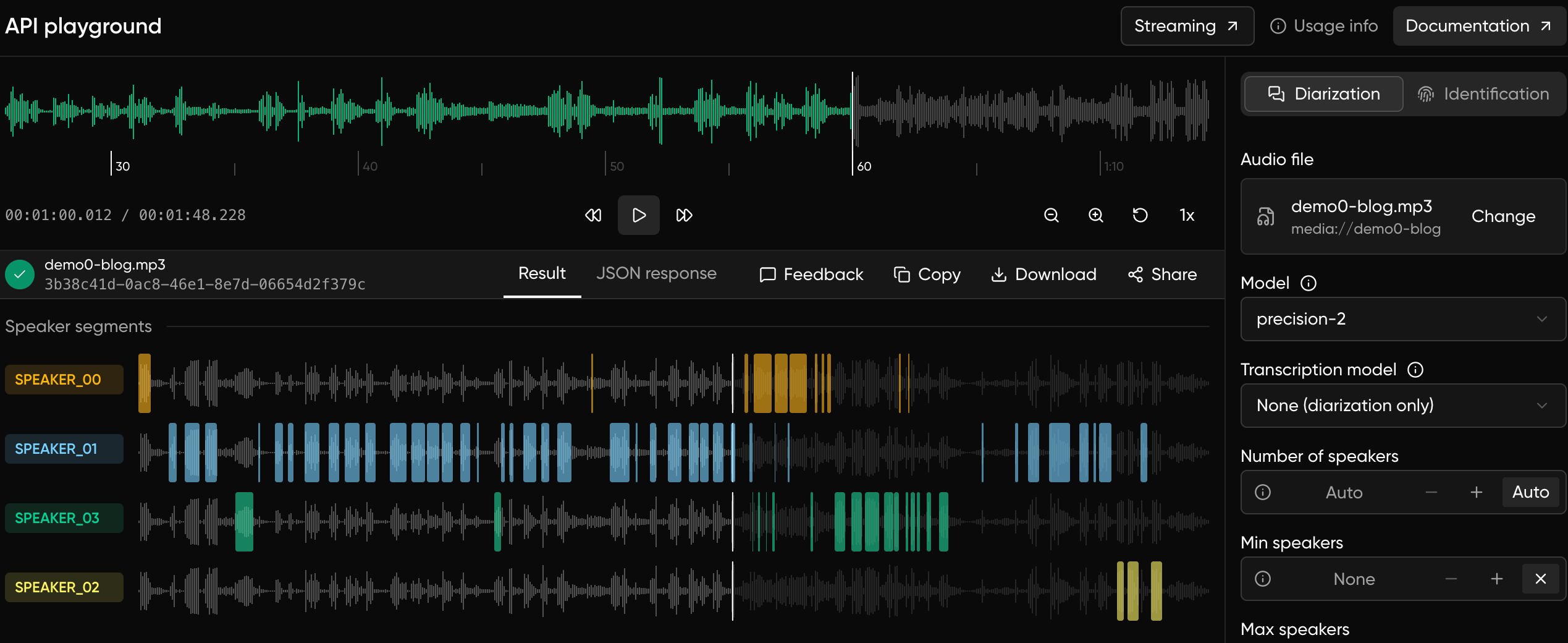
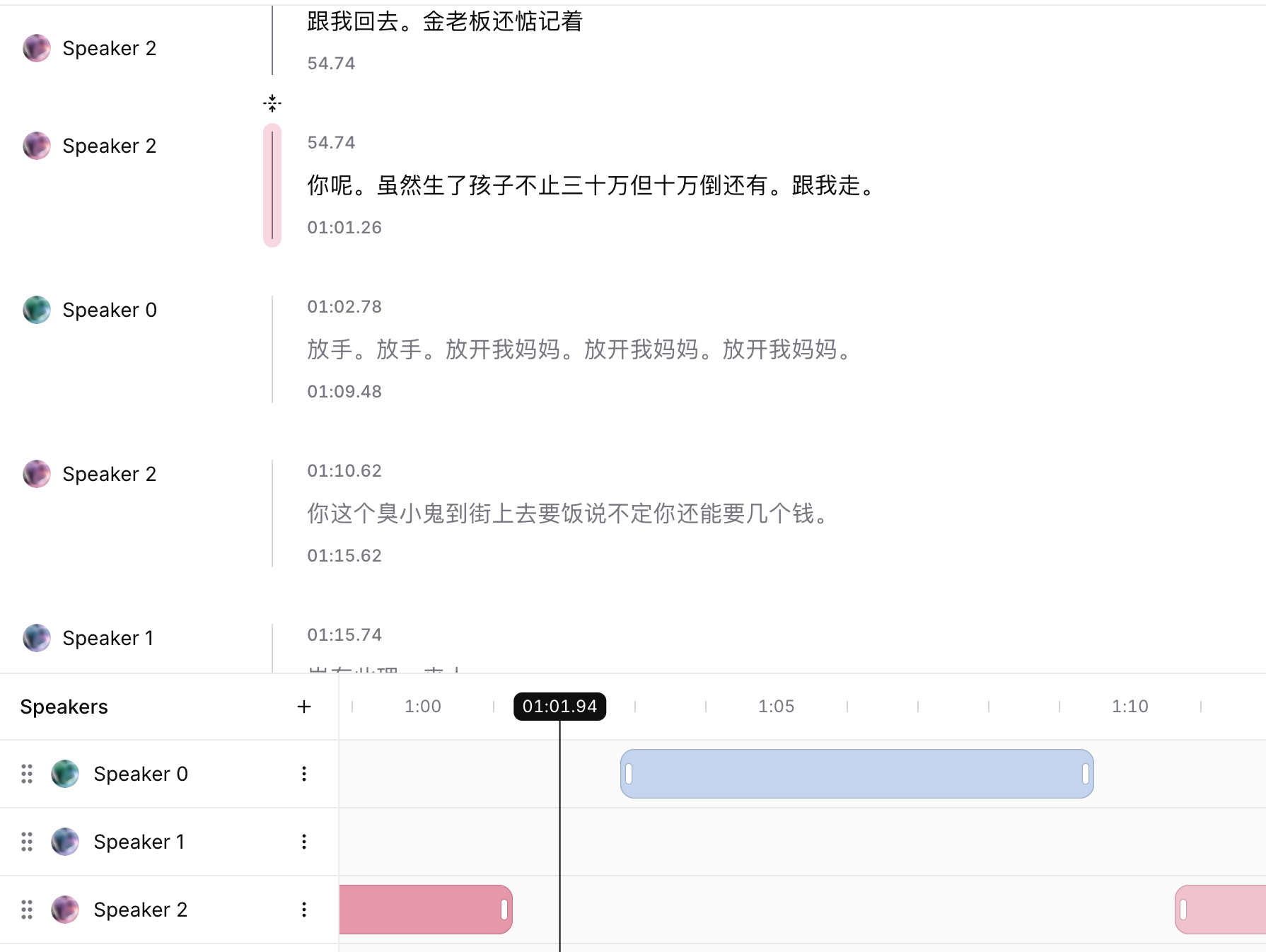
Below is one typical short drama example of comparison between VMEG and one top speech-to-text provider Elevenlabs.
Pyannote:
Elevenlabs:
VMEG:
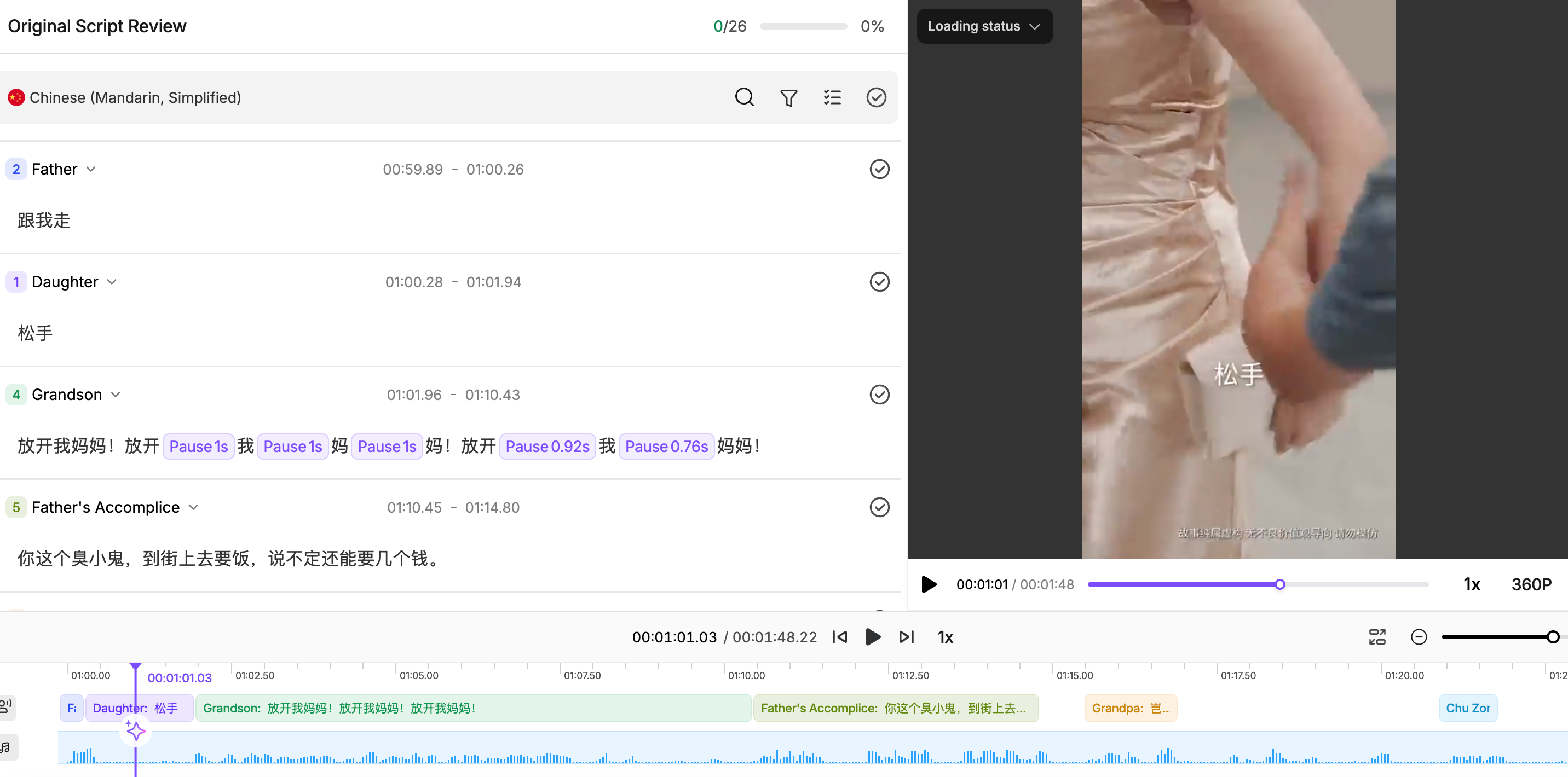
Starting from 00:59.89 to 01:15.00, there are four speakers: father, daughter, grandson and father's accomplice(maybe father's son), which are successfully and correctly identified by VMEG. However, Elevenlabs mistakenly recognized daughter and grandon as one speaker, father and father's accomplice as one speaker. These mistakes will lead to serious voice consistency issues during dubbing.
Benchmarks Tell Only Part of the Story
Speaker diarization is typically evaluated using Diarization Error Rate (DER).
DER measures three types of errors:
- Missed speech
- False alarms
- Speaker confusion
On widely used research datasets, state-of-the-art systems often report DER values roughly in these ranges:
| Scenario | Typical DER* |
|---|---|
| Clean meeting recordings | 5–10% |
| Telephone conversations | 8–15% |
| Podcasts | 10–20% |
| YouTube videos | 15–30% |
| Heavy overlap / noisy recordings | 20–40%+ |
*Representative ranges reported across different datasets and evaluation settings. Exact performance varies significantly with overlap rate, recording quality, and evaluation protocol.
These numbers highlight an important point:
Speaker diarization is far from a solved problem in real-world media.
The Hidden Trade-off: Diarization vs. Transcription
Many people assume better diarization always improves transcription.
It doesn’t.
Consider this conversation:
Speaker A:
I think—

Speaker B:
Exactly.
A transcription model optimized for readability might produce:
I think exactly.A diarization model prefers:
Speaker A:
I think—

Speaker B:
Exactly.
Both outputs are reasonable, but they optimize different objectives.
Speech recognition aims to reconstruct language naturally.
Speaker diarization aims to identify speaker boundaries accurately.
Sometimes those goals conflict.
Another Trade-off: Diarization vs. Subtitle Segmentation
Subtitle systems introduce another constraint.
Good subtitles should:
- preserve complete thoughts
- minimize reading effort
- maintain balanced line lengths
- remain synchronized with speech
Suppose the conversation is:
Host:
I believe the best solution is—

Guest:
—to start with small experiments.
A subtitle system may prefer:
I believe the best solution
is to start with small experiments.
A diarization system prefers splitting exactly at the speaker change.
Neither output is universally correct.
This is why optimizing individual AI components independently often produces worse subtitles.
A Small Diarization Error Can Have a Large UX Impact
DER treats every second equally.
Users don’t.
Imagine a 45-minute interview.
If one speaker switch is missed at the 5-minute mark, every subsequent subtitle may be assigned to the wrong speaker until the next correction.
Technically:
- DER increases only slightly.
Practically:
- the cloned voices become inconsistent,
- subtitles become confusing,
- viewers immediately notice.
Production systems should therefore optimize user experience, not just benchmark scores.
Speaker Diarization Is Only One Objective
Video localization simultaneously optimizes several competing goals.
| Component | Primary objective |
|---|---|
| Speech recognition | Maximize transcription accuracy |
| Speaker diarization | Maximize speaker consistency |
| Subtitle segmentation | Improve readability |
| Translation | Preserve meaning |
| AI dubbing | Natural speech timing |
| Lip sync | Visual synchronization |
Improving one objective can degrade another.
This is one reason why production systems differ significantly from academic benchmarks.
Best Practices for Production Systems
Based on our experience building multilingual AI video localization pipelines, several engineering principles consistently improve the final viewing experience.
Optimize the pipeline, not individual models
The best diarization model is not necessarily the one with the lowest DER.
Instead, evaluate how speaker labels affect subtitles, translation, dubbing, and lip synchronization.
Combine acoustic and linguistic signals
Speaker embeddings alone are often insufficient.
Transcription timestamps, punctuation, conversational structure, and dialogue context can all help refine speaker boundaries.
Avoid unnecessary speaker switches
Frequent label changes create visual noise and inconsistent voice assignments.
Temporal smoothing often improves overall user experience.
Evaluate with real production videos
Meeting benchmarks are useful, but customer videos contain music, editing cuts, narration, overlapping speech, and multilingual conversations.
Always validate on production data.
Looking Beyond DER
As video localization systems become more sophisticated, traditional diarization metrics tell only part of the story.
Future evaluation should also consider questions like:
- Does the speaker keep the same synthetic voice throughout the video?
- Does translation preserve dialogue correctly?
- Are subtitles easier to read?
- Does the dubbed conversation feel natural?
- Does the final localized video improve user satisfaction?
Ultimately, users never experience a diarization score.
They experience the finished video.
Conclusion
Speaker diarization is much more than assigning speaker labels.
It sits at the intersection of speech recognition, subtitle generation, translation, AI dubbing, and lip synchronization.
Its success should not be measured solely by benchmark accuracy, but by how effectively it improves the end-to-end localization experience.
The most effective production systems recognize this and optimize the pipeline as a whole, balancing competing objectives rather than maximizing a single metric.
References
- Bredin, H., et al. pyannote.audio: Neural Building Blocks for Speaker Diarization. https://github.com/pyannote/pyannote-audio
- NVIDIA NeMo Speaker Diarization Documentation. https://docs.nvidia.com/nemo-framework/
- DIHARD Speaker Diarization Challenge. https://dihardchallenge.github.io/
- AMI Meeting Corpus. https://groups.inf.ed.ac.uk/ami/corpus/
- VoxConverse Dataset. https://github.com/joonson/voxconverse
- Park, T., et al. A Review of Speaker Diarization: Recent Advances with Deep Learning. https://arxiv.org/abs/2101.09624
- NIST Rich Transcription Evaluation. https://www.nist.gov/itl/iad/mig/rich-transcription-evaluation
- ElevenLabs Speech to Text. https://elevenlabs.io/speech-to-text