

'%3e%3cpath%20d='M21.0949%203.79395L13.9961%209.82854H21.0949V3.79395Z'%20stroke='black'%20stroke-width='1.38'%20stroke-miterlimit='10'/%3e%3cpath%20d='M13.998%209.82854L7.44531%203.79395V9.82854H13.998Z'%20stroke='black'%20stroke-width='1.38'%20stroke-miterlimit='10'/%3e%3cpath%20d='M13.9961%202.69922V25.1919'%20stroke='black'%20stroke-width='1.38'%20stroke-miterlimit='10'/%3e%3cpath%20d='M20.5488%2016.4113L13.9961%209.82812V18.2217L20.5488%2024.0918V16.4113Z'%20stroke='black'%20stroke-width='1.38'%20stroke-miterlimit='10'/%3e%3cpath%20d='M7.44531%2016.4113L13.998%209.82812V18.0526L7.44531%2024.0918V16.4113Z'%20stroke='black'%20stroke-width='1.38'%20stroke-miterlimit='10'/%3e%3cpath%20d='M4.71094%209.82812V18.6057H7.44125V16.4113L13.9941%209.82812H4.71094Z'%20stroke='black'%20stroke-width='1.38'%20stroke-miterlimit='10'/%3e%3cpath%20d='M13.9961%209.82812L20.5488%2016.4113V18.6057H23.2792V9.82812H13.9961Z'%20stroke='black'%20stroke-width='1.38'%20stroke-miterlimit='10'/%3e%3c/g%3e%3c/svg%3e)

'%3e%3cmask%20id='mask0_21456_29260'%20style='mask-type:luminance'%20maskUnits='userSpaceOnUse'%20x='0'%20y='0'%20width='28'%20height='28'%3e%3cpath%20d='M27.5%200.5H0.5V27.5H27.5V0.5Z'%20fill='white'/%3e%3c/mask%3e%3cg%20mask='url(%23mask0_21456_29260)'%3e%3cpath%20d='M14%2027.5C13.4854%2024.1035%2011.8974%2020.9608%209.46828%2018.5317C7.03922%2016.1026%203.89651%2014.5146%200.5%2014C3.89651%2013.4854%207.03922%2011.8974%209.46828%209.46828C11.8974%207.03922%2013.4854%203.89651%2014%200.5C14.5147%203.89644%2016.1028%207.03905%2018.5318%209.46816C20.9609%2011.8972%2024.1035%2013.4853%2027.5%2014C24.1035%2014.5147%2020.9609%2016.1028%2018.5318%2018.5318C16.1028%2020.9609%2014.5147%2024.1035%2014%2027.5Z'%20fill='url(%23paint0_linear_21456_29260)'/%3e%3c/g%3e%3c/g%3e%3cdefs%3e%3clinearGradient%20id='paint0_linear_21456_29260'%20x1='9.5'%20y1='9.5'%20x2='20.75'%20y2='21.875'%20gradientUnits='userSpaceOnUse'%3e%3cstop%20stop-color='%23F0DCD6'/%3e%3cstop%20offset='0.914506'%20stop-color='%231D6DFF'/%3e%3c/linearGradient%3e%3cclipPath%20id='clip0_21456_29260'%3e%3crect%20width='28'%20height='28'%20fill='white'/%3e%3c/clipPath%3e%3c/defs%3e%3c/svg%3e)
'%3e%3cpath%20d='M22.8019%2011.2412L23.5234%2011.6807V12.0103L23.3172%2012.7796L14.5579%2014.9771L13.7344%2012.7951L22.8019%2011.2412Z'%20fill='%23D97757'/%3e%3cpath%20d='M19.5236%204.77832L20.5322%205.00396L20.8%205.35575L21.0552%206.19876L20.9494%206.73644L15.0712%2015.3068L13.1133%2013.2191L18.5338%205.63471L19.5236%204.77832Z'%20fill='%23D97757'/%3e%3cpath%20d='M14.4577%203.43951L15.0761%203L15.5912%203.21976L16.1065%203.9889L14.6949%2013.0345L13.7364%2012.3397L13.3242%2011.131L14.0456%204.31853L14.4577%203.43951Z'%20fill='%23D97757'/%3e%3cpath%20d='M7.84766%203.5851L8.48285%202.7199L8.89716%202.61914L9.71923%202.74717L10.125%203.08581L13.0815%2010.0748L14.1509%2013.3954L12.8997%2014.1372L8.13117%204.91019L7.84766%203.5851Z'%20fill='%23D97757'/%3e%3cpath%20d='M4.77232%208.38688L4.56641%207.50742L5.18478%206.73828L5.90613%206.84816H6.11223L10.4403%2010.2544L11.78%2011.3531L13.6349%2012.8914L12.6044%2014.7594L11.6769%2013.9903L11.0586%2013.331L5.08168%208.82593L4.77232%208.38688Z'%20fill='%23D97757'/%3e%3cpath%20d='M3.53288%2014.0982L3.06641%2013.5489L3.06647%2013.0601L3.53288%2012.8896L8.78833%2013.2193L13.9408%2013.6588L13.7736%2014.7528L3.94502%2014.2082L3.53288%2014.0982Z'%20fill='%23D97757'/%3e%3cpath%20d='M6.62378%2019.8178H5.59334L5.18359%2019.3146V18.7132L6.93299%2017.3946L14.045%2012.5674L14.7648%2013.8785L6.62378%2019.8178Z'%20fill='%23D97757'/%3e%3cpath%20d='M8.57739%2022.8884L8.16518%2022.9984L7.54688%2022.6687L7.64995%2022.1193L13.7299%2013.5488L14.5543%2014.7574L10.0201%2021.1305L8.57739%2022.8884Z'%20fill='%23D97757'/%3e%3cpath%20d='M13.7361%2023.9861L13.4271%2024.4257L12.8088%2024.6454L12.2935%2024.2058L11.9844%2023.5466L13.5301%2014.6465L14.4576%2014.7563L13.7361%2023.9861Z'%20fill='%23D97757'/%3e%3cpath%20d='M18.9869%2021.5713V22.4503L18.8838%2022.7799L18.4716%2022.9997L17.7503%2022.8974L12.7969%2015.0367L14.7617%2013.4404L16.4104%2016.6269L16.5652%2017.7805L18.9869%2021.5713Z'%20fill='%23D97757'/%3e%3cpath%20d='M21.3629%2020.2507L21.4659%2020.8L21.1568%2021.2396L20.8476%2021.1297L19.0958%2019.8112L16.4165%2017.284L14.3555%2015.7457L14.9736%2013.6582L16.0041%2014.3175L16.6226%2015.5259L21.3629%2020.2507Z'%20fill='%23D97757'/%3e%3cpath%20d='M20.0232%2014.6482L22.5995%2014.8679L23.2178%2015.3074L23.6299%2015.9667V16.441L22.4964%2016.9556L16.7256%2015.4173L14.3555%2015.3074L14.9737%2013L16.6226%2014.3185L20.0232%2014.6482Z'%20fill='%23D97757'/%3e%3c/g%3e%3c/svg%3e)
Video has become the global language of communication, education, and advertisement via the digital world. Video lessons have taken over the web with the videos available on YouTube tutorials or even official webinars of corporations. So, what is AI localization?
However, with the audience expanding worldwide, there is one problem that becomes obvious: how do you make your videos available and attractive to people who do not speak the same languages and belong to different cultures?
That is where AI localization comes in a game-changer of an innovation that is redefining the way global brands and creators communicate. This technology, with the assistance of artificial intelligence, is used to bridge the gap between languages, cultures, and audiences quicker and more precisely than ever.
This ultimate guide will discuss what AI localization is, its functionality, and how such applications as VMEG AI - The Ultimate Multimedia Translator are changing the content of the global videos of creators, educators, and marketers around the globe.
What Is AI Localization?
AI localization refers to the process of adapting digital content—such as videos, podcasts, apps, and multimedia—into other languages and cultural contexts using artificial intelligence.
Instead of relying heavily on human translators and editors, AI systems handle most of the workflow through automated speech recognition, machine translation, NLP, voice synthesis, and lip-sync technologies. This makes localization faster, more scalable, and more cost-efficient compared to traditional methods.
The result? Videos not just read the text, but also sound and appear as native to each target audience.
As an illustration, using such tools as VMEG AI, one can:
- Translations of videos and audio files into 170 and more languages.
- Naturally replicate the voices in the target language.
- Correlate lip movements to speech that is being translated.
- Automate the extraction and translation of transcripts on YouTube.
- Get professional translations that are of high quality in a fraction of the time.
In a nutshell, AI localization puts the very notion of translation in a whole new dimension - in one that is genuine, touching and human.
The Reason AI Localization is More Important Than Ever
The consumption of videos has gone cross-border. Multilingual audiences are now found in such platforms as YouTube, Tik Tok, and Netflix, each of them requiring personalized and comprehensible content. According to recent studies:
- More than eighty percent of the global users have a preference of watching videos in their local language.
- Localized brands get up to 10 times increased engagement.
- Localized educational and marketing videos with subtitles and voiceovers do not only have high retention rates but also gain much more importance.
- The conventional localization strategies are just unable to meet this increasing demand. The process of recruiting translators, voice actors and video editors in all the languages is expensive and time-consuming.
However, AI localization is a mechanism that automates such tasks with accuracy and scale to enable creators and companies to cut across the world with ease.
How AI Localization Works
To see how AI localization alters the global content, we can divide it into its principal components:
Automatic Speech Recognition (ASR)
The first step of AI is to turn spoken words in a video or podcast into a text with the help of speech recognition. In order to be trained to be highly accurate, even in noisy settings or with other accents, modern ASR systems, such as those in VMEG AI, are trained on large multilingual datasets.
Machine Translation (MT)
Neural machine translation then presents the text that has been transcribed into the target language. The systems are more knowledgeable about linguistic nuances, idioms, and context than older translation systems.
Speech Synthesis and Voice Cloning
The voice cloning is then applied by AI to recreate the voice of the original speaker in the new language. This makes the version that has been translated to sound natural and familiar without losing any tone and emotion.
Lip Synchronization (Lip-Sync AI)
Lip-sync technology is one of the most amazing inventions and this is able to make the lips to match the lips of the video to match the translated speech. This process is fully automated with the help of such tools as VMEG AI and it appears very realistic.
Generation of Subtitles and Transcripts
Lastly, the AI produces subtitles that are synchronized so that the viewer can also read simultaneously or those with hearing issues can also access it.
These elements have the effect of creating a complete local video that makes it seem like it was created in the target language in the first place.
AI Localization in the Real World: Practical Cases
AI localization is not only a technological buzzword, it is changing industries on the whole:
Education & eLearning
AI localization is being used by teachers and online educators to target students worldwide. It has become possible to offer automatic translations and dubs of a single course to dozens of languages with the help of such tools as VMEG AI, which makes the learning process inclusive and accessible.
Corporate Training
The global corporations localize their employee training videos so that the same message is delivered in all the offices throughout the world. AI localization ensures proper communication and thousands of dollars would be saved in production.
Media & Entertainment
On streaming services, AI is utilized to instantly translate and dub movies or series without changing turnaround time and preserving the quality of the natural voice.
Marketing & Social Media
Global brands also use AI localization to customize video ads to various audiences. They do not need to recreate new campaigns; they can localize them in a matter of seconds, which saves them time and money, and preserves the brand tone.
Benefits of AI Localization
The emergence of AI localization is associated with numerous advantages to creators of content, educators, and even business people.
1. Speed and Efficiency
Conventional video localization could be days or even a week. AI localization, conversely, is capable of processing whole video hours at a time- without loss of quality.
2. Cost-Effective
Professional translators, voice artists and editors have to be hired on a per-language basis and this can be costly. VMEG AI and other AI tools automate the processes and despite the quality of results, they cost a lot lower.
3. Scalability
Ai localization can be scaled immediately whether you require 3 languages or 30. VMEG AI supports more than 170 languages, which would easily enable it to expand to international markets.
4. Consistency
AI models keep tones, styles, and terminology uniform across multiple translations, which is difficult when using human teams that work independently.
5. Cultural Adaptation
The current AI solutions are trained to identify local idioms and phrases so that the translations sound natural and not literal.
6. Accessibility
Your videos can be translated by use of subtitles and multilingual dubbing to include even individuals with hearing deficiencies or low literacy levels.
7. Enhanced Engagement
Whether they are learning, purchasing or becoming a subscriber, the viewers interact more, become more trustful and subscribe quicker when watching videos in their native language.
The Role of AI Tools Like VMEG AI in Localization
The best illustration of how high-tech technology enhanced ease in communication world over is VMEG AI -The Ultimate Multimedia Translator. As a professional, creator, and educator tool, it is not just any basic translation, but it provides comprehensive localization of videos.
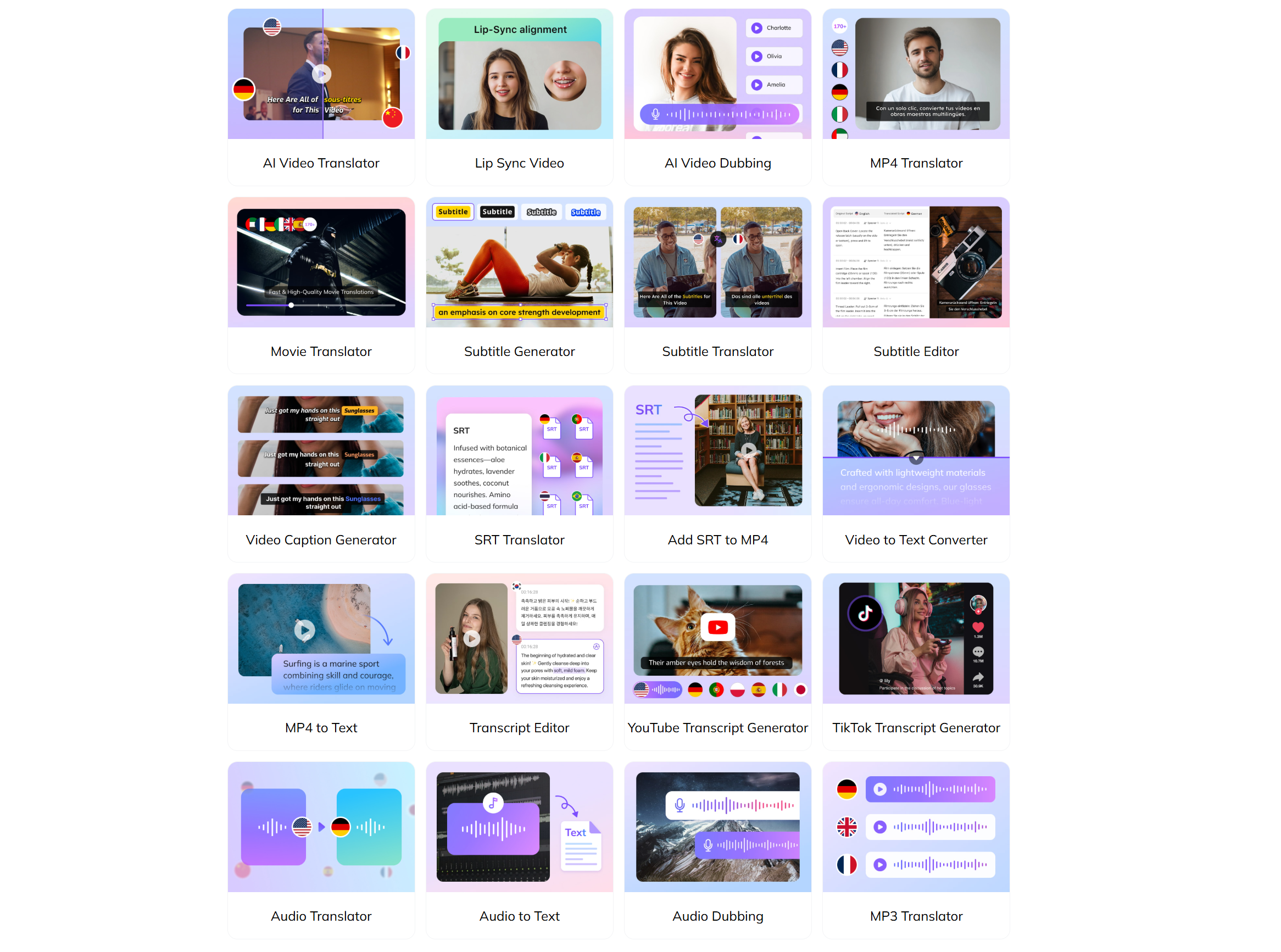
Here’s how VMEG AI stands out:
Multimedia Powerhouse
VMEG AI works with videos, podcasts and audio recordings without any problems- ideal with YouTubers, online educators and marketing teams.
170+ Languages Supported
It has a wide geographical coverage in regards to its language to the mainstream European and regional Asian and African dialects, and there is no market that it cannot reach.
Lip Sync and Voice Replication
It is not the same as the traditional tools because, unlike them, VMEG AI can produce the natural voice tone and automatically match lip movements. The result? Quality dubbing which seems natural.
YouTube Automatic Transcript Extraction
Transcription of YouTube videos can be done in real-time using VMEG AI, and translations are fast and can be performed without human involvement.
User-Friendly Interface
It is also user friendly in design and hence even a first time user can translate and localize videos without having the technical knowledge.
High-Quality AI Translation
VMEG AI delivers human-like and contextually correct results with the support of the latest neural translation models.
Perfect for Professionals
VMEG AI makes the process of professional localization of content creators, educators, and marketers throughout the globe easier: it assists them to overcome the language barrier without the message losing its cultural and linguistic characteristics.
The Best Practices of a Successful AI Localization
In order to maximize AI localization, observe the following best practices:
- Brand: Clear Audio High-quality input will give it correct speech recognition and translation. Background noise should be avoided when recording.
- Include Correct Scripts: When available, upload your original script to enhance translation accuracy.
- Select the Right Languages: Select markets in which your target audience is the most active.
- Review and Refine: Despite AI sophistication, human review will provide cultural sensitivity and precision.
- Maintain Brand Voice: Modify your preference of translation to ensure that your tone and brand image are consistent from language to language.
- Audience Analytics: Use insights to understand which languages or locations perform best and make changes to your localization policy.
The Future of AI Localization
The second step of AI localization will exceed voice and text. New technologies are already coming up with:
- Live video translation: Live videos and webinars are translated in real-time.
- Feel-the-flow AI dubbing: Voice tones, which react to emotions and expressions.
- 3D avatar translators: The avatars can show digital information in different languages.
- Individualized localization: AI translating to user preferences or dialects.
Through such developments, brands will be in a position to provide hyper-personalized content to all parts of the world without destroying cultural or emotional authenticity.
VMEG AI is leading through the change using the power of combining the language intelligence with the power of multimedia to assist creators and businesses in telling their stories in other languages and cultures.
Final Thoughts
With video spearheading communication across the world, AI localization is now a necessity but not an option. It transcends language barriers, speeds up the world and makes telling stories universal.
Using the latest innovations such as VMEG AI - The Ultimate Multimedia Translator, any individual or even a global company can now create multilingual videos that appear, sound and feel as natural. Hope so, now you know what is aI localization.
Nowadays, in the world where people want to see the real world, AI localization can guarantee that your message does not lose its meaning during the translation but instead gets multiplied. Therefore, regardless of localizing an educational course, business tutorials, or global campaigns, AI will do the footwork and see your idea speak any language.


The VMEG Team
Behind VMEG stands a passionate team of creatives, engineers, and language lovers. At the crossroads of AI and storytelling, they craft tools that bridge languages and cultures.