

'%3e%3cpath%20d='M21.0949%203.79395L13.9961%209.82854H21.0949V3.79395Z'%20stroke='black'%20stroke-width='1.38'%20stroke-miterlimit='10'/%3e%3cpath%20d='M13.998%209.82854L7.44531%203.79395V9.82854H13.998Z'%20stroke='black'%20stroke-width='1.38'%20stroke-miterlimit='10'/%3e%3cpath%20d='M13.9961%202.69922V25.1919'%20stroke='black'%20stroke-width='1.38'%20stroke-miterlimit='10'/%3e%3cpath%20d='M20.5488%2016.4113L13.9961%209.82812V18.2217L20.5488%2024.0918V16.4113Z'%20stroke='black'%20stroke-width='1.38'%20stroke-miterlimit='10'/%3e%3cpath%20d='M7.44531%2016.4113L13.998%209.82812V18.0526L7.44531%2024.0918V16.4113Z'%20stroke='black'%20stroke-width='1.38'%20stroke-miterlimit='10'/%3e%3cpath%20d='M4.71094%209.82812V18.6057H7.44125V16.4113L13.9941%209.82812H4.71094Z'%20stroke='black'%20stroke-width='1.38'%20stroke-miterlimit='10'/%3e%3cpath%20d='M13.9961%209.82812L20.5488%2016.4113V18.6057H23.2792V9.82812H13.9961Z'%20stroke='black'%20stroke-width='1.38'%20stroke-miterlimit='10'/%3e%3c/g%3e%3c/svg%3e)

'%3e%3cmask%20id='mask0_21456_29260'%20style='mask-type:luminance'%20maskUnits='userSpaceOnUse'%20x='0'%20y='0'%20width='28'%20height='28'%3e%3cpath%20d='M27.5%200.5H0.5V27.5H27.5V0.5Z'%20fill='white'/%3e%3c/mask%3e%3cg%20mask='url(%23mask0_21456_29260)'%3e%3cpath%20d='M14%2027.5C13.4854%2024.1035%2011.8974%2020.9608%209.46828%2018.5317C7.03922%2016.1026%203.89651%2014.5146%200.5%2014C3.89651%2013.4854%207.03922%2011.8974%209.46828%209.46828C11.8974%207.03922%2013.4854%203.89651%2014%200.5C14.5147%203.89644%2016.1028%207.03905%2018.5318%209.46816C20.9609%2011.8972%2024.1035%2013.4853%2027.5%2014C24.1035%2014.5147%2020.9609%2016.1028%2018.5318%2018.5318C16.1028%2020.9609%2014.5147%2024.1035%2014%2027.5Z'%20fill='url(%23paint0_linear_21456_29260)'/%3e%3c/g%3e%3c/g%3e%3cdefs%3e%3clinearGradient%20id='paint0_linear_21456_29260'%20x1='9.5'%20y1='9.5'%20x2='20.75'%20y2='21.875'%20gradientUnits='userSpaceOnUse'%3e%3cstop%20stop-color='%23F0DCD6'/%3e%3cstop%20offset='0.914506'%20stop-color='%231D6DFF'/%3e%3c/linearGradient%3e%3cclipPath%20id='clip0_21456_29260'%3e%3crect%20width='28'%20height='28'%20fill='white'/%3e%3c/clipPath%3e%3c/defs%3e%3c/svg%3e)
'%3e%3cpath%20d='M22.8019%2011.2412L23.5234%2011.6807V12.0103L23.3172%2012.7796L14.5579%2014.9771L13.7344%2012.7951L22.8019%2011.2412Z'%20fill='%23D97757'/%3e%3cpath%20d='M19.5236%204.77832L20.5322%205.00396L20.8%205.35575L21.0552%206.19876L20.9494%206.73644L15.0712%2015.3068L13.1133%2013.2191L18.5338%205.63471L19.5236%204.77832Z'%20fill='%23D97757'/%3e%3cpath%20d='M14.4577%203.43951L15.0761%203L15.5912%203.21976L16.1065%203.9889L14.6949%2013.0345L13.7364%2012.3397L13.3242%2011.131L14.0456%204.31853L14.4577%203.43951Z'%20fill='%23D97757'/%3e%3cpath%20d='M7.84766%203.5851L8.48285%202.7199L8.89716%202.61914L9.71923%202.74717L10.125%203.08581L13.0815%2010.0748L14.1509%2013.3954L12.8997%2014.1372L8.13117%204.91019L7.84766%203.5851Z'%20fill='%23D97757'/%3e%3cpath%20d='M4.77232%208.38688L4.56641%207.50742L5.18478%206.73828L5.90613%206.84816H6.11223L10.4403%2010.2544L11.78%2011.3531L13.6349%2012.8914L12.6044%2014.7594L11.6769%2013.9903L11.0586%2013.331L5.08168%208.82593L4.77232%208.38688Z'%20fill='%23D97757'/%3e%3cpath%20d='M3.53288%2014.0982L3.06641%2013.5489L3.06647%2013.0601L3.53288%2012.8896L8.78833%2013.2193L13.9408%2013.6588L13.7736%2014.7528L3.94502%2014.2082L3.53288%2014.0982Z'%20fill='%23D97757'/%3e%3cpath%20d='M6.62378%2019.8178H5.59334L5.18359%2019.3146V18.7132L6.93299%2017.3946L14.045%2012.5674L14.7648%2013.8785L6.62378%2019.8178Z'%20fill='%23D97757'/%3e%3cpath%20d='M8.57739%2022.8884L8.16518%2022.9984L7.54688%2022.6687L7.64995%2022.1193L13.7299%2013.5488L14.5543%2014.7574L10.0201%2021.1305L8.57739%2022.8884Z'%20fill='%23D97757'/%3e%3cpath%20d='M13.7361%2023.9861L13.4271%2024.4257L12.8088%2024.6454L12.2935%2024.2058L11.9844%2023.5466L13.5301%2014.6465L14.4576%2014.7563L13.7361%2023.9861Z'%20fill='%23D97757'/%3e%3cpath%20d='M18.9869%2021.5713V22.4503L18.8838%2022.7799L18.4716%2022.9997L17.7503%2022.8974L12.7969%2015.0367L14.7617%2013.4404L16.4104%2016.6269L16.5652%2017.7805L18.9869%2021.5713Z'%20fill='%23D97757'/%3e%3cpath%20d='M21.3629%2020.2507L21.4659%2020.8L21.1568%2021.2396L20.8476%2021.1297L19.0958%2019.8112L16.4165%2017.284L14.3555%2015.7457L14.9736%2013.6582L16.0041%2014.3175L16.6226%2015.5259L21.3629%2020.2507Z'%20fill='%23D97757'/%3e%3cpath%20d='M20.0232%2014.6482L22.5995%2014.8679L23.2178%2015.3074L23.6299%2015.9667V16.441L22.4964%2016.9556L16.7256%2015.4173L14.3555%2015.3074L14.9737%2013L16.6226%2014.3185L20.0232%2014.6482Z'%20fill='%23D97757'/%3e%3c/g%3e%3c/svg%3e)
Key Takeaways
- An AI translation agent is a feature in a translation platform that enhances workflow efficiency. With this agent, users can simplify the translation process and let the agent plan, decide, and act.
- AI agents improve translation quality by preserving context, ensuring consistent terminology, ensuring content is localized to the intended audience and their culture, maintaining tone and brand voice, and supporting automated quality scoring.
- AI translation agents support regulatory compliance by maintaining terminology standards across languages, understanding regional requirements, human-in-the-loop review for sensitive content, and data privacy and secure translation pipelines.
- When it comes to an AI translation agent for video localization, VMEG’s AI Agent for Video Localization is an ideal tool. It supports more than 170 languages, a human-in-the-loop workflow, and provides highly accurate results.
- An AI translation agent must be used for high-volume multilingual content, regulated or compliance-sensitive content, continuous localization workflows, and multimedia and video content to make workflows more convenient.
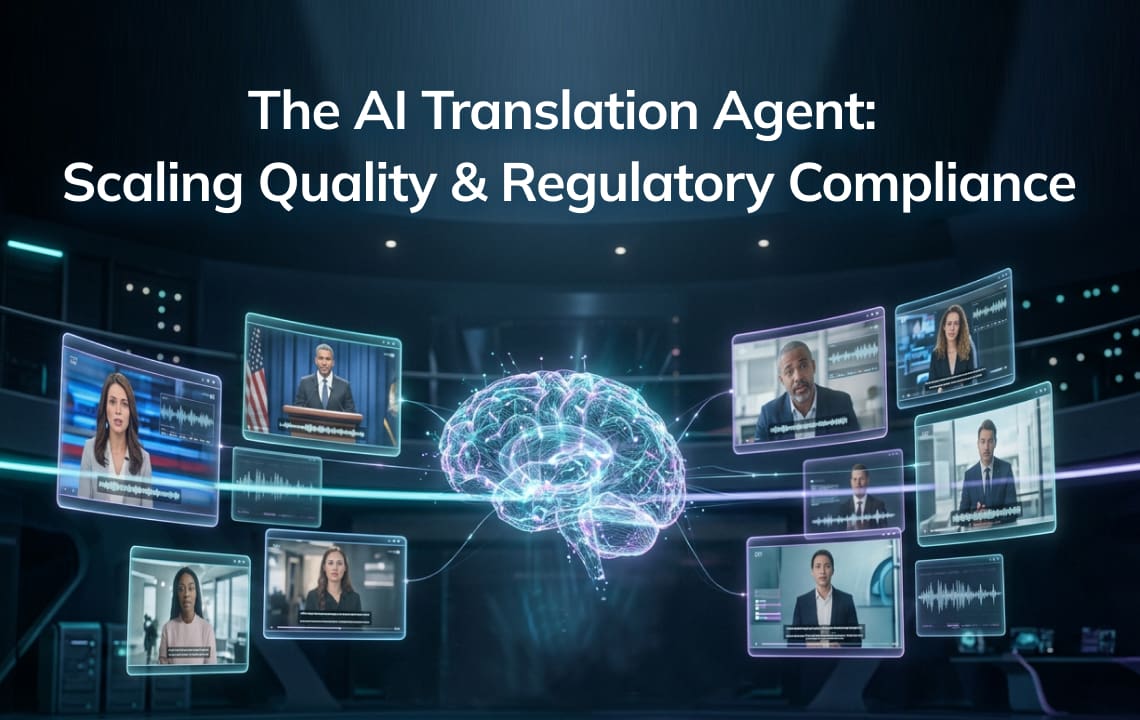
AI agents are among the trends that speed up workflows. Various AI agents have been developed for different purposes, from customer service to video localization. These AI agents can also help individuals and organizations ensure quality and regulatory-compliant output.
What Is an AI Translation Agent?
An AI Translation Agent is an AI system that is designed to translate text, audio, documents, or video from one language to another. An advanced system can also understand context, tone, and intent. It uses advanced machine learning and natural language processing to produce more natural and accurate translations.
An AI translation agent can:
- Read or hear content in one language
- Understand the meaning and context
- Generate an equivalent message in another language
How It Works
- Input Processing. The agent receives text, audio, document, or video in the source language.
- Language Understanding. AI models analyze grammar, context, and meaning.
- Translation Generation. The system produces a translation in the target language.
- Refinement. Some agents check grammar, tone, and fluency before output to ensure accuracy and cultural context.
AI Translation Agent vs AI Translation Tool
What Is an AI Translation Tool?
An AI translation tool is a platform powered by artificial intelligence that translates text, documents, audio, images, websites, video, and other file types it supports.
For example, VMEG AI is an AI translation tool that can translate videos into more than 170 languages. It is ideal for those who want to bring their content to an international audience.
An AI translation tool can also detect the context, making it relevant to the intended audience. It provides various benefits, making translation faster and easier.
What Makes a Tool an AI Agent?
An AI agent is one of the features of an AI translation tool. The AI Agent feature makes the tool an AI Agent. Some organizations may also design or develop an AI agent tool for a specific purpose. Some advanced tools add an AI agent feature to make their products deliver more benefits to users. It is designed to make tasks faster and easier.
For example, VMEG AI has an AI agent for the video localization feature that makes localizing videos easier. With an AI agent, you will be able to localize videos faster, produce more videos, expand to a wider market, and adapt to trends faster.
The Architecture of an AI Translation Agent
An AI agent architecture is a structure that shows how an AI agent will perceive, decide, and act to achieve its goal or complete the task. The architecture of an AI translation agent may differ, depending on the design, purpose, and other elements integrated into it. It may consist of various layers, tools, frameworks, and systems.
These are just some of the architectures that developers may integrate into an AI translation agent. An AI translation agent’s architecture may consist of several architectures, such as:
- Agent Reasoning Architectures. It may include reactive, deliberative, and hybrid architectures.
- Agent Deployment Architectures. It can be single-agent or multi-agent architectures.
- Agent Coordination Architectures. These consist of hierarchical, workflow-based, and human-in-the-loop architectures.
How AI Agents Improve Translation Quality
AI agents are beneficial, especially for improving translation quality, as they can capture context. It goes beyond simple word-for-word translation, as it can add reasoning, context awareness, and improvement.
Context Preservation
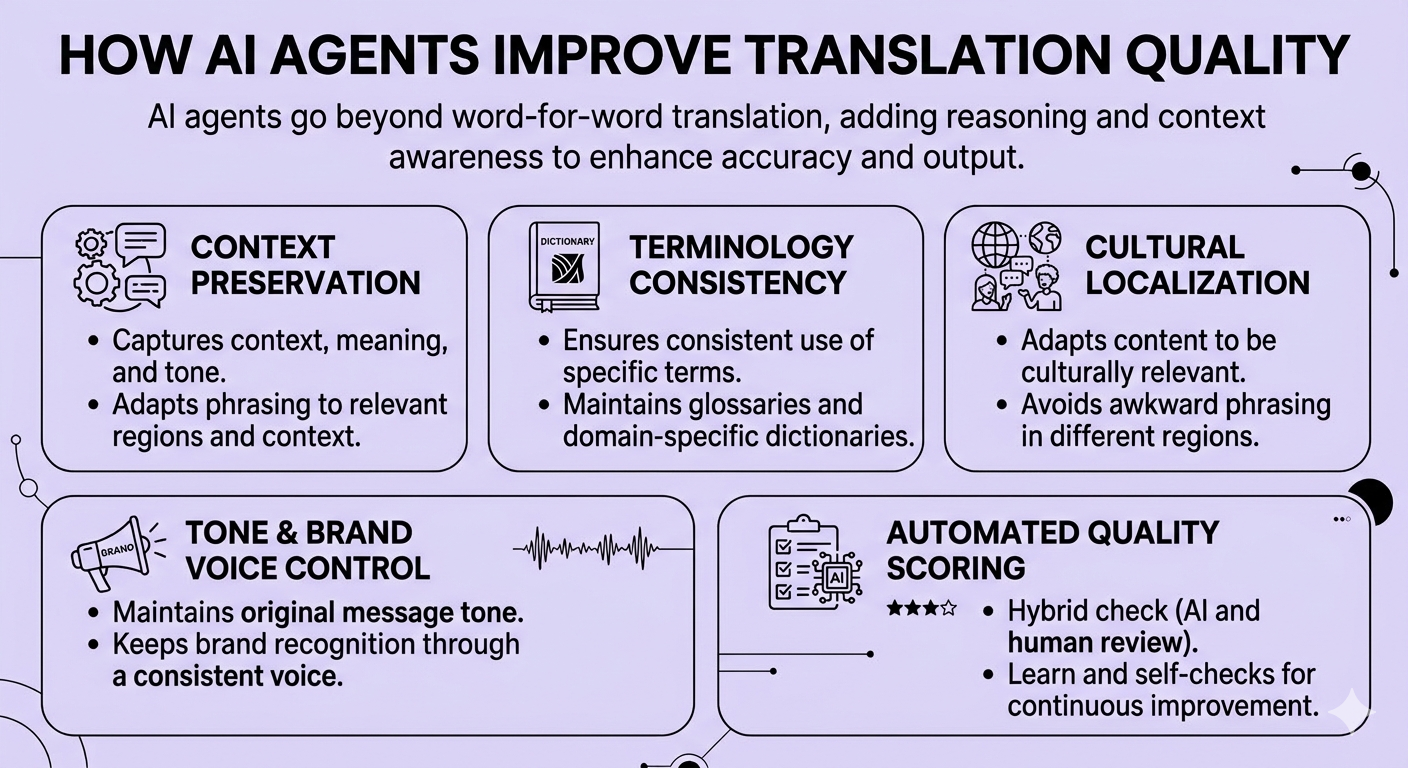
AI Agents ensure that it does not just provide direct translation, but also preserves meaning, tone, and cultural nuance that make the context relevant to different regions. Words may have different meanings in different regions, and AI agents can phrase them appropriately based on context.
Terminology Consistency
It also ensures that terminology is used consistently, especially when brand or industry-specific terms must be preserved. Agents can maintain glossaries and domain-specific dictionaries.
Cultural Localization
The audience is more likely to engage when they can relate to the content, so it is important to ensure that the localized content is culturally relevant, as some translations may feel awkward in other regions.
Tone & Brand Voice Control
Another important element is tone, as it also affects the original message. The tone and brand voice must be maintained to make it easier for your content and brand to be recognized by your audience. So, when they hear the tone and voice, they will immediately recognize it as your brand or content.
Automated Quality Scoring
Quality assurance is important for verifying content and minimizing errors. Quality checks can be hybrid, combining an AI system check with a human check. Some AI agents can also learn and self-check to improve their output over time.
How AI Translation Agents Support Regulatory Compliance
According to the World Economic Forum (2026), operational, technical, and employee trust are the dimensions of establishing trust at scale in AI agents.
Trust in AI systems is strengthened when their outputs are consistently high in quality and regulatory compliant, as these characteristics signal reliability and responsible system design.
Regulatory compliance is an important factor to consider when localizing content. It ensures that the content is compliant with regulations to avoid any issues with your content.
Maintaining Terminology Standards Across Languages
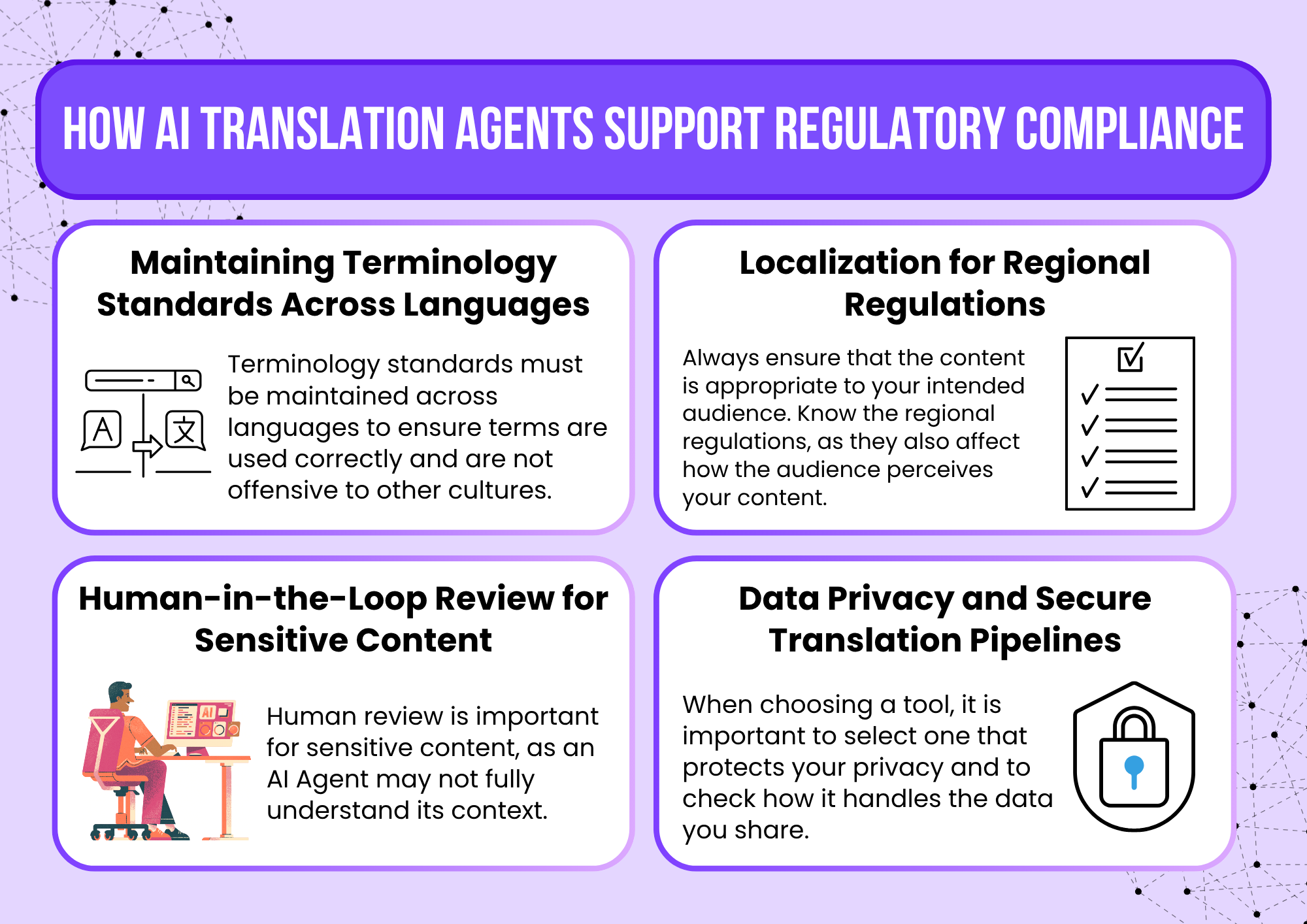
Terminology standards must be maintained across languages to ensure terms are used correctly and are not offensive to other cultures. Some words may have different meanings when translated or when the context changes, leading to confusion. It also affects the content’s authority. If the terminology is correct, the audience will see that your content is trustworthy.
Localization for Regional Regulations
It is also important to know the regional regulations before publishing content to ensure that there will be no issues. Always ensure that the content is appropriate to your intended audience. Know the regional regulations, as they also affect how the audience perceives your content. If they see that you know local rules, they will be more likely to engage.
Human-in-the-Loop Review for Sensitive Content
Human review is important for sensitive content, as an AI Agent may not fully understand its context. Quality must be observed to ensure that the content serves its purpose, and you will gain the audience's trust. Some AI agents provide a hybrid review, with AI and humans both reviewing the content.
Data Privacy and Secure Translation Pipelines
Data privacy is important, especially since others can use the data you share online for various purposes. When choosing a tool, it is important to select one that protects your privacy and to check how it handles the data you share. Here at VMEG AI, privacy is built into our architecture. It ensures that your videos, scripts, and voice are encrypted and are not used in training AI models.
How Organizations Implement AI Translation Agents
The implementation of AI translation agents in an organization differs, as each agent has its own structure and purpose. When implementing an AI agent, the organization should design or use one that provides high-quality, regulatory-compliant translations.
Custom AI Translation Agents Built on LLM Frameworks
Organizations can create custom AI translation agents that will make their translation workflow easier. In building their own AI translation agents, they can use an existing language model and combine it with their translation system to create an AI Agent for Translation.
Organizations can also use an existing AI agent for translation and combine it with their workflow/system to create an integrated translation solution.
Specialized AI Translation Agents for Specific Content Types
Organizations can also use specialized AI translation agents for specific content types. For example, an organization uses VMEG’s AI Agent for Video Localization to localize its video content. They can also use other AI translation agents for tasks such as marketing, customer support, and more.
How VMEG AI Implements an AI Translation Agent for Video Localization
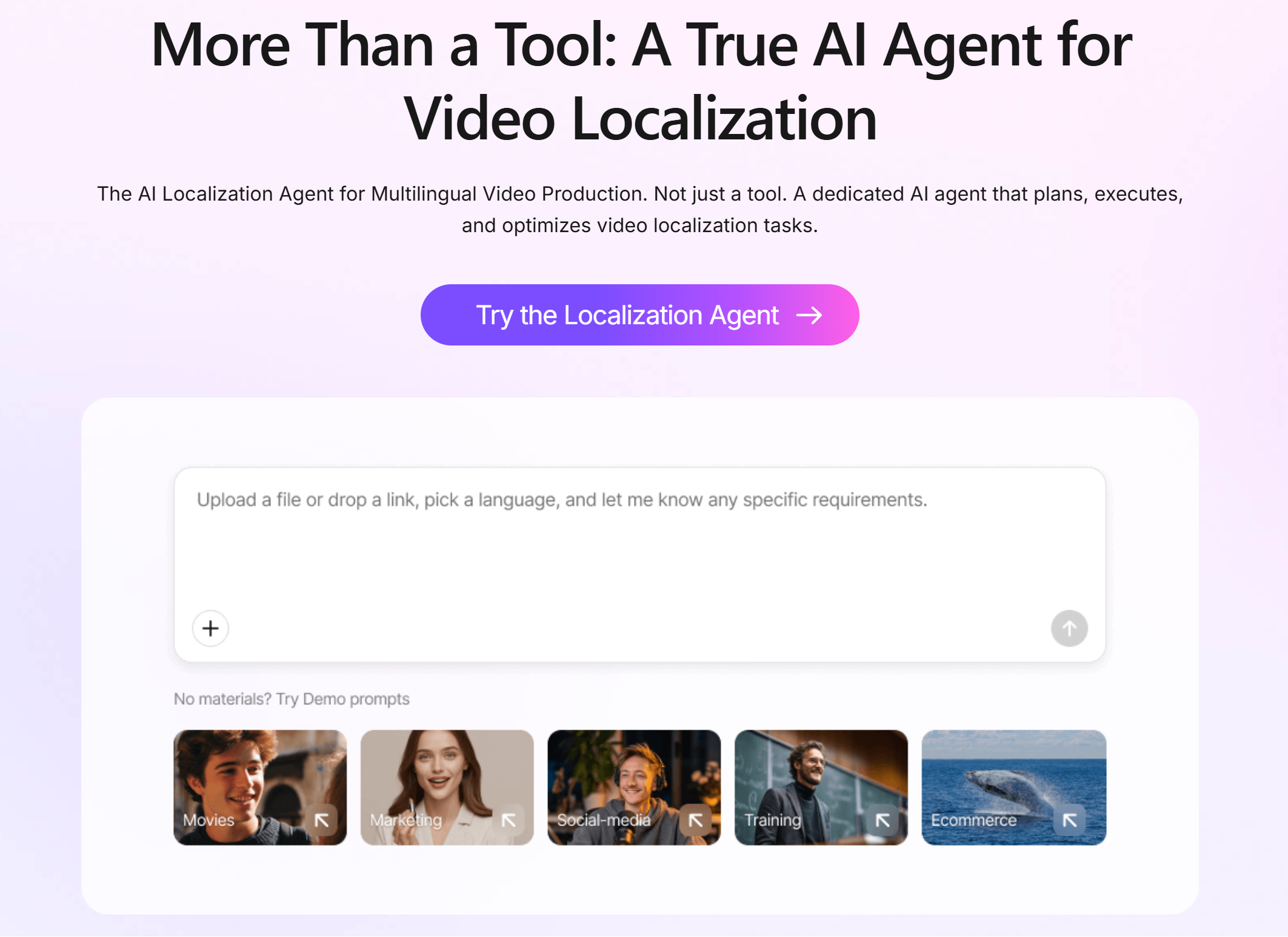
Video localization is complex and requires more than simply translating text. It involves adapting subtitles, voiceovers, cultural context, and timing so that the video feels natural for audiences in different languages. To address these challenges, VMEG AI simplifies video localization while maintaining quality and compliance across large volumes of video content.
AI Translation Challenges in Video Localization
There are various elements involved in localizing video, making the process more complex and challenging. Here are some challenges of AI translation in video localization.
Timing and synchronization. These elements are critical. Subtitles must match the speaker’s timing, and voiceovers must align with the video's visual pacing. Poor synchronization can make it hard for the audience to follow, as it can disrupt them.
Context and tone. In audiovisual content, context and tone are important. These include humor, slang, idioms, and emotional cues that require contextual interpretation rather than literal translation.
Multimodal elements. These elements can complicate the video localization process. Video localization may involve translating on-screen text, subtitles, narration, and dialogue simultaneously. This requires the translation system to process both audio and visual information.
Scaling localization across many languages. It can be difficult for organizations to produce large volumes of content. Manual translation workflows may become slow and expensive when videos need to be localized for multiple global markets.
VMEG AI’s Agent Video Localization Workflow
To manage these challenges, VMEG AI simplifies video localization with a straightforward workflow.
- Upload a video or paste the link.
Upload the video or paste its link, then provide a prompt that includes the instructions on how you want to localize your video. The VMEG AI agent will understand the context and create a plan.
- Approve the AI agents' plan.
After the agent creates a plan, review it. You can make any necessary adjustments if there are still parts that need adjustment. If you are satisfied with the AI agents' plan, approve it.
- Preview, Edit, and Export.
The AI agent will create the first version. Preview it, and if any elements need adjustment, you can edit them in the editor. Once you are satisfied, you can export and use it.
How VMEG AI Maintains Translation Quality at Scale
Scaling translation for global audiences requires maintaining consistent quality even when processing large volumes of content. VMEG AI addresses this through several mechanisms.
Operates Based on Defined Localization Objectives. The VMEG AI agent understands the intended audience, the platform on which it will be distributed, and the quality level. It helps the agent plan tasks that support decision-making at each step until the goal is achieved.
Autonomous. VMEG AI Agent is autonomous and will handle the complex tasks for you. It helps save time and allows users to produce more content, making it easier to stay up to date with trends and expand internationally.
Context-Awareness. It ensures that the tone, pacing, speaker intent, and brand voice are maintained and adapted according to the intended audience and platform. With this, you will be able to produce consistent, high-quality content.
Scalable Localization Infrastructure. With VMEG AI, you can achieve seamless, large-scale, and ongoing localization operations at a lower cost. It also supports more than 170 languages, helping you expand your global reach.
Compliance and Localization Considerations in Video Translation
Aside from translation quality, organizations must also consider regulatory and cultural factors when localizing video content.
For example, some regions may have language regulations requiring media content to be available in specific official languages. In addition, subtitles and captions may be required to support accessibility standards for viewers with hearing impairments. Some platforms may also have their own regulations to consider before publishing a video.
Localization also involves cultural adaptation, ensuring that expressions, references, and visual elements are appropriate for the target audience.
Platforms such as VMEG AI help organizations address these concerns by integrating localization workflows that can support multiple languages while maintaining consistent formatting and compliance requirements.
AI translation agent systems enable organizations to scale video localization efforts efficiently while meeting both quality expectations and regulatory requirements across global markets.
Real-World Use Cases for AI Translation Agents
AI translation agents are beneficial to individuals and businesses that create content for international audiences.
SaaS Product Localization
Localization is important for software companies as they have users from different countries. The AI translation agents help translate user interfaces, product documentation, and support materials in different languages.
Some software companies also integrate tools and frameworks in their localization pipelines to support automated translation workflows. These AI-powered systems allow SaaS companies to release updates in multiple languages simultaneously, reducing the time required for international product launches.
eCommerce Global Expansion
Those eCommerce businesses that serve international markets also need AI translation agents to translate product listings, descriptions, and customer support content. AI translation agents enable companies to scale this process efficiently.
Online retailers may use AI agents to translate product catalogs into different languages while preserving key information such as product specifications and features. The system can also localize marketing campaigns, customer reviews, and promotional messages.
Video & Social Media Content
Video platforms, media companies, and marketing teams also need AI translation agents to localize audiovisual content for global audiences. Video localization typically involves multiple tasks, including subtitle generation, translation, and voiceover creation. AI-driven tools like VMEG AI automate these steps, allowing organizations to produce multilingual video content at scale.
For example, a company publishing social media videos may use AI translation agents to automatically generate subtitles and translate them into several languages before distributing the content across different regions. It helps organizations reach wider audiences without significantly increasing production costs.
Learning Platforms
Online education platforms must support learners from different linguistic backgrounds. AI translation agents help eLearning providers make educational content accessible to students globally.
These systems can translate course materials, lecture transcripts, subtitles, quizzes, and instructional resources. For video-based courses, AI tools can generate subtitles and localized voiceovers to help learners better understand the content.
Customer Support Automation
Customer support teams often interact with users from different countries who speak different languages. AI translation agents help automate multilingual communication, allowing companies to respond to customer inquiries quickly and efficiently.
Organizations can also integrate translation systems into their support platforms. These systems can automatically detect the customer’s language, translate messages, and ensure responses remain clear and contextually relevant. AI translation agents can also support chatbots and automated help centers, allowing companies to provide multilingual support 24/7.
When Should You Use an AI Translation Agent?
High-Volume Multilingual Content
An AI translation agent is helpful to those who create and translate high-volume multilingual content. Translating content can be time-consuming, especially if multiple pieces of content must be translated. Using an AI agent will help speed up the process.
Regulated or Compliance-Sensitive Industries
Those AI agents that incorporate compliance into their frameworks or designs can help users create regulatory-compliant translation and content. It can check whether any parts need editing. This can also be combined with human verification to ensure that content meets the regulatory requirements.
Continuous Localization Workflows
You need an AI agent if you need a continuous localization workflow. In traditional translation, the process can be complex, as multiple individuals may be involved. With AI agents, one or fewer individuals can handle the checking or verification. This ensures the localization will be continuous and not delayed.
Multimedia and Video Content
If you or your organization is publishing multimedia and video content, you need an AI agent like VMEG AI. It can help you streamline your workflow and accelerate video localization, so you can do more and keep up with trends.
FAQs
What is an AI agent for language translation?
An AI agent for language translation varies depending on the design, purpose, and other frameworks. It improves the translation process by streamlining workflows and enhancing context, providing high-quality, regulatory-compliant output.
Which is the best AI translator?
The best AI agent translator depends on your needs. For example, you need an AI agent for video localization; VMEG AI is one of the best AI translators.
Can AI agents replace human translators?
AI agents cannot replace human translators, as a hybrid approach is most effective. It may transform their role, but it cannot replace them, as human skills are still top-notch.
Are AI translation agents more accurate?
The accuracy of AI translation agents depends on how the system is built and designed. The best way to check accuracy is to test the platform. VMEG AI’s video localization agent delivers highly accurate output.
What is the best AI translation agent for video?
The best AI translation agent for video is VMEG AI’s video localization agent. It supports more than 170 languages, is easy to use, ideal for all skill levels, and supports hybrid localization.
Conclusion
AI translation agents make translation faster and more convenient. Video is one of the media file types that are complex to translate, as it includes various elements such as audio and subtitles. With VMEG AI’s video localization agent, you can localize videos with high quality, as it supports more than 170 languages, a human-in-the-loop workflow, proper lip-sync and dubbing, and context awareness, ensuring high-quality, regulatory-compliant output.


The VMEG Team
Behind VMEG stands a passionate team of creatives, engineers, and language lovers. At the crossroads of AI and storytelling, they craft tools that bridge languages and cultures.