The future of AI dubbing is likely to combine end-to-end multimodal intelligence with pipeline-level control.
AI dubbing is entering an interesting phase.
For years, the dominant approach was a chain of specialized models:
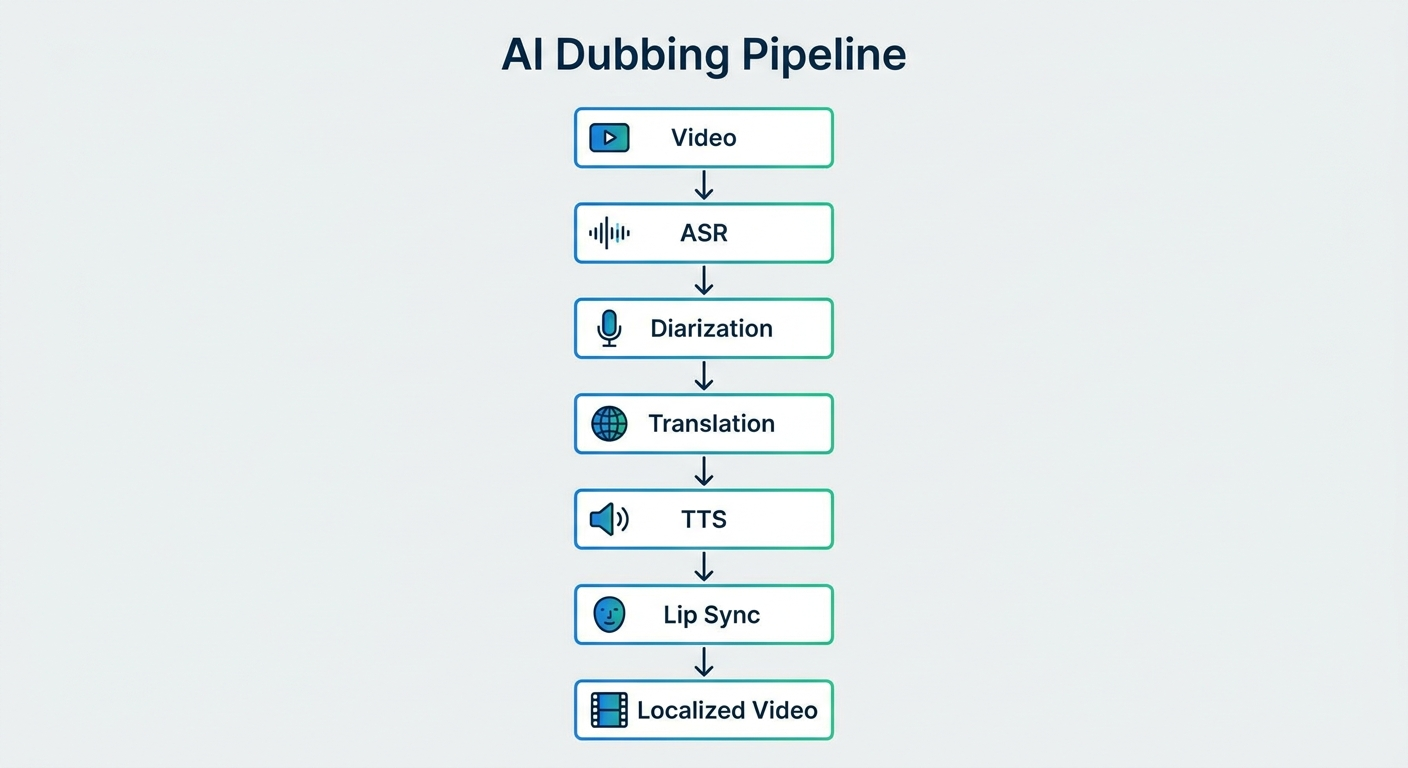
Then multimodal foundation models changed the conversation.
Instead of decomposing a video into audio, text, and images, increasingly capable models can understand video directly. Google’s Gemini models, for example, can process video together with audio and reason about events and specific timestamps; current 1M-context Gemini models can process up to one hour of video at default media resolution or three hours at low resolution.
At the same time, commercial dubbing systems are becoming increasingly integrated. HeyGen now exposes video translation as a single API operation combining translation, voice cloning, and lip sync, while ElevenLabs’ Dubbing v2 explicitly aims to preserve the original speaker’s tone, pacing, delivery, and emotional intent.
So is the future of AI dubbing simply:
Video in → one model → dubbed video out?
We don’t think so.
The more interesting future is:
End-to-end intelligence with pipeline-level control.
The End-to-End Dream
The appeal of an end-to-end system is obvious.
Imagine uploading a two-hour movie and asking:
“Dub this into Japanese, preserve every character’s voice and emotion, synchronize the dialogue with the original performance, and return the finished video.”
The ideal system looks like:
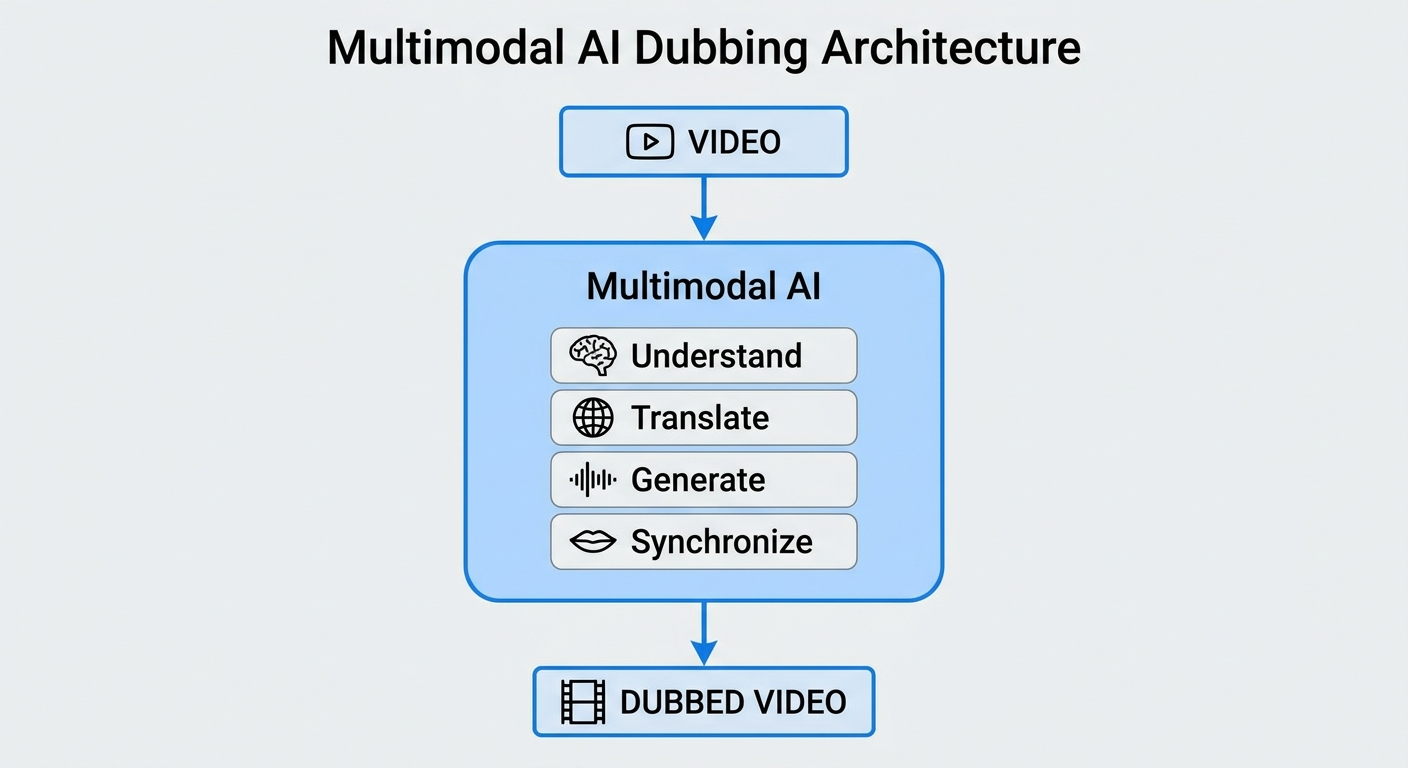
There are compelling reasons to pursue this architecture.
Global context
A single model can potentially reason about:
- who is speaking,
- what happened earlier,
- what is visible on screen,
- the relationship between speakers,
- the emotional state of a conversation,
- and the meaning of a sentence in the broader scene.
This is fundamentally different from passing isolated text between independent models.
Fewer information bottlenecks
Every interface in a traditional pipeline can throw information away.
For example:
Audio
  ↓
ASR
  ↓
Text
The text may preserve the words but lose information about:
- emotion,
- pitch,
- speaking style,
- hesitation,
- breathing,
- background context.
A downstream translation model cannot recover information that never reached it.
Joint optimization
An end-to-end system can theoretically optimize for the final objective:
Does the localized video look and sound like a natural version of the original?
rather than separately optimizing ASR, translation, TTS, and lip sync.
This is not merely theoretical. Recent research has begun explicitly combining translation and timing control in end-to-end automatic dubbing systems. One EMNLP 2025 study reported up to a 24% relative improvement in speech overlap by explicitly constraining translation duration while maintaining competitive COMET translation scores.
But Production Is Different From a Demo
Suppose an end-to-end system produces a beautiful 30-minute dubbed video.
Then you discover:
Speaker 7 uses the wrong voice for 12 seconds.
What do you do?
If the entire system is truly monolithic, your options may be surprisingly limited.
Regenerate everything?
Run the model again with a modified prompt?
Hope the problem doesn’t reappear?
That’s not how production systems are normally operated.
Production asks much more specific questions:
- Where did the error happen?
- Can we identify the affected segment?
- Can we fix only that segment?
- Can we preserve everything else?
- Can a human review the correction?
- Can we reproduce the result?
- Can we automatically verify that the repair didn’t introduce another problem?
This is where the pipeline comes back.
The Hidden Value of Intermediate Representations
Consider a production dubbing job.
Instead of treating the video as one opaque object, we can represent it as a collection of structured artifacts:
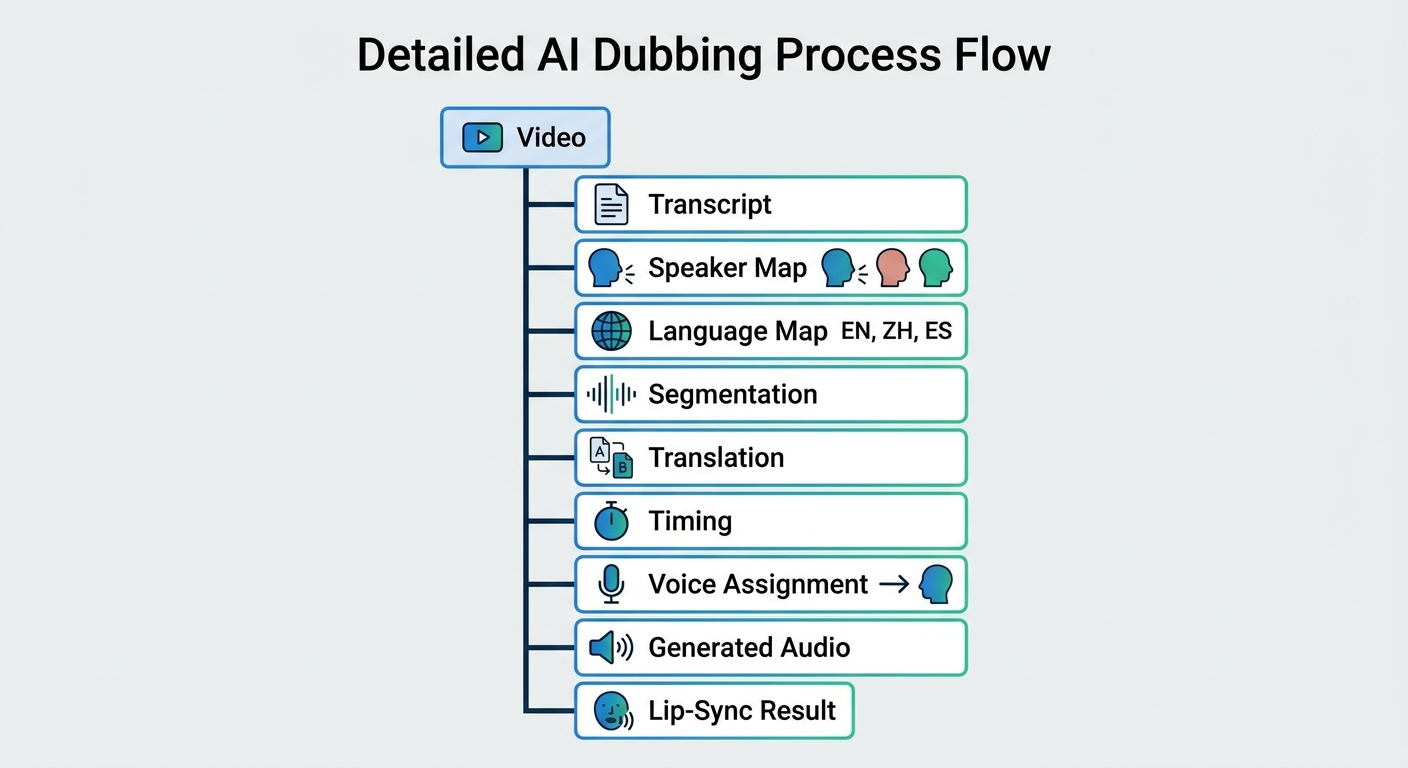
These aren’t merely implementation details.
They are control points.
If the translation is wrong, edit the translation.
If the speaker is wrong, correct the speaker.
If the timing is wrong, adjust the timing.
If one TTS segment is mispronounced, regenerate that segment.
If lip sync fails, rerun the visual stage without throwing away the entire localization.
This is the fundamental advantage of a pipeline:
It makes the AI system observable and recoverable.
End-to-End Intelligence Does Not Mean End-to-End Opacity
This distinction is important.
“End-to-end” can describe the intelligence of a system.
It doesn’t have to describe the operational boundaries of the system.
A production architecture can use a highly capable multimodal model to reason about the entire video while still maintaining structured intermediate representations.
Conceptually:
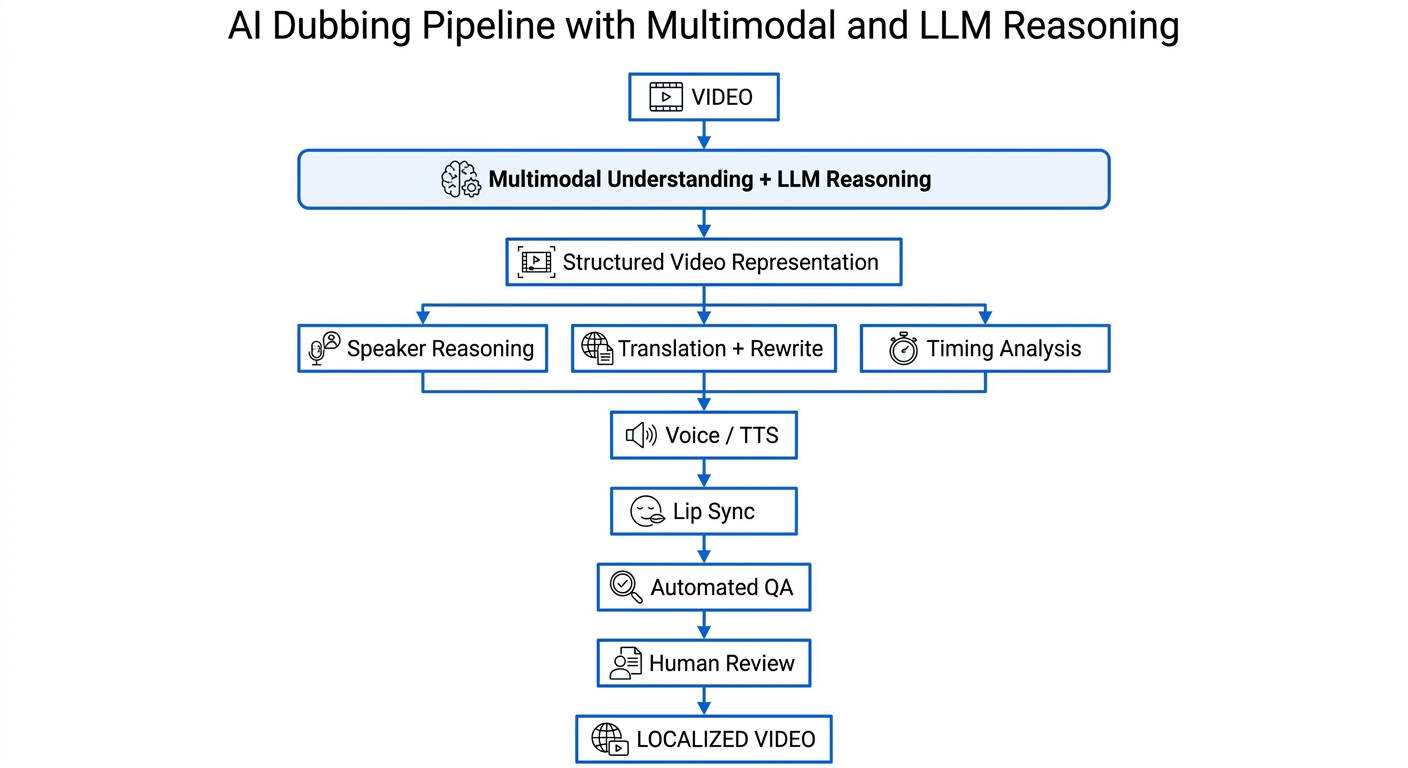
The models become increasingly intelligent.
The pipeline remains increasingly controllable.
Three Architectural Approaches
It’s useful to compare three broad approaches.
| Traditional Pipeline | Integrated Dubbing | Multimodal + Controlled Pipeline | |
|---|---|---|---|
| Understanding | Specialized models | Integrated | Multimodal reasoning |
| Context | Usually local/stage-specific | Better global context | Global + structured context |
| Modularity | High | Medium | High |
| Intermediate artifacts | Many | Often hidden/partial | Explicit |
| Debugging | Relatively easy | Harder | Easier |
| Partial regeneration | Strong | Varies | Strong |
| Human review | Natural fit | Increasingly supported | First-class |
| Global reasoning | Limited | Stronger | Strong |
| Specialized models | Easy to swap | More coupled | Easy to swap |
| Production control | High | Medium | High |
| End-to-end optimization | Limited | Strong | Increasing |
The third architecture is where we think the industry is heading.
Commercial Systems Are Already Moving in This Direction
Interestingly, today’s commercial systems demonstrate that the debate isn’t really “pipeline versus end-to-end.”
It’s already becoming a hybrid.
HeyGen
HeyGen presents video translation as a highly integrated experience: translation, voice cloning, generated audio, and lip synchronization can be performed as one workflow. Its API exposes video translation as a single operation, with separate speed and precision modes.
But it also exposes a proofread stage in its API, allowing an editable transcript to be extracted and reviewed before translation.
That is an important architectural clue.
The product feels end-to-end to the user.
But production control still requires intermediate representations.
HeyGen Video Translation
ElevenLabs
ElevenLabs’ Dubbing v2 is another interesting example.
The company describes the model as preserving the original performance—including tone, pacing, delivery, and emotional intent—rather than generating disconnected speech from a transcript. It currently supports dubbing across 90+ languages.
But its API is explicitly project-based.
Source transcripts and translations are represented as editable data, and the current API supports changing individual segments and regenerating only the regions that changed.
Again, the product is highly integrated.
But the production workflow remains structured.
ElevenLabs Dubbing
Multimodal Foundation Models Change the Other Side of the Equation
The other major development is the rise of general multimodal models.
Gemini, for example, can directly process video and audio, extract information from video, answer questions about specific timestamps, and reason over visual and audio content together. Google’s documentation describes approximately 300 tokens per second of video at default media resolution, or around 100 tokens per second at low resolution, with current 1M-context models supporting up to one hour or three hours depending on media resolution.
That capability opens up an entirely different architecture.
Instead of:
Video
 ↓
ASR
 ↓
Text
 ↓
LLM
we can increasingly do:
Video
 ↓
Multimodal Reasoning
 ↓
Structured Understanding
The model can reason about both what is said and what is happening.
That is particularly important for dubbing.
Because the right voice, emotion, pacing, and translation often depend on the visual scene.
But Multimodal Does Not Mean End-to-End Dubbing
This distinction deserves emphasis.
A model that can understand a video is not automatically a model that can produce a production-ready dubbed video.
Video understanding and video generation have different requirements.
A dubbing system still has to solve:
- speaker consistency
- translation
- terminology
- timing
- voice identity
- pronunciation
- prosody
- speech generation
- audio mixing
- lip synchronization
- quality assurance
The multimodal model may become the reasoning layer connecting these tasks.
It doesn’t necessarily replace every specialized model.
This is similar to how modern software systems use a general-purpose reasoning layer while relying on specialized services for storage, search, rendering, encoding, and other operations.
The Case for Pipeline-Level Control
There are at least six reasons why production systems need explicit control points.
Observability
When something goes wrong, you need to know where it went wrong.
Bad video
   ↓
???
isn’t actionable.
But:
Bad video
   ↓
Lip sync ✓
TTS ✓
Timing ✓
Translation ✗
is.
Partial Regeneration
A one-sentence mistake shouldn’t require regenerating a three-hour video.
Ideally:
3-hour video
     ↓
10,000 segments
     ↓
1 bad segment
     ↓
Regenerate 1 segment
     ↓
Reassemble
This matters enormously at scale.
Human Review
AI systems don’t need to eliminate humans.
They need to make human intervention efficient.
A reviewer should be able to inspect:
Original
Speaker
Transcript
Translation
Timing
Voice
Generated Audio
and correct only what is necessary.
Quality Gates
Each stage can have automated checks.
For example:
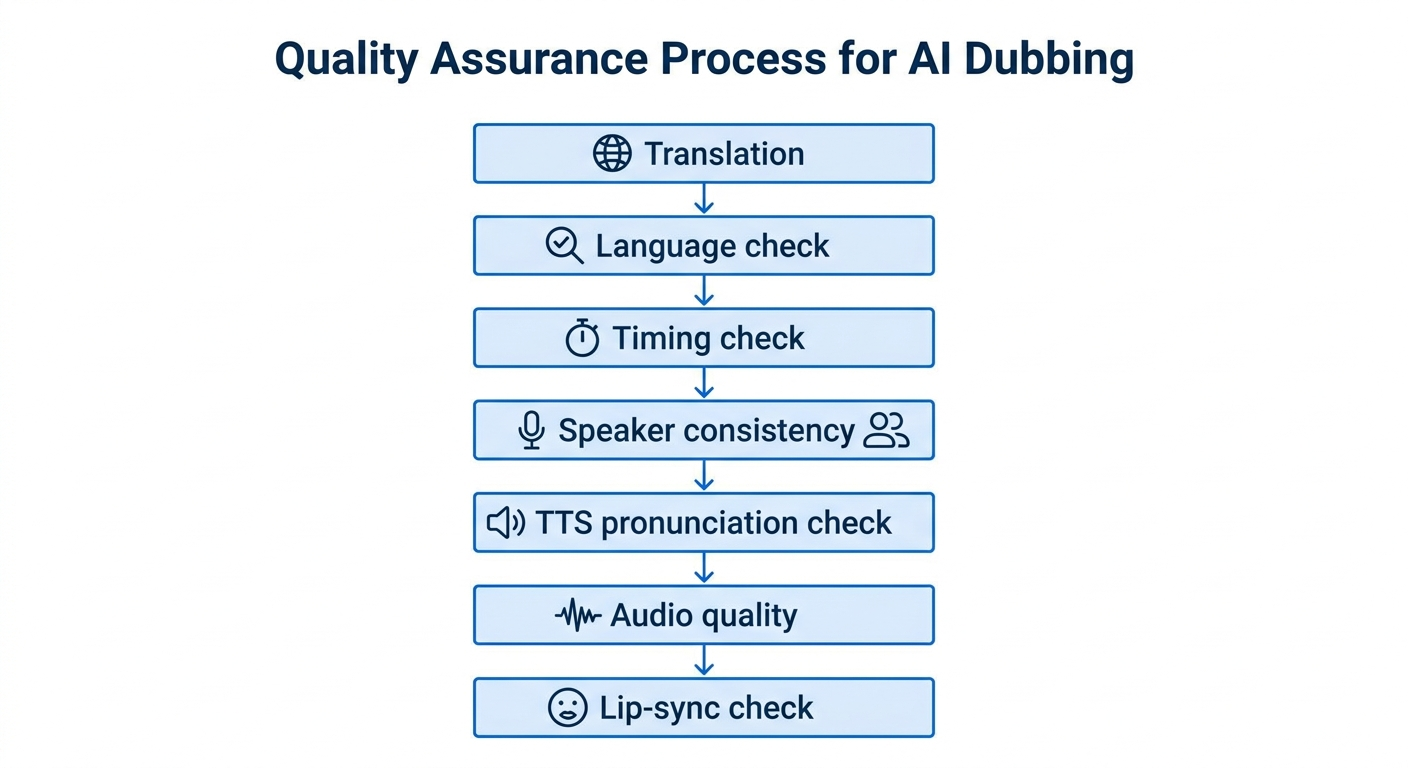
A system can reject a result before the error propagates downstream.
Reproducibility
Production systems need to answer:
“Why did this video look different when we regenerated it last month?”
With explicit intermediate artifacts, you can record:
- model versions
- prompts
- translations
- timestamps
- voice IDs
- configuration
- QA results
That is much harder when everything is hidden inside one opaque generation call.
Cost and Latency
Not every video needs the most expensive model at every stage.
A production system can selectively use:
- fast models for easy segments,
- larger models for difficult segments,
- specialized models for high-value operations,
- additional reasoning only when confidence is low.
This is difficult to achieve with a single monolithic model.
Proofreadable AI
This is where our experience at VMEG has strongly influenced our architecture.
We process tens of thousands of AI video localization tasks every day. Around 10% of these tasks are longer than one hour, and the longest projects we’ve handled have exceeded three hours, sometimes involving dozens of speakers.
At this scale, the question isn’t simply:
“Can AI produce a good result?”
The question becomes:
“Can we reliably produce a good result, find the failures, repair them, and do this tens of thousands of times a day?”
That changes the architecture.
A long-form video might go through:
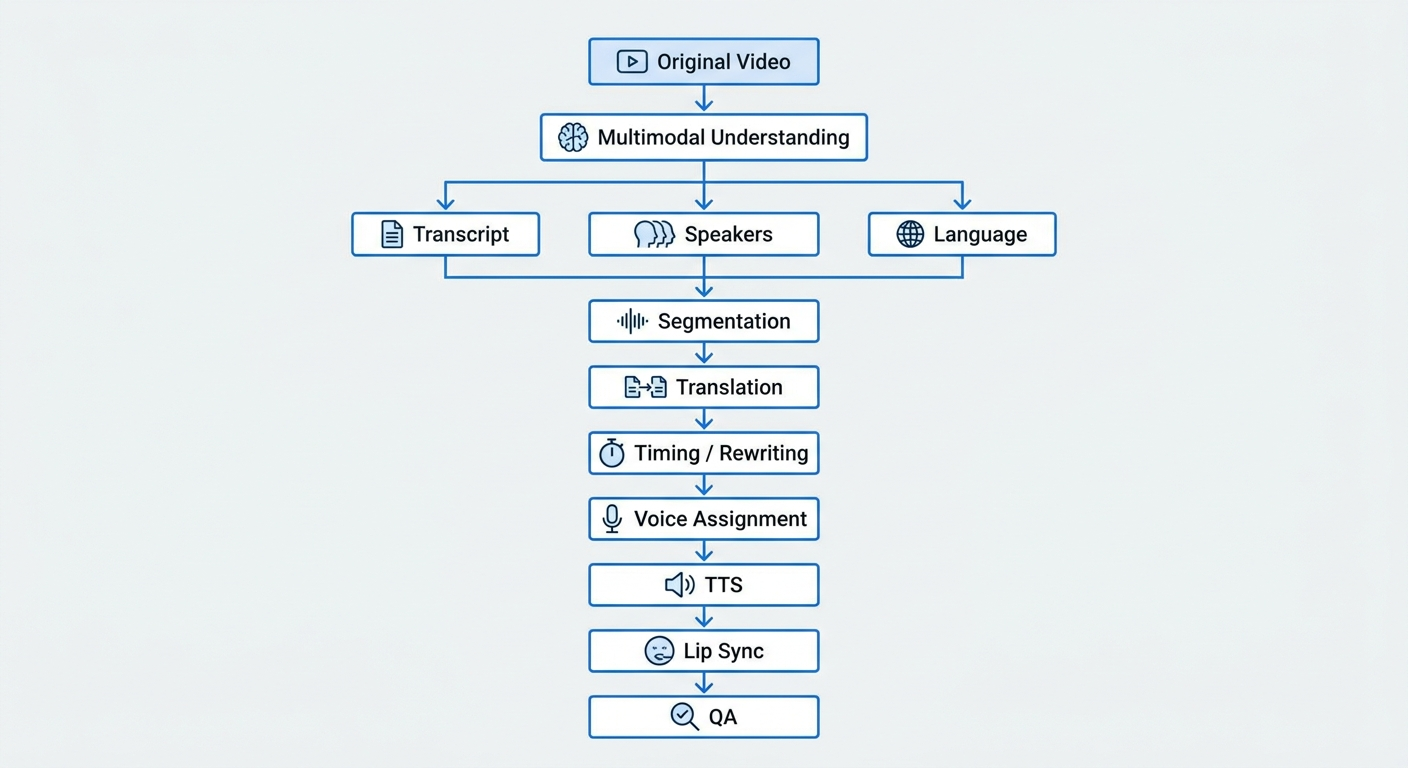
At each important stage, the output should be proofreadable.
That means an AI system doesn’t simply produce a final answer.
It produces a chain of inspectable decisions.
The Interesting Paradox
There is a paradox here.
As models become more capable, we might expect pipelines to disappear.
Instead, the opposite may happen.
Better models make pipelines more intelligent.
A weak pipeline might look like:
ASR → Translator → TTS → Lip SyncA modern pipeline could look like:
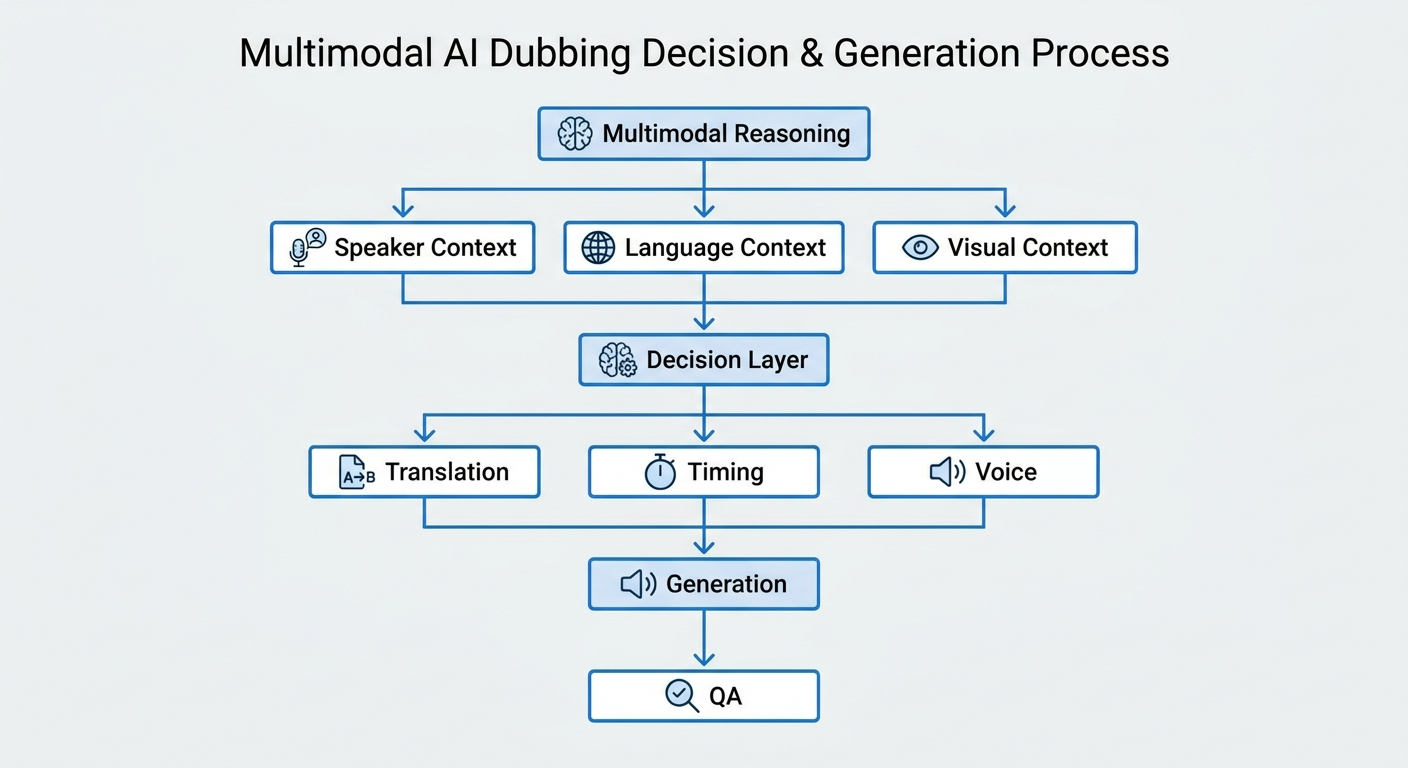
The pipeline becomes less of a sequence of dumb transformations and more of a control system around intelligent models.
What Should Be End-to-End?
Not everything needs to be modular forever.
Some tasks are increasingly well suited to joint modeling.
For example:
Multimodal understanding
Instead of separately asking:
Who is speaking?
What is happening?
What is the emotion?
What is the context?
A multimodal model can reason about all of these together.
Translation + timing
Recent research demonstrates that translation and duration can be optimized together, rather than translating first and trying to force the resulting speech into the original timing afterward. The EMNLP 2025 work mentioned earlier achieved up to a 24% relative improvement in speech overlap with explicit duration-aware translation.
Emotion + prosody + duration
Recent dubbing research similarly treats emotion, prosody, duration, and visual alignment as related rather than completely independent tasks. InstructDubber, published at AAAI 2026, uses multimodal inputs and instruction-based reasoning to derive speaking-rate and emotion information before generating aligned dubbing.
This is exactly where end-to-end intelligence makes sense.
What Should Remain Modular?
Other boundaries are valuable precisely because they provide control.
For example:
- transcript editing
- speaker reassignment
- translation review
- voice selection
- timing correction
- audio regeneration
- lip-sync regeneration
- final QA
These are not necessarily weaknesses of a pipeline.
They are interfaces for reliability.
The goal isn’t to eliminate all intermediate stages.
The goal is to make those stages smarter.
A Better Definition of “End-to-End”
Perhaps we should stop using “end-to-end” to mean:
One model does everything.
A better definition might be:
The system optimizes toward the final user experience while allowing intelligent components to reason across the full context.
Under this definition, a system can still have many specialized components.
The intelligence is end-to-end.
The execution is modular.
The artifacts are inspectable.
The failures are recoverable.
End-to-End Intelligence + Pipeline-Level Control
This leads to the architecture we believe is most promising for production AI dubbing:
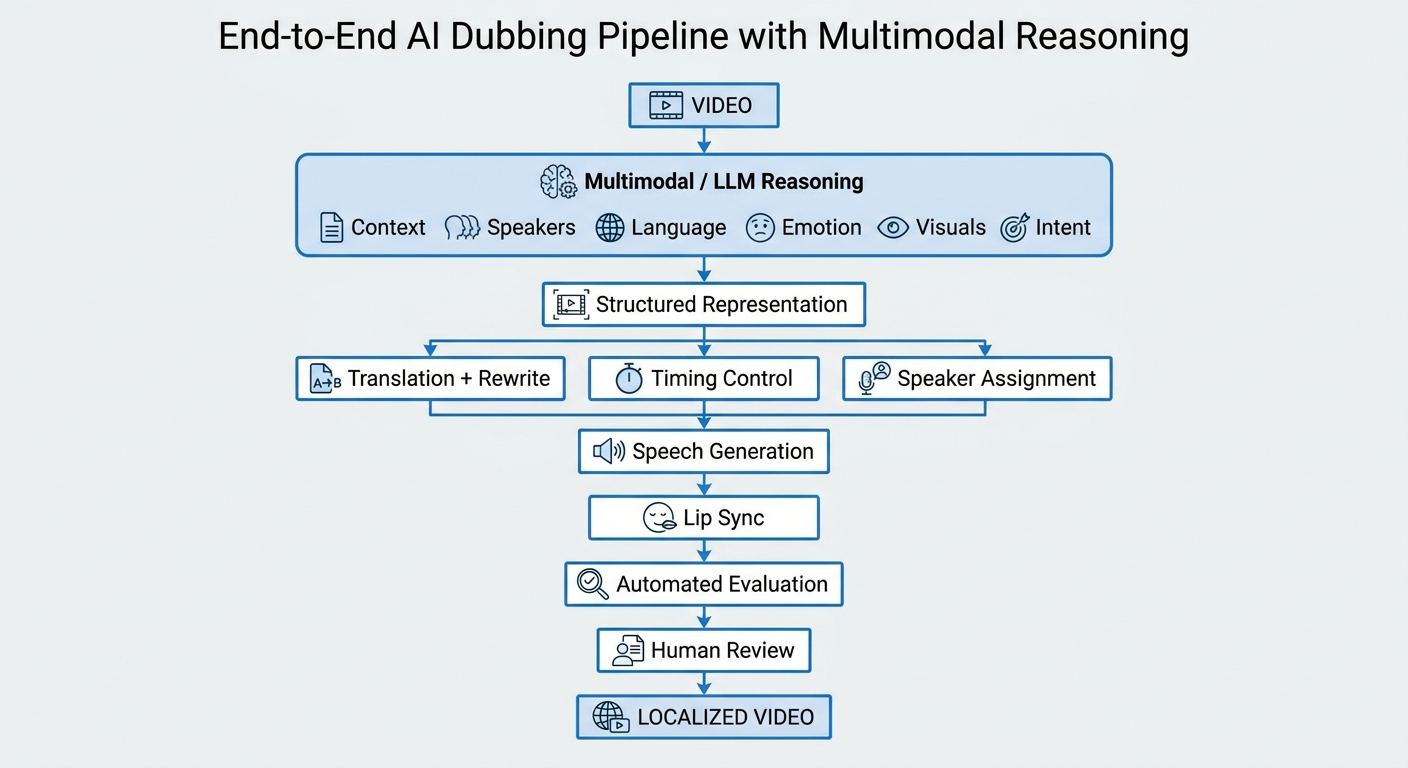
The principle is simple:
Use end-to-end intelligence to understand the problem. Use pipeline-level control to solve it reliably.
What the Future Might Look Like
The next generation of AI dubbing probably won’t look like today’s pipeline forever.
Nor will it necessarily become a single giant model.
Instead, we expect a gradual convergence.
Today
Specialized models
        +
Hand-designed pipeline
Near future
Multimodal reasoning
        +
Specialized generation
        +
Structured pipeline
Longer term
Highly integrated multimodal models
        +
Inspectable intermediate representations
        +
Adaptive production orchestration
The models become more end-to-end.
The system becomes more intelligent.
But the need for control, observability, and quality assurance doesn’t disappear.
It becomes more important.
Conclusion
The debate between end-to-end models and pipelines is often framed as a choice.
We don’t think it has to be.
End-to-end models are exceptionally good at understanding context, connecting modalities, and reasoning across a complex video.
Pipelines are exceptionally good at making systems observable, controllable, recoverable, and scalable.
AI dubbing needs both.
The future of AI dubbing is likely to combine end-to-end multimodal intelligence with pipeline-level control.
The winning architecture may not be the one with the fewest models.
It may be the one that combines the strongest intelligence with the best ability to inspect, correct, regenerate, and verify every important decision.
Because a production AI system isn’t successful when it can generate one impressive video.
It’s successful when it can generate tens of thousands of videos reliably, find the difficult cases, repair them efficiently, and maintain quality from the first word of the transcript to the final frame of the localized video.
End-to-end intelligence. Pipeline-level control.
That may be the architecture that takes AI dubbing from impressive demos to dependable production.
References & Further Reading
Multimodal video understanding
- Google Gemini — Video Understanding — Direct video/audio understanding, timestamp-aware reasoning, and current long-video capabilities.
- Google Gemini — Long Context — Background on multimodal long-context processing.
Commercial AI dubbing
- HeyGen Video Translation — Integrated video translation, voice cloning and lip sync; HeyGen currently advertises 175+ languages/dialects.
- HeyGen Video Translation API — API-level view of integrated video translation and precision/speed modes.
- ElevenLabs Dubbing v2 — Performance-preserving multilingual dubbing.
- ElevenLabs Dubbing API — Project-based dubbing with editable source/target segments and regeneration workflows.
Research
- Dubbing in Practice: A Large Scale Study of Human Localization With Insights for Automatic Dubbing — A study based on 319.57 hours of video from 54 professionally produced titles, examining the constraints and characteristics of human dubbing.
- End-to-End Multilingual Automatic Dubbing via Duration-based Translation with Large Language Models — End-to-end duration-aware translation for dubbing; reports up to 24% relative improvement in speech overlap.
- InstructDubber: Instruction-based Alignment for Zero-shot Movie Dubbing — Multimodal reasoning over video, script, speaking rate, emotion, and duration for movie dubbing.
- From Speaker to Dubber: Movie Dubbing with Prosody and Duration Consistency Learning — Research on aligning dubbing with both emotional and temporal characteristics of the original performance.