Quality control sits at the heart of statistics. Long before large language models or multimodal AI made automated evaluation a practical engineering problem, statisticians were already asking a similar question: how do you measure quality when the thing you care about cannot be observed directly?
At VMEG, we encountered exactly this challenge while building quality control for a multilingual video translation and dubbing pipeline.
Version one: I could see the surface, not the process
The first version of our QC system naturally reflected our understanding of the pipeline at the time. Early on, I didn’t yet know the algorithm chain well. What I mostly had were artifacts left by finished jobs—scripts, recognition outputs, TTS results, alignment results, and the like. The natural move was:
Break each job into stages (language selection, recognition, translation, TTS, alignment). In each stage, flag “looks abnormal” surface signals, score by the share of bad segments, then take the weakest stage as the overall score. Alignment especially drifted toward duration ratios: how long the raw audio was versus how long it occupied on the timeline, whether speaking-rate ratios left a sensible band, whether relative swings looked extreme.
That approach had real upsides: it shipped, it ran, and every job got a number. It also had a ceiling:
- A score tells you something is bad; it rarely tells you which layer is bad. Was the upstream window wrong? Did a mid-pipeline strategy swallow a line? Or is the listening experience still acceptable? One total score flattens those distinctions.
- Surface parameters correlate—and mislead. Duration ratios and rate ratios do matter, but correlation isn’t causation. Without walking the chain, you don’t know which step to fix.
- There was no confirmed bad-case pool. Without a stable set of labeled failures, algorithm iteration leans on gut feel about individual examples.
Looking back, that first version was the stats homework answer: “compute a composite score.” It got us started. It wasn’t yet quality control that could carry algorithm engineering.
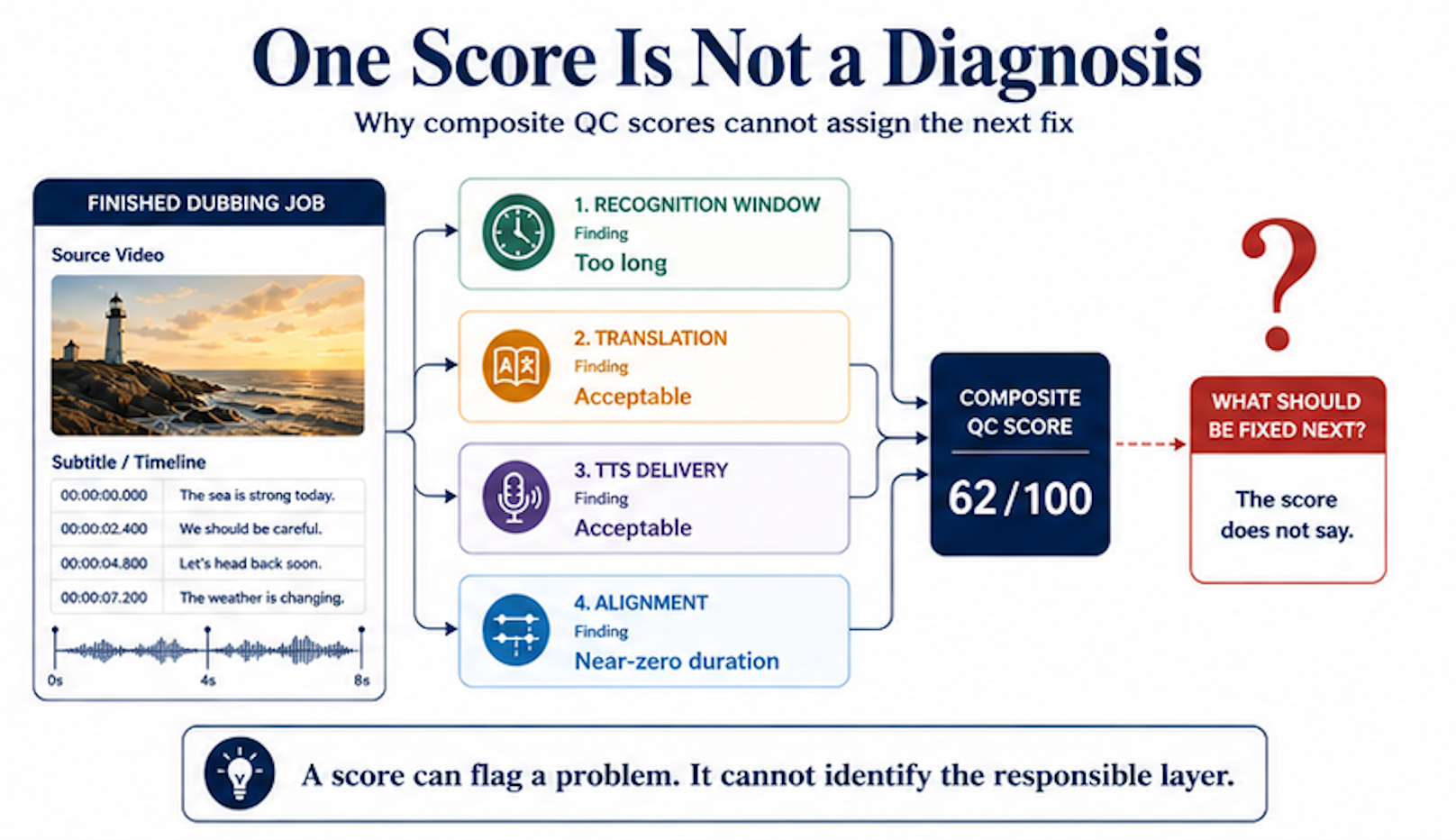
Why stage scores weren't enough: useful metrics point to fixable action
The real turn came after I went deeper into the whole system. On the same finished video, once you can compare the source dialogue window with the dubbed placement window, abstract scores become actionable questions:
- Fit: How do the two windows overlap? A whole-line shift, or only a messy start/end?
- Hard failures: A dubbed line that barely exists on the timeline—i.e., the line never plays.
- Mid-line drift: The line as a whole has slid; sound and picture no longer meet.
- Side signals: Recognition windows that are far too long or short, speech rate pushed too hard, translation rewritten after a low score, unstable timbre, separation needing a safety correction—each answers a different question, and none of them belong mashed into a single “quality score.”
Our current algorithm QC board is built in that spirit. At the top: trends (defect rates, experience conversion, job volume, how often users rerun steps in the editor). Below: module detail (alignment, recognition, translation, separation, speaking rate, voice consistency, post-processing reach, and so on). The goal is no longer one number that pretends to summarize everything. It’s clearer answers to: what are we seeing, where does it point, and who should fix it next?
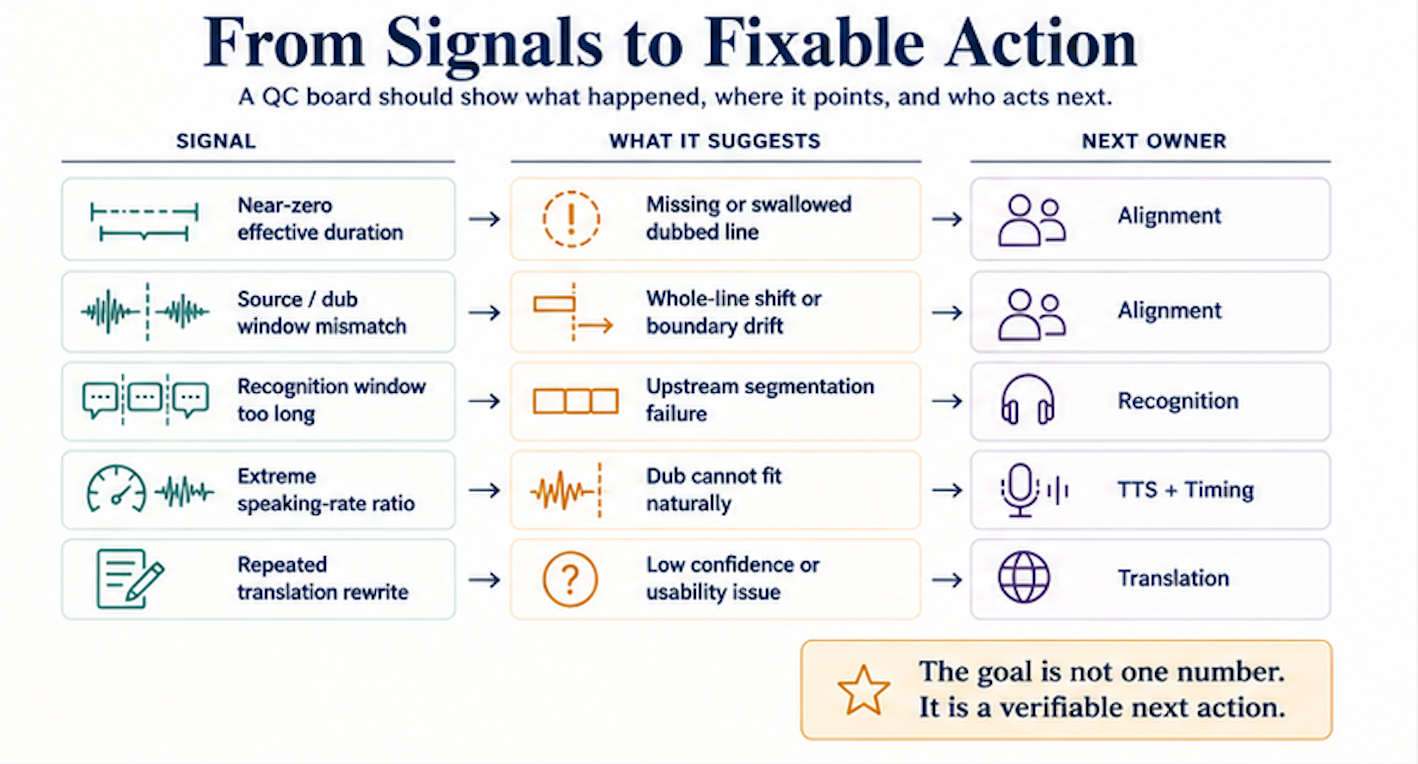
Only then did the classroom language land for real—factor analysis, outliers, all of it—as a boundary for decisions:
Can this signal sort failures into different root-cause buckets? Can it drive a fix we can verify?
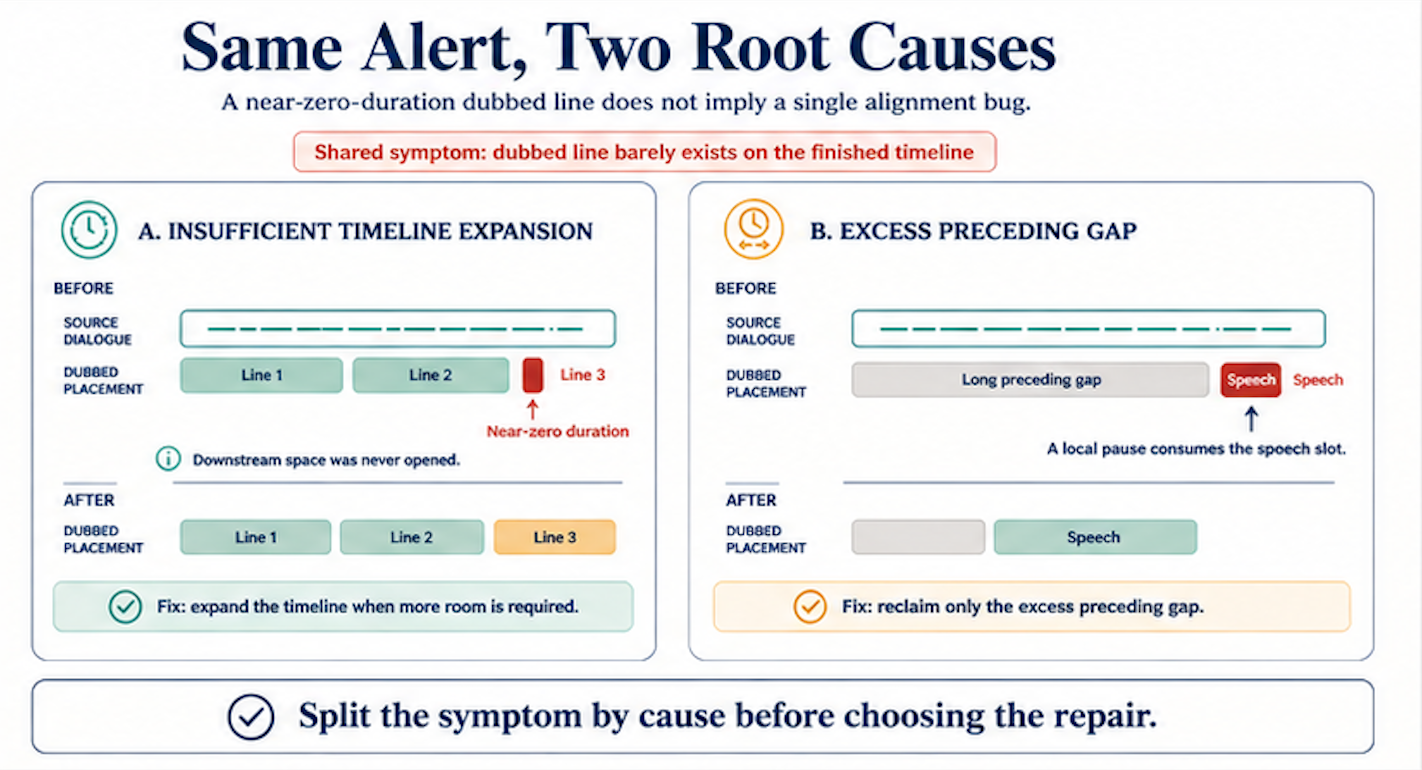
Same alert, two root causes: two alignment fixes
On the alignment path we watch a hard alert: a dubbed line whose effective duration on the finished timeline is nearly zero. It stands out on the board because users almost always hear it—a missing line, or lines stuck together.
The interesting part: two independent fixes looked almost identical on the surface—both were zero-duration hard failures—with completely different root causes.
Fix one: the video hadn’t been stretched enough
In the first class of bugs, the dubbing needed more temporal room, but the finished timeline didn’t open enough space. Downstream lines were crushed or swallowed and landed as empty shells—zero duration in the metrics; missing speech or neighbor overlap in the ear.
QC’s job here wasn’t only to light a red lamp. We pulled a set of high-severity, already-confirmed bad cases, replayed candidate changes on the same inputs, and asked whether the damage actually fell. Early, intuition-led patches barely moved the needle. Once we made sure expansion really expanded when it should, zero-duration cases and neighbor collisions retreated on most of that bad set. After merge, we retested a larger batch of unlabeled cases of the same symptom to confirm we hadn’t only fitted a few familiar anecdotes.
What that round taught: the same surface alert, without a replayable bad-case library, is easy to twist on the wrong knob.
Fix two: the preceding gap was too long
The second class still showed up as zero duration. Looking closer, the line had enough duration in principle—but the silence ahead of it had taken so much of the slot that the spoken part had nowhere to go. On the finished cut you could hear the breath and miss the words.
The fix was different too. Not “stretch the video harder,” but a change of policy: keep reasonable pauses by default; only when a line has clearly been crushed to an empty shell, reclaim a little time from the gap immediately before it and put the speech back. Take only as much as needed for the line to stand—no more—so ordinary pauses don’t get clipped away.
What that round taught: when the same metric shows up a second time, it often means you removed the primary cause and a secondary one has floated up. Without ongoing measurement, people write it off as “the same bug came back.” Often it’s the same symptom, newly stratified.
What QC really changes for algorithm iteration
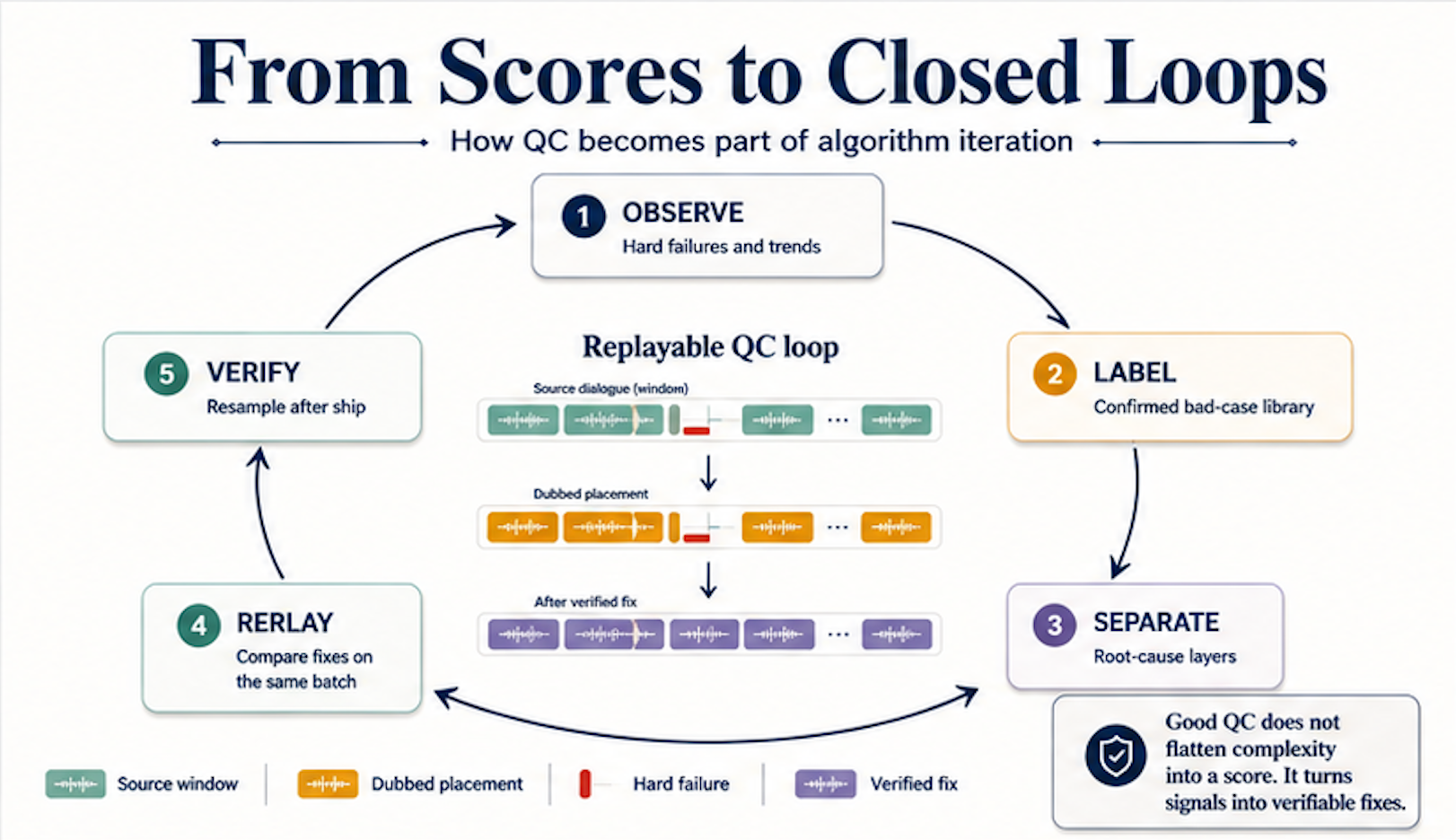
String the two fixes together and QC isn’t sitting inside one diff. It’s sitting in a closed loop:
- Daily observation — Hard failures and trends show up before support tickets pile up.
- Human labeling into a store — Bad cases become a replayable set, not screenshots in chat.
- Root-cause layers — For the same zero-duration alert, ask first: not enough total timeline, or a local gap eating the slot?
- Candidate replay — Compare before/after on the same bad batch, instead of “I think it’s fixed.”
- Another sweep after ship — If the same symptom reappears, prefer a new stratum over rewriting yesterday’s story.
For algorithm folks, the cadence changes: from “change one thing, listen to a few clips” to “change one thing, replay a batch, explain the leftovers.” For product and experience, a drop in defect rate can be tied to a concrete fix, instead of dissolving into a composite score.
A plain takeaway
Good QC doesn’t crush a complex system into a more convenient score. It breaks the system into signals that are blunt enough to trust day to day—and actionable enough to verify after a fix.
Blunt, so noise doesn’t run the board. Actionable, so a fix can be proven.
We lost early by wanting a score too fast. We gained later by writing down, for each signal, what it deliberately doesn’t claim to measure. The value of those two alignment fixes isn’t how flashy the patches were. It’s that they showed what happens when QC actually lives inside the algorithm loop: the same symptom can be split apart, repairs can be rechecked, and whatever remains gets honest.
A score measures quality. A closed loop improves it.
References
[1] Fabrigar, L. R., & Wegener, D. T. (2012). Exploratory Factor Analysis. Oxford University Press.
[2] Chandola, V., Banerjee, A., & Kumar, V. (2009). Anomaly Detection: A Survey. ACM Computing Surveys.
[3] Pearl, J. (2009). Causality: Models, Reasoning, and Inference. Cambridge University Press.
[4] Beyer, B., Jones, C., Petoff, J., & Murphy, N. R. (2016). Site Reliability Engineering: How Google Runs Production Systems. O’Reilly Media.
[5] Huyen, C. (2022). Designing Machine Learning Systems. O’Reilly Media.