In AI media pipelines, the first audio question used to be almost embarrassingly simple: is someone speaking right now? That binary gate is Voice Activity Detection (VAD). It is cheap, stable, and old enough to be infrastructure—telephony, meetings, ASR chunking all start there.
As soon as the audio is mixed, that question is not enough. A clip can hold speech, music, laughter, applause, a door slam, a car horn. Where each event starts and ends, and what overlaps it, changes what happens next: send it to recognition, send it to dubbing, or keep it as an effect. That is no longer a speech / non-speech gate. It is sound-type / event recognition—Audio Event Detection (AED) in production language, Sound Event Detection (SED) in the research literature.
For creator-facing AI video and audio products such as VMEG, getting those events right is mainly about making later processing more reliable—including AI dubbing. This article treats VAD and AED as one continuous capability: what the binary gate is for, where it runs out of answers, and what a general event detector actually adds.
1. The question has already changed
Early audio systems faced a relatively clean channel: one talker, office noise or a telephone band. VAD’s job was to drop silence and pass speech-like frames to a codec or recognizer. The cost of errors was asymmetric, but the direction was simple—miss a word and users complain; false-alarm a stretch of noise and you mostly waste compute.
Mixed audio inverts the problem. The same timeline can hold talking, laughter, music, environmental sound, and short effects. High energy is not automatically speech; a faint, brief event can still be the cue that matters. Downstream modules do not need “there is voice here.” They need a typed timeline: what kind of event, how long it lasts, and whether anything else is overlapping.
So VAD is not obsolete. It has been demoted from final verdict to an optional coarse gate. AED answers the questions VAD was designed not to ask: what sound is this, and when does it happen?
2. VAD still matters: it is a cheap binary gate
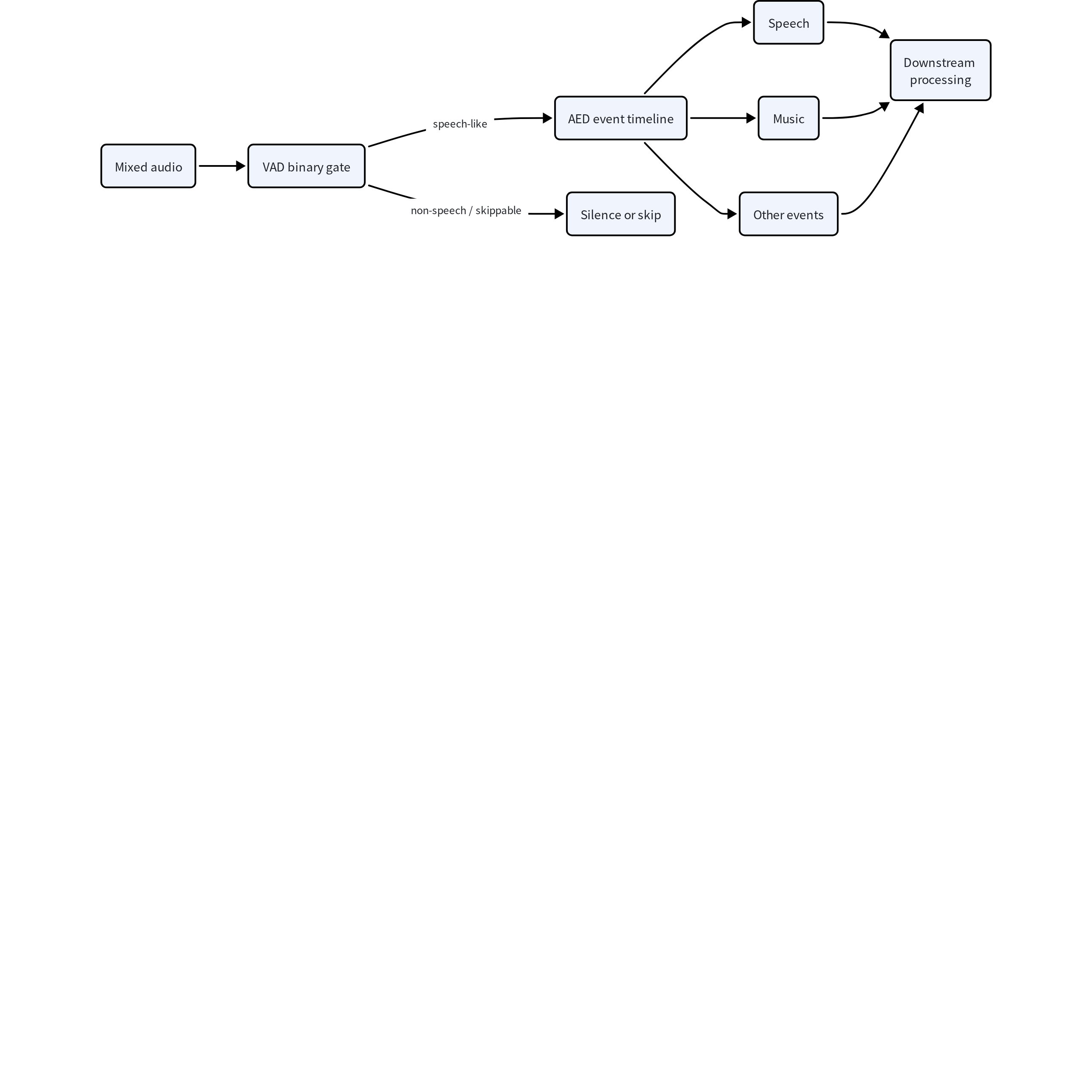
VAD usually emits a speech / non-speech timeline. The methods run from energy thresholds, zero-crossing rates, and GMMs through WebRTC VAD and neural models such as Silero. The objective stays modest: mark intervals that probably contain talking, at a given SNR, as fast as possible.
It remains irreplaceable for practical reasons. ASR needs segmentation or long files drift in alignment. Voice-conversion and TTS data cleaning need to drop long silences. Call and meeting stacks must open and close in real time on-device. In those settings, voice versus not-voice is the right question, and VAD is a good enough answer.
When VAD is healthy, you barely hear it: onsets and offsets are clean, breaths and short pauses are kept, the noise floor is not promoted into speech. Its failure modes are equally concrete—treating singing as speech, tagging laughter as a line, fragmenting dialogue under drums, or swallowing a reverb tail into the next sentence.
Those failures are often tolerable on a phone call. Once the same audio has to go into recognition, dubbing, or mixing, knowing only that “there is voice” puts every later module on the wrong assumption.
3. Why “is there voice?” is not enough
VAD is typically trained as “speech versus everything else.” Open-world audio does not obey that split.
Human sound is more than talking. Singing, laughter, crying, and screams all carry vocal-fold signatures, so a VAD will happily mark them speech. Downstream treatment is usually not the same: a spoken line may need recognition or replacement, a laugh or a scream behaves more like an effect, and singing often belongs with the music. A binary gate cannot encode that difference.
Sounds also rarely own the timeline. Speech can sit under music; applause can overlap cheering; a siren can share the frame with an engine. VAD often sees only a union—“there is voice in this span”—while later stages need per-event boundaries.
In short: VAD answers existence. Later processing needs class plus localization.
| Capability | What VAD can answer | What later processing still lacks |
|---|---|---|
| Is there voice? | Yes, and usually well enough | Speech, singing, laughter, or something else? |
| When? | A coarse boundary | Per-event boundaries, not a single union |
| Noise / silence | Can drop it as non-speech | What are the music, effects, and ambient events? |
| Signal to downstream | Only send / don’t send | How should this span be treated? |
4. AED: detecting sound events on a timeline
AED / SED can be stated in one sentence: given audio, emit timestamped events, each with a class (and usually a confidence). It does not collapse a clip into one global tag—that is audio tagging / scene classification. It is multi-label, overlapping, and localized.
The research community, especially DCASE Sound Event Detection, has used this language for years: polyphonic means several classes can be active at once; event-based metrics care whether events were placed in time, not whether a frame accuracy plot looks smooth. A general label set can be wide. AudioSet-style taxonomies include speech and music, but also laughter, applause, dog barks, sirens, dishes, footsteps, gunshots, and a long tail of other events. For AED these are the same problem: what sound, in which interval, and does it coexist with others?
Architectures differ. CRNNs catch local spectrogram patterns with convolutions and temporal structure with recurrent layers—the classic SED backbone. PANNs, AST, BEATs and related pretrained audio encoders strengthen frame features before a detection head. Names change; the contract does not: waveform in, event timeline out.
What AED adds over VAD is not “a more accurate is-there-voice bit.” It is an overlapping type dimension. A two-second window can be speech + music, or laughter + applause, or a fully non-vocal siren + engine. That is what lets later stages act on events instead of on “was there sound.”
5. General events, and application-specific labels
In a real product, teams rarely hand a few hundred classes straight to every downstream module. More often they collapse a general event detector into a smaller working set—not because AED can only hear those classes, but because later processing only branches in a few places.
Media production is a typical example. Dialogue, singing, and instrumental music can all look like “voice” or “energy” to a coarse detector, yet they need very different treatment: speech often goes to recognition or dubbing, while singing and a music bed are often meant to stay. Some systems therefore remap general AED output into a working set such as speech / singing / music. That is an application-specific taxonomy, not the definition of AED.
A general AED can still detect laughter, crying, applause, and environmental effects. The product only decides which events to handle separately, which to merge, and which to ignore. Narrowing the label set makes later processing simpler. It does not shrink the sound world to three classes.
6. Making later processing easier
AED sits early in a pipeline, and it should stay modest: it does not unmix stems, and it does not generate new speech. It gives later modules a timeline they can actually read.
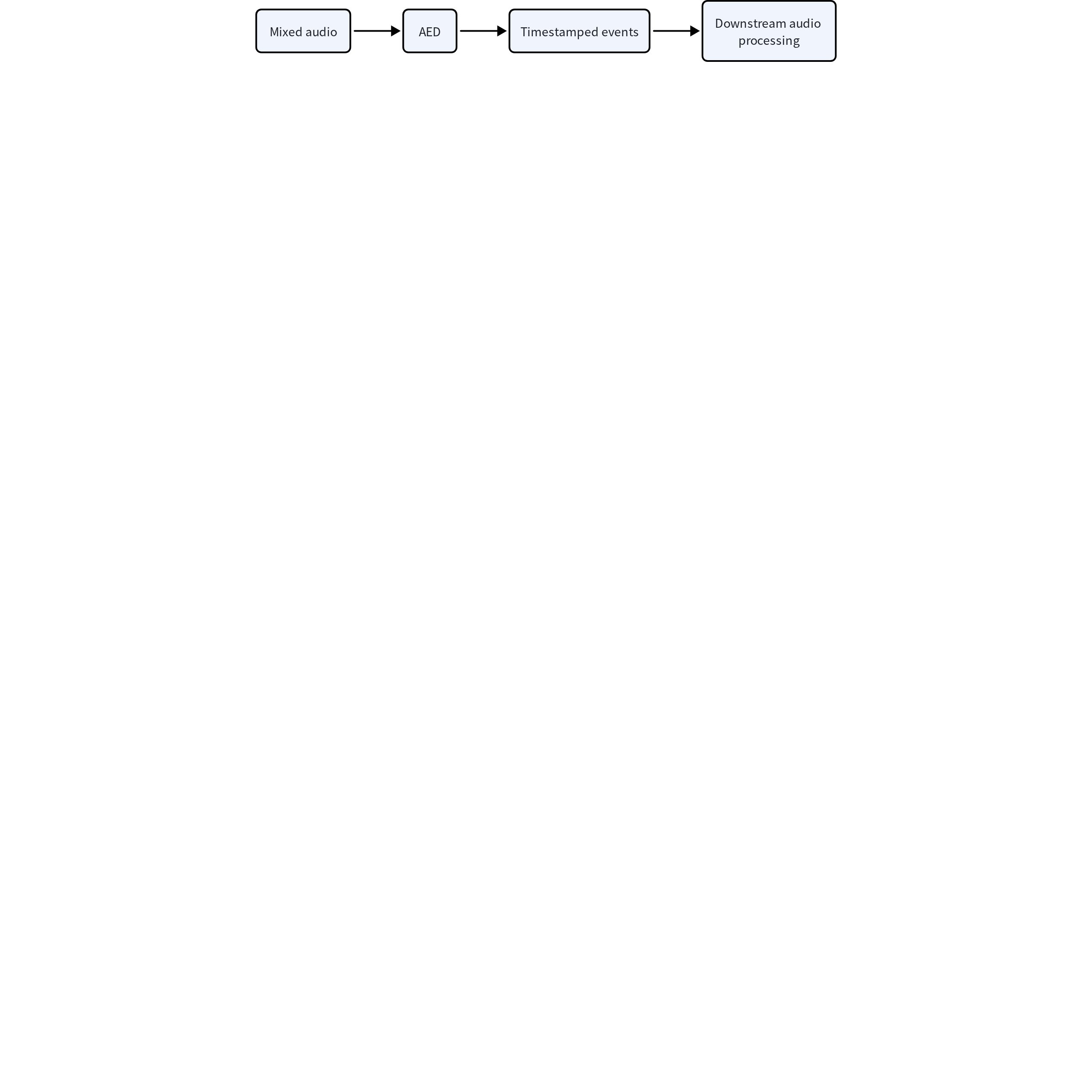
With an event timeline, recognition can spend less compute on pure music, dubbing can see which intervals look like dialogue, and mixing or effects can tell applause from laughter from ambience. Raw detections are usually multi-label and overlapping; downstream code then decides what to do with each span. That mapping belongs to the product, not to the detector.
7. How to score it: lab numbers are not the scoreboard
SED papers lean on event-based F1 with a collar, and on curves such as PSDS (Polyphonic Sound Detection Score) that punish timing error and misses more honestly. Those are the right tools for comparing detection heads: how much the boundary drifted, whether overlapping events were split, whether the long tail collapsed.
A score that can actually ship has to ask a second question: would a listener catch this error immediately? A strong average does not mean short events, confusable classes, or overlaps are acceptable. A clear eval at least separates three error types:
- Class error — one event tagged as another, such as laughter versus speech, or a siren versus an engine.
- Boundary error — the class is right, but the cut lands inside the event. It sounds worse, and later segmentation inherits the cut.
- Existence error — missing a short event, or promoting unrelated sound into a target class. Weight these by actual use; do not average them with class error.
Listening lists should follow the same split instead of a handful of random clips. Averages wash the long tail out. The failures that hurt later processing almost all come from it.
8. The limits are still there
Half-sung lines, distant ambient voices, and two-syllable emotional bursts will keep hugging thresholds. Acoustically close events—speech and singing, laughter and breath, a siren and a synth—will keep stealing each other’s labels. Once AED cuts wrong, recognition, dubbing, and mixing all follow the bad window.
Physics still binds. If several sources are already crushed together on one master, a perfect event detector still cannot losslessly recover each source from a single channel. What AED can reduce is semantic mislabeling that should not happen: do not hand one kind of sound to a module that expects another. It improves the quality of time-semantics. It does not repeal information theory.
9. Takeaway
VAD asks whether there is voice. AED asks what event it is, and when. The first is still a cheap, necessary gate. The second is a more general layer of sound understanding, so later processing has to guess less.
AED itself is about open sound events, built on top of general event detection, so that later stages know how to treat a span. Hear the events first, then decide what the audio should do next—for tools such as VMEG, that is a prerequisite for trustworthy dubbing and mixing, not a polish pass after launch.