Recreating a human performance across languages is far more difficult than generating a natural voice.
Introduction
Over the past decade, Text-to-Speech (TTS) has improved dramatically.
Today’s state-of-the-art models can generate voices that are remarkably natural, clone a speaker from only a few seconds of audio, and even express different speaking styles.
Yet if you’ve watched AI-dubbed videos, you’ve probably experienced something like this:
- The translated words are correct.
- The cloned voice sounds realistic.
- But something still feels… off.
The dialogue is slightly rushed.
The emotion doesn’t match the actor.
The pauses feel unnatural.
The voice changes subtly between scenes.
The lips don’t quite synchronize.
The final video simply doesn’t feel like the original.
This raises an interesting question.
If modern TTS is already so good, why is AI dubbing still so difficult?
The answer is surprisingly simple:
AI dubbing is not a speech synthesis problem. It is a performance reconstruction problem.
At VMEG, this is one of the biggest lessons we’ve learned after processing tens of thousands of AI video localization tasks every day across 170+ languages, with around 10% of projects exceeding one hour and the longest spanning more than three hours.
Generating speech is only one step.
Recreating a believable performance is the real challenge.
The Pipeline Everyone Imagines
Most people picture AI dubbing like this:
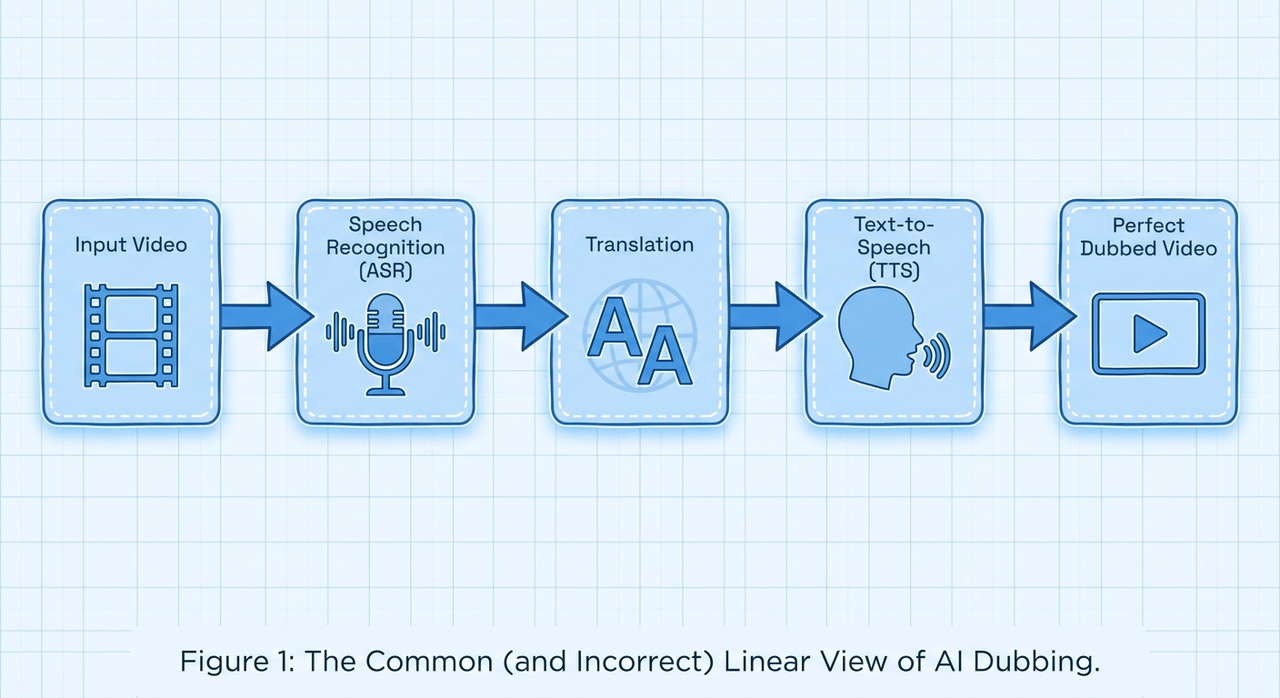
It looks perfectly reasonable.
Unfortunately, it rarely produces a video that viewers actually enjoy watching.
Because between translation and speech synthesis, an enormous amount of information is missing.
Text-to-Speech Solves One Problem
Traditional TTS answers one question:
“Given this text, how should it sound?”
AI dubbing asks a much harder one:
“How should this person perform this sentence in another language while preserving the original viewing experience?”
Those are fundamentally different objectives.
A TTS model focuses on generating natural speech.
A dubbing system must preserve:
- speaker identity
- speaking rhythm
- emotion
- pauses
- conversational flow
- translation constraints
- synchronization with the video
- consistency across an entire film
Natural speech is only one piece of the puzzle.
One Sentence, Many Performances
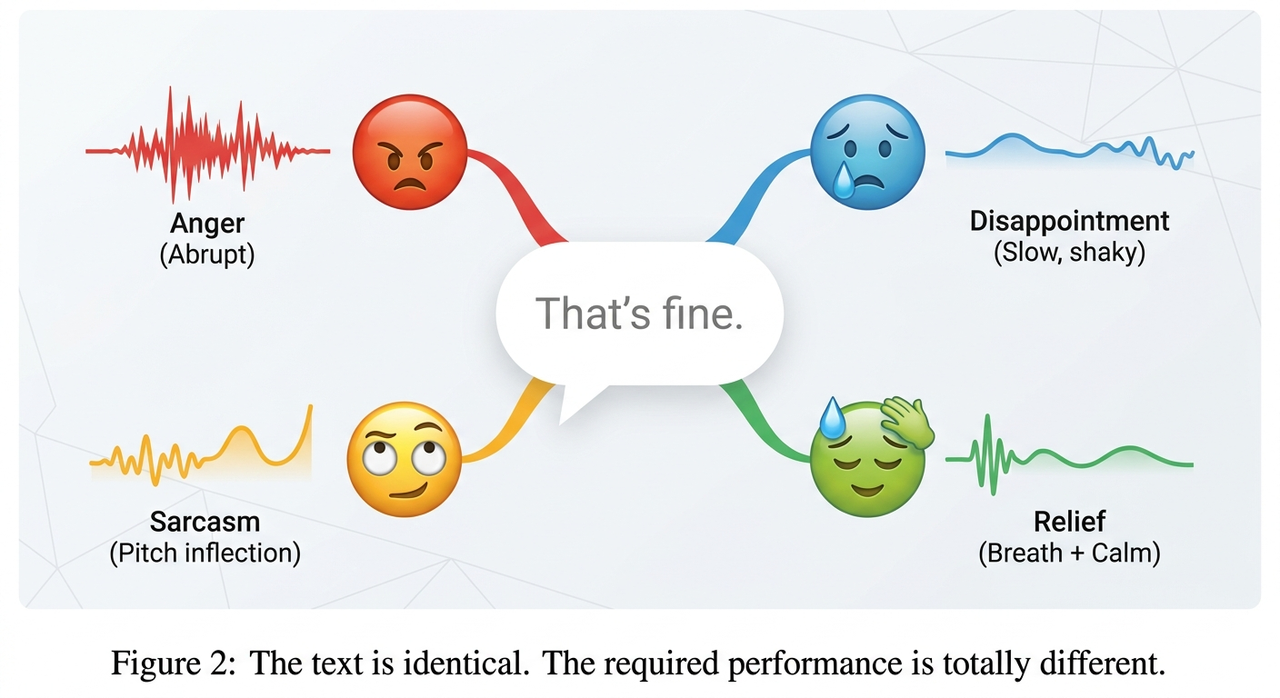
Consider this sentence.
“That’s fine.”
A TTS model sees:
That's fine.A dubbing system sees something much richer.
| Attribute | Scene A | Scene B |
|---|---|---|
| Speaker | Host | Customer |
| Emotion | Encouraging | Frustrated |
| Speaking Pace | Calm | Fast |
| Pause Before | 500 ms | None |
| Pause After | 700 ms | Abrupt cut |
| Facial Expression | Smiling | Frowning |
| Camera Shot | Wide | Close-up |
| Lip Visibility | Low | High |
The text is identical.
The performance shouldn’t be.
Challenge 1 — Translation Changes Time
One of the biggest misconceptions about AI dubbing is that translation simply replaces one language with another.
It doesn’t.
Different languages naturally require different amounts of time to express the same idea.
For example:
| Language | Example |
|---|---|
| English | “I can’t believe it.” |
| German | Often significantly longer due to compound words and sentence structure. |
| Chinese | Often shorter and more compact. |
| Japanese | Different grammar and pacing. |
Suppose the original speaker finishes a sentence in 2.3 seconds.
After translation, the target language naturally requires 3.5 seconds.
Now the system faces a difficult decision.
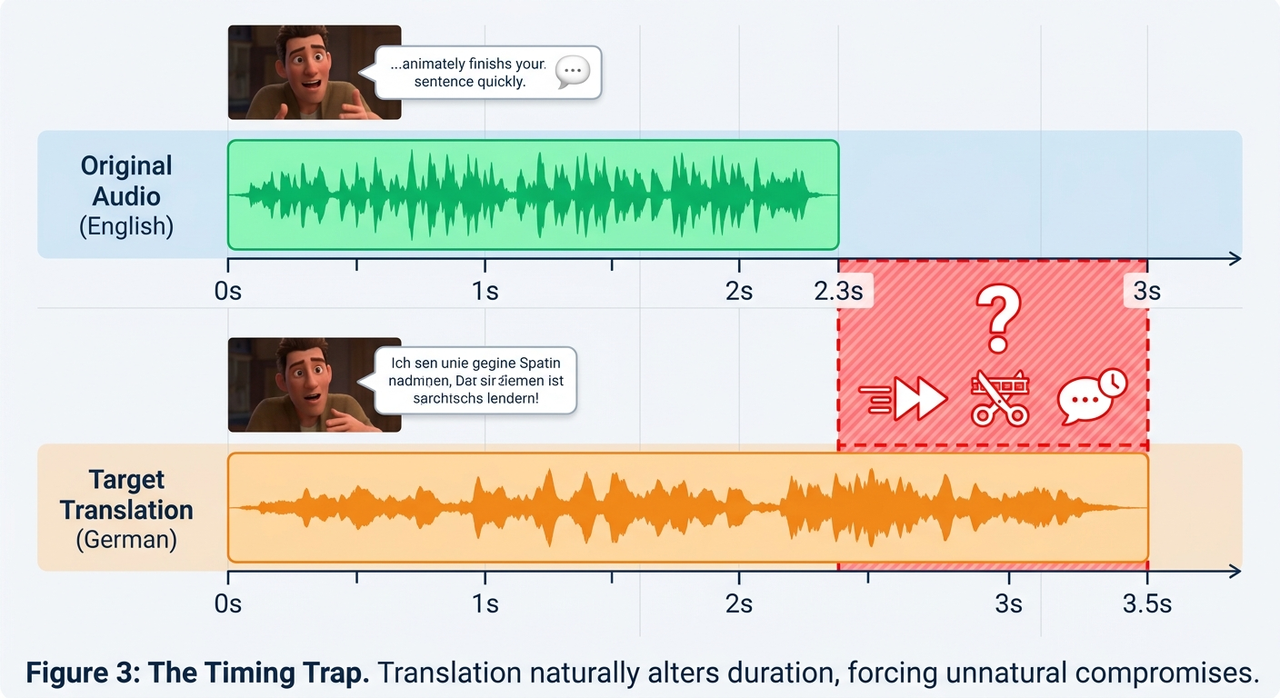
Should it
- speed up the synthesized speech?
- rewrite the translation?
- shorten pauses?
- slightly compress audio?
- extend silence between shots?
None of these problems are solved by a TTS model.
They are localization decisions.
Challenge 2 — Emotion Is Not Written in Text
Humans don’t simply read words.
They interpret intent.
Compare:
“Fine.”
It could mean
- agreement
- disappointment
- sarcasm
- anger
- relief
The transcript doesn’t tell us.
The video often does.
Facial expressions.
Body language.
Conversation history.
Speaker relationships.
All contribute to how a sentence should be spoken.
Recent research in expressive machine dubbing and visually guided speech synthesis has shown that incorporating prosody, visual context, and duration control significantly improves the naturalness and synchronization of dubbed speech.
Challenge 3 — Timing Is Everything
Suppose a subtitle ends here.
The dubbed sentence finishes 300 milliseconds later.
Humans notice.
Not consciously.
But they feel the conversation is unnatural.
Now imagine this happening thousands of times throughout a feature-length film.
Timing errors accumulate.
Lip synchronization becomes harder.
Speaker turns become confusing.
Subtitles drift.
Even streaming platforms emphasize that subtitles should synchronize closely with both audio and visual edits because timing directly affects viewing comfort.
Good dubbing begins long before lip synchronization.
Challenge 4 — Speaking Pace and Pauses
Professional voice actors rarely speak at a constant speed.
They
- hesitate
- interrupt
- breathe
- pause for emphasis
- accelerate during excitement
- slow down during emotional moments
These pauses are part of communication.
Removing them often makes synthesized speech sound robotic—even if every word is correct.
Preserving rhythm is just as important as preserving pronunciation.
Challenge 5 — Speaker Consistency
In our previous article, we discussed why speaker diarization matters.
The reason becomes obvious during dubbing.
Imagine a two-hour documentary with:
- a narrator
- five interviewees
- historical recordings
- audience questions
- multilingual guests
Each speaker should maintain a consistent synthetic voice throughout the entire program.
A single diarization mistake can result in:
- the wrong cloned voice,
- inconsistent narration,
- confusing conversations.
Speaker consistency is not merely an ASR problem.
It directly affects the credibility of the dubbed video.
Challenge 6 — Not Everything Should Become Speech
Videos contain much more than dialogue.
They contain
- music
- applause
- laughter
- cheering
- silence
- singing
- narration
- ambient sounds
Should a singing segment become
♪ Never gonna give you up ♪
or
[music]
or
be left untouched?
The correct answer depends on the content and the localization objective.
Dubbing requires understanding what should be recreated and what should be preserved.
Challenge 7 — Lip Sync Starts Much Earlier Than You Think
People often blame lip-sync models when the final video looks unnatural.
In reality, lip synchronization depends on everything that happened before.
Poor transcription
↓
Poor translation
↓
Incorrect timing
↓
Wrong speaking rate
↓
Bad pause placement
↓
Lip-sync failure
The lip-sync model may simply be receiving impossible inputs.
This is why recent research increasingly focuses on controlling speech duration and prosody jointly with visual information rather than treating lip synchronization as an isolated post-processing step.
AI Dubbing Is a Systems Problem
This is perhaps the biggest misconception in the industry.
People compare TTS models.
In reality, viewers experience the entire pipeline.
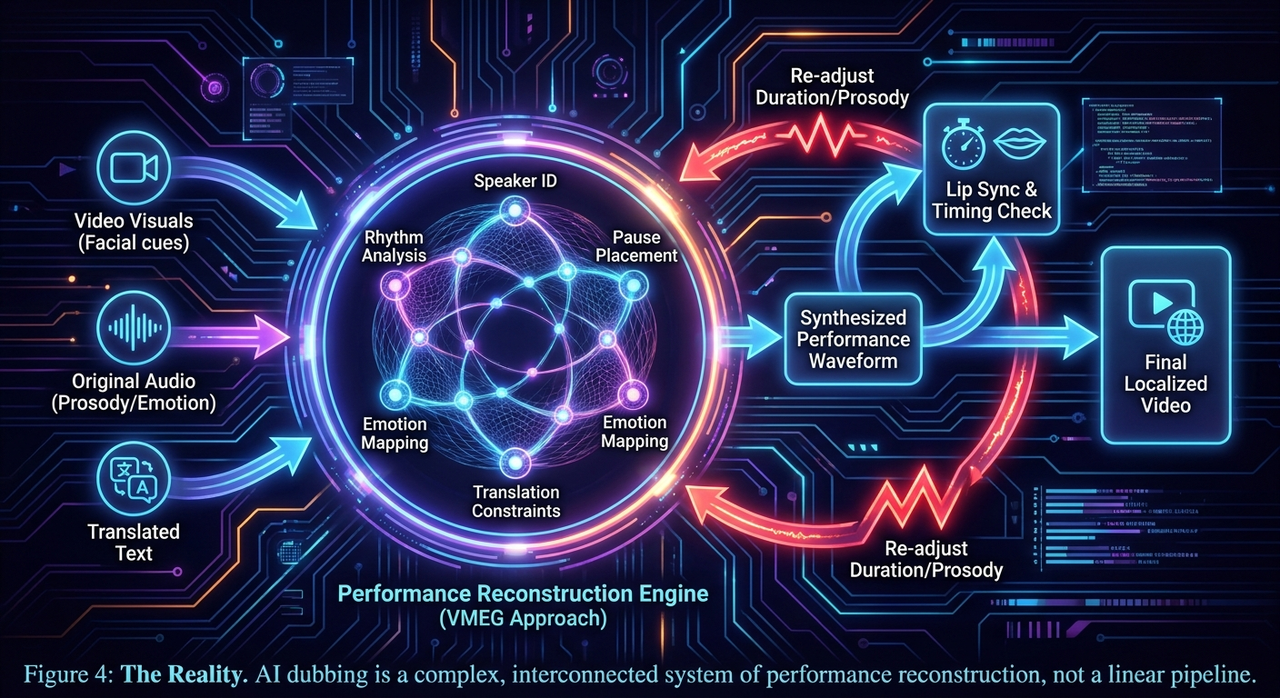
Every stage influences the next.
Optimizing only speech synthesis rarely produces the best dubbed video.
How We Think About AI Dubbing at VMEG
At VMEG, speech synthesis is only one component of AI dubbing.
Before generating a single waveform, our localization pipeline progressively reasons about:
- speaker identity
- multilingual context
- sentence completeness
- speaking pace
- pauses
- emotion
- subtitle structure
- translation constraints
- synchronization requirements
- visual context
Instead of asking:
“How do we synthesize this sentence?”
we ask:
“How do we recreate this person’s performance in another language?”
That shift in perspective changes almost every engineering decision.
Conclusion
Text-to-Speech converts text into audio.
AI dubbing recreates a human performance.
Those are fundamentally different problems.
As speech synthesis models continue to improve, we believe the next wave of progress in AI video localization will come less from generating better voices, and more from better understanding the original performance—its timing, emotion, rhythm, speaker identity, and interaction with the visual scene.
Because in the end, viewers don’t judge a dubbed video by how realistic the voice sounds.
They judge it by whether it feels like the original.
References
Speech Recognition & Alignment
Subtitle & Localization Guidelines
- Netflix Timed Text Style Guide – Subtitle Timing — Why subtitle timing and synchronization affect viewing experience.
- Netflix Timed Text Overview — An overview of Netflix’s large-scale timed-text pipeline.
Research on AI Dubbing
- DubWise: Video-Guided Speech Duration Control in Multimodal LLM-based TTS for Dubbing — Duration control for cross-lingual dubbing with visual guidance.
- More than Words: Visually-Driven Prosody for Text-to-Speech — Using visual cues to improve prosody and synchronization.
- Expressive Machine Dubbing Through Phrase-level Cross-lingual Prosody Transfer — Cross-lingual prosody transfer for expressive dubbing.