Speech recognition converts speech into words. AI video localization needs to understand the entire video.
Every day, VMEG processes tens of thousands of AI video localization tasks across 170+ languages. Around 10% of them exceed one hour, and the longest production workflow we’ve handled spans more than three hours, involving dozens of speakers across multilingual conversations.
At this scale, we learned something that fundamentally changed how we think about speech recognition:
A transcript is not the product. It’s only the beginning.
The Pipeline Everyone Draws
If you search for AI dubbing or video translation, the pipeline usually looks something like this:
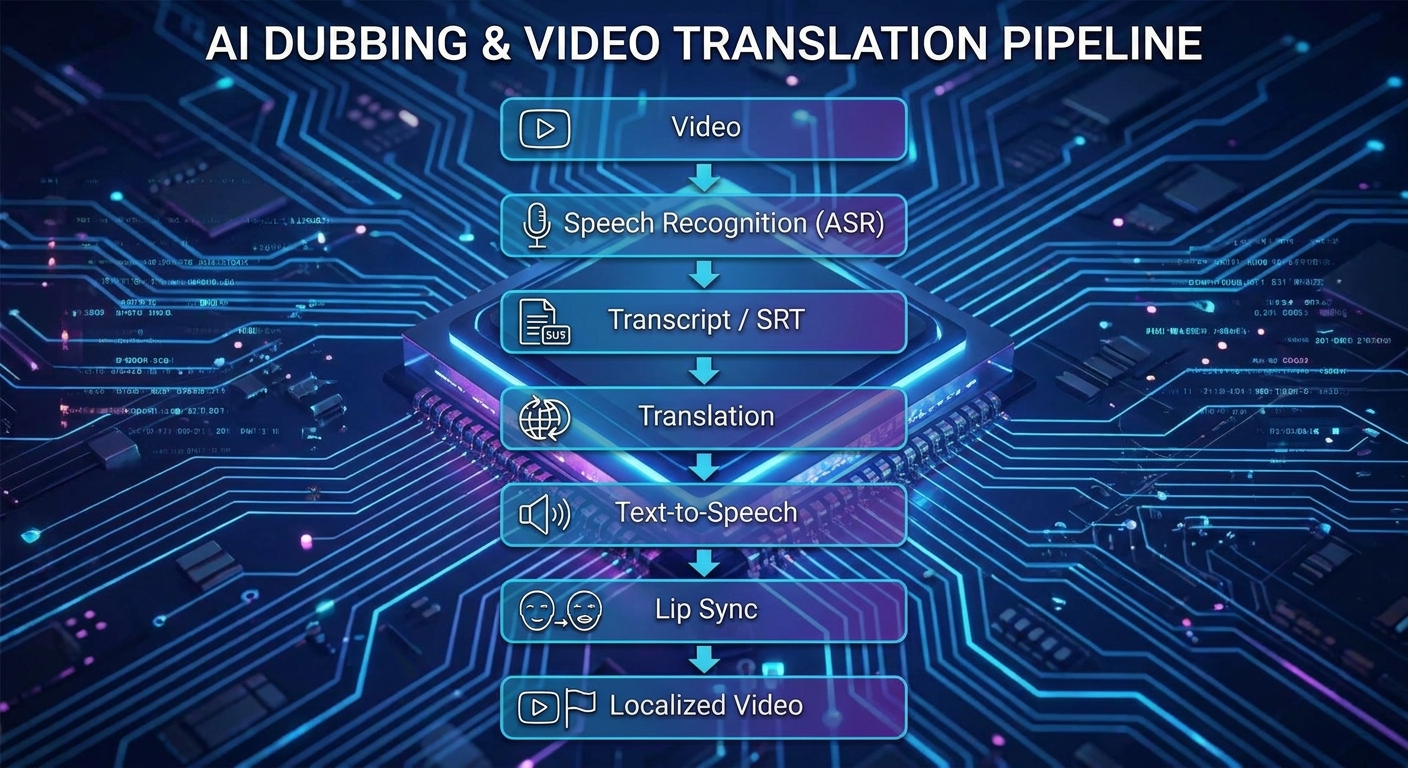
Simple.
Logical.
And surprisingly incomplete.
This pipeline assumes that a transcript—or perhaps an SRT subtitle file—is a complete representation of the source video.
For production AI video localization, it isn’t.
A transcript tells us what was said.
A localized video needs to know much more.
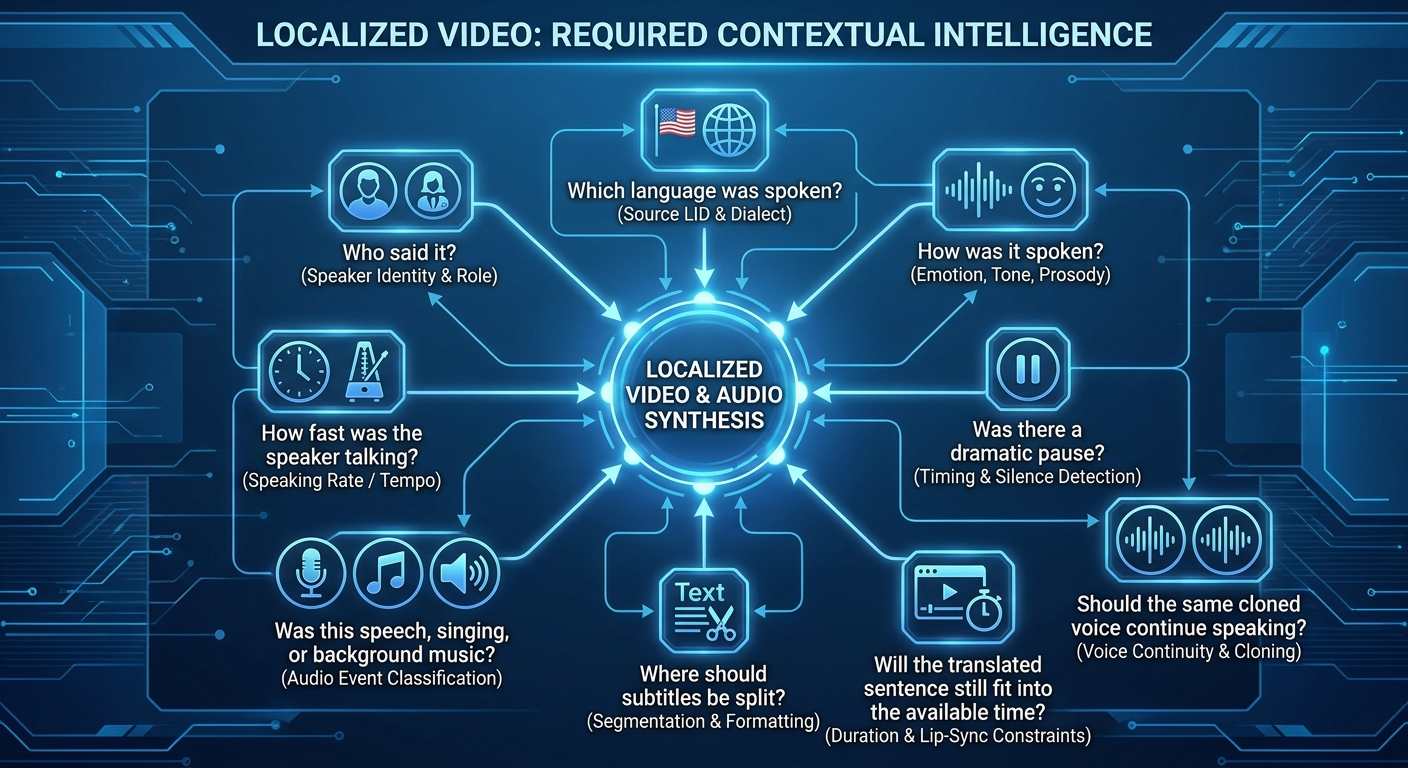
None of these questions are answered by plain text.
A Transcript Was Never Designed for AI Dubbing
Traditional Automatic Speech Recognition has one primary objective:
Convert speech into text as accurately as possible.
The output is intentionally simple.
00:10:21

Hello everyone.

00:10:23

Today we're discussing AI.
Or as an SRT file:
1
00:10:21,000 --> 00:10:23,200
Hello everyone.

2
00:10:23,200 --> 00:10:27,000
Today we're discussing AI.
That’s exactly what subtitles were designed for.
But generating a natural dubbed video requires far richer information.
An SRT doesn’t know:
- whether the speaker changed,
- whether the sentence is complete,
- whether the speaker is whispering or shouting,
- whether the audio is singing,
- whether applause follows,
- whether the translated sentence should be shortened,
- or whether the cloned voice should remain consistent throughout the conversation.
In other words,
An SRT is an exchange format for subtitles. It is not a complete representation of a video.
Reality Check: What Does a Three-Hour Video Actually Look Like?
A long-form production video can easily contain:
- 20,000+ spoken words
- 4,000–6,000 subtitle segments
- Dozens of speakers
- Multiple languages with frequent code-switching
- Music, applause, laughter, silence, narration, and interviews
Small errors rarely stay isolated.
A missed speaker boundary becomes the wrong cloned voice.
Timestamp drift affects subtitle timing.
Broken sentence boundaries reduce translation quality.
Poor pacing makes dubbed speech sound unnatural.
Long-form localization is less about fixing individual errors than preventing them from accumulating across the pipeline.
AI Video Localization Needs More Than Words
Instead of asking:
What words were spoken?
Production localization asks:
What does every downstream AI system need to know?
Different tasks require different information.
| Downstream Task | Information Required |
|---|---|
| Translation | Complete sentences, language, context, terminology |
| Subtitle Generation | Reading speed, segmentation, line breaks |
| AI Dubbing | Emotion, speaking pace, pauses, speaker identity |
| Voice Assignment | Consistent speaker identity and voice selection |
| Lip Synchronization | Precise timestamps and speech boundaries |
| Human Review | Confidence, speaker names, revision history |
Notice something interesting.
Almost none of these systems consume a plain transcript directly.
They consume a much richer understanding of the source video.
What Does a Production-Ready Transcript Actually Contain?
At VMEG, speech recognition is only the first stage of video understanding.
Each segment is progressively enriched before translation and dubbing begin.
| Information | Why It Matters |
|---|---|
| Spoken text | Linguistic content |
| Speaker identity | Keeps the same synthetic voice throughout the conversation |
| Speaker role or inferred name | Improves review and editing |
| Language (per segment) | Handles multilingual conversations naturally |
| Emotion | Enables expressive dubbing |
| Speaking pace | Matches translated speech duration |
| Pauses | Preserves natural rhythm |
| Speech type | Speech, narration, singing, voice-over |
| Non-speech events | Music, applause, laughter, crowd noise |
| Sentence completeness | Avoids translating incomplete thoughts |
| Subtitle boundaries | Optimizes readability rather than transcription |
| Timestamp precision | Enables subtitle synchronization and lip sync |
| Confidence | Prioritizes human review |
Together, these signals describe not only what was spoken, but how the communication happened.
The Same Words Can Produce Completely Different Videos
Consider the sentence:
“That’s fine.”
A transcript records two words.
A localization system sees much more.
| Attribute | Version A | Version B |
|---|---|---|
| Speaker | Host | Customer |
| Emotion | Encouraging | Frustrated |
| Pace | Calm | Fast |
| Pause | 600 ms | None |
| Language | English | English |
| Subtitle Boundary | Continue | End |
The words are identical.
The final dubbed video shouldn’t be.
One Video, Multiple Languages
Real conversations frequently switch languages.
Hi everyone.

今天我们开始讨论。

Let's continue.
A conventional transcript may simply record:
Language: EnglishA production localization system instead identifies language per segment.
| Segment | Language |
|---|---|
| Hi everyone. | English |
| 今天我们开始讨论。 | Chinese |
| Let’s continue. | English |
Without this information, translation pipelines become unreliable.
Not Everything Is Speech
Another overlooked challenge is deciding what should be transcribed at all.
Consider a musical performance.
Should the output be:
Never gonna give you upOr:
♪ Never gonna give you up ♪Or:
[music]Each is correct for a different downstream application.
Similarly, production systems must distinguish:
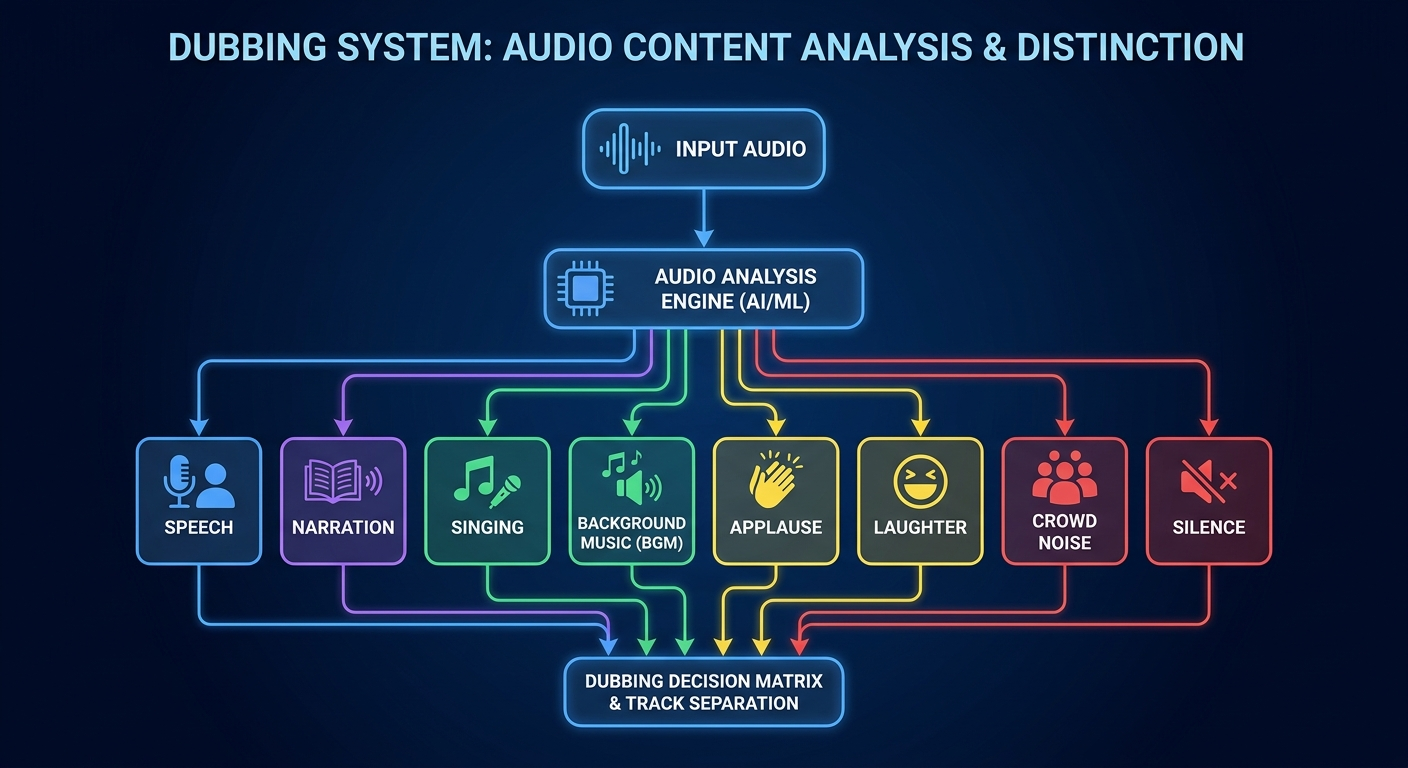
These aren’t transcription errors.
They’re semantic decisions.
Video Localization Is a Multimodal Problem
Humans don’t identify speakers using voice alone.
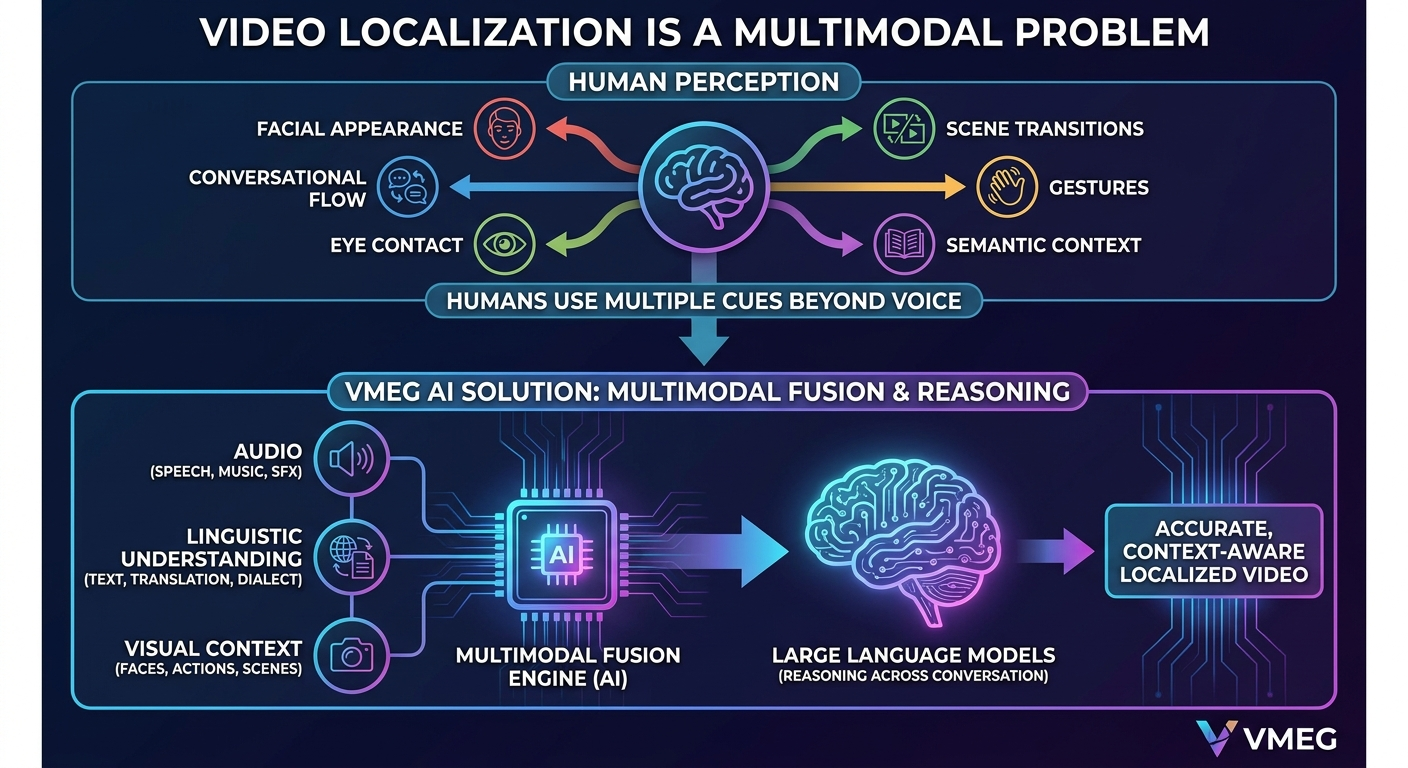
At VMEG, we combine audio, linguistic understanding, and visual context, then use large language models to reason across the entire conversation.
Instead of asking only:
Who sounds like whom?
the system also asks:
Given everything happening in this video, who is most likely speaking, and what does every downstream AI model need to know?
This multimodal reasoning helps improve speaker consistency, subtitle quality, translation accuracy, and dubbing reliability throughout long recordings.
Thinking Beyond Speech Recognition
Speech recognition has traditionally been evaluated using Word Error Rate (WER).
Speaker diarization uses Diarization Error Rate (DER).
Both remain important.
But neither measures whether viewers enjoy the final localized video.
Translation needs complete sentences.
Subtitle generation needs readable segmentation.
AI dubbing needs emotion and pacing.
Lip synchronization needs precise timing.
Every downstream system depends on information that extends well beyond words.
As AI models become more capable, the competitive advantage shifts from recognizing speech to understanding communication.
Conclusion
For decades, speech recognition has been judged by one simple question:
Did the model recognize the words correctly?
AI video localization asks a much harder question:
Did the system understand the video well enough to recreate it naturally in another language?
Those are fundamentally different problems.
At VMEG, we don’t treat transcription as the end of the pipeline.
We treat it as the structured understanding that connects every downstream AI capability—from translation and subtitle generation to expressive dubbing and lip synchronization.
Because ultimately, users don’t read transcripts.
They experience videos.
References
Speech Recognition
- Radford et al., Whisper: Robust Speech Recognition via Large-Scale Weak Supervision (OpenAI, 2022) https://github.com/openai/whisper
- Bain et al., WhisperX: Time-Accurate Speech Transcription of Long-Form Audio https://github.com/m-bain/whisperX
Speaker Diarization
- pyannote.audio https://github.com/pyannote/pyannote-audio
- DIHARD Speaker Diarization Challenge https://dihardchallenge.github.io/
Subtitle & Caption Guidelines
- Netflix Timed Text Style Guides https://partnerhelp.netflixstudios.com/hc/en-us/categories/360000004527-Timed-Text-Style-Guides
- BBC Subtitle Guidelines https://www.bbc.co.uk/accessibility/forproducts/guides/subtitles/
Cloud Speech Services
- Microsoft Azure Speech https://learn.microsoft.com/azure/ai-services/speech-service/
- Google Cloud Speech-to-Text https://cloud.google.com/speech-to-text
- Amazon Transcribe https://aws.amazon.com/transcribe/