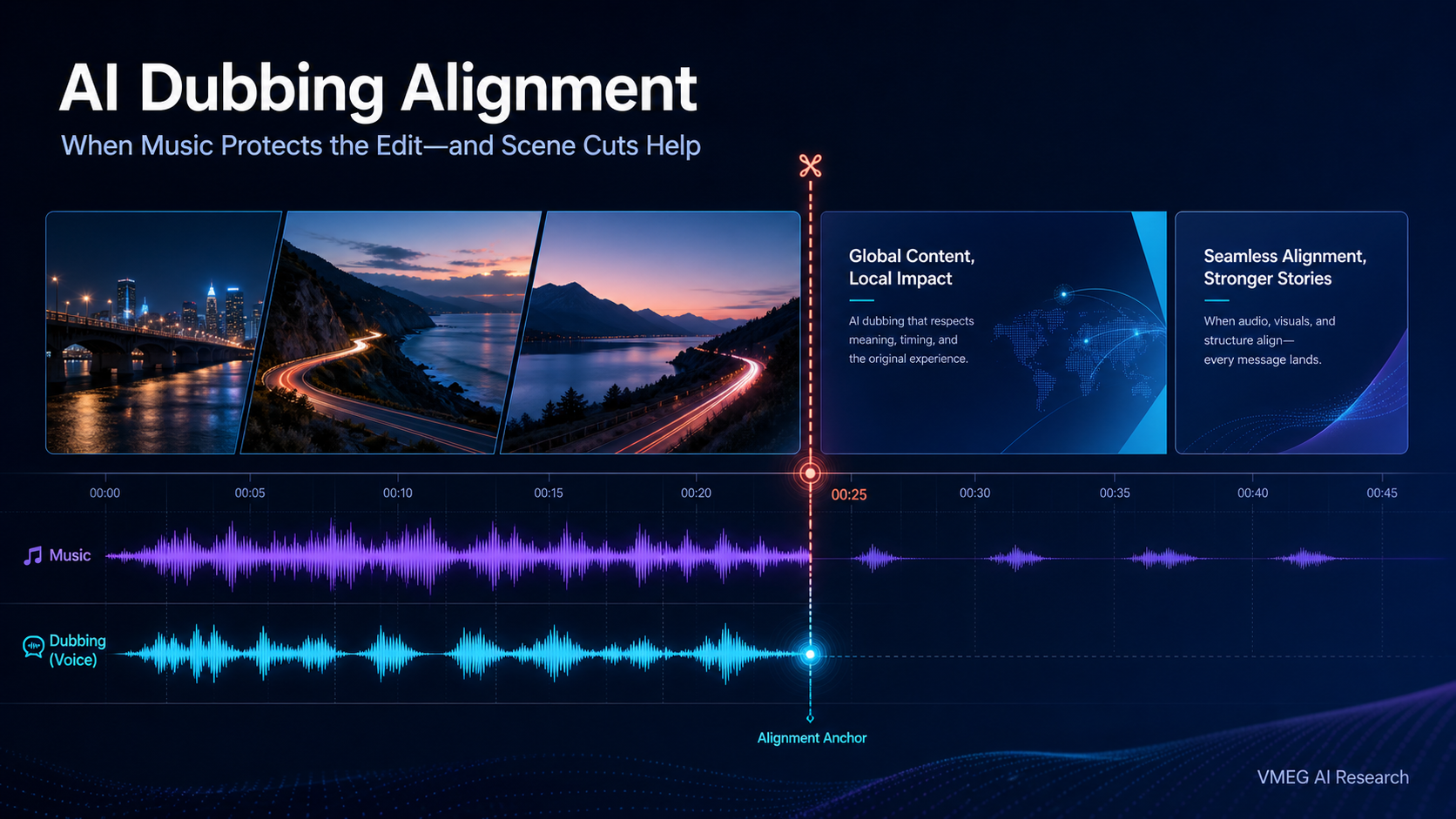
In dubbed video, a sentence can outgrow the moment it was meant to occupy. The voice then trails into the next slide or shot. One way to recover that timing is to use a real scene change as a boundary. That approach works only when it respects the rhythm already carried by the video.
The deciding context is the retained background score: its strength and how continuously it carries the edit. If music is driving the edit, extra cuts can make a dub feel more abrupt. If the background is quiet, an existing shot boundary can give the spoken line room to land with the picture.
The timing problem behind dubbed video
The same idea takes different amounts of time in different languages. A dubbed line may end too early or too late for its picture. The system can change timing, wording, or playback speed, but each option introduces a trade-off.
Playback speed has its own order of preference. Keep the video at its original pace whenever possible. First use available timing room, including a verified scene transition, and shorten or rewrite a line when that is the cleaner fix. If timing still needs correction, make a bounded adjustment to the dubbed audio rate. A local video-rate adjustment is more disruptive because viewers can see the picture change, so it is reserved for dynamic cases where the line still cannot fit after those steps. A large whole-video speed change is therefore usually the wrong remedy. As explained in VMEG’s research on dubbed pace, the goal is natural speech, meaning, and picture timing together.
Why the retained music bed changes the decision
In an interview or tutorial with little audible background music, a shot boundary can be a reasonable place to give speech more room. In a music-led montage, trailer, or performance clip, the same boundary may be part of a deliberate visual rhythm. If every shot change forces the dubbed line to finish or catch up at that exact moment, the voice can feel rushed against the music and edit.
A practical workflow therefore measures the retained background score in two simple dimensions: how strongly it is present in the mix, and how continuously it carries across nearby speech and edits. A strong, continuous score protects the original rhythm. A weak or intermittent bed can leave room for scene-aware alignment, provided the video also contains a credible transition.
When a dub falls out of step with the picture
The problem is easy to spot without a dashboard: a slide changes while the dub is still explaining the previous one, or the voice arrives before the picture catches up. The goal is simply to keep those two moments together.
Evidence from controlled backtests
In controlled VMEG backtests, the retained score is a safety check. The system first asks whether the score is strong and continuous enough to be carrying the rhythm. If it is, that part of the timeline stays unchanged. If the score is light or intermittent, the system then checks whether the picture has a real slide change or shot change. Only when both checks pass can the transition become an optional landing point for the dub. We use two kinds of comparison. Same-input comparisons keep ASR, translation, TTS, separation, and the source video unchanged, so they isolate this alignment choice. Full-pipeline reruns allow normal variation in wording and sentence breaks. In those cases, we compare the same meaning against the same picture and ask whether the strategy still reduces visible mismatches. Together, the two comparisons show both why a change works and whether it remains useful under normal run-to-run variation.
| Scenario | Background-score decision | Effect on voice-picture sync |
|---|---|---|
| Sports tutorial | Intermittent, non-dominant background sound. A verified shot change may be used. | At a real shot change, the Italian dub can reach the next demonstration at its intended moment instead of moving there too early. |
| Long-form lecture (same-input comparison) | Intermittent, non-dominant background sound. A verified shot change may be used. | Visible voice-picture mismatches decreased while ASR, translation, TTS, the background score, and the source video stayed the same. |
| Software tutorial (English to Italian) | Intermittent, unobtrusive background score. A verified transition may be used. | More spoken explanations landed with the new shot, without a meaningful increase in the worst mismatch. |
| Exercise / wellness clip | Prominent, continuous background score. Preserve the original edit. | No new timing boundary was added, so the music-led pace stayed intact. |
| Interview with prominent score | Prominent, continuous background score. Preserve the original edit. | No new timing boundary was added, and reviewers found no pace side-effect. |
The samples support three practical rules. Prominent music leaves the timeline untouched. Quiet music permits a change only when the video contains a real transition. Better voice-picture sync is still not enough on its own. Reviewers also listen for abrupt pace changes between neighboring lines.
A safer decision framework
- Check that a usable source video exists. Audio-only work has no visual cuts to use.
- Inspect the background signal. Obvious, sustained music should protect the original visual rhythm.
- Allow scene-aware alignment only when the signal is safe. A faint or intermittent residual sound should not automatically block useful timing adjustments.
- Use a cut only when one is actually detected. Permission to use scene information does not mean the timeline must change.
- Measure the result. Check whether speech-to-picture alignment improves and whether adjacent lines acquire abrupt pace changes.
What “safe” looks like in practice
A conditional system should fail closed. If it cannot observe the background signal, if the source video is missing, or if the music is clearly prominent, it leaves scene-cut expansion off. If it is allowed to look for cuts but finds none, it leaves the timeline alone. These are important outcomes, not failed experiments.
For the cases where a new boundary is found, quality checks should look beyond a single score. Teams should track whether large alignment errors decrease, whether the largest timing drift worsens, and whether the relative pace of neighboring lines remains stable. A small improvement in a score is not worth a conspicuous speed jump.
Where this fits in an AI dubbing workflow
Scene-aware timing is one stage of a larger process. A complete workflow still needs transcription, translation, voice generation, alignment, review, and rendering. It also needs a recovery path for the occasional line that remains too fast or too slow after alignment. In those cases, a refinement pass can adjust wording or regenerate only the affected line instead of rebuilding an entire video.
That is the value of pipeline-level control. A localized video is not improved by one universal rule. It improves when the system can make a constrained decision, preserve the original when evidence is weak, and make each decision observable for review.
What creators should look for
When evaluating an AI dubbing result, pay attention to transitions as well as voice quality. Watch a few cuts where dialogue is tight. Listen for sudden changes in pace between neighboring lines. Check music-led sections separately from talking-head sections. If a tool offers an editing timeline, use it to inspect the spots where speech and picture appear to pull in different directions.
See the timing difference for yourself
The controlled comparison below follows the same instructional moment before and after scene-aware timing.
Source: youtube.com/watch?v=C4oHUdhtcXg (English, US → Italian). This sports tutorial cuts to a wider shot as the coach begins to speak, then moves to a close-up. In the older alignment, the previous Italian sentence continues into the start of that speaking moment. With scene-aware timing, it ends at the cut, so the next sentence begins with the coach on screen.
| What to watch | Older alignment without scene awareness | Alignment with scene awareness |
|---|---|---|
| The cut to the next tackling demonstration | The previous Italian sentence continues as the coach begins speaking in the wider shot. | The previous sentence ends at the cut, so the next one begins with the coach on screen. |
At this cut, the older alignment has one sentence spanning the picture change. Scene-aware timing makes the cut a sentence boundary. Across the fixed-input replay, large voice-picture offsets fell from 26 to 8.
Top: original English video. Bottom left: Italian dubbing without scene-aware timing. Bottom right: the same fixed input with scene-aware timing. Watch the cut to the wider shot where the coach starts speaking. On the left, the previous sentence continues for about 1.3 seconds after the cut. On the right, it ends at the cut.
Source: youtube.com/watch?v=byrcFICCiDc (ar-MA → fr-FR). The excerpt contains real finance-slide transitions. In the baseline, the French dub remained on the previous slide after the transition. With scene-aware timing, the same inventory beats landed on the new slide.
| What to watch | Without scene-aware timing | With scene-aware timing |
|---|---|---|
| The finance-slide transitions shown in the clip | The French voice arrives after the slide has changed. | The inventory lines land with the new slide, making the explanation easier to follow. |
These clips cover the same idea, rather than the same timestamp. Watch how the spoken inventory lines relate to the new slide.
- Sports tutorial shot change: a public YouTube source with a real cut between demonstrations. In the older Italian alignment, the explanation crossed into the new shot too early; scene-aware timing restored the intended beat.
- French finance-slide example: the public-source excerpt contains real transitions. The baseline lagged after them; scene-aware timing aligned the inventory lines to the new slide.
- Long-form lecture checkpoint: with the same ASR, translation, TTS, score, and source video, scene-aware alignment produced fewer visible voice-picture mismatches.
- Music-led workout example: a prominent, sustained score correctly kept scene-aware timing off, so the dub followed the original rhythmic edit.
These are research and development samples, not a guarantee for every genre. They show why the retained background score must gate the decision instead of treating every shot boundary as a timing opportunity.
VMEG’s AI dubbing workflow is built around this broader localization problem: translated speech has to sound natural while staying connected to the original video. Background music and scene structure are part of that context.
The takeaway
Good voice-picture sync does not make the dub chase every scene transition. When a prominent score carries the rhythm, preserve the original edit. When the score is light and the picture genuinely changes, that transition can help the dub land naturally with the new image. When the signal is unclear, leave the timeline alone.
References
For related VMEG context, see temporal alignment in AI video translation for preserving the original mix while matching translated speech, and from VAD to AED for why sound events need type, duration, and overlap context.
- Boreczky, J. S., & Rowe, L. A. (1996). Comparison of video shot boundary detection techniques. Journal of Electronic Imaging, 5(2), 122–128. https://doi.org/10.1117/12.238675
- Défossez, A. (2021). Hybrid spectrogram and waveform source separation. arXiv preprint arXiv:2111.03600.
- Federico, M., Enyedi, R., Barra-Chicote, R., Goyal, R., Hamza, W., Iglesias, A., Silva, A., & Wang, Y. (2020). From speech-to-speech translation to automatic dubbing. In Proceedings of the 17th International Conference on Spoken Language Translation (pp. 257–264). Association for Computational Linguistics. https://doi.org/10.18653/v1/2020.iwslt-1.31
- Öktem, A., Farrús, M., & Bonafonte, A. (2019). Prosodic phrase alignment for machine dubbing. arXiv preprint arXiv:1908.07226.
- Sahipjohn, N., et al. (2024). DubWise: Video-guided speech duration control in multimodal LLM-based text-to-speech for dubbing. Interspeech 2024. https://doi.org/10.21437/Interspeech.2024-399