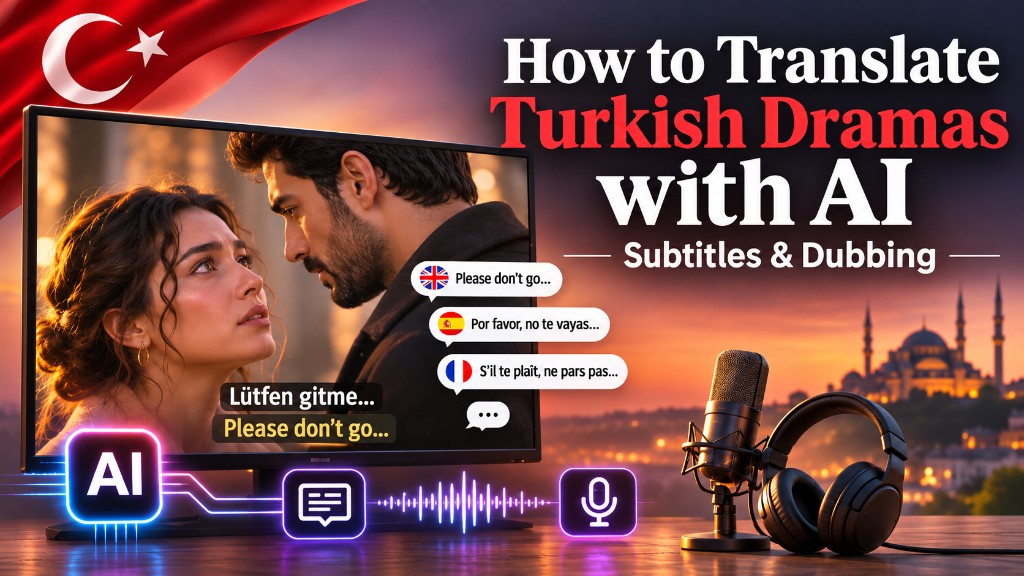
Turkish dramas have attracted audiences far beyond Turkey, particularly in the Middle East, Latin America, and parts of Europe and Asia. As more series reach international viewers, subtitles and dubbing have become an important part of their distribution.
There are two ways to translate Turkish dramas: add translated subtitles while keeping the original dialogue, or dub the characters' voices into another language. AI tools can handle both, making it easier to prepare Turkish series for different markets without producing every language version from scratch.
Should You Translate Subtitles or Dub the Voices?
It depends on how you want people to watch the series.
Subtitles leave the original Turkish performances untouched. Viewers hear the actors' real voices while reading translated dialogue. They're generally faster and less expensive to produce, and work well for audiences accustomed to watching foreign-language content.
Dubbing offers a different experience. Instead of reading subtitles, viewers hear the dialogue in their own language. It's particularly useful for audiences who prefer localized audio, although producing convincing dialogue takes more than simply converting text to speech.
| Subtitles | AI Dubbing | |
|---|---|---|
| Original voices | Preserved | Replaced with translated voices |
| Cost | Generally lower | Higher than subtitles |
| Main editing work | Translation and timing | Voices, emotion, translation, and timing |
| Viewing experience | Read while listening to Turkish | Listen in the target language |
Both approaches can be used for Arabic, English, Hindi, Urdu, Spanish, Portuguese, and other target languages. Some distributors also provide dubbed audio and translated subtitles together.
How Does Turkish Drama Translation Work?
The process usually begins with transcribing the Turkish dialogue. Once the script is available, it can be translated into the target language and used to generate subtitles or new voice tracks.
The challenge is making the result feel natural.
A literal translation may not work when characters use idioms, nicknames, or culturally specific expressions. The translated dialogue may also be considerably longer than the original, affecting subtitle readability and speech timing.
For dubbing, there are additional considerations. Characters need recognizable voices across episodes, emotional scenes should sound convincing, and music or sound effects shouldn't disappear when the Turkish dialogue is replaced.
AI can handle the initial production, but reviewing these details makes a noticeable difference, particularly for longer drama series.
Translating Turkish Dramas with VMEG
VMEG supports both subtitle translation and AI dubbing. You can generate a translated version directly, or use its editor to refine the result when a scene needs more attention.
Start with the Video or an Existing Subtitle File
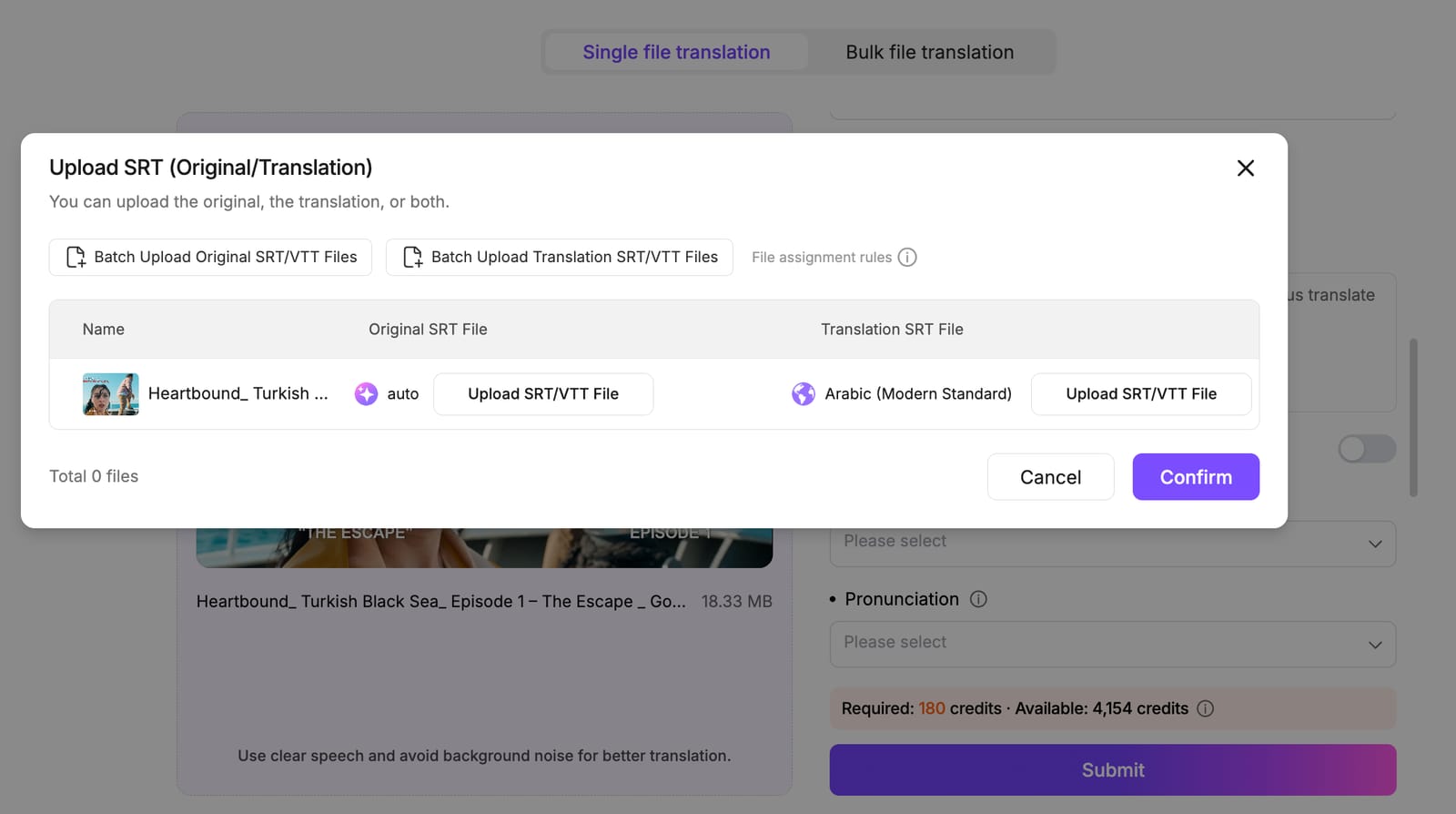
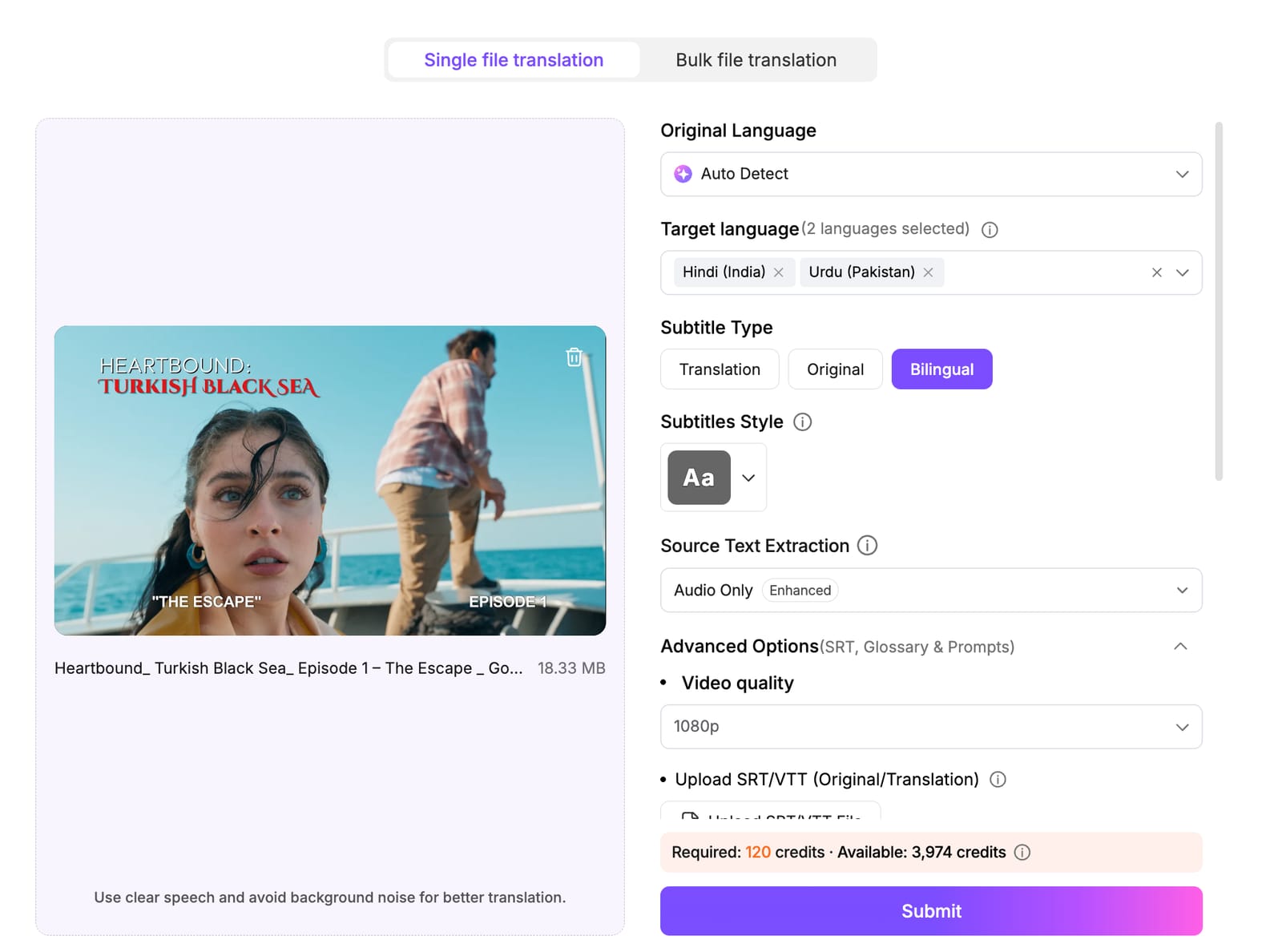
Upload your Turkish drama, select Turkish as the source language, and choose the language you want to translate into.
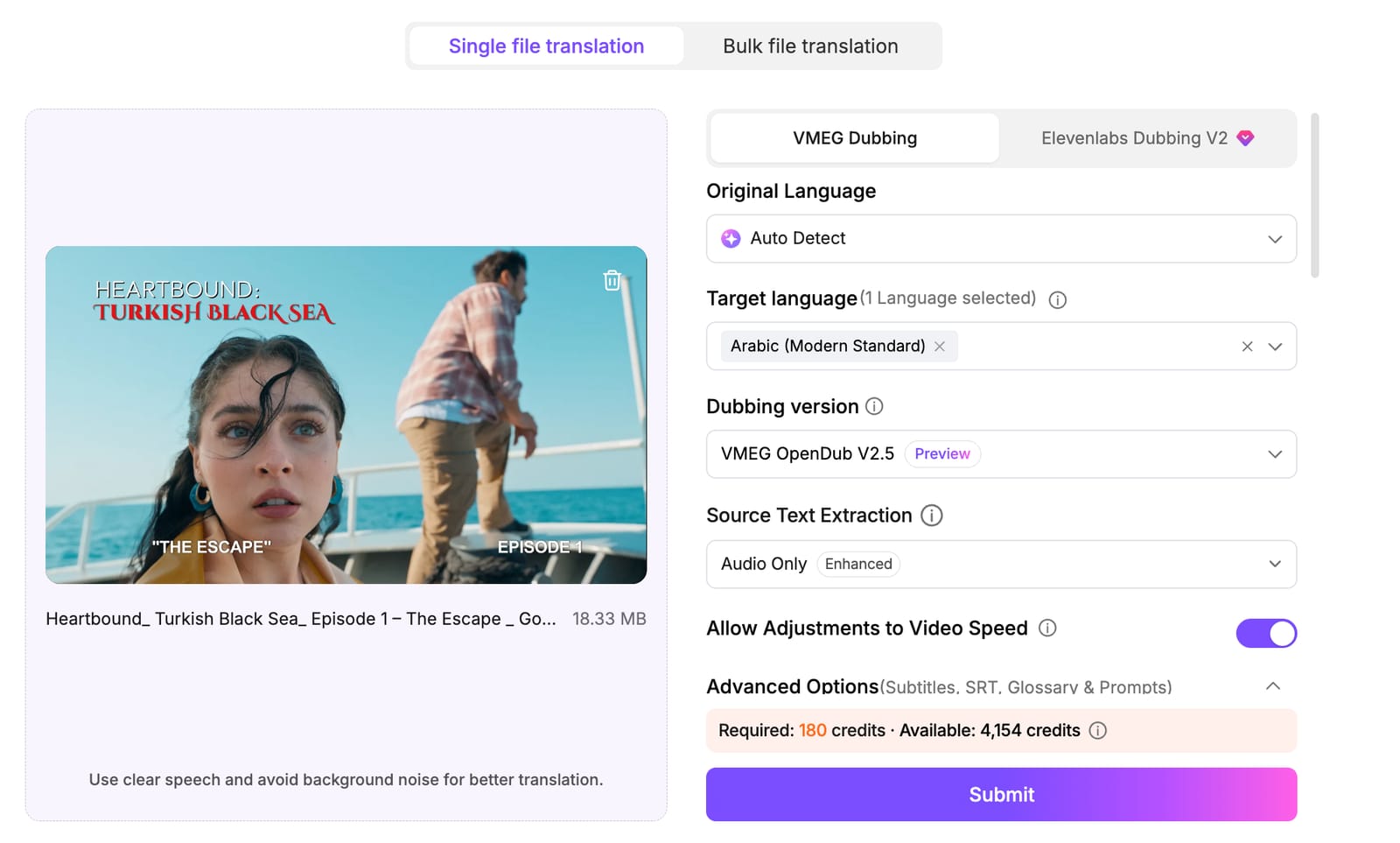
If you already have an SRT or VTT file, you can upload it before starting the dubbing task. Simply open Advanced Options and select Upload SRT/VTT (Original/Translation) to add your subtitle file.
This is helpful when you've prepared or corrected the dialogue beforehand and want to work from an existing subtitle timeline.
Generate Subtitles or Dubbed Audio
For subtitle translation, VMEG creates translated dialogue with timestamps that you can review and export.
For dubbing, it detects speakers and generates translated voices. You can use voice cloning to retain aspects of the original speakers' voices or choose different AI voices for individual characters.
If the generated result sounds right, you can export it directly. There's no requirement to manually edit every scene.
You can also combine dubbed dialogue with translated subtitles, depending on how you plan to distribute the episode.
Make Changes Where They Matter
Not every line in a Turkish drama needs the same attention. A simple conversation may sound fine immediately, while an emotional confrontation or fast exchange may need several adjustments.
VMEG's editor allows you to work on individual dialogue segments rather than regenerate the entire episode.
You can correct translations, change voices, adjust speech speed or volume, and regenerate selected lines. Subtitle segmentation can also be adapted to the dubbed dialogue, including how much text appears in each subtitle segment. Timing, text, and line breaks remain editable.
For recurring character names and expressions, glossaries and pronunciation settings help maintain consistency throughout a series.
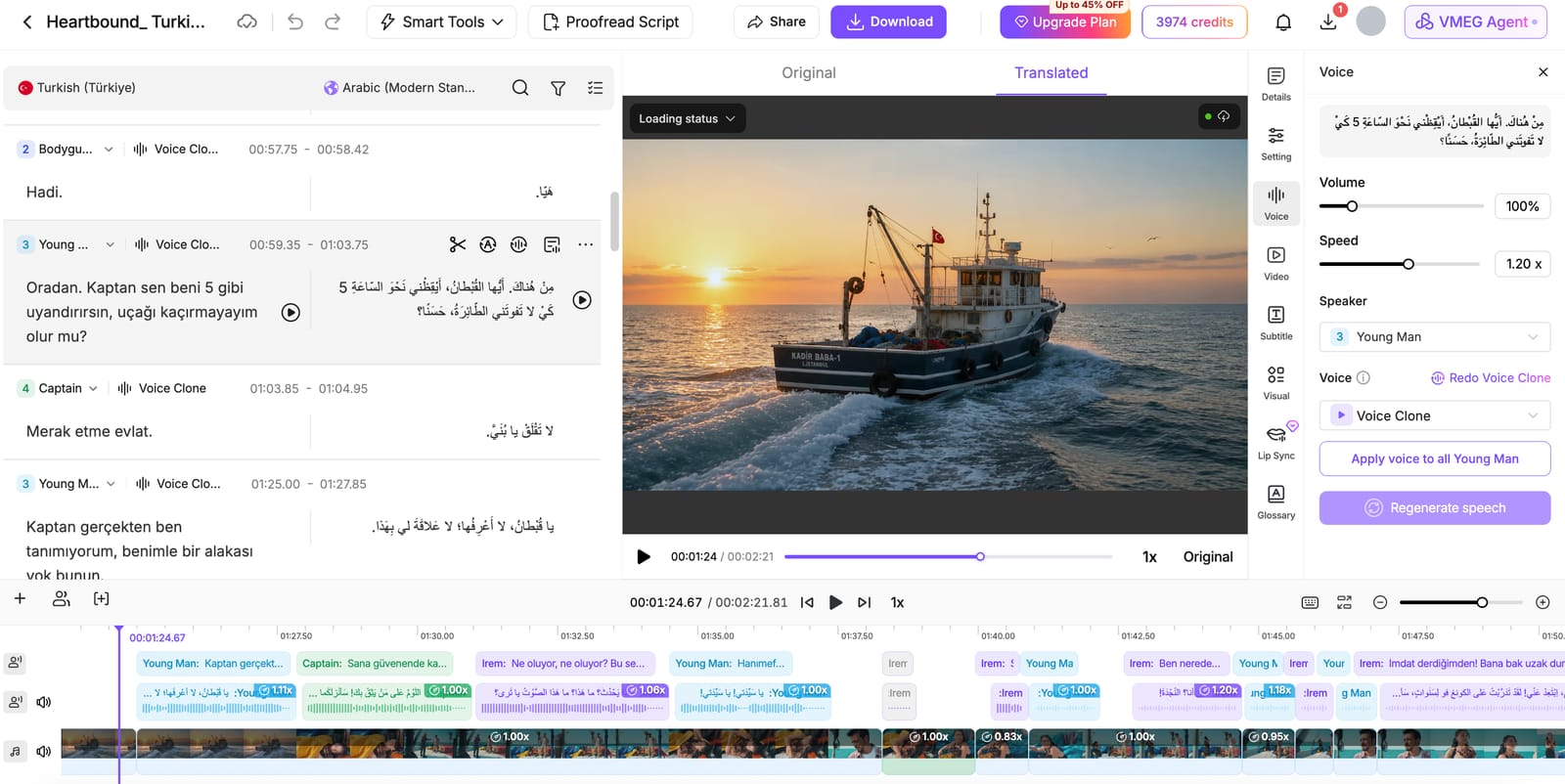
Voice performance is another area where editing helps. With VMEG, you can use prompts to guide emotional delivery, change voice-cloning modes, or regenerate speech when a character sounds too flat or unnatural.
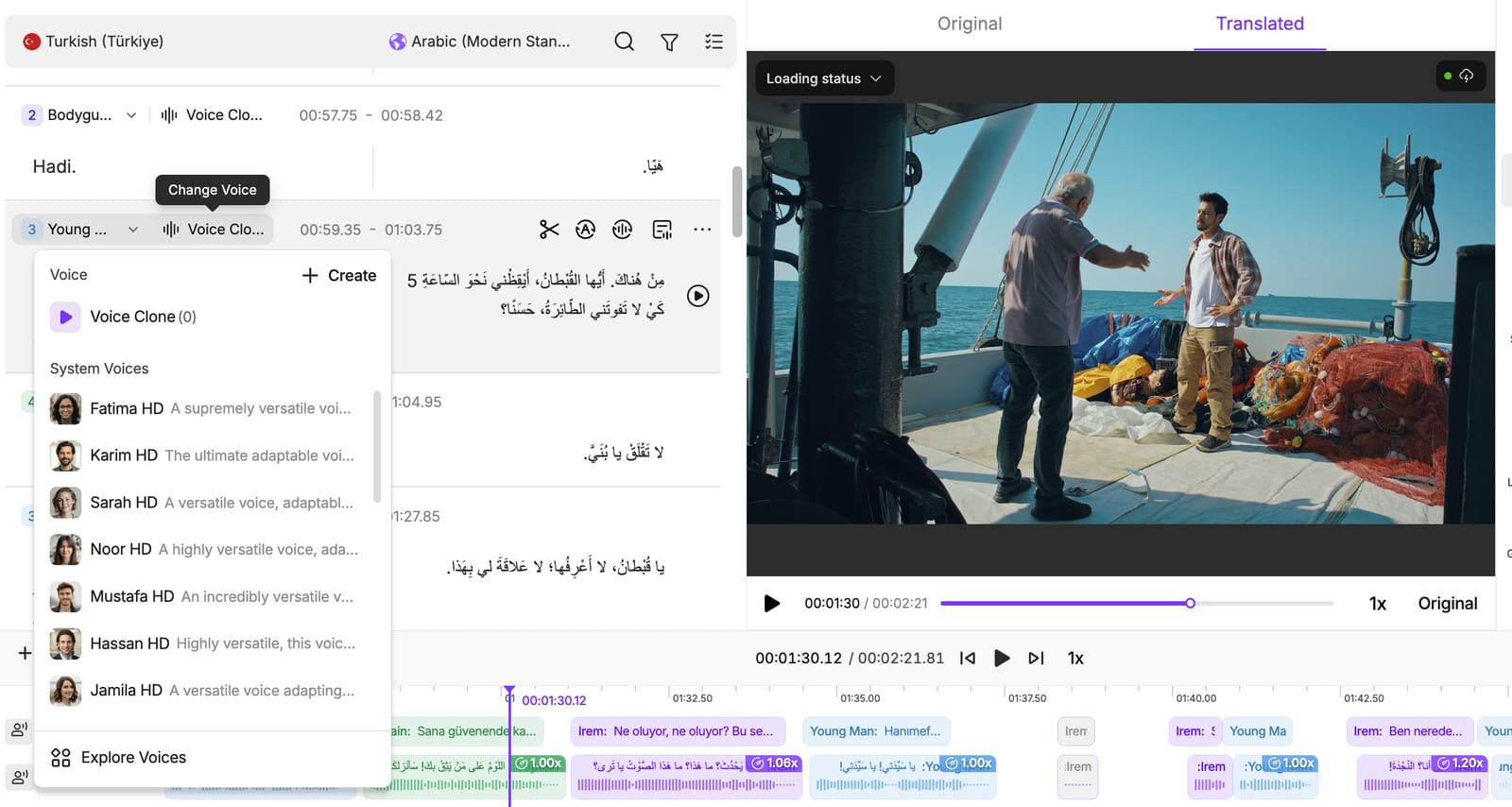
You can also decide when to retain the original audio. Certain vocal reactions, names, or other sounds may be better left untouched.
Background music and sound effects need attention too. VMEG provides several audio processing options for separating dialogue and handling background sound, so you can choose an approach that better suits the scene.
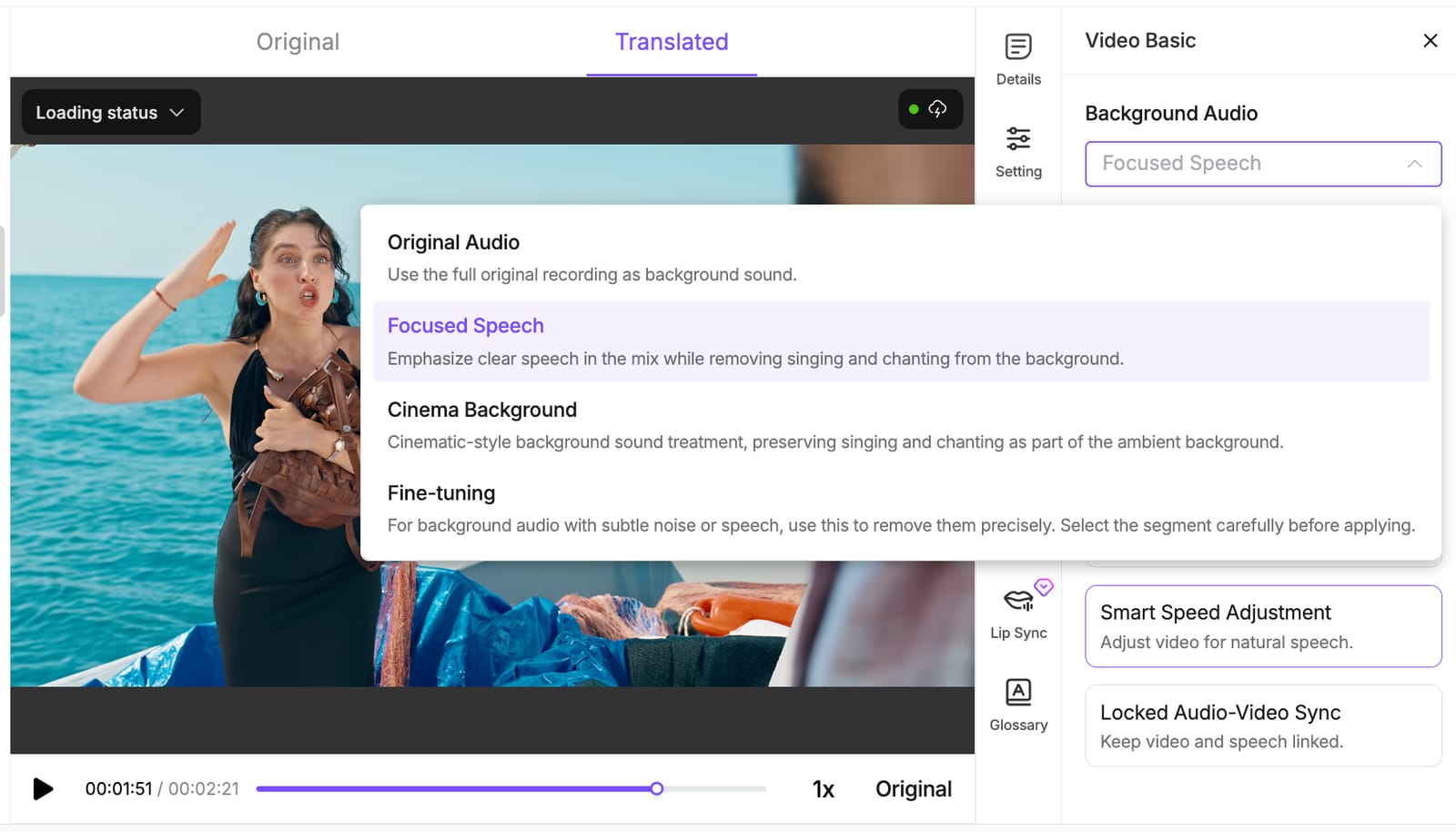
Once you're satisfied, export the translated video, audio, or subtitle files. For an entire series, it's worth testing a representative episode first and keeping voice and terminology choices consistent across subsequent episodes.
Is AI Dubbing Better Than Traditional Voice Acting?
Cost is one of the main reasons producers are turning to AI dubbing, particularly for series with dozens of episodes or multiple target languages.
Traditional dubbing requires voice actors, studio recording, and audio post-production, all of which can become expensive at scale. AI significantly reduces that workload and makes revisions simpler, since a line can be translated again and the voice regenerated without booking another recording session.
Still, lower costs don't automatically make AI the better choice for every production. Professional voice actors remain difficult to replace when a scene calls for subtle emotions, strong character interpretation, or complex dramatic performances.
For short dramas produced on tight budgets and schedules, fully automated AI dubbing may be sufficient. Premium films and TV series, on the other hand, often justify the cost of traditional voice acting.
Between these two extremes, there's a growing role for AI dubbing with human review. Producers can use AI for the initial translation and voice generation, then bring in human editors to refine dialogue, pronunciation, emotional delivery, and voice consistency.
This approach can reduce production costs without leaving every creative decision to AI. Rather than choosing one method for an entire series, it's often worth testing a few representative scenes first to see where AI performs well and where human involvement makes a noticeable difference.
Frequently Asked Questions
Can AI match the emotion of Turkish drama actors?
AI can generate different speaking styles, including whispering, shouting, and excited or sad delivery. However, complex emotional scenes may still need adjustments. Tools such as VMEG allow you to guide delivery with prompts and regenerate individual lines.
How do I keep background music and sound effects when dubbing Turkish series?
Look for a dubbing tool with audio separation and background sound controls. VMEG provides different processing modes to help preserve music and sound effects while replacing dialogue. You can also retain selected original audio segments.
Which languages are popular for Turkish drama localization?
Arabic and Spanish are important languages for Turkish dramas, given their established audiences in the Middle East and Latin America. English, French, Portuguese, and Urdu are also relevant in different markets. The right choice depends on where you plan to distribute the series.
Conclusion
Whether you choose subtitles or dubbing depends largely on your audience, budget, and distribution plans. AI has made both options easier to manage, particularly for Turkish dramas with long-running episodes and multiple characters.
Tools like VMEG can take care of the initial translation and dubbing, while giving you the option to adjust dialogue, voices, and timing where needed. For most productions, it's worth testing a few scenes first before deciding whether automated dubbing is enough or additional human review is needed.