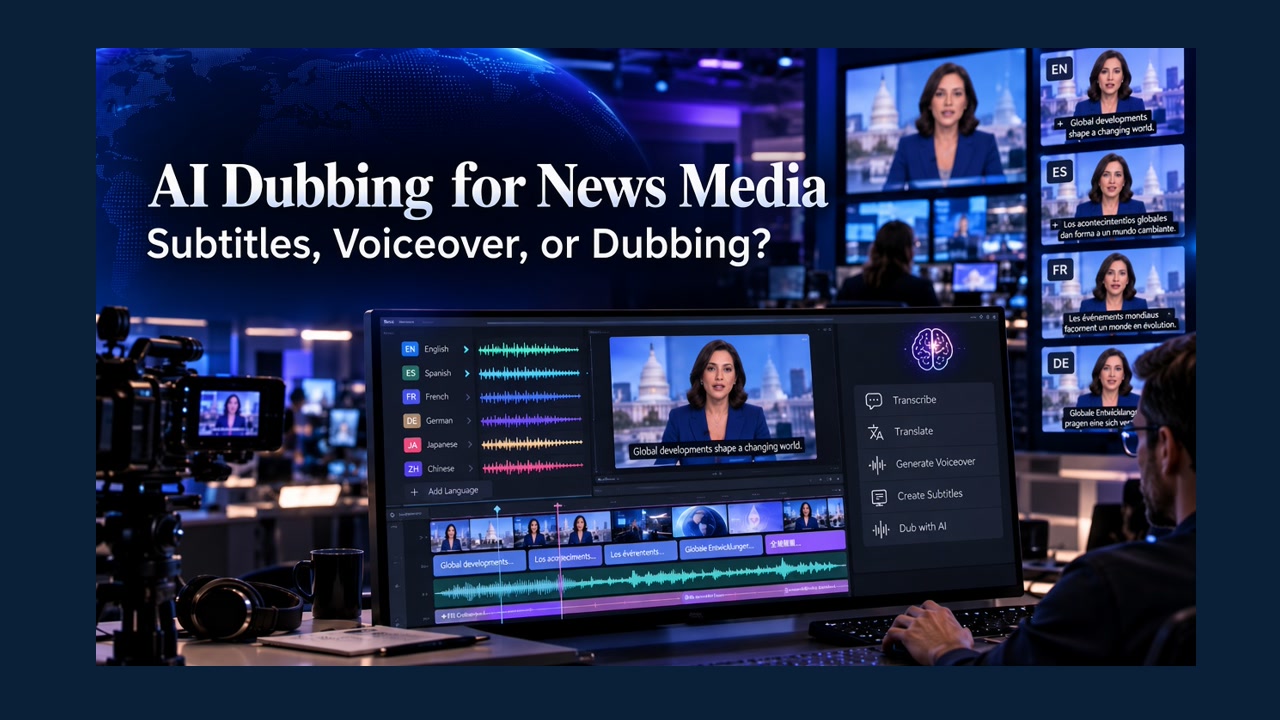
This analysis brings together 2026 audience and newsroom research, current platform capabilities, and public editorial guidance. It proposes a practical decision framework for pre-recorded news video—not an accuracy benchmark, a legal compliance opinion, or a claim that AI-generated journalism can be published without human review.
1. Why multilingual news video matters in 2026
The distribution case has strengthened. The Reuters Institute's Digital News Report 2026 surveyed roughly 100,000 online news consumers across 48 markets. On average across those markets, 54% said they accessed news through social media or video networks, compared with 51% using news organizations' own websites and apps. Some 77% said they watched an online news video in the previous week. These figures describe surveyed markets and behavior—not a forecast that every publisher will gain an international audience by adding more languages.
The production challenge is equally important. An October 2026 WAN-IFRA/Base Media Cloud survey of 58 news executives found that none rated their video workflows “very efficient.” Respondents cited content discovery (39%) and file transfer or sharing (25%) among the leading technical bottlenecks. In the same survey, 53% identified transcription and subtitling as areas where AI already delivers value. This is a small, industry-focused sample rather than a representative census of all newsrooms, but it helps explain why generating a translated voice is only one piece of the job.
Platforms are moving too. In February 2026, YouTube announced expanded automatic dubbing to 27 languages and said more than six million viewers per day had watched at least ten minutes of auto-dubbed content during December 2025. That is evidence of consumption, not proof of translation quality for any particular news video. YouTube's current help guidance allows eligible channels to review auto-dubs before publication but states that the automatically generated tracks cannot be edited line by line. Publishers can also upload their own finished-language audio tracks, subject to platform eligibility and restrictions. [5]
For a publisher, the strategic choice is therefore platform-generated language access versus an independently reviewed, reusable localized master. The second option matters when the same story must appear across a website, an app, YouTube, a broadcast channel, or a licensed archive.
2. Which format fits which news video?
“Translation” is not a single deliverable. Same-language captions support accessibility and comprehension; translated subtitles preserve the source audio while making the speech understandable in another language; voiceover adds a translated narration track; full dubbing replaces more of the original spoken performance. Voice cloning and lip-sync are optional production choices, not requirements for multilingual news.
The table below is a recommended editorial starting point, not a universal rule. Newsrooms should adjust it for audience, language pair, rights, and local publication standards.
| News format | Recommended default | Why it fits | Minimum editorial check |
|---|---|---|---|
| Breaking update | Translated subtitles; publish only after fact review | Events, numbers and attribution may change quickly | Verify names, figures, qualifiers and current facts against the source |
| Presenter-led daily briefing | Subtitles or reviewed AI voiceover | Scripts are structured and the format repeats | Compare the full target-language script with the approved original; listen to the output |
| On-camera interview or eyewitness account | Keep the original voice; add translated subtitles | Voice, pauses and hesitation may carry evidentiary meaning | Check quotations line by line; keep context and speaker identity intact |
| Field report with reporter narration and soundbites | Dub the reporter's narration; subtitle the original soundbites | A hybrid version improves access without replacing sources' voices | Review both the translated narration and subtitles against the video |
| Documentary or evergreen explainer | Reviewed voiceover or full dub where appropriate | Longer shelf life can justify more extensive localization | Full-language review, pronunciation, sound mix and rights check |
| Archive re-release | Choose subtitles or dub based on genre, not age | Existing content can reach another audience | Recheck footage rights, historical context, dates and potentially outdated claims |
| Social cutdown | Short, legible translated subtitles; optional voiceover | Fast formats need clarity without sacrificing factual precision | Verify the edited clip does not alter the meaning of the source |
The practical rule: the more a voice functions as evidence—an eyewitness account, interview quotation, allegation, or testimony—the stronger the case for keeping that voice audible. Voice synthesis is more defensible for clearly identified narration than for recreating an interview subject's performance.
There is no need to decide between subtitles and dubbing for an entire organization. The useful unit of policy is often the programme type, or even an individual audio segment.
3. A multilingual news-video workflow that an editorial team can run
A usable workflow begins after the source report has been fact-checked and approved. AI may accelerate parts of the process, but the approval of the source story and the approval of its localized version remain separate decisions.
Step 1 — Confirm the version and rights. Identify the final approved source cut, publication territories, licensed footage, interview permissions and any embargo. Check whether presenter narration may be synthesized and whether a contributor's voice or likeness may be replicated. Do not assume a right to translate includes permission to clone a voice.
Step 2 — Create a source transcript with speaker boundaries. Use automatic speech recognition (ASR) to produce time-coded text, then correct names, numbers, quotations and speaker changes. The approved transcript is a reference for translation, not a substitute for checking the actual recording. For a technical explanation of why speech boundaries and scene context matter, see VMEG Research's analysis of transcript limitations.
Step 3 — Choose the treatment by segment. Label each segment retain source audio, translate as subtitles, translate and voice, or omit from the localized version with editorial approval. Translate the approved text, maintain a glossary of recurring names and institutions, and make any required adaptation without changing the claim.
Step 4 — Generate, correct, and mix. Produce translated subtitles and, where planned, synthetic narration. Review pronunciation, timing, level balance and the relationship between speech and background sound. When a name or sentence is wrong, correct that segment rather than automatically regenerating the whole report. The target-language version must still be checked end to end after such corrections.
Step 5 — Sign off and export for each destination. A bilingual reviewer verifies meaning; an editor with publication authority approves the version. Record the language, source cut, reviewer, corrections, and publication date in the newsroom's own tracking system. Export the required subtitle files, audio track or video master, and apply appropriate synthetic-audio disclosures under the organization's policies and destination rules.
Worked example: a three-minute English report localized into Spanish
This is an illustrative editorial workflow, not a claim about a completed customer production.
| Segment in the report | Spanish-language treatment | What the reviewer checks |
|---|---|---|
| Studio presenter introduction | Reviewed AI voiceover or subtitles | Identity, location, figures, factual framing |
| Reporter narration over footage | AI voiceover, with background sound preserved where feasible | Complete meaning, pacing, natural sentence breaks |
| Eyewitness quote | Keep English original; add Spanish subtitles | Exact attribution, negation, hedging and context |
| Chart, caption or on-screen lower third | Translate the graphic or add a legible language layer | Units, dates, spelling and consistency with narration |
| Closing summary and final package | Mix approved audio; export captions and a publishable master | Whole-video listen/watch, disclosure and approval |
This hybrid approach makes the distinction visible: translation changes the language of access; it should not silently change who appears to be speaking.
4. Accuracy, editorial responsibility, and the limits of automation
The Associated Press' July 23, 2026 guidance permits AI-assisted transcription, translation, summaries and shotlists, while requiring AP journalists to review and edit output before publication. AP also maintains a prohibition on using generative AI to create, alter or enhance news photography, and it requires disclosure when generative AI plays a material role in published content. These are AP's newsroom standards, not a single law binding every broadcaster.
For translated news, review effort should follow editorial risk, not simply video length. At minimum, an assigned bilingual reviewer should check:
- Factual precision: names, titles, dates, figures, locations, causes and uncertainty. Translation must preserve may, allegedly, not, and other qualifiers.
- Attribution and context: direct quotes, speaker identity, chronological order, and whether the edit makes a statement appear stronger than the original.
- Voice and editorial presentation: whether synthetic speech implies a person uttered words they never spoke; whether voice cloning has the necessary permissions; and whether disclosure is appropriate.
- Technical integrity: subtitle timing and readability, pronunciation, speaker switches, sound mix, and consistency between subtitles and dubbed audio.
A content-type decision matrix should never be used to justify sampling only a small fraction of a published translation when the result contains consequential factual claims. A library search transcript may tolerate errors as a finding aid; a published translated quote does not.
Accessibility is related but distinct. Same-language captions for deaf and hard-of-hearing audiences and translated subtitles are not interchangeable services. In the EU, the European Accessibility Act applies, among other things, to services providing access to audiovisual media services; its precise applicability and related captioning obligations depend on the service and jurisdiction. This article does not treat automated subtitles as a legally compliant finished deliverable without validation.
5. Published 2026 price ranges for video localization
Published 2026 pricing guides show a wide range of costs. The table draws on Mark Studios' dubbing cost guide and Increditors' video localization cost guide. All figures are in US dollars and generally relate to one target language. Since the sources cover different mixes of software use, human services, and production work, these are reported price ranges—not a single market-average rate.
| Localization method | Mark Studios (2026) [12] | Increditors (2026) [13] |
|---|---|---|
| Translated subtitles | $3–$25/video minute across different subtitling services | Human-translated subtitles: $3–$10/video minute |
| AI-assisted subtitles with editing or review | AI-drafted subtitles: $3–$10/min; professionally edited: $10–$25/min | AI translation + human review: $1–$4/video minute |
| Non-lip-synced voiceover | $15–$50/min | $50–$400/finished minute |
| AI dubbing | Self-service AI tools: approximately $0.50–$2.70/min | AI-dubbing production estimate: $20–$150/finished minute |
| Professional lip-sync dubbing | $30–$100+/min | $200–$2,000+/finished minute |
The $0.50–$2.70 self-service generation rate should not be treated as equivalent to a $20–$150 finished-minute production estimate. Mark Studios compiles software usage prices and a range of subtitling and dubbing services; Increditors provides broader method-based planning estimates. The latter notes that transcription, coordination, adaptation, and quality assurance can add costs beyond the method price, estimating an additional 20–60% depending on project complexity—not a fixed markup on every quote. [13]
To compare offers, specify the language pair, finished duration, human review, audio mixing, subtitle deliverables, revision rounds, and export formats. These are published reference ranges from two industry guides, not an independently sampled market average.
6. How to run a pilot—and know whether to expand it
Run the first test with three to five rights-cleared, previously published videos: one structured explainer, one field report containing a quoted source, and one evergreen item. Use one target language that existing audience data or distribution plans justify. Predefine the source version, format choice, reviewer and publishing destination.
| Measure | How to capture it | Decision it informs |
|---|---|---|
| Turnaround to approval | Time from approved source cut to approved localized master | Whether the process fits the editorial schedule |
| Reviewer effort | Minutes of bilingual review per approved video minute | Cost and staffing requirements |
| Critical errors | Count and classify mistranslated claims, names, numbers, attribution and misleading voices | Whether the workflow is safe to scale |
| Rework rate | Segments changed and regenerated after first review | Glossary, model and process improvements |
| Audience response | Watch time or completion by language and channel, against a relevant baseline | Which languages or formats deserve more investment |
Define a stop condition before the pilot: a material factual error, unapproved synthetic portrayal, or unresolved rights issue prevents release until corrected and reapproved. Do not substitute a high average accuracy score for this rule. On the commercial side, compare total approved cost and time with the newsroom's actual current process, not with a hypothetical perfect studio pipeline.
A 2026 distribution example is ZDF Digital's announced partnership with Dubhub for Spanish-language versions of documentary content on the Get.factual YouTube channel. It demonstrates a concrete archive-localization initiative; the announcement does not establish a measured return on investment, audience uplift or quality score.
7. Where VMEG fits in the workflow
In the workflow outlined above, VMEG is used primarily after the source video has been edited. A media team can transcribe the original speech into time-coded text, translate it into the target language, and produce translated subtitles. For segments suited to dubbing—such as presenter scripts, reporter narration, or documentary voiceover—it can also generate a target-language audio track. In a multi-speaker field report, different sections can be handled differently: the reporter's narration can be dubbed, while an interviewee's original soundbite remains audible with translated subtitles.
The next stage is refinement. Editors can revise translations, correct names and terminology, adjust pronunciation, voice delivery, and pacing, and re-dub specific segments. Split Audio allows a long segment to be divided so that only the part needing a change is regenerated. Once the language version is ready, subtitles, audio, or video files can be exported for the publisher's distribution channels. The segment-level dubbing editing guide illustrates these controls.
In practical terms, VMEG covers transcription, translation, subtitle and dubbed-audio production, targeted editing, and export within the multilingual post-production process. The format can vary by program or even by segment within a single news report.
Evidence and scope
This is a desk-based industry analysis prepared from publicly available research, official product documentation and editorial guidance, checked against the sources below on October 28, 2026. The proposed decision matrix, workflow, and pilot measures are editorial recommendations, not findings from a newsroom field experiment. Section 5 summarizes publicly reported pricing ranges, not an independently sampled market average. Survey percentages retain the scope of their cited samples; platform features and regulations may change after the review date.
References
[1] Reuters Institute, Digital News Report 2026: Overview and Key Findings, June 2026.
[2] WAN-IFRA & Base Media Cloud, Measuring Multimedia Readiness in Newsrooms (report announcement), October 22, 2026.
[3] YouTube Official Blog, Unlocking a Global Audience with Auto Dubbing, February 4, 2026.
[4] YouTube Help, Use Automatic Dubbing, accessed October 28, 2026.
[5] YouTube Help, Add Multi-language Features to Your Videos, accessed October 28, 2026.
[6] Associated Press, AP Updates Newsroom Standards for Artificial Intelligence, July 23, 2026.
[7] EBU Technology & Innovation, Enhancing EuroVOX with Real-time Translation and Smarter AI Support, March 2026.
[8] EU Directive 2019/882, European Accessibility Act, Article 2 and Article 3.
[9] Broadband TV News, ZDF Digital Teams with Dubhub to Localise YouTube Documentary Channel, March 18, 2026.
[10] VMEG Research, Why AI Video Localization Needs More Than Transcripts, July 23, 2026.
[11] VMEG Blog, How to Fix AI Dubbing Errors Without Re-dubbing the Entire Video, October 27, 2026.
[12] Mark Studios, How Much Does Video Dubbing Cost in 2026? AI, Freelancer and Studio Prices per Minute, October 2026; compilation of published pricing references.
[13] Increditors, Video Localization Cost: Dubbing to Subtitles, September 21, 2026; indicative localization cost ranges.


