Continuous learning does not happen only through model training.
Models learn patterns from data. Rules, measurements, and experimental loops help the whole system learn what is worth optimizing and what must never be sacrificed. For complex production algorithms, this second kind of learning can be just as important as model capability.
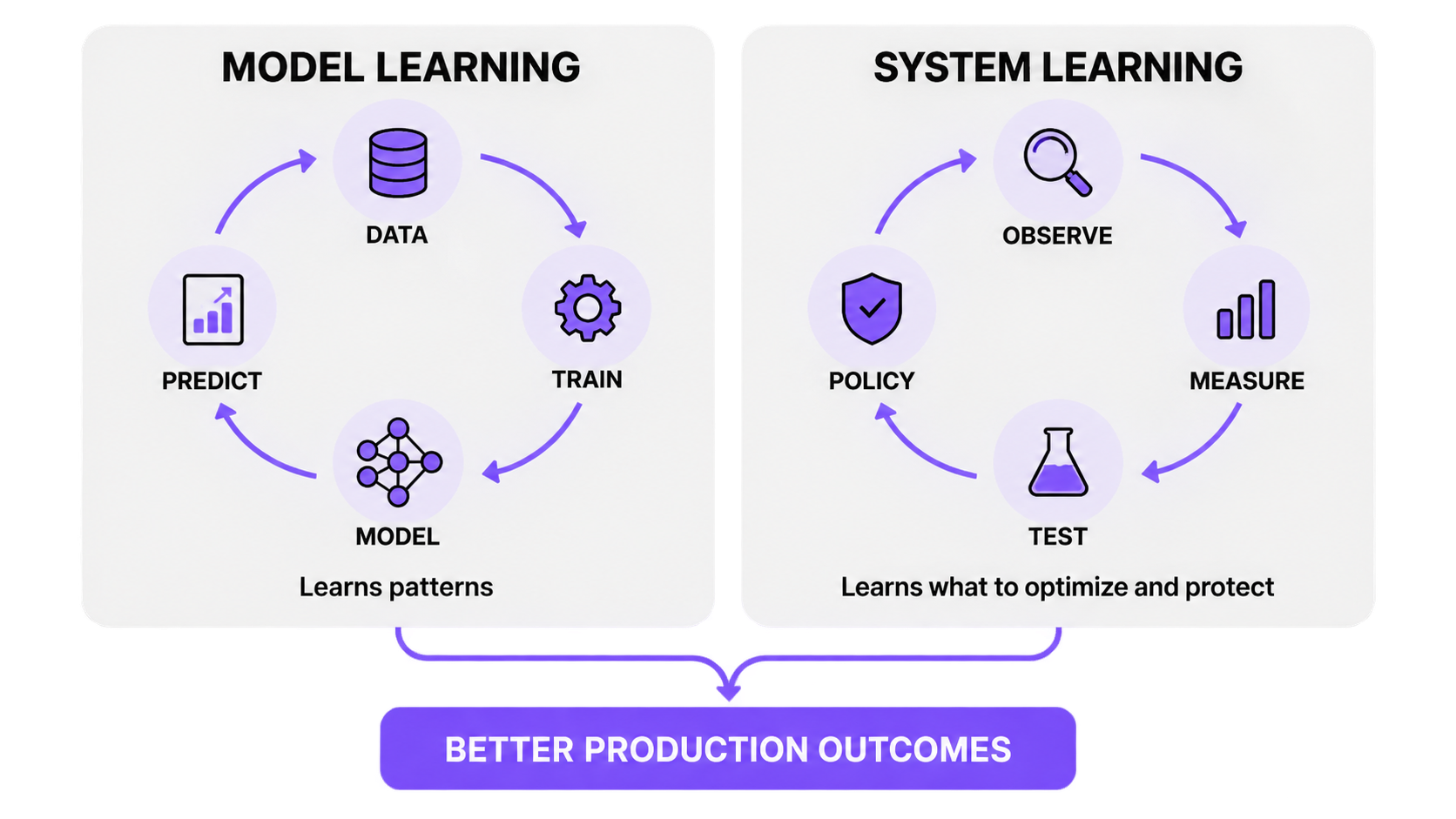
This article examines system-level learning through a production case in AI dubbing alignment. The system did not retrain a model. It observed a repeated failure, traced the decision that caused it, tested a safer policy, and turned the verified result into a rule that future runs could follow.
The alignment system needs this kind of learning because it has many goals, and some requirements are basic quality limits. Reducing video segments and tracks may simplify processing, but the change should still be rejected if it causes the dubbed speech to miss the matching visual moment. The same applies when smoother playback makes speech difficult to understand or creates a new gap or overlap. These limits must be satisfied before secondary benefits are considered.
VMEG uses different alignment strategies for different situations. Because these strategies do not always emphasize the same goals, the system does not apply one fixed set of weights to every video. It first selects a strategy suited to the situation, then looks for an acceptable result in that strategy’s priority order.
A single weighted score would assume that every gain and loss can be converted into the same unit. It would also require one set of weights to remain reliable across languages, video types, sentence lengths, and different situations. In practice, a weight tuned for one situation could hide a serious failure in another. The system might report a higher total score even though viewers see a sentence arrive at the wrong moment.
VMEG therefore uses a layered decision process. The selected strategy first determines which changes are appropriate for the situation. Safety checks then protect voice-picture timing, understandable speech, and a valid timeline. Only candidates that pass those checks are compared on secondary benefits such as smoother picture playback or simpler processing.
This does not rule out scoring models. A learned or weighted score can be useful for ranking several candidates that are already safe. It should not be allowed to trade away a safety condition in order to raise the total score.
AI dubbing alignment provides a concrete example of that learning process. A cleanup step made the video timeline simpler, yet sometimes moved speech away from the picture it belonged to. Step-by-step observation exposed the conflict. Historical data, controlled replays, and live results then showed which lesson was safe to encode into the system.
Why a reasonable optimization can still be wrong
One alignment step joins nearby video sections. This can reduce the number of video tracks and make changes in playback speed less abrupt. Both are useful, but neither is the final goal.
A cleaner timeline can still feel worse. Joining two sections may place a translated sentence too early or too late, take away quiet time needed by the next sentence, or force part of the picture to play too quickly. If we only count tracks or inspect the final file, this negative optimization is easy to miss.
A local improvement is acceptable only when it keeps every more important part of the viewing experience at least as good as before.
Observation gives the system a memory
The final video tells us that something is wrong, but not where it became wrong. We therefore record four moments around every important alignment decision:
- Before: the result we would keep if the step did nothing.
- Proposal: the new timeline suggested by the step.
- Comparison: what improved, what worsened, and why the proposal was accepted or rejected.
- After: the timeline that actually continues to the next step.
This turns a long chain of rules into a trail we can inspect. It also prevents us from blaming the last step merely because it was the last one to touch the output.
Four kinds of signals, in plain language
| What we observe | The question it answers | Role in the decision |
|---|---|---|
| Final viewing experience | Does the translated voice still land on the matching visual moment? Has the sentence moved farther from where it belongs? | Must not get worse |
| Speech and timeline safety | Is the speaking pace still acceptable? Did we create a new gap, overlap, or wrong order? | Must not get worse |
| Local benefit | Did the picture become smoother or the video structure become simpler? | At least one real benefit is required |
| Decision record | Which step changed the result, and why was it kept or rejected? | Makes the outcome explainable |
The first two groups protect the viewer. The third tells us whether an optimization achieved its purpose. The fourth lets us learn from production instead of guessing from isolated outputs.
What the shadow observations revealed
Before changing production behavior, we observed 2,035 records in which the video-section joining step could propose a new timeline. In 924 records, the proposal did not actually simplify the structure. Keeping the original result was the obvious choice.
The remaining 1,111 proposals did change the structure. Only 456, or 41.0 percent, delivered that benefit without worsening a more important signal. The other 655, or 59.0 percent, made at least one protected part of the result worse.
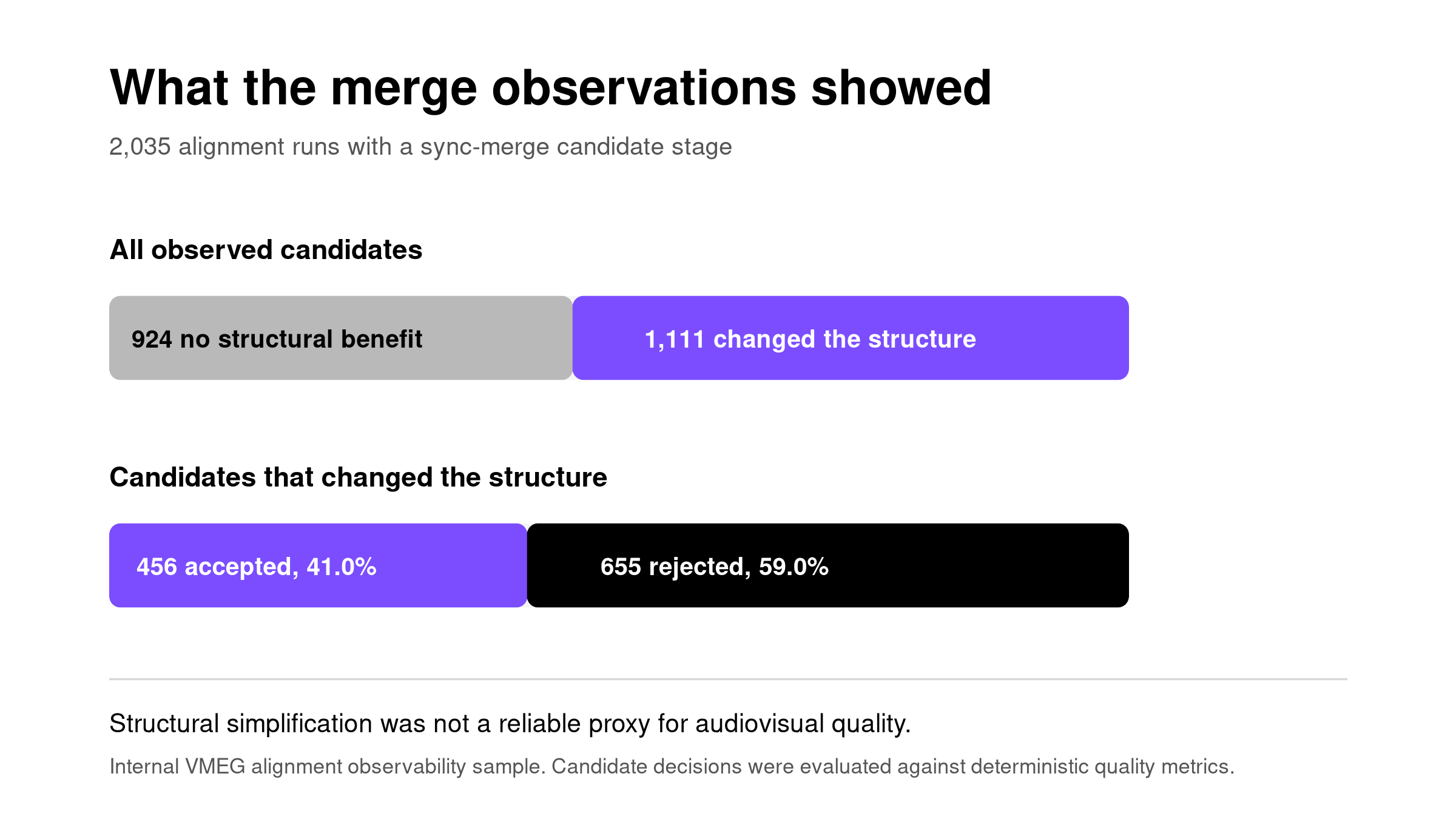
The finding changed our interpretation of the step. The safety check was not protection for a rare corner case. It was the main decision maker for proposals that truly changed the timeline.
Change one: let every proposed join earn acceptance
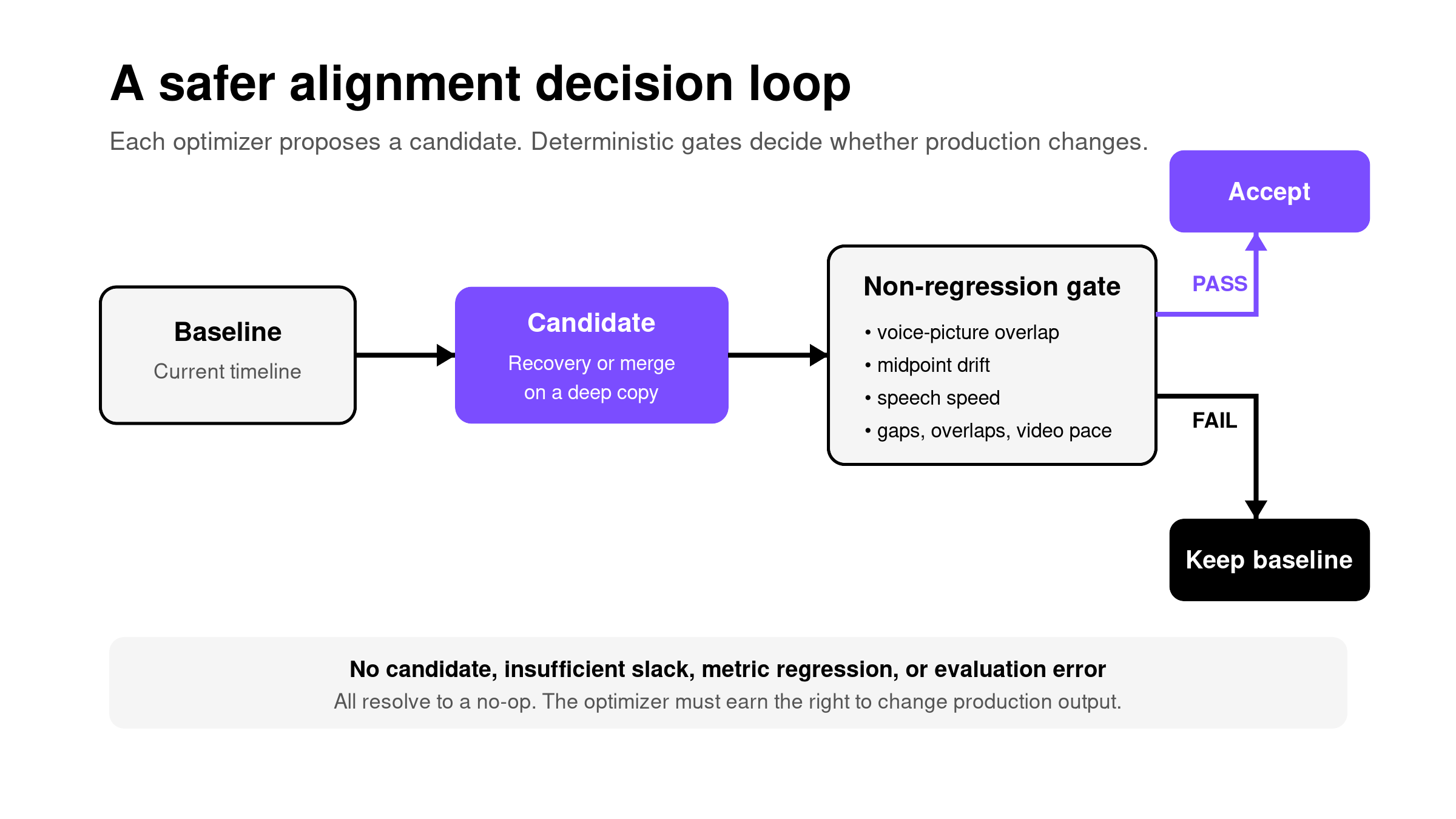
The new rule is simple. First, make the proposed timeline without touching the current result. Next, verify that it creates a real local benefit. Then compare it with the current result on voice-picture timing, sentence placement, speaking pace, timeline safety, and video speed. Keep the proposal only if the benefit is real and none of the more important signals gets worse.
If the comparison cannot be completed, the current result stays in place. Uncertainty is not permission to change a production video.
Change two: reuse later quiet time to reduce extreme picture acceleration
The safety check can stop a bad proposal, but it cannot repair a problem that already exists. In one representative case, the alignment plan compressed 7.7 seconds of source picture into about 2.47 seconds of output. The intervening picture therefore played at 3.116 times normal speed, even though a long no-dialogue section was available later in the same scene.
Why was any picture acceleration needed? Cross-language dubbing creates duration mismatches. This case translated Chinese into Vietnamese: the target sentence occupied about 1.2 seconds in the source, while its generated Vietnamese TTS file lasted about 1.71 seconds. Some timing adjustment was reasonable, but the 3.116x video speed was not required by the voice alone. It appeared because an earlier speech group had been finalized before the algorithm reused the later quiet time.
A simple way to understand the fix is this: the scene contained a later stretch with no dialogue, so the system reassigned part of that available time to the earlier picture.
Before the fix, 7.7 seconds of source picture had only about 2.47 seconds of output time, forcing it to play at 3.116x. After the fix, it received about 6.16 seconds and slowed to 1.25x. The later picture, translated voice slots, and subtitles moved together, preserving their timing. The target line itself remained at 1.034x. The TTS files, speaking pace, background audio, and final video length also remained unchanged.
A separate merge safety check protected voice-picture timing after this recovery. It rejected a later timeline simplification that would have moved the target voice away from its matching picture. Compared with the old ungated final result, the accepted result raised their overlap from zero to 0.677 and reduced center drift from 2.756 seconds to 0.253 seconds. The speaking pace remained unchanged.
The video below shows the combined result of both changes, not the isolated effect of either one.
Listening order: source with original audio → previous translated version → repaired translated version. Each pass includes the previous line, target line, and following line.
This recovery is deliberately conservative. If there is not enough later quiet time to complete the correction, it does nothing. A partial move is not accepted simply because it points in the right direction.
Why the two changes belong together
- The safety check protects the current result. It stops timeline cleanup from buying simplicity with worse voice-picture timing.
- The quiet-time recovery improves the current result when enough evidence exists. It reduces unnecessary picture acceleration without changing the voice.
Using only the safety check would leave some already-fast sections untouched. Using only the recovery could allow a later cleanup step to undo the improvement. Together they create a clear sequence: propose a recovery, check it, establish a new current result, propose a join, check it, and complete the final timeline checks.
What happened after release
We then checked live records collected from 17 September 2026 at 09:13 UTC to 18 September 2026 at 04:18 UTC. The dataset contained 2,634 observation records from 1,389 tasks. Of these, 2,548 completed the full alignment path, 86 skipped it because they contained subtitles only, and none failed during observation.
The video-section joining step produced 2,401 proposals. It accepted 268 and rejected 2,133. Among the rejected proposals, 1,024 would have worsened at least one more important quality signal. Among the 268 accepted proposals, none worsened voice-picture timing, sentence placement, speaking pace, or timeline safety.
The quiet-time recovery triggered 33 times and was accepted 29 times. In all 29 accepted cases, the highest picture playback speed fell. The typical reduction was 0.359 times normal speed. Voice-picture timing improved in 28 cases and stayed unchanged in one. Speaking pace did not change in any case.
These live results support a clear conclusion: the safety check reliably blocks harmful changes, while quiet-time recovery reduces extreme picture acceleration in the intended cases without changing the audio. Reviews of released tasks showed that the improvement is visible in the metrics and directly perceptible during playback.
How we checked whether the numbers matched human perception
Each controlled replay used a continuous window containing the previous sentence, the target sentence, the following sentence, and the background track. The previous and repaired versions used exactly the same translated voice and background audio. Only the video alignment timeline changed. We also included the source clip to show where the original speech belonged.
This setup isolated the effect of alignment. With the voice, wording, speaking pace, and background audio held constant, the repaired version placed speech more reliably on the matching picture and reduced extreme picture acceleration. Reviews of live tasks showed the same pattern. Together, the controlled replays and production checks confirm a clear and perceptible improvement in voice-picture alignment.
A continuous learning loop for production algorithms
In this kind of learning, new knowledge does not have to become a model weight. It can become a clearer measurement, a protected quality limit, an acceptance rule, a replay method, or a safer rollout decision. The loop is repeatable:
- Observe every important step, not only the final output.
- Separate protected viewing quality from secondary engineering benefits.
- Create a proposal first; do not change production output immediately.
- Keep the proposal only when it has a real benefit and makes no protected signal worse.
- Replay the same audio against the old and new video timing to confirm that the measured change is perceptible.
- Use live rollout data to learn how often the change helps across the production population.
Conclusion
The most important result was larger than one alignment fix. The system learned a reusable principle from production evidence: a local engineering gain is valuable only when it preserves the parts of the experience that matter more.
That lesson now lives in the measurements, safety checks, replay method, and release process. The model itself did not change, but the algorithmic system became better at deciding what to optimize and what to protect. This is continuous learning at the system level: observe, explain, test, encode the result, and keep measuring what happens next.
References
- D. Sculley et al., Hidden Technical Debt in Machine Learning Systems, NeurIPS 2015.
- Saleema Amershi et al., Software Engineering for Machine Learning: A Case Study, ICSE 2019.
- Rob Ewaschuk, Monitoring Distributed Systems, Google Site Reliability Engineering.
- Aleksander Fabijan et al., Safe Velocity: A Practical Guide to Software Deployment at Scale Using Controlled Rollout, ICSE 2019.