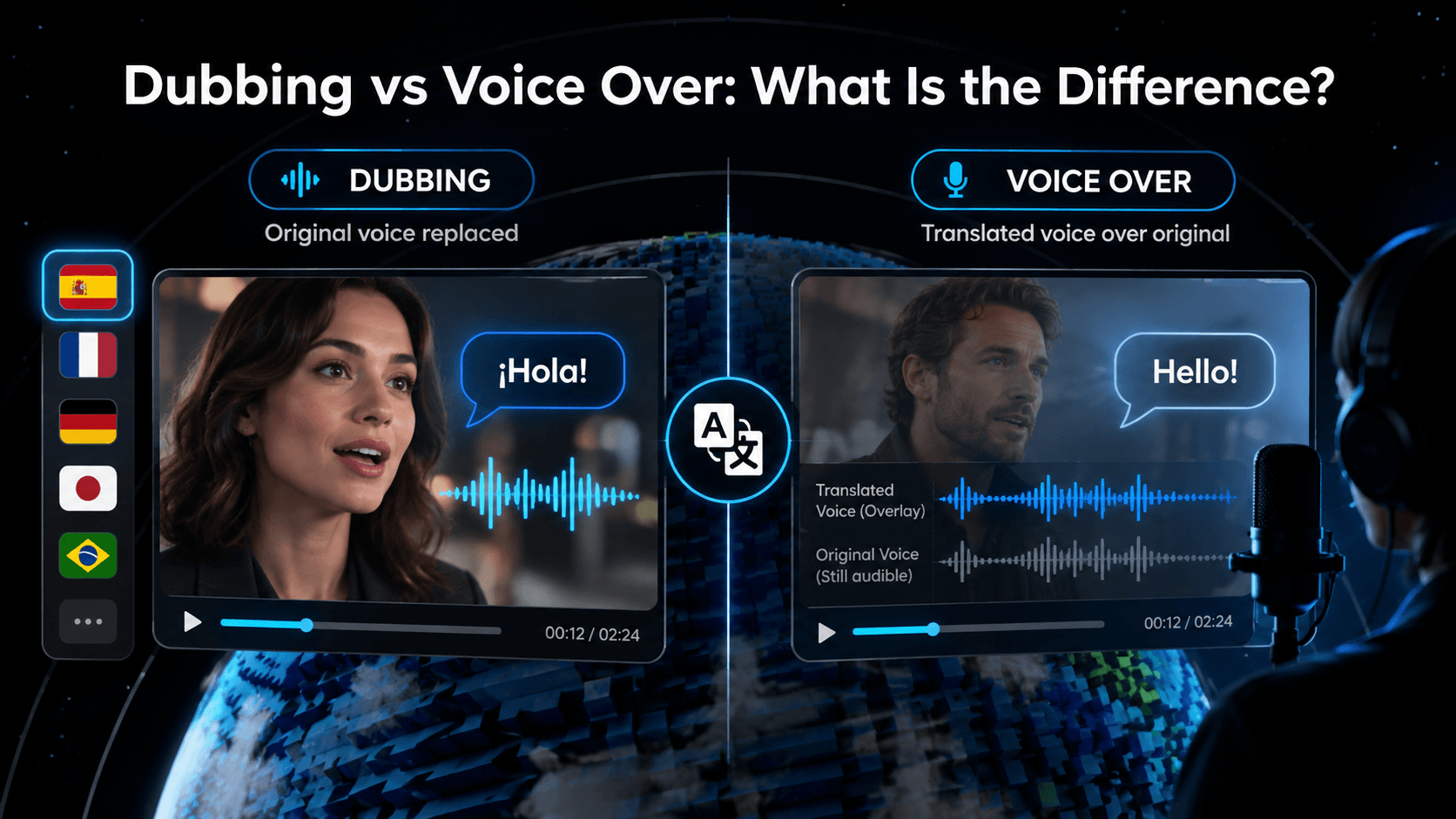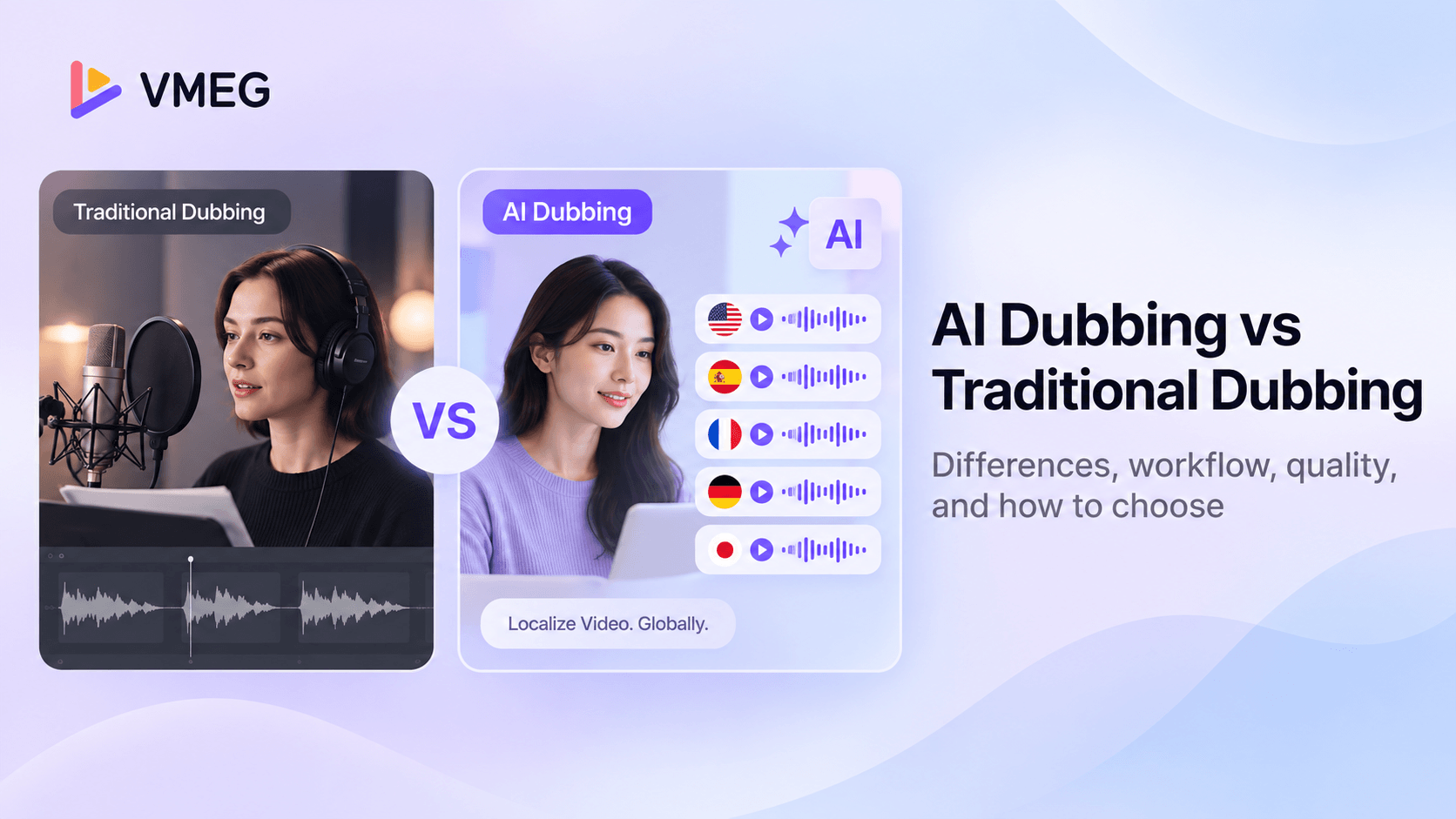
AI dubbing uses automated speech recognition, translation, synthetic or cloned voices, and timing tools to create a target-language track. Traditional dubbing relies on translators, adapters, casting, actors, directors, recording engineers, and post-production teams. AI is usually easier to scale and revise. Traditional dubbing gives people more direct control over performance and creative interpretation.
The useful choice is rarely “machines or humans.” A more accurate comparison is self-service AI, AI with human review, and a full studio production. The right level depends on the content, audience, number of languages, quality threshold, rights, and consequences of an error.
- AI dubbing is strongest when speed, multilingual scale, consistent updates, and targeted revisions matter.
- Traditional dubbing is strongest when acting, casting, creative direction, and detailed audio finishing determine the viewing experience.
- “Cost per minute” only makes sense when the scope is defined: raw generation, reviewed dub, or fully mixed production-ready master.
- A hybrid workflow—AI production plus native-language and subject-matter review—is often the practical middle ground for business video.
AI Dubbing vs Traditional Dubbing at a Glance
Both methods replace or recreate spoken content in another language. The difference is how the translated performance is produced, reviewed, and finished.
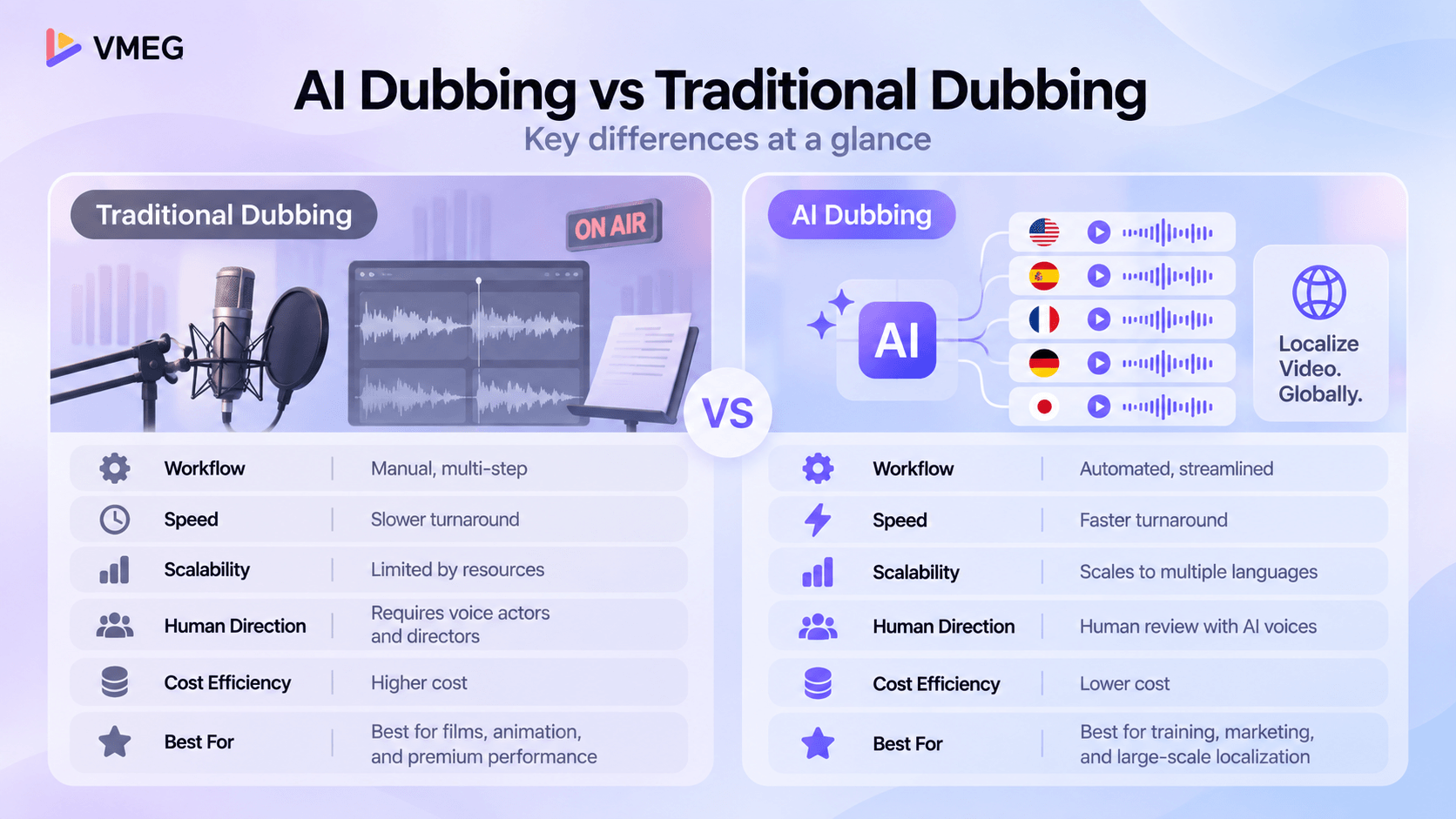
Factor | AI dubbing | Traditional dubbing |
Core production method | Automated transcription, translation, voice generation, and timing, with optional human review | Human translation and adaptation, casting, directed recording, editing, and mixing |
Turnaround | Fast first version; revisions can target individual lines or segments | Depends on talent, studio, director, scheduling, and post-production availability |
Cost structure | Usually usage- or subscription-based, plus review and optional services | Usually project-based, with translation, talent, studio, direction, and post-production fees |
Performance control | Voice, pronunciation, pace, emphasis, and timing can be adjusted within platform controls | Actors and directors can interpret character, subtext, emotion, and scene dynamics in real time |
Revision workflow | Good for line-level text changes and regeneration | Script changes may require renewed talent coordination, recording, editing, and mixing |
Scaling to languages | Designed for repeatable multilingual workflows | Requires a qualified team and production plan for every locale |
Best fit | Training, product demos, explainers, creator content, and frequently updated libraries | Film, premium animation, dramatic advertising, and performance-led entertainment |
Practical middle ground: A team can create the first multilingual version with VMEG AI Dubbing, then have a native-language reviewer correct terminology, pronunciation, timing, and speaker choices before export. This keeps the editable AI workflow without treating the first render as the final master.
What Do AI Dubbing and Traditional Dubbing Actually Mean?
What Is AI Dubbing?
AI dubbing uses software to convert source speech into target-language dialogue. A typical system transcribes the audio, translates the transcript, assigns voices, generates speech, and aligns the new track with the video. Some tools also support speaker detection, voice cloning, glossaries, subtitle editing, background-audio preservation, and optional lip sync.
Automation describes the production method, not the approval standard. A low-risk internal update may need a quick language check. A public campaign or technical course may need native-language, brand, legal, or subject-matter review.
What Is Traditional Dubbing?
Traditional dubbing is a human-led production process. Translators and dialogue adapters create a target-language script, casting teams select voices, actors record under direction, and editors and mixers prepare the final audio. The process may also include spotting, pronunciation research, performance notes, lip-sync adaptation, quality control, and client approval.
The DEG Creative Dubbing white paper describes quality as a combination of translation, credible dialogue, acting, image-word coherence, lip sync, and clear sound. This helps explain why a studio quote covers much more than the act of recording translated words.
AI Dubbing vs Traditional Translation: Why They Are Not Direct Equivalents
Translation transfers meaning between languages. Dubbing turns that translated meaning into a performed, timed audio track. A human translator can support either AI or traditional dubbing; an AI translation can also be followed by human actors. Comparing “AI dubbing vs traditional translation” mixes a complete audiovisual workflow with one linguistic stage.
For a fair comparison, separate three questions: Who creates or reviews the translated script? How is the voice track produced? Who approves the finished audiovisual result? The answers can combine AI and human work in different ways.
How the Two Dubbing Workflows Differ
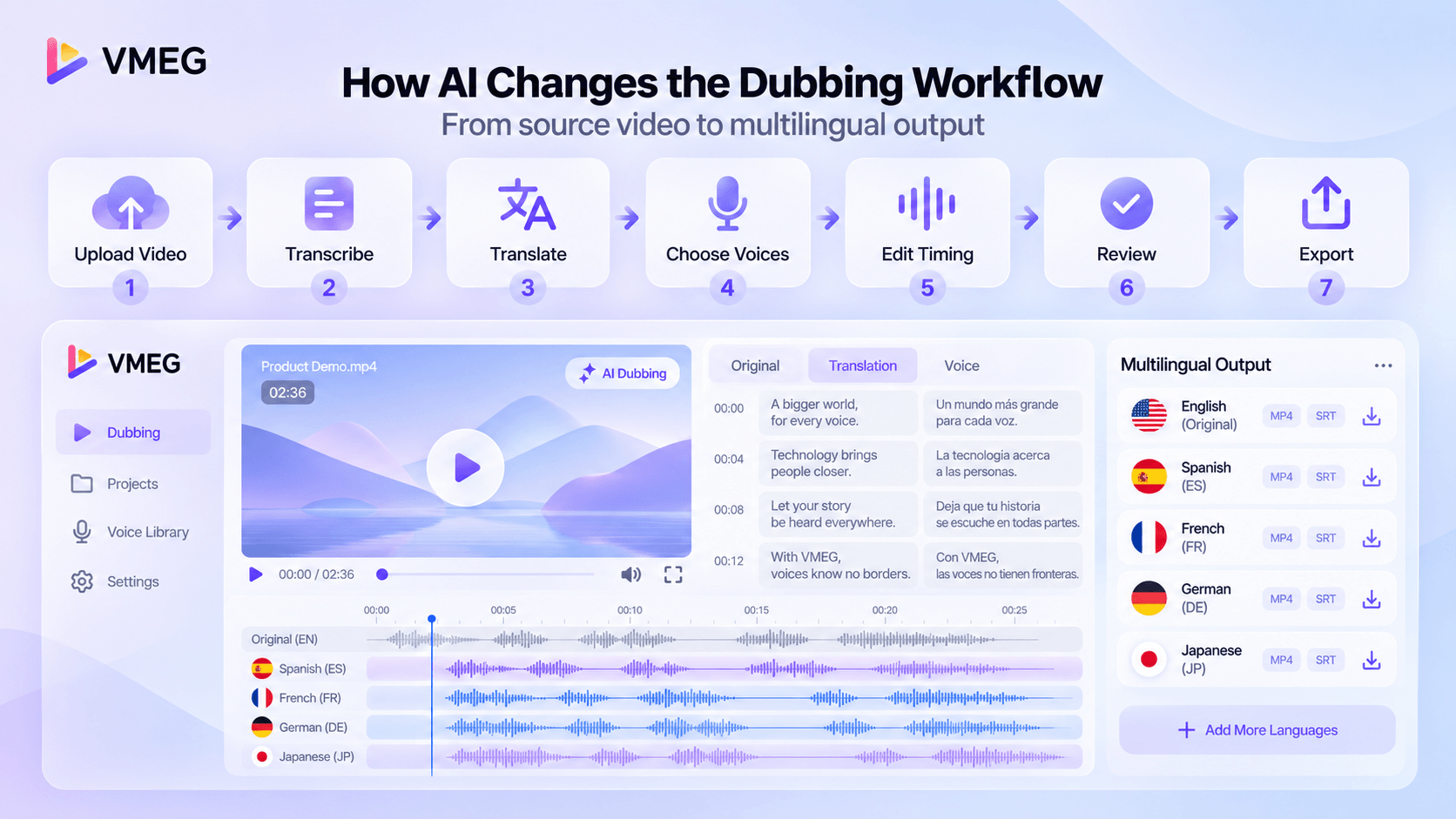
AI Dubbing Workflow
- Upload the source. Provide a supported video file or public link.
- Analyze and transcribe. The platform identifies speech, segments, and speakers.
- Translate and assign voices. Select the target locale and suitable AI or authorized cloned voices.
- Generate a first dub. Create target-language speech and align it with the video.
- Review and revise. Correct text, terms, voices, pronunciation, speed, and timing.
- Regenerate and export. Rebuild only the affected segments, run final QA, and export.
Traditional Dubbing Workflow
- Prepare and spot the source. Define dialogue segments, references, and timing constraints.
- Translate and adapt. Make the script accurate, speakable, culturally appropriate, and suitable for the scene.
- Cast and direct. Select performers and guide the target-language interpretation.
- Record. Capture performances in a controlled studio environment.
- Edit and mix. Clean dialogue, align it with the picture, and balance music and effects.
- Review and master. Complete linguistic, creative, technical, and client quality control.
Where Human Review Still Matters
Names, numbers, acronyms, humor, product terms, dialect, and ambiguous speech can create plausible-looking errors. Reviewers should also check whether the voice fits the speaker, the delivery matches the scene, and the translated line has enough time to sound natural.
Research based on professionally produced dubbed content found that vocal naturalness and translation quality should not be sacrificed simply to force a rigid length match. That is useful guidance for both automated and studio workflows: timing is a constraint, not the only measure of quality. See Dubbing in Practice.
For a step-by-step production sequence, see how to dub a video.
Advantages and Disadvantages of AI Dubbing
Advantages of AI Dubbing
- Faster first versions. Teams can preview a new language without organizing a complete recording session.
- Lower coordination overhead. Translation, voices, timing, subtitles, and revisions can live in one workspace.
- Easier multilingual scale. A repeatable project structure can support more languages and larger content libraries.
- Targeted updates. A changed product name or line can be corrected and regenerated without rebuilding the entire dub.
- Consistent production controls. Glossaries, prompts, pronunciation rules, and voice settings can be reused across related content.
- Early validation. Stakeholders can hear a translated version before committing to a more expensive finishing path.
Disadvantages of AI Dubbing
- Performance may need shaping. Complex emotion, comedy, character relationships, and dramatic subtext can exceed available voice controls.
- Errors can propagate. A wrong transcript can become a wrong translation, pronunciation, subtitle, and voice line.
- Language coverage is not the same as equal quality. Voice choice and naturalness can vary by language, accent, and content type.
- Lip sync is not a quality guarantee. Visual alignment cannot fix inaccurate meaning, poor casting, or an unsuitable performance.
- Rights require attention. Voice cloning must use authorized voices, appropriate consent, and permitted usage.
- Finishing work remains. Public-facing projects may still need native review, audio balancing, subtitles, and delivery checks.
Advantages and Disadvantages of Traditional Dubbing
Advantages of Traditional Dubbing
- Human performance range. Actors can respond to direction, scene partners, character arcs, humor, and emotional transitions.
- Creative adaptation. Translators and adapters can reshape dialogue so it sounds native while preserving meaning and intent.
- Purposeful casting. Producers can choose voices for age, personality, accent, market expectations, and character fit.
- Integrated audio finishing. Editors and mixers can solve scene-specific issues across dialogue, music, effects, and room sound.
- Established approval roles. Premium productions can involve language directors, creative leads, rights holders, and technical QC.
Disadvantages of Traditional Dubbing
- More scheduling and handoffs. Translators, actors, studios, directors, engineers, and approvers must be coordinated.
- Higher entry cost. Minimum fees and professional services can make short or low-volume projects expensive per minute.
- Slower revisions. A late script change may trigger new availability checks, recording, editing, and mixing.
- Scaling is operationally demanding. Every target locale needs appropriate linguistic and production resources.
- Consistency can be harder across updates. Talent or studio availability may change over a long content lifecycle.
Dubbing Cost per Minute: What Are You Actually Paying For?
What “Cost per Finished Minute” Means
A finished minute is one minute of delivered target-language video—not one minute of studio time or one minute spent editing. The rate can include very different scopes. A self-service platform may quote generation usage. A studio may quote translation, casting, talent, direction, recording, editing, mixing, QC, and project management.
Before comparing prices, ask what the deliverable includes: translated script, native review, subtitles, voice rights, lip sync, music-and-effects handling, audio mix, revisions, and final format.
AI Dubbing Cost Components
- Base video translation or dubbing usage
- Target languages and processed minutes
- Premium or cloned voices
- Optional lip sync
- Native-language, brand, or subject-matter review
- Audio finishing, subtitle preparation, and project management
Traditional Dubbing Cost Components
- Translation, dialogue adaptation, and spotting
- Casting, actor fees, usage rights, and session minimums
- Director, recording studio, and engineer time
- Dialogue editing, synchronization, mixing, and mastering
- Linguistic, creative, and technical quality control
- Project management, revisions, and delivery versions
A Practical Dubbing Cost Formula
Estimate the complete project, not an isolated voice rate:
Total cost = finished minutes × target languages × base rate + add-ons + minimum fees + human review
Then divide the total by all delivered finished minutes if you need a comparable effective cost per minute.
For example, a ten-minute video in three languages produces 30 finished target-language minutes. However, one-time work such as source preparation may not triple, while language review, voice production, and locale-specific fixes usually do. Quote assumptions should show which costs scale by minute, language, speaker, or project.
VMEG Cost Example
VMEG’s current public credit pricing guide lists Video Translation at 60 credits per minute and Lip Sync as an additional 90 credits per minute. Voice Cloning is listed at 10 credits per voice. Videos shorter than one minute are charged as one minute.
Using those units, a 10-minute source translated into three languages would require 1,800 base translation credits: 10 minutes × 3 languages × 60 credits. Applying lip sync to every delivered minute would add 2,700 credits. The resulting 4,500-credit platform estimate does not include any external reviewer, specialist, or custom post-production cost.
Credit rates, plan limits, and included features can change. Confirm the current product and pricing pages before budgeting.
Why Published Dubbing Prices Vary So Much
Raw Render vs Production-Ready Deliverable
Delivery level | Usually includes | Useful for | What may still be missing |
Raw AI render | Automated transcript, translation, generated voices, and basic timing | Internal preview, feasibility check, low-risk draft | Native review, terminology checks, creative direction, detailed audio finishing |
Reviewed AI dub | Editable AI production plus linguistic review, pronunciation fixes, voice and timing adjustments | Training, explainers, product videos, recurring business content | Actor-led performance and full studio post-production |
Studio master | Adapted script, casting, directed performances, editing, mix, QC, and delivery | Premium entertainment, dramatic advertising, flagship creative | May be slower or costlier to update and scale |
Main Cost Drivers
Costs rise with more target languages, speakers, specialized terminology, visible dialogue, tight deadlines, emotional range, audio damage, versioning, and approval steps. Short projects may also carry minimum charges. A clean single-speaker tutorial is not priced or produced like a multi-character animated series.
The most useful proposal states the source duration, language pair, speaker count, content type, delivery level, revision allowance, voice rights, and final technical format. Without those details, two “per-minute” prices may describe different products.
Quality Comparison: Where Each Method Wins or Struggles
Translation and Cultural Context
AI can accelerate a first translation and enforce terminology, while human adapters are better placed to resolve ambiguity, humor, wordplay, cultural references, and character-specific speech. Either method needs a reliable source transcript. A fluent sentence can still be factually wrong.
Voice Fit and Emotional Performance
AI voices can be clear and consistent, especially for narration-led or informational content. Human performers can take nuanced direction and build a performance across a scene or story. Judge the voice against the actual content: a product tutorial and a dramatic confrontation have different requirements.
Timing, Lip Sync, and Audio Mixing
AI can automate timing and optional visual alignment. Studio teams can rewrite, perform, edit, and mix around scene-specific constraints. In both cases, review starts with natural speech and correct meaning. A line that matches the mouth but sounds rushed, mistranslated, or emotionally wrong is not a good dub.
Consistency and Revision Control
AI workflows are effective when a team needs recurring updates and reusable rules. Traditional workflows can maintain strong creative continuity, but talent and studio availability affect later revisions. Keep approved terminology, pronunciation notes, casting decisions, and mix references whichever method you choose.
Test dimension | Question to score from 1–5 | Common failure signal |
Meaning | Does the target line preserve the source intent and facts? | Names, numbers, claims, or relationships change |
Naturalness | Would a native listener phrase and deliver it this way? | Literal wording, awkward pauses, unnatural emphasis |
Voice fit | Does the voice suit the speaker, role, age, and context? | Distracting mismatch or inconsistent speaker identity |
Timing | Does speech fit the scene without rushing or drifting? | Clipped words, compressed pauses, late line endings |
Audio finish | Are dialogue, music, effects, and room sound balanced? | Voice feels pasted on, masked, or much louder than source |
When to Choose AI, Traditional, or Hybrid Dubbing
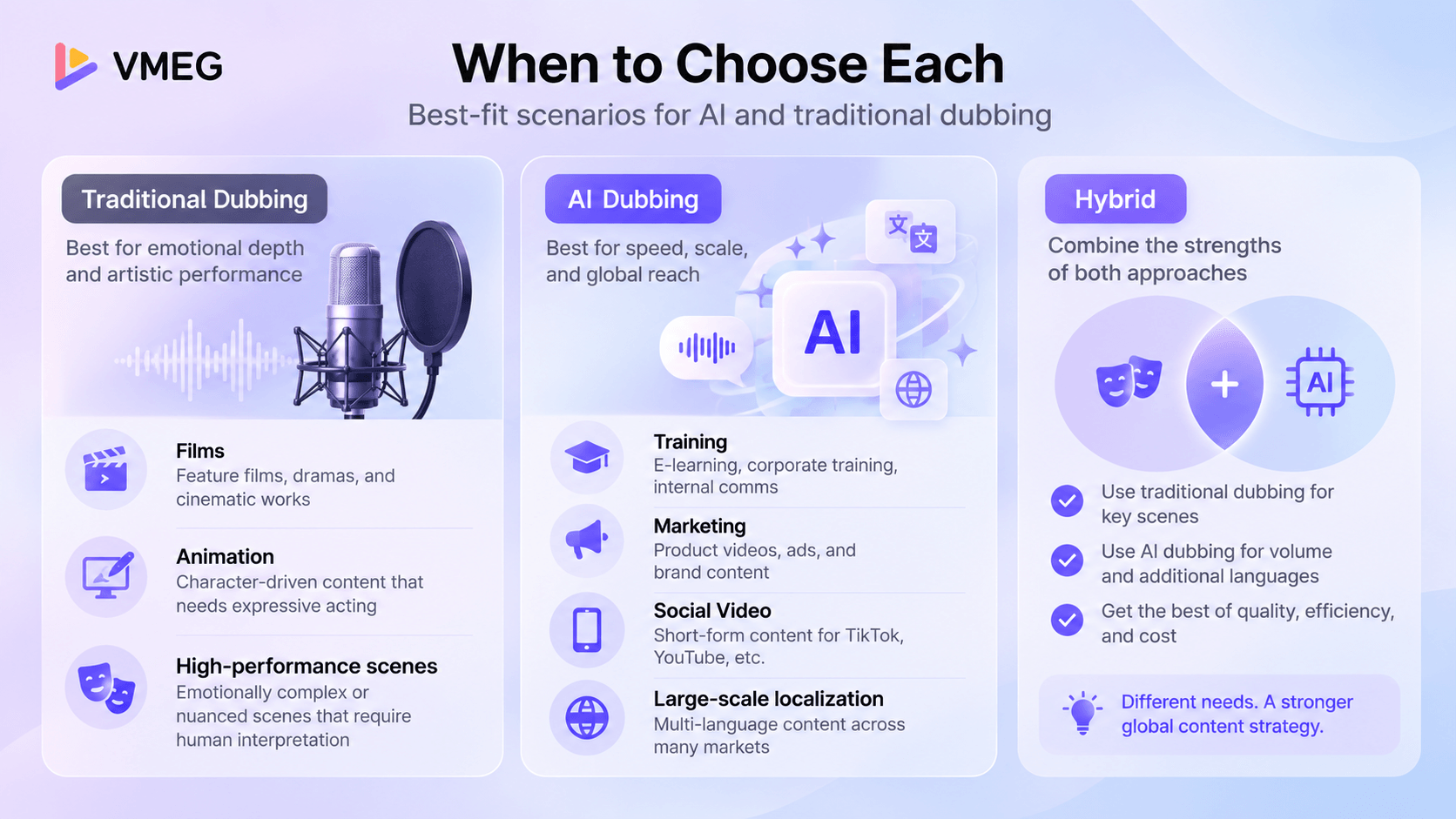
Choose AI Dubbing When
You need a fast first version, many languages, frequent updates, or a repeatable workflow for informational video. It is a strong starting point for training, tutorials, product demos, explainers, and creator content—provided the review level matches the risk.
Choose Traditional Dubbing When
The performance is the product. Film, character animation, premium dramatic ads, comedy, and culturally sensitive storytelling benefit from casting, human direction, dialogue adaptation, and detailed post-production.
Choose AI Dubbing With Human Review When
You want AI speed and editability but cannot accept an unchecked first render. A native reviewer can approve meaning and naturalness; a product expert can verify terms; an editor can fix timing and mix issues. This is often the most practical model for customer-facing business video.
Content type | Recommended starting point | Reason |
Internal training | AI + targeted review | Efficient for updates; review safety, policy, and technical terms |
Product demo | AI + product review | Supports frequent releases; names, UI terms, and timing need checks |
YouTube or creator video | AI or hybrid | Fast localization; creator voice and audience expectations guide review |
Documentary interview | Hybrid or human-led | Meaning, identity, emotion, and source-audio treatment need care |
Commercial advertising | Hybrid or traditional | Brand voice, claims, timing, and performance are high stakes |
Animation or film | Traditional studio | Casting, acting, scene dynamics, and creative direction are central |
How to Test an AI Dubbing Workflow With VMEG
1. Select a Representative Clip
Use 30–90 seconds that contains the problems the full project must solve: important terminology, more than one speaker, visible speech, emotion, background music, or a difficult name. An easy clip can create false confidence.
2. Generate the First Dub
Upload a supported video or paste a supported public link, select the target language, choose voices, and add glossary or translation guidance where required. Generate a preview before applying optional lip sync.
3. Review and Regenerate Specific Segments
Check the source transcript and target text line by line. Correct speaker assignments, wording, pronunciation, voice, speed, and timing. Regenerate the affected segments rather than judging the project only from the first automatic output.
4. Compare Against a Quality Scorecard
Score meaning, naturalness, voice fit, timing, and audio finish. Record the time and cost required to reach an acceptable result. That gives you a useful comparison with a studio quote or existing workflow.
VMEG keeps the main dubbing stages editable
VMEG AI Dubbing connects transcription, translation, voices, subtitles, timing, and revision in one workspace. The workflow is designed to let teams:
- Upload supported video files or paste supported public links.
- Identify dialogue segments and speakers, then assign target-language voices.
- Use glossaries and translation prompts to protect names and terminology.
- Adjust wording, speaker assignment, pronunciation, voice, speed, and timing.
- Regenerate selected segments and add optional lip sync when visible speech requires it.
- Preserve background audio where the source and selected workflow support it.
The controls make corrections visible and targeted, but they do not remove the need for approval. Review meaning, terminology, pronunciation, timing, voice fit, and visual context before publishing. Obtain the required rights and consent before cloning a voice.
Test a clip with VMEGA Pre-Publish Dubbing Checklist
- The source transcript correctly captures names, numbers, acronyms, and speakers.
- The translation preserves meaning, tone, claims, and locale-appropriate terminology.
- Each voice suits its speaker and stays consistent throughout the video.
- Pronunciation is correct for names, products, abbreviations, and technical terms.
- Speech sounds natural and fits the scene without rushing, clipping, or long drift.
- Lip sync, if used, supports the picture without hiding language or performance problems.
- Dialogue is balanced with music, effects, and remaining source audio.
- Subtitles, on-screen text, and audio say the same thing where they overlap.
- Voice, media, music, and likeness rights cover the planned markets and channels.
- A qualified reviewer approves high-risk technical, legal, medical, financial, or safety content.
Frequently Asked Questions
Is AI Dubbing Cheaper Than Traditional Dubbing?
AI usually lowers the cost and coordination required to create a first version, especially across many languages. The final saving depends on the human review, lip sync, audio finishing, and revision work needed to reach the required quality. Compare equivalent deliverables rather than an AI generation fee with a complete studio master.
How Much Does Dubbing Cost per Minute?
There is no universal rate. Cost depends on language, duration, speakers, performance needs, rights, lip sync, review, mixing, revisions, and minimum fees. Ask for a scoped total and calculate the effective rate across all finished target-language minutes.
Is Traditional Translation the Same as Traditional Dubbing?
No. Translation creates the target-language meaning and text. Traditional dubbing also includes adaptation, casting, performance, recording, synchronization, editing, mixing, and quality control.
Can AI Dubbing Replace Human Voice Actors?
AI can handle many informational and scalable localization tasks, but it does not make human performance unnecessary. Actors remain valuable when character, emotion, improvisation, cultural interpretation, and creative direction define the experience.
Does AI Dubbing Include Lip Sync?
Some platforms offer lip sync as an optional feature rather than a default. Use it when visible mouth movement is important, and review the result in context. It cannot correct mistranslation, unsuitable voices, or poor delivery.
Which Dubbing Method Is Best for YouTube, Training, Ads, and Films?
AI or hybrid dubbing often fits YouTube, training, tutorials, and product content because it supports scale and updates. Ads may need hybrid or traditional production depending on creative risk. Films and performance-led animation usually benefit most from traditional casting, direction, and studio finishing.
Final Recommendation
Choose AI dubbing for speed, scale, editability, and repeatable multilingual production. Choose traditional dubbing when acting, casting, scene-by-scene direction, and premium audio finishing are central to the value of the content. Choose a hybrid process when you want AI efficiency but still need native-language, brand, technical, or creative approval.
The safest comparison is a representative test. Create the same short clip with each viable workflow, score meaning, naturalness, voice fit, timing, and audio finish, then compare the real time and cost required to reach your publication standard.
Start with one representative clip
Generate a first multilingual dub in VMEG, correct individual lines and voices, and evaluate the result against your own quality threshold before scaling the project.
Try VMEG AI DubbingEditorial note: Product capabilities and credit rates were checked against VMEG’s public product and Help Center pages. Pricing, plan limits, and feature availability can change; verify them before purchasing.