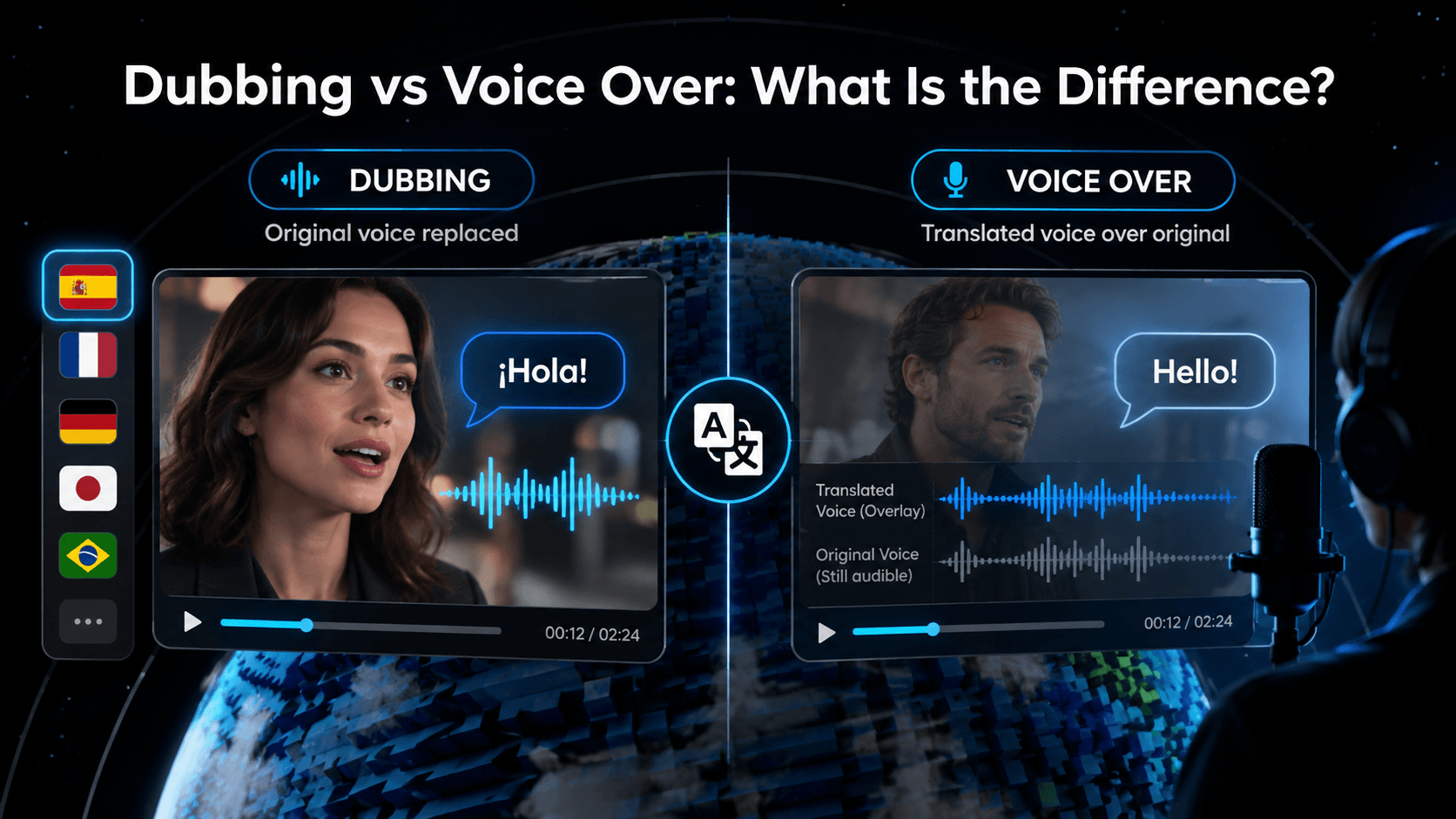
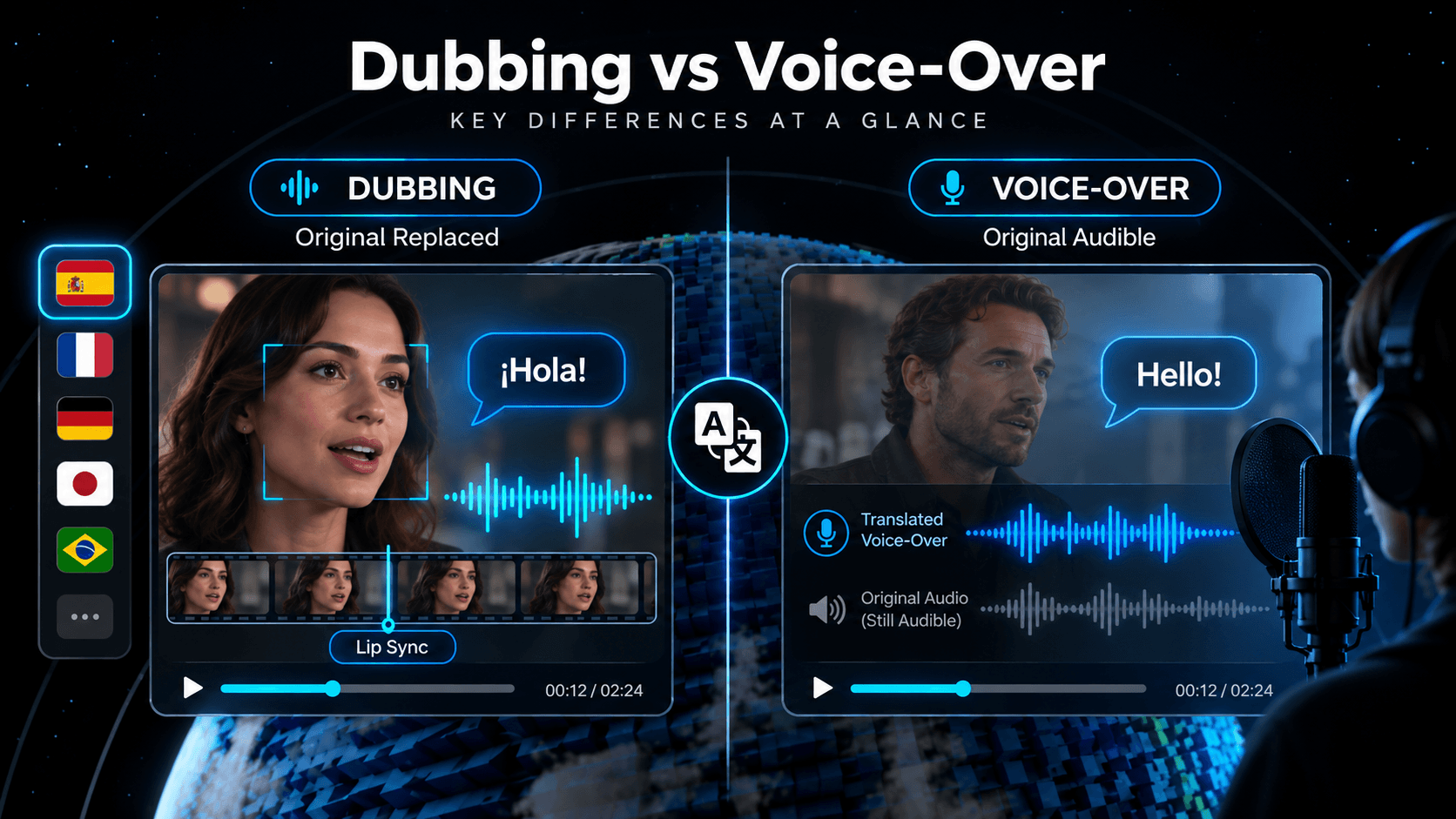
Dubbing and voice-over are both ways to add target-language speech to video, but they create different viewer experiences. Dubbing usually replaces the original dialogue with a new performance that fits the scene and, where useful, the visible speaker. Translated voice-over normally keeps the source speaker faintly audible underneath and does not try to match lip shapes. In everyday production, “voiceover” can also mean narration recorded over footage with no on-screen speaker.
Choose dubbing when the localized video should feel as though the people or characters are speaking the target language. Choose voice-over when clear information, the presence of the original speaker, or a simpler revision process matters more than immersion. The right choice depends on what the viewer sees, how the original audio should be treated, and what the translated track needs to accomplish.
- Dubbing replaces the original dialogue and is usually the stronger choice when immersion, character performance, or a visible presenter matters.
- Translated voice-over normally keeps the original speaker audible, while narration voiceover explains visuals without replacing dialogue.
- Dubbing often requires tighter timing and may use lip sync; voice-over usually prioritizes clarity, authenticity, and easier revisions.
- Choose the format by original-audio treatment, visible speech, content type, and revision needs—or combine methods in a hybrid workflow.
Dubbing vs Voice Over at a Glance
The clearest distinction is not simply “expensive versus inexpensive” or “lip sync versus no lip sync.” It is how the new track relates to the original dialogue and to the picture.
Comparison point | Dubbing | Voice-over |
Original dialogue | Usually removed or replaced in the final mix | Often remains audible at a lower level in translated voice-over; narration may have no source dialogue underneath |
Lip sync | May match mouth movements closely when visible speech is important | Usually does not match lip shapes |
Timing | New performance must fit the scene, pauses, and speaker turns | Must remain clear and fit the available time, but can be looser than character dubbing |
Viewer experience | More immersive; the localized voice becomes the character or speaker | More visibly mediated; viewers can retain a sense of the original speaker or hear an explanatory narrator |
Common voice setup | Often one localized voice per speaking role | May use one narrator, a small voice cast, or one voice per speaker |
Best-fit content | Drama, animation, ads, presenter-led videos, and content where performance matters | Documentaries, interviews, news, training, explainers, and narration-led videos |
Workflow complexity | Typically higher because performance, timing, scene fit, and sometimes lip sync must be reviewed together | Typically lighter, though translation, pacing, pronunciation, and audio mixing still require review |
Revisions | A wording change may affect performance and synchronization | Script changes are often easier to re-record or regenerate, especially for narration |
The format can also change within one video. A documentary might use translated voice-over for interviews, narration for context, subtitles for incidental speech, and dubbing for a short dramatized scene.
If you already know that the original dialogue should be replaced, VMEG AI Dubbing connects transcription, translation, speaker handling, voice selection, timing edits, and optional lip sync in one workflow. If the job is to turn a prepared script into clean narration, the VMEG Voiceover Generator is the more direct starting point. The sections below explain why those are different production decisions rather than interchangeable labels.
What Is Dubbing?
Dubbing replaces spoken dialogue with a newly recorded or generated performance in another language. The target-language track becomes the dialogue the audience is expected to follow, while the production aims to preserve the intent, emotion, speaker identity, and rhythm of the scene.
A good dub is not a literal transcript read aloud. Translators may need to shorten, reorder, or adapt a line so it sounds natural in the target language and fits the available time. Voice direction matters too: a technically accurate translation can still feel wrong if the delivery is too flat, too formal, or inconsistent with the person on screen.
Lip sync is a technique within dubbing, not the definition of dubbing. A close-up in a drama may need careful mouth matching. An off-screen speaker, animated tutorial, or wide shot may only need believable timing and performance. Trying to force every syllable into exact mouth movements can damage clarity or naturalness. A large-scale study of professionally produced German and Spanish dubs found that translation quality and vocal naturalness should not be sacrificed simply to chase strict visual matching; timing and characteristics of the source speech still matter.
For a deeper introduction to the format itself, see What Is Dubbing?.
What Is Voice Over?
Voice-over means a voice is added over visual content, but the term is used in two different ways. Separating them prevents confusion when you brief a translator, voice actor, or AI tool.
Narration Voiceover
Narration voiceover is written to explain, guide, or frame what appears on screen. It is common in product demos, e-learning, corporate videos, advertisements, and documentaries. The narrator may never appear in the footage, and there may be no original dialogue to replace.
The main production questions are script clarity, tone, pronunciation, pacing, and how the narration fits the edit. If the video is localized, the script is translated and adapted before the new narration is recorded. Because languages expand and contract, the translated voiceover may require revised wording, adjusted pauses, or small changes to the visual timing.
Translated Voice Over
Translated voice-over is an audiovisual translation method often used for interviews, factual programs, news, and documentary content. The source speaker is usually heard briefly or quietly beneath the target-language voice. The translated track conveys the message without pretending that the on-screen person is speaking the target language.
This format can preserve a sense of authenticity because the audience still hears the speaker’s original voice, cadence, or emotion. It also reduces the need for lip matching. However, it is not a “no-sync” option: the translated line still needs to enter at a sensible moment, finish before the scene changes, respect speaker turns, and remain intelligible over the lowered source track.
When comparing dubbing vs voice over, confirm which meaning of voiceover is intended. “Add narration to this tutorial” and “translate this interview with the original speaker underneath” require different scripts, mixes, and review criteria.
Dubbing vs Voice Over: Key Differences
Original Audio and Dialogue
Dubbing makes the localized performance the primary dialogue. Editors normally remove or suppress the source dialogue while preserving music, effects, and room tone where possible. The result should feel like a coherent version of the original program, not a second voice layered on top.
Translated voice-over normally keeps the source dialogue in the mix at a lower level. Narration voiceover may sit over music, ambient sound, or visuals without any source speech. This audio decision should be made before production because it affects stem preparation, mixing, and how much space the translated script has.
Lip Sync and Timing
Dubbing usually has tighter synchronization requirements. The new line must fit the speaking window, and visible speakers may require closer alignment with mouth openings, pauses, and emotional beats. Lip-sync technology can help, but it cannot compensate for an awkward translation or incorrect pronunciation.
Voice-over does not normally imitate mouth shapes. Even so, timing remains part of quality. A translation that starts too late, overlaps the next speaker, or continues after the relevant visual has disappeared will confuse viewers. The difference is the degree and purpose of synchronization, not whether timing matters at all.
Performance and Viewer Experience
Dubbing asks the audience to accept the localized voice as the voice of the person or character. Casting, consistency, emotion, and scene context therefore carry more weight. The method can reduce reading effort and create a more immersive experience, particularly for entertainment, children’s content, presenter-led videos, and fast-moving visuals.
Voice-over keeps more distance between the source performance and the translation. In interviews and documentaries, that distance can be useful: the audience hears that the words are being interpreted while retaining an audible connection to the original speaker. Narration, by contrast, guides the viewer from outside the scene.
Production Workflow and Revisions
Both methods begin with an accurate source transcript and a translation adapted for speech. Dubbing then adds more interdependent decisions: role assignment, voice fit, delivery, line duration, scene timing, lip sync where needed, and separation of dialogue from background audio. A small script change can require a new performance and another synchronization review.
Voice-over can be easier to revise, especially when one narrator reads a modular script. Yet pronunciation, emphasis, pacing, loudness, and the relationship between the new voice and the original track still need quality control. The simpler workflow is not an excuse to publish an unreviewed translation.
Best Fit by Content Type
Dubbing is usually stronger when dialogue performance drives the experience. Voice-over is usually stronger when information, speaker authenticity, or a narrator-led structure drives the experience. The content format is a useful starting point, but the final decision should also consider audience expectations, visible speech, accessibility, brand voice, and the number of future revisions.
How to Choose Between Dubbing and Voice Over
Ask five questions before choosing a format:
- Should viewers feel that the on-screen person is speaking the target language?
- Does the original speaker’s audible voice carry documentary or emotional value?
- How visible are mouth movements, and how distracting would loose synchronization be?
- Will the script change often after localization?
- Is the content driven mainly by character performance, factual information, or narration?
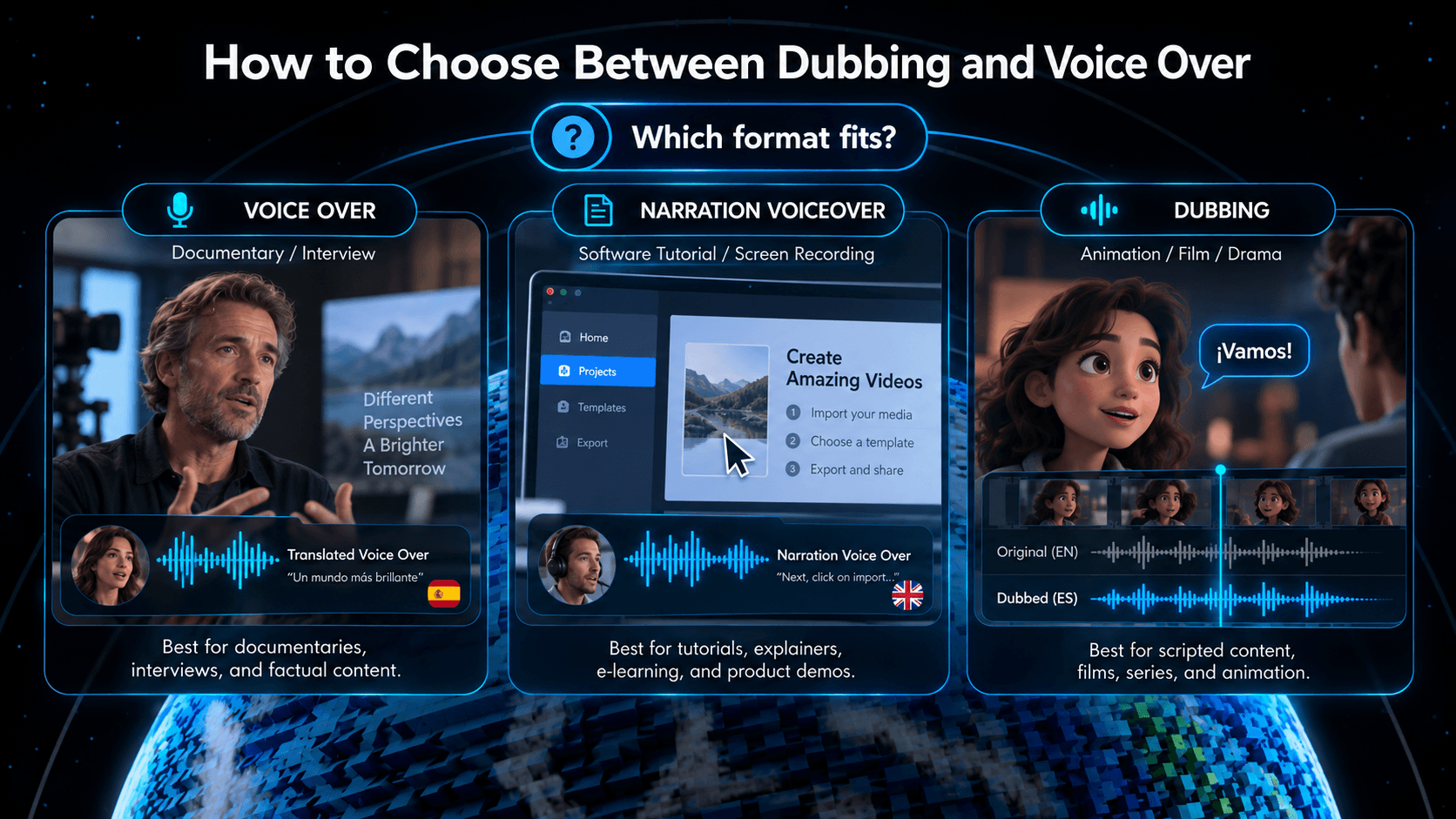
Choose Dubbing When
- The localized version should feel native to the scene.
- Characters, presenters, or actors are central to the viewer experience.
- The audience should be able to watch without reading subtitles or hearing a second speech layer.
- Voice consistency, emotion, and scene-level timing justify a more controlled workflow.
- Visible speech makes synchronization important.
Choose Voice Over When
- The original speaker should remain faintly audible for context or authenticity.
- The video is an interview, documentary, news segment, training module, or factual explainer.
- A narrator explains visuals rather than replaces a character’s dialogue.
- The script is likely to be updated and needs a simpler revision path.
- Natural delivery and clear information matter more than mouth matching.
Use a Hybrid Approach When
A single format does not have to cover the entire program. Keep the method consistent within comparable scenes, but choose the treatment that serves each type of content.
Scenario | Recommended starting point | Why |
Character-led animation or short drama | Dubbing | Performance and immersion are part of the story |
Documentary interview | Translated voice-over | The source speaker can remain audible while the translation stays clear |
Software tutorial with screen recording | Narration voiceover | The voice explains actions; script revisions are common |
Presenter-led product launch | Dubbing or close-timed voice replacement | The localized voice should feel connected to the visible presenter |
Multilingual campaign with dialogue and text cards | Hybrid | Dub key dialogue, localize text, and use subtitles where they improve access |
This matrix is a starting point, not a rule. Test a representative scene before committing a long series, especially when the content contains several speakers, rapid dialogue, specialized terms, or close-up faces.
How AI Changes the Workflow
AI can connect transcription, translation, voice production, timing, and revision in one workflow. The format decision still comes first: use dubbing to replace dialogue and voiceover for narration or an audible source-speaker treatment.
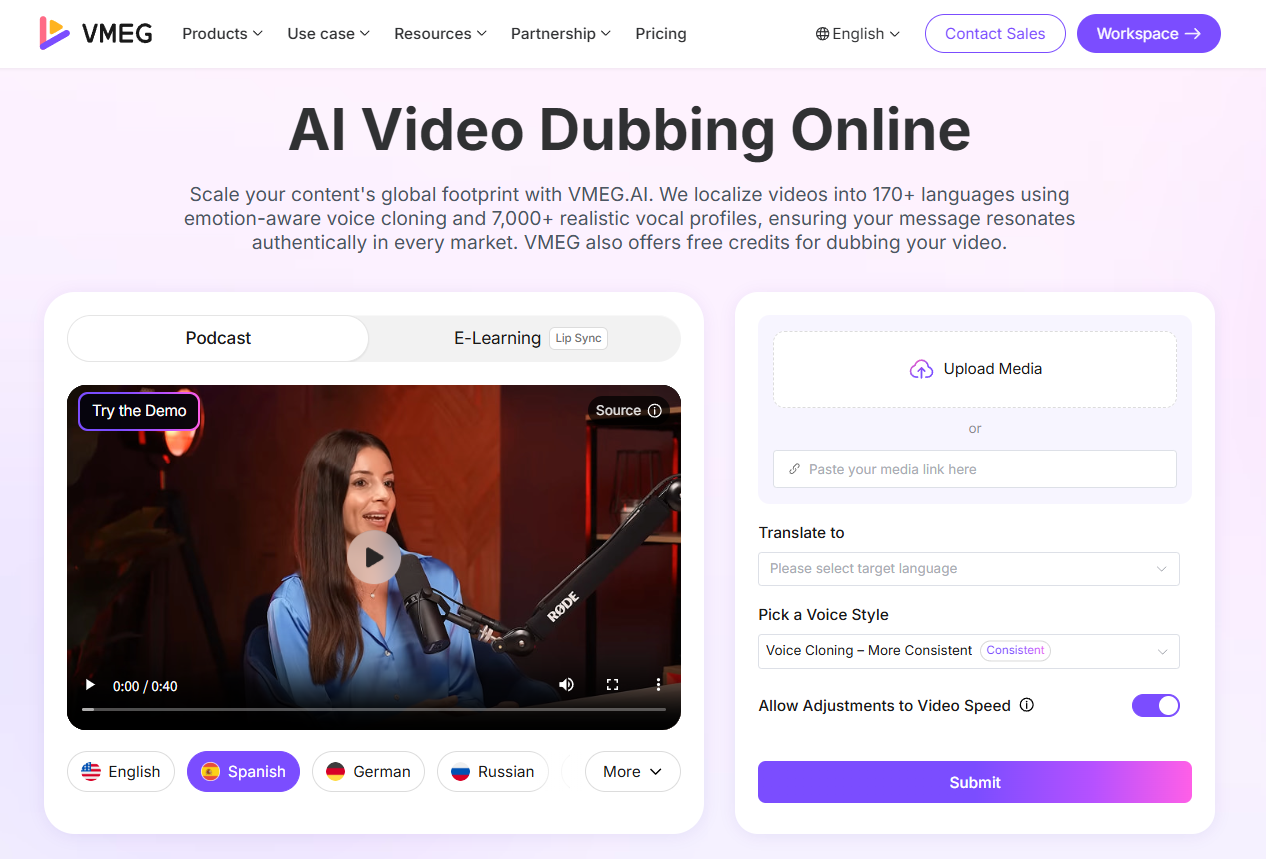
- Create the first dub: With VMEG AI Dubbing, upload a supported video or paste a supported public link, then choose the target language and voices.
- Review and refine: Check source and translated text, correct wording or speaker assignments, adjust pronunciation, voice, speed, and timing, and regenerate selected segments.
- Control terminology and visual fit: Use glossaries and translation prompts for important terms, with optional lip sync when visible speakers need closer alignment.
- Create narration: The VMEG Voiceover Generator turns a prepared script into audio with voice, speed, pause, and pronunciation controls. Plan the final mix separately when the original speaker must remain audible.
AI output still needs a final human review for meaning, terminology, pronunciation, voice fit, timing, and visual context. Obtain the necessary rights and consent before cloning a voice.
For a step-by-step production view, see How to Dub a Video.
A Practical Quality Checklist
Review the localized video as a viewer, not only as a script editor.
- Meaning: Does each line preserve the intended message, implication, and level of formality?
- Terminology: Are names, product terms, numbers, and recurring phrases consistent?
- Natural speech: Does the translation sound spoken rather than copied from written text?
- Pronunciation: Are proper nouns, abbreviations, and specialized terms correct?
- Speaker fit: Are voices assigned consistently, and does the delivery suit the person or character?
- Timing: Do lines begin and end at logical moments without collisions or rushed endings?
- Visual fit: For dubbing, does the performance align closely enough with visible speech and emotion? For voice-over, does it respect scene changes and speaker turns?
- Audio mix: Is speech intelligible without burying music, effects, or the source speaker?
- On-screen text: Are captions, titles, labels, and interface text localized where the audience needs them?
- Final playback: Has the complete export been reviewed on headphones and ordinary speakers, with subtitles checked separately?
If the project will also use captions, Subtitles vs Dubbing explains how reading load, accessibility, and viewer preference change that decision.
Dubbing vs Voice Over Examples
Documentary Interview
A filmmaker wants an English version of interviews recorded in Spanish. Translated voice-over is a strong default because viewers can still hear the interviewees and recognize their emotion. The English track should enter cleanly, remain intelligible over the lowered Spanish, and finish before the next question or cut. Full dubbing may be appropriate if the distributor expects a completely localized version, but it changes the documentary relationship between viewer and speaker.
Product Tutorial
A software company updates its interface every month. Narration voiceover gives the team a reusable script-based workflow and makes individual lines easier to revise. If an on-camera presenter demonstrates the product throughout, dubbing may create a more coherent localized experience. The choice depends on whether the voice explains the screen or represents the visible presenter.
Animation or Short Drama
Character identity, reactions, and comic timing are central, so dubbing is usually the better fit. The translation must sound natural, preserve personality, and fit the action. Close lip matching may matter in detailed facial animation, while stylized or limited animation may allow more timing flexibility.
Multilingual Campaign
A campaign may combine a dubbed spokesperson, narration over product footage, localized on-screen text, and subtitles for silent viewing. This is a hybrid localization plan, not an inconsistency. Define the treatment for each scene in advance so voices, terminology, and brand tone remain consistent across languages.
Frequently Asked Questions
Is Dubbing the Same as Voice-Over?
No. Dubbing usually replaces the original dialogue with a target-language performance. Translated voice-over normally places the translation over a quieter version of the source speaker, while narration voiceover explains visuals without replacing dialogue. Teams should define the intended audio treatment rather than relying on the label alone.
Does Voice-Over Keep the Original Audio?
Translated voice-over usually keeps the original speaker audible at a lower level. Narration voiceover may be mixed over music or visuals without original dialogue. The final mix depends on the format, so specify whether source speech should be preserved, lowered, or removed.
Does Dubbing Always Require Lip Sync?
No. Dubbing requires the new dialogue to fit the scene, but the necessary level of mouth matching varies. Close-ups and character-led content may need precise alignment. Off-screen speech, wide shots, or some animation may only need believable timing, emotion, and turn-taking.
Which Is Better for Training Videos and Product Explainers?
Narration voiceover is often the simplest option when a voice guides viewers through slides or screen recordings, especially if the script changes frequently. Dubbing may be better when an on-camera instructor or presenter is central and the localized version should feel native to the performance.
Can AI Create Both Dubbing and Voiceovers?
Yes, but the workflows differ. AI dubbing tools can transcribe dialogue, translate it, assign voices, and help align the new speech with the video. AI voiceover tools typically turn a prepared script into narration. In both cases, a reviewer should check meaning, terminology, pronunciation, voice fit, and timing before publishing.
Can One Video Use Dubbing, Voice-Over, and Subtitles Together?
Yes. A documentary, training course, or campaign may use different treatments for different scenes and add subtitles for accessibility or silent viewing. The important part is to define the role of each format, keep terminology and voices consistent, and review the final mix as one complete experience.
Final Recommendation
Choose dubbing when the localized voice should belong to the person or character on screen and the audience benefits from a more immersive performance. Choose translated voice-over when the original speaker should remain present, or narration voiceover when a script needs to guide the viewer through visuals. Use a hybrid approach when the video contains several kinds of scenes.
Whichever format you select, judge quality by meaning, natural speech, pronunciation, timing, audio balance, and visual context—not by a single feature such as lip sync. To build and review a dialogue-replacement workflow, try VMEG AI Dubbing. For script-based narration, start with the VMEG Voiceover Generator.