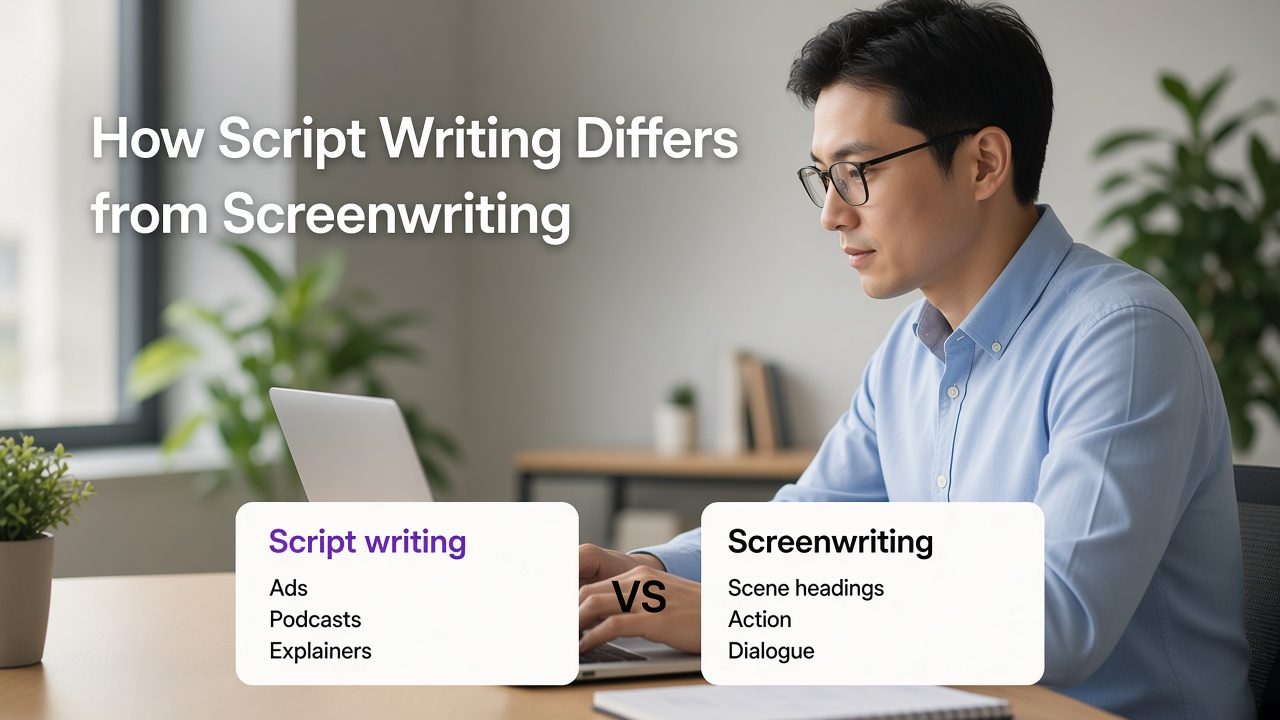
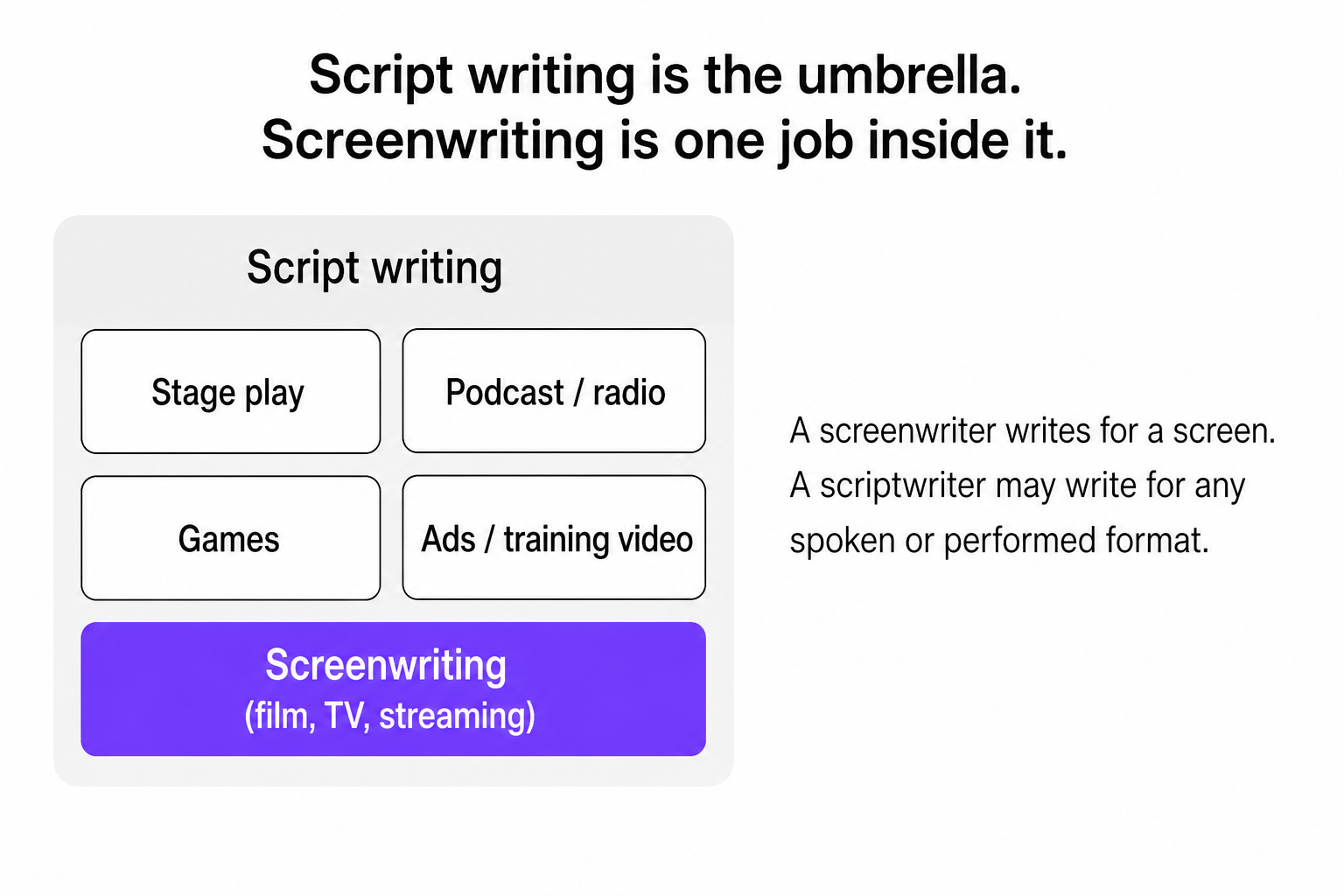
Script writing is the broader craft: any planned spoken or performed text, from a stage play to a training video. Screenwriting is the subset written for a screen (film, television, and streaming). A screenwriter is a kind of scriptwriter. The reverse is not always true.
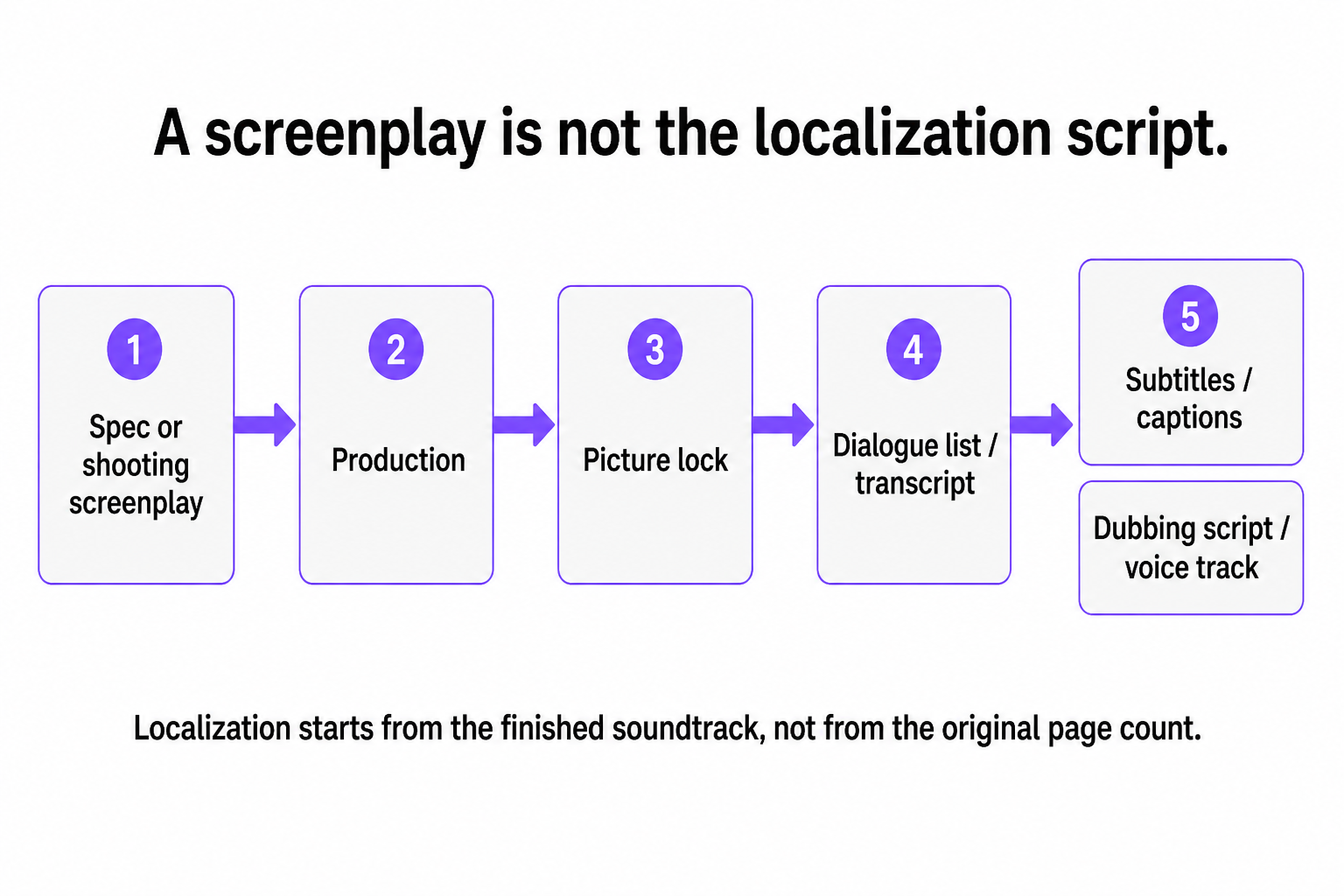
People mix the words because everyday English treats them as twins, and because Wikipedia lists “screenwriting or scriptwriting” together for mass-media work. In hiring, credits, and post-production, the split matters. Hollywood guild credits use Screenplay by and Written by, not “Script by.” After picture lock, localization teams work from a timed dialogue list or dubbing script, not from the original spec pages.
Key takeaways
- Script writing covers plays, podcasts, games, ads, corporate video, and screen work.
- Screenwriting is visual storytelling for film, TV, and streaming, usually in screenplay format.
- A spec screenplay sells the story. A shooting script adds production numbering. Neither is a subtitle file.
- WGA theatrical credits include Written by, Screenplay by, and Story by. “Script by” is not an approved form.
- For another language, start from the finished soundtrack: transcript, captions, or a dubbing script.
What script writing means
A script is a document that tells performers and crews what is said and, often, what happens in order. That definition is older than movies. Stage plays, radio drama, podcasts, game barks, commercials, and e-learning modules all use scripts.
Expectations change with the medium:
- A stage play leans on dialogue and stage directions. The audience imagines much of the world.
- A podcast or radio script lives in sound: speech, silence, music, and effects.
- A game script may branch by player choice.
- An ad or training script may be timed to seconds and a brand line.
If the job is “write words people will speak,” script writing is the accurate umbrella.
What screenwriting means
Screenwriting is writing a screenplay (or a teleplay for TV) so a story can be photographed and cut. The page has to show what a camera can see and a microphone can hear. Interior states that cannot be performed or implied on screen do not belong in the action lines.
Typical screenplay elements:
- Scene headings (sluglines): INT. or EXT., place, day or night
- Action lines in present tense
- Character cues and dialogue
- Spare parentheticals
The Academy Nicholl Fellowships ask for feature scripts in 12-point Courier. That is the usual U.S. submission look. Courier is monospaced, which is why people treat “one page ≈ one minute” as a planning heuristic, not a law. The Academy also notes that professional format varies in the details, and that shooting scripts (scene numbers, camera notes) are not the form most writers submit when they are selling a story.
Script writing vs screenwriting, side by side
| Script writing | Screenwriting | |
|---|---|---|
| Scope | Any performed or spoken plan | Film, TV, streaming |
| Typical document | Play, AV script, game dialogue, spec or shooting screenplay | Screenplay or teleplay |
| What it must do | Fit the medium (stage, audio, interactive, screen) | Make a visual story produceable |
| Common credit language | Varies by industry | WGA: Written by, Screenplay by, Teleplay by |
| After the work is “done” | May be the final spoken text | Picture still changes in production; localization needs a new document |
Casual speech can treat the terms as interchangeable. Job posts, festival rules, and guild paperwork usually do not.
Documents people confuse with “the script”
The word script hides several files:
Spec screenplay. Written on speculation, to sell or to sample a voice. Feature specs are usually master scenes: few camera angles, no scene numbers. Wikipedia notes that WGA members are not supposed to write a script for a specific producer without a contract. That is different from writing your own sample spec.
Commissioned or assignment draft. A producer or studio hires the writer. The story may already exist as a novel, a pitch, or a prior draft.
Shooting script. The production version: numbered scenes, locked pagination habits, sometimes camera or transition notes. Directors and ADs live here. Spec readers often do not want this extra hardware.
Teleplay. Episode writing for television, with act breaks that used to map to commercials and still shape pacing on streaming.
AV / corporate / YouTube script. Often two columns (visual / audio) or a short timed monologue. Useful for a 90-second explainer. Wrong for a feature contest.
Rewrite, polish, page-one. Later writers may change dialogue or replace the draft. Credit then depends on contribution rules, not on who typed the first file.
What the WGA actually prints on screen
If the project is Guild-covered, titles are not freeform. The WGA Screen Credits Manual uses forms such as:
- Written by: the same writer(s) earn both story and screenplay credit, and there is no assigned story-nature source material (factual sources are a special case).
- Screenplay by: individual scenes and full dialogue that substantially contribute to the final script; used when story and screenplay writers differ, or when there is story-nature source material.
- Story by / Screen Story by / Teleplay by (TV) for other splits.
“Script by” is not on that list. Calling yourself a scriptwriter in an email is fine. Putting “Script by” on a theatrical card is a different problem.
Contribution thresholds for sharing Screenplay by are specific (for original screenplays, a subsequent writer typically needs a large share of the final shooting script). Treat the manual as the source if credit is in dispute. Do not guess percentages from blog summaries.
The 2026 job market behind the titles
The words also track two labor markets.
Screenwriter in the U.S. often means WGA-covered film and TV work. That market contracted after the streaming boom. Deadline, reporting the WGA West annual financial report in August 2026, said about 5,072 writers reported earnings in 2025, down 27% from nearly 7,000 in 2022. TV employment was down more than 33% over that span; feature writing jobs were down about 14% to 2,007 members with earnings. Feature writers still reported about $521 million in 2025, up 7.2% year over year. Residuals were $535.5 million, down 4.9%. The guild marked the employment figures as preliminary as of March 2026 and expected 2025 totals to rise somewhat, while remaining below 2024.
In April 2026, WGA members ratified a new Minimum Basic Agreement (May 2, 2026 through May 1, 2030) with 90.38% voting yes. The Guild’s own summary includes a new minimum for page-one rewrites and says it will keep watching streaming and AI. Those are contract facts, not a forecast of staffing.
Scriptwriter in ads, training, games, and social video is a wider, less Guild-shaped label. It can mean steadier freelance volume. It does not mean the same credit, scale, or residuals as a WGA screenplay.
After picture lock, “script” means something else
A produced film is not the spec. Lines change on set. Scenes drop in the cut. Localization and accessibility therefore start from the finished soundtrack, not from page 1 of the draft.
Common post-production language documents:
- Dialogue list: timed transcript of what is actually spoken (and often who speaks). Distributors use it for translation. Netflix’s partner docs describe a dialogue list as timed events that support dubbing-script work.
- Spotting list / subtitle or caption file: in- and out-times plus text. An SRT is one delivery format, not a screenplay.
- Dubbing script / as-recorded dubbing script: target-language lines timed to picture, written for mouth rhythm and performance, then updated to match what was recorded.
- As-broadcast or continuity lists: add visuals, burned-in text, and cut descriptions for legal and version control.
If you need closed captions versus subtitles, you are already in this layer. Dubbing is another pass on the same locked picture: new voices, not a new act structure.
For teams that already have a finished video and need another language, a video translator workflow (transcribe, translate, subtitle or dub, then review) replaces “rewrite the screenplay in Spanish.” The screenplay still matters for creative canon. It is the wrong source file for timing.
Which one should you learn or hire?
| Goal | Hire or practice |
|---|---|
| Feature or series for festivals, studios, or WGA work | Screenwriting (spec craft, Courier 12, credits literacy) |
| Play, podcast, game narrative, brand film | Script writing in that format |
| 60-second social or training clip | Short AV or voiceover script, timed to picture |
| Same video in another language | Dialogue list + captions and/or dubbing script from the locked cut |
If a client says “send the script,” ask which file they mean: spec, shooting draft, transcript, SRT, or dubbing pages. The wrong attachment wastes a week.
FAQ
Are script writing and screenwriting the same thing?
No. Screenwriting is script writing for a screen. Script writing also covers stage, audio, games, and corporate work.
Is a screenplay a script?
Yes. A screenplay is a type of script. A shooting script is a later production type. A subtitle file is not a screenplay.
Can I call myself a scriptwriter if I write movies?
In casual use, yes. For film and TV credits, use the form the Guild or the contract specifies.
Do I need screenwriting software?
For features and TV samples, software that outputs Courier 12 screenplay format saves pain. For a two-column explainer, a plain timed script is enough.
If I already have a finished video, should I rewrite it as a screenplay to translate it?
Usually no. Transcribe the finished audio, then subtitle or dub. Keep the screenplay for story reference only.
Use screenwriting when the product is a film, episode, or streaming original on a page built for cameras. Use script writing when the job is any planned spoken text. Once the picture is locked, switch vocabulary again: the useful “script” is timed language for captions or voices, not the spec you used to get the movie made.